 0
0
 0
0
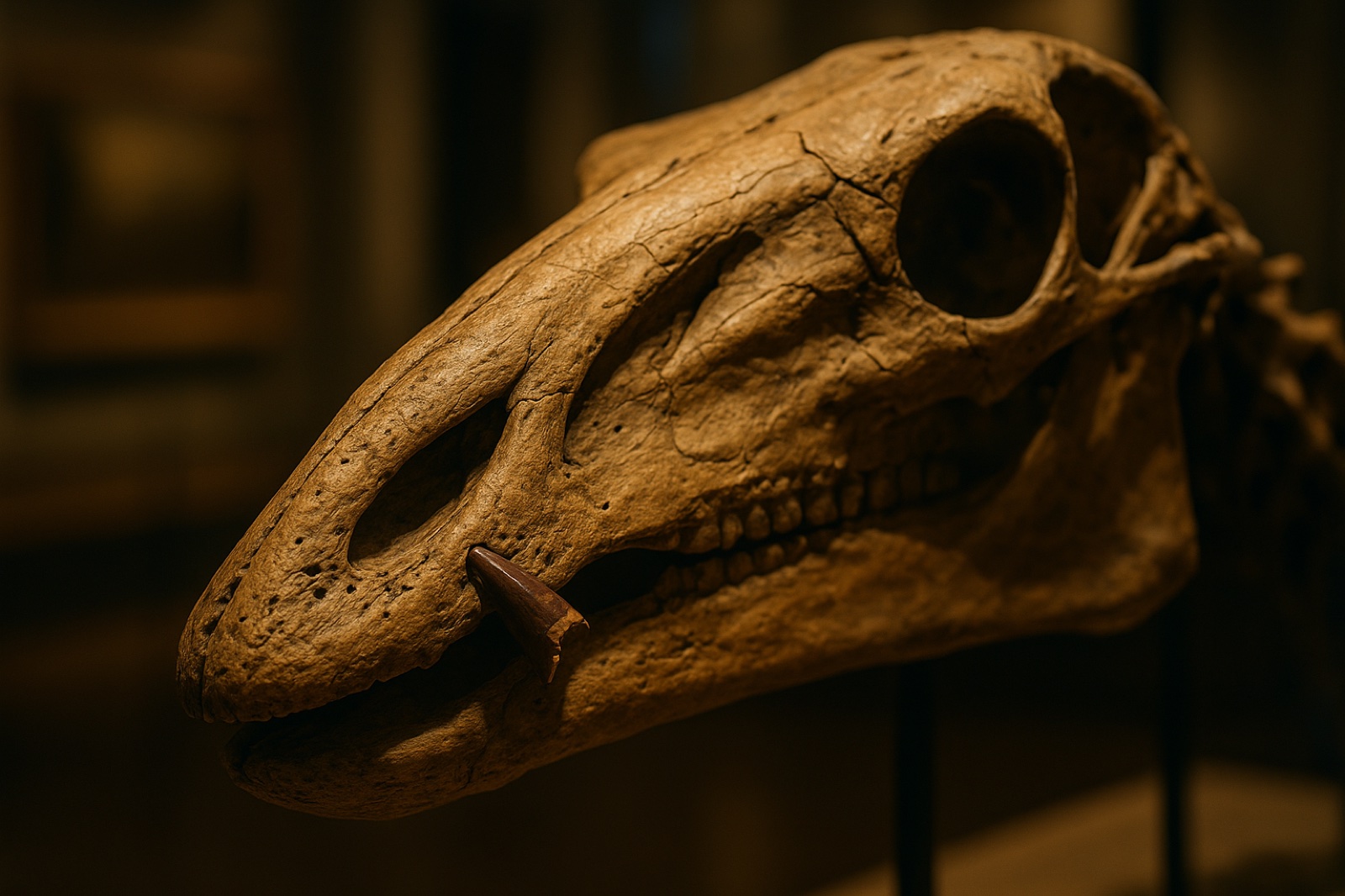
In 2005, paleontologists digging in Montana’s Hell Creek Formation pulled a skull out of the ground. At first glance, it looked like a fairly ordinary find: an Edmontosaurus, a duck-billed plant-eater about the size of a city bus, one of the most common dinosaurs of the late Cretaceous. Nothing a hungry T. rex would think twice about.
But when researchers finally got a close look at the nose of that skull, they found something that had been sitting there, untouched, for 66 million years: a broken tooth. Not a scratch. Not a bite mark scraped across the bone. An actual T. rex tooth, snapped clean off and lodged directly in the Edmontosaurus’s face.
What the Tooth Actually Proves
Bite marks on dinosaur bones aren’t rare. Paleontologists find scored and punctured bone all the time — evidence that something with teeth was there at some point, chewing on something. What’s rare is a tooth still stuck in the wound. That requires a very specific kind of violence: enough force to snap a tooth off at the root, and a piece of prey that closed around it before the two animals ever separated.
Taia Wyenberg-Henzler, the researcher who studied the skull, put it plainly: the position of the tooth "provides important clues about the encounter between predator and prey." It’s lodged near the nose, which tells scientists the two animals were face to face when it happened — not a T. rex trailing an Edmontosaurus from behind, but a direct, close-range confrontation.
There’s no healing around the wound. In paleontology, that detail matters more than almost anything else. Bone that survives an attack starts to remodel itself — new tissue grows in, the edges smooth out, the body starts repairing what it can. This bone shows none of that. Which means one of two things: the Edmontosaurus was already dead when the tooth broke off in its face, or the bite itself is what killed it.
"This paints a terrifying picture of the last moments of this Edmontosaurus," Wyenberg-Henzler said. And she’s not being dramatic for effect — breaking a tooth off inside bone takes real, deliberate force. This wasn’t a nibble.
The Debate This Fossil Helps Settle
For decades, paleontologists have argued about how T. rex actually got its meals. Was it an active hunter, chasing down live prey the way a lion runs down a gazelle? Or was it mostly a scavenger, wandering the Cretaceous landscape and cashing in on animals that were already dead — the way T. rex’s oddly tiny arms have themselves fueled endless speculation about how this animal actually fought and fed?
Bite marks alone don’t settle that argument, because a scavenger can leave bite marks on a corpse just as easily as a hunter can. But a tooth broken off inside fresh, unhealed bone, in a face-to-face position, is much harder to explain as scavenging. Scavengers don’t usually need to apply bone-breaking force to something that’s already stopped moving.
Finds like this one are exceptionally rare — rarer than bite marks by a wide margin — which is exactly why it’s getting attention now, two decades after it was pulled out of the ground. It’s not new evidence of a debate. It’s close to direct evidence that ends one.
It also fits into a much bigger pattern of just how strange and violent the Cretaceous world actually was underneath the ground we now walk on. Even something as basic as how long a single day lasted back then was different from today. The world this Edmontosaurus lived and died in wasn’t just a distant setting — it operated by its own physical rules, and predation was one of the harshest ones.
A Danger That’s Always Been There
There’s something unsettling about sitting with this fossil for more than a few seconds. It’s not really about the dinosaurs. It’s about what it confirms: that violence, danger, and sudden death aren’t some modern invention, or some flaw that crept into an otherwise gentle world later on. They were there from the beginning. Written into the bones. Baked into creation itself, long before anyone existed to be afraid of it.
That’s a hard thing to sit with, honestly. If the world has always had teeth in it, what do you do with that?
Long before this particular Edmontosaurus took a tooth to the face, people were already putting words to that exact fear — not the fear that something might happen, but the fear that lives in a world where you already know it eventually will. And what those old words landed on wasn’t a promise that the danger would be removed. It was something quieter: that whatever you’re walking through, you don’t have to walk through it alone. Something bigger walks it with you, not around it.
It’s an old idea. It’s stuck around this long because the thing it’s answering — that the world has always had teeth — hasn’t gone anywhere either.
Living in a World With Teeth
Maybe that’s the strange, small comfort hiding inside a 66-million-year-old fossil. The world was dangerous long before you got here, and it’ll stay dangerous long after. That was never really in question. The only real question is whether you carry that fear by yourself.
This particular Edmontosaurus didn’t get a choice in how its story ended. You still get to choose what you do with the fear that story leaves behind.
What do you think — does knowing predators like T. rex hunted with this much force change how you picture the natural world, or does it just confirm what you already assumed? Drop your take in the comments.
Share This
- "A T. rex tooth was just found still stuck in a dinosaur’s skull — 66 million years after the bite that put it there. No healing on the bone. Scientists say it happened fast, and it happened hard. 🦖"
- "Paleontologists found a broken T. rex tooth lodged in an Edmontosaurus skull with zero signs of healing. Translation: this may be the most direct fossil evidence we have of a T. rex actually killing something."
- "The world has always had teeth in it — even 66 million years ago. This fossil is proof. What you do with that fear is still up to you."
Common Questions
Did scientists actually prove a T. rex killed this dinosaur? Not with total certainty, but the evidence points strongly that way. A broken T. rex tooth was found lodged in the nose of an Edmontosaurus skull, with no healing around the wound — meaning the animal either died from the bite or was already dead when the tooth broke off inside it.
Why is a tooth stuck in bone more important than a bite mark? Bite marks are fairly common in the fossil record and can be left by scavengers feeding on an animal that was already dead. A tooth broken off and lodged inside fresh bone requires much more force and direct contact, which makes it stronger evidence of an active, violent encounter rather than simple scavenging.
Where was this fossil found? The Edmontosaurus skull was discovered in 2005 in Montana’s Hell Creek Formation, a site well known for late Cretaceous dinosaur fossils, and it’s now held at Montana State University’s Museum of the Rockies.
Were T. rex known to hunt live prey, or were they mostly scavengers? Paleontologists have debated this for decades. This fossil — a tooth broken off inside unhealed bone, positioned as if from a face-to-face encounter — is considered unusually strong direct evidence that T. rex actively hunted and killed prey, not just fed on carcasses.
How rare is a discovery like this? Very rare. Bite marks on dinosaur bone are documented fairly often, but an actual tooth left embedded inside the bone is far less common, which is part of why this 20-year-old fossil is getting fresh attention now.