 0
0
 0
0
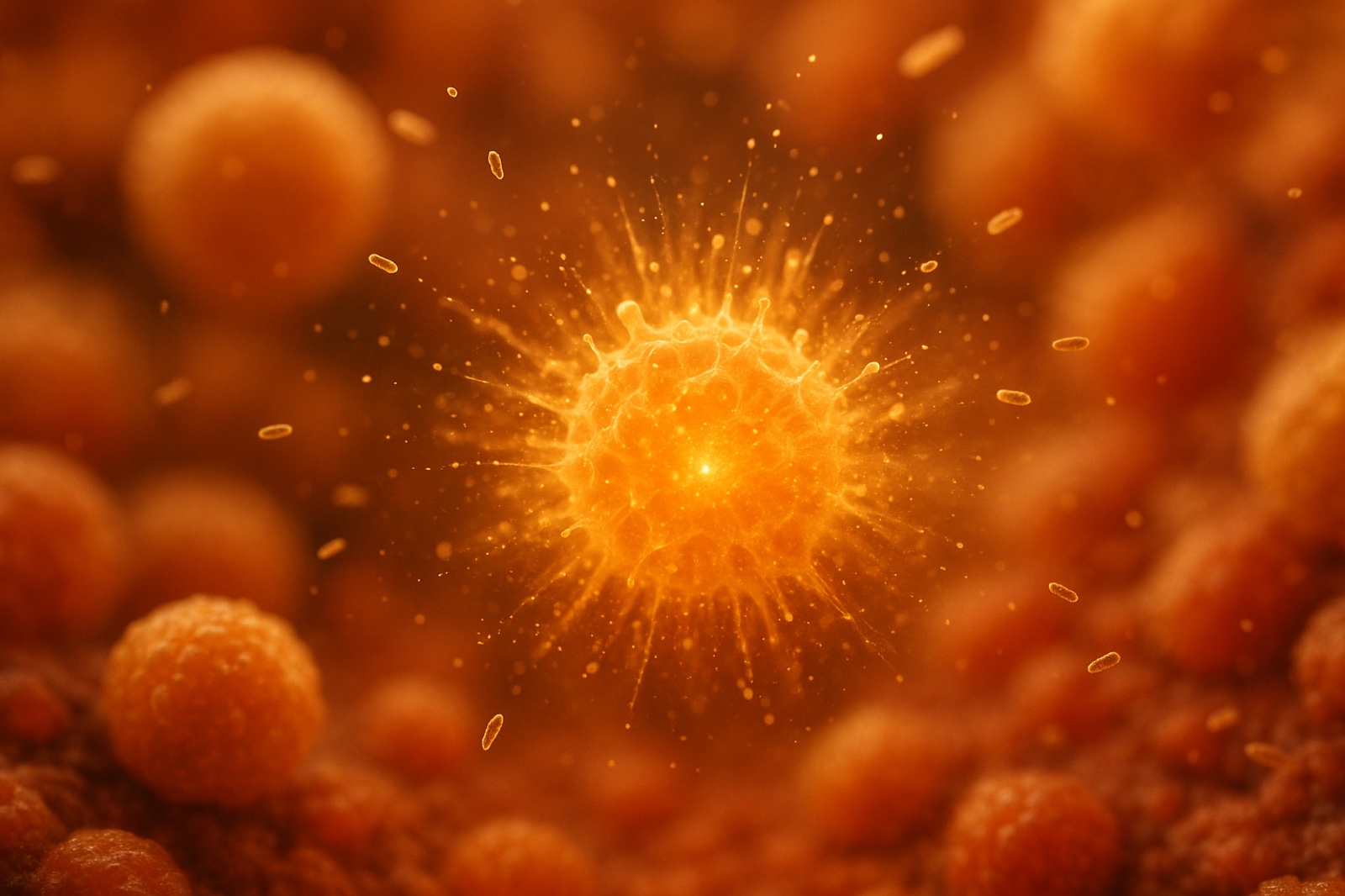
Somewhere inside a flatworm — an animal so simple it doesn’t even have a brain — a cell just did something scientists had never seen before. It sensed danger. It positioned itself. And then, in a fraction of a second, it exploded.
Not out of malfunction. Not out of panic. On purpose. As a plan.
The blast killed the threat, protected dozens of neighboring cells, and then the cell that started it all was simply gone — no trace left behind, no reward collected, no memory kept. Researchers at Stanford and Ben-Gurion University just gave this kind of cell a name for the first time: the ruptoblast. And the more they studied how it works, the stranger — and more familiar — the whole thing started to look.
A Cell Built to Sacrifice Itself
Every animal, including you, relies on an immune system to fight off things that shouldn’t be there — bacteria, viruses, damaged cells. Usually, immune cells do this the way you’d expect: they surround a threat, engulf it, or release chemical signals that call in reinforcements. It’s a process. It takes time.
The ruptoblast doesn’t do any of that. It does one thing, one time, and then it’s finished.
When researchers infected flatworms with dangerous bacteria, they watched neighboring immune cells release a hormone called activin — essentially a signal flare. The moment a ruptoblast received that signal, it detonated. The blast wave shattered the membranes of nearby invading microbes almost instantly, and a single explosion could take out as many as 70 threatening cells in one shot. The study, published in the journal Cell, describes it as “explosive cytotoxicity” — a controlled, targeted act of cellular self-destruction that exists for exactly one purpose: to protect what’s around it.
Then the ruptoblast is gone. Not injured. Not recovering. Spent — completely, on behalf of something outside itself.
How a Cell “Decides” to Give Everything
What makes this discovery genuinely new isn’t just that a cell can self-destruct — biologists have known about cell death for decades. What’s new is the coordination. A ruptoblast isn’t dying from damage. It’s responding to a call from its neighbors and choosing, in the most literal biological sense available to a single cell, to spend its entire existence on their behalf.
Researchers believe the hormone activin functions almost like an alarm system stretched across tissue — a way for cells to warn each other and mobilize a defense faster than the immune system’s usual, slower channels allow. It’s a shortcut built entirely around sacrifice. The system doesn’t work unless some cells are willing to give everything, immediately, without waiting to see if it’s worth it first.
Scientists are already looking at whether this same mechanism exists — quietly, undiscovered until now — in more complex animals, including humans, and whether it could be harnessed for faster, more targeted treatments against infections and even cancer. A recent study on the immune system’s own internal alarm signals found something similar: the body is wired with early-warning systems most people never think about until they fail.
The Pattern That Keeps Showing Up Once You Start Looking
Here’s the part that stayed with the researchers themselves, according to their own published notes: this isn’t the first time biologists have found something like self-sacrifice built into a system that has no reason to “care” about anything. A 2026 study on Galápagos daisies found that separate island populations independently evolved the exact same heat-tolerant leaf shape — using completely different genetic blueprints to arrive at it. Different starting points. Same design. Over and over, when scientists look closely enough at how living systems actually function, they keep finding the same quiet signature: things built not just to survive, but to give something up for what’s around them.
There’s an idea far older than biology that describes exactly what a ruptoblast does, without knowing anything about cells or hormones or membranes. It says the deepest kind of love a person can show isn’t a feeling at all — it’s an action. It’s laying down what you have, on purpose, for someone else, and asking for nothing back. Not as a strategy. Not as a transaction. Just because the ones around you were worth it.
It’s a strange thing to find that same pattern running on a loop inside a flatworm, at a scale too small for the eye to see, with no one watching and no praise to collect. Whatever built a system like that clearly wasn’t only interested in survival. Something, somewhere, seems to have designed self-giving love into the blueprint of life itself — long before any human wrote the idea down, and long before any scientist had a microscope powerful enough to see it happening.
What This Means for the Rest of Us
You will probably never think about ruptoblasts again after today. But it’s worth sitting with the shape of what they do, because it’s not actually a story about flatworms.
It’s a reminder that the smallest, most overlooked pieces of the world are often doing something quietly remarkable — giving themselves fully to something bigger than their own survival, without anyone noticing, without anyone keeping score. If that’s true down at the level of a single cell in a creature with no brain, it might be worth asking what it says about the bigger, harder version of that same choice — the one you get to make, on purpose, in your own life, for the people around you.
If you’ve ever wondered whether that kind of love — the quiet, sacrificial, no-strings-attached kind — actually means something bigger than the moment it happens in, this short reflection on what it feels like to sense something greater than yourself is worth two minutes of your time.
A Question Worth Sitting With
If a cell with no brain, no memory, and no stake in the outcome can be built to give everything it has for something outside itself — what does that say about the systems we build, the way we compete with each other, and the value we put on self-sacrifice when nobody’s watching? Is that instinct something we’re taught, or something we were built with from the start? Drop your take in the comments — we’d genuinely like to know what you think.
Share This
- Scientists just found a cell whose entire job is to explode and save everything around it — then disappear completely. Not what I expected from a flatworm. 🧬
- A new immune cell called a “ruptoblast” gives up its entire existence in one shot to save 70 neighboring cells. No reward. No recovery. Just gone. There’s something bigger hiding in that design. https://bgodinspired.com/index.php/nature-and-creation/exploding-immune-cell-ruptoblast-self-sacrifice/
- Turns out self-sacrifice might be written into biology at the cellular level. Stanford just found the proof. 🔬
Common Questions About This Discovery
What is a ruptoblast?
A ruptoblast is a newly identified type of immune cell, first described by researchers at Stanford and Ben-Gurion University in flatworms. It self-destructs within minutes of detecting a threat, releasing a blast that kills nearby bacteria and infected cells before the ruptoblast itself disappears completely.
How does a ruptoblast know when to explode?
Neighboring immune cells release a hormone called activin when they detect an infection or damage. This hormone acts as a signal that triggers the ruptoblast to detonate almost immediately, destroying invading microbes in the surrounding area.
How many cells can one ruptoblast kill?
According to the study published in the journal Cell, a single ruptoblast explosion can kill as many as 70 nearby threatening cells in one event.
Could this discovery help treat human diseases?
Researchers believe the mechanism could offer clues for developing faster, more targeted treatments against infections and cancer, since it represents an entirely new category of rapid, localized immune response.
Do humans have cells that work like ruptoblasts?
Scientists are still investigating whether a similar mechanism exists in more complex animals, including humans. The discovery is recent enough that this research is ongoing.