 0
0
 0
0
Three thousand kilometers beneath your feet, there is an ocean nobody has ever seen. It is made of molten iron, hotter than the surface of the sun, and it never stops moving. That churning metal is the reason a compass points north and your phone’s GPS works — and a new analysis of satellite data released this week reveals that Earth’s core reversed direction beneath the Pacific, in a way scientists still can’t fully explain.
Around 2010, a massive region of that liquid iron beneath the Pacific Ocean quietly flipped direction. It had been drifting slowly westward. Then it reversed, and started moving fast to the east. Nobody announced it at the time, because nobody could see it happening — not directly. It took over a decade of satellite data, stitched together by a European Space Agency team, to even notice.
How Scientists Caught the Core’s Reversal
You can’t drill three thousand kilometers into the Earth. The deepest hole humans have ever dug — the Kola Superdeep Borehole in Russia — barely scratched 12 kilometers, and that took nearly 20 years. So scientists studying the core do something stranger: they watch its shadow.
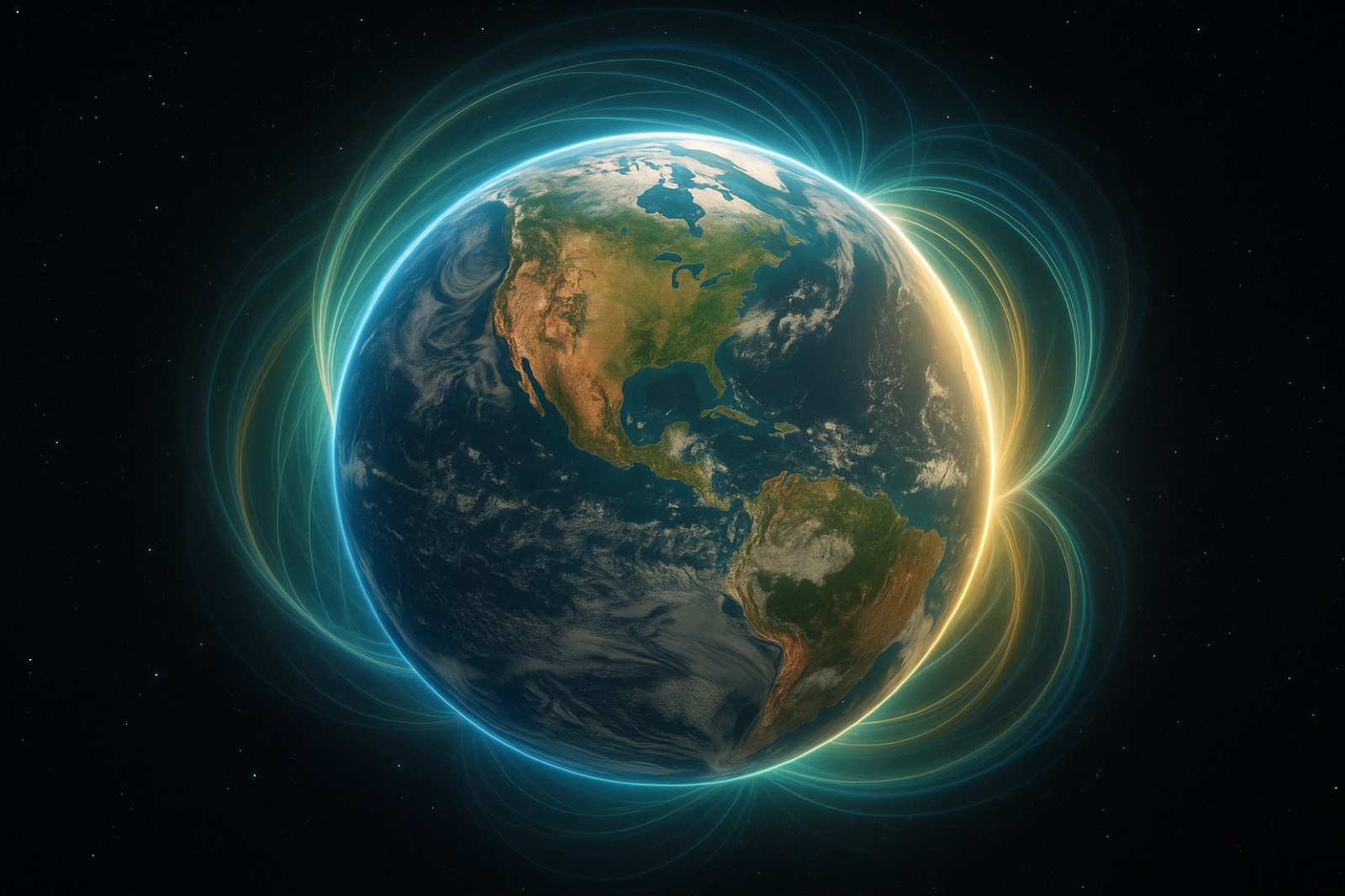
The molten iron in Earth’s outer core acts like the spinning conductor inside a bicycle dynamo. As it moves, it generates electric currents, and those currents generate the magnetic field that surrounds the entire planet. Every shift in how that iron flows shows up, faintly, as a shift in the magnetic field at the surface — and in space.
That’s what ESA’s Swarm mission was built to catch. Three small satellites, each carrying an extremely sensitive magnetometer, have been circling Earth since 2013, joined by data from older missions — Germany’s CHAMP satellite, the Danish Ørsted mission, and ESA’s CryoSat — plus ground station records stretching back to 1997. Stack nearly three decades of that data together, and a pattern that was invisible year to year suddenly becomes obvious: something shifted beneath the Pacific in 2010, and it has been slowly settling down again since about 2020.
“The large-scale flow reversal beneath the Pacific raises new questions,” said Frederik Dahl Madsen of the University of Edinburgh, one of the researchers behind the analysis.
Is this a “pole reversal”? No — and that matters
If you’ve heard the phrase “magnetic pole reversal” before, it’s tempting to assume that’s what’s happening here. It isn’t, and the distinction is worth sitting with. A full pole reversal — where north and south magnetic poles swap places entirely — is a planet-wide event that unfolds over thousands of years and has happened many times in Earth’s deep history. What researchers just documented is something smaller and more local: a regional current inside the core changing direction, the way an eddy in a river can spin one way for a while and then the other, without the whole river reversing course.
It also isn’t dangerous. Researchers were direct about this: the shift poses no threat to people or to the climate. What it can affect is more technical — the precision of satellite navigation systems, spacecraft operations, and the models scientists use to predict space weather. In other words, it matters enormously to the engineers who keep GPS accurate to the meter. It does not matter to your Tuesday.
What makes it genuinely strange is the “why.” Fluid dynamics inside a planet’s core is one of the least directly observable processes in all of science. Researchers can measure that the flow changed. They can measure how fast, and roughly where, and that it’s been quieting down for the past several years. What they cannot yet do is say with confidence what triggered it — only that something down there, in a region no human will ever visit, chose a different direction and then, just as quietly, began to change its mind again.
The part that’s easy to miss
Step back from the mechanics for a second. The reason any of this is knowable at all — the reason we have a magnetic field worth measuring in the first place — is that something at the center of this planet has been running continuously for over four billion years. Not occasionally. Not with maintenance breaks. A liquid-iron engine, unseen and unsupervised, has kept a shield up around the entire Earth for the whole span of life’s existence here — deflecting the solar wind and cosmic radiation that would otherwise strip the atmosphere away, the way it did on Mars.
People who spend their lives studying that engine keep running into the same quiet surprise: the closer you look at what’s sustaining things, the less it looks like something running on autopilot. Ancient wisdom put it more simply than any satellite data ever could — that the world is held together, moment to moment, by something bigger than the world itself. You don’t have to resolve every mechanism to notice that. Sometimes the mystery isn’t a gap waiting to be explained away. Sometimes it’s just evidence that something has been faithfully keeping the lights on the whole time, long before anyone was watching closely enough to say thank you.
That doesn’t make the science less real. If anything, it makes it more worth paying attention to. The people who study Earth’s core aren’t chasing a loophole for faith — they’re some of the most rigorous, patient observers on the planet, cross-referencing three decades of satellite readings just to notice one reversal a decade after it happened. And what they keep finding, again and again, is a planet that has been remarkably, improbably, consistently held together. It’s the same pattern people keep running into everywhere they actually stop and look closely at the natural world — right down to an ancient Hebrew word that shows up in a completely different corner of creation — the closer the study, the more deliberate the design looks.
What happens next
For now, researchers are watching to see whether the weakening trend since 2020 continues — whether this was a temporary eddy that has mostly run its course, or the opening chapter of something longer. Anja Stromme, who manages the Swarm mission for ESA, has made a simple point about missions like this: it’s the years of continuous global coverage that let scientists see a pattern a single snapshot never could.
It’s a strangely comforting thought, actually. Not that the mystery gets solved — it probably won’t be, not soon. But that somewhere, quietly, someone has been keeping watch long enough to notice.
If a decade-old shift in a place no one can see still felt unsettling to read about, you’re not alone — a lot of us carry a version of that same low hum: the sense that there’s more going on beneath the surface of things than we can measure or control. If that’s you today, this piece on facing the fear of the unknown was written for exactly that feeling. And if “mysteries science still can’t fully explain” is a rabbit hole you enjoy, this one about a century-old medical mystery is worth your next few minutes.
Something to think about
If scientists eventually explain exactly why the core’s flow reversed, would that make the whole thing feel less remarkable to you — or more? Drop your answer in the comments.
Share this
- Earth’s molten core quietly reversed direction beneath the Pacific 15 years ago and scientists are only now piecing together why. Wild. https://bgodinspired.com/index.php/nature-and-creation/earths-core-reversed-direction-scientists-dont-know-why/
- The magnetic field protecting our entire planet from solar radiation is generated by an ocean of liquid iron nobody has ever seen — and it just changed direction without asking permission. https://bgodinspired.com/index.php/nature-and-creation/earths-core-reversed-direction-scientists-dont-know-why/
- Turns out the “why” behind a lot of what keeps this planet livable is still a mystery — even to the people whose whole job is measuring it. https://bgodinspired.com/index.php/nature-and-creation/earths-core-reversed-direction-scientists-dont-know-why/
Common Questions
Did Earth’s core really reverse direction?
Yes — a regional flow of molten iron beneath the Pacific Ocean shifted from a weak westward drift to a strong eastward flow starting around 2010. Researchers only confirmed the pattern recently, after analyzing nearly three decades of satellite and ground-based magnetic data.
Is this the same thing as a magnetic pole reversal?
No. A pole reversal is a rare, planet-wide event where Earth’s north and south magnetic poles fully swap places over thousands of years. What happened here is smaller and more localized — a shift in one current within the core’s fluid iron, similar to an eddy changing direction inside a larger, unchanged river.
Is Earth’s core reversal dangerous?
No. Researchers have stated it poses no direct threat to people or the climate. Its main effects are technical, slightly affecting the precision of satellite navigation systems, spacecraft operations, and space weather forecasting models.
How do scientists study something 3,000 kilometers underground?
They can’t observe the core directly, so they measure its effects instead — specifically, tiny shifts in Earth’s magnetic field at the surface and in orbit. ESA’s Swarm satellites, along with older missions like CHAMP and Ørsted and decades of ground station data, track those shifts closely enough to reconstruct what the core’s fluid iron is likely doing.
What causes Earth’s magnetic field in the first place?
It’s generated by the geodynamo — the movement of molten iron in Earth’s outer core, which creates electric currents the same way a spinning conductor does inside a generator. That field has been shielding the planet’s atmosphere from solar wind and radiation for billions of years, which is part of why Earth remained habitable while a planet like Mars, without a strong magnetic field, lost most of its atmosphere.