 0
0
 0
0
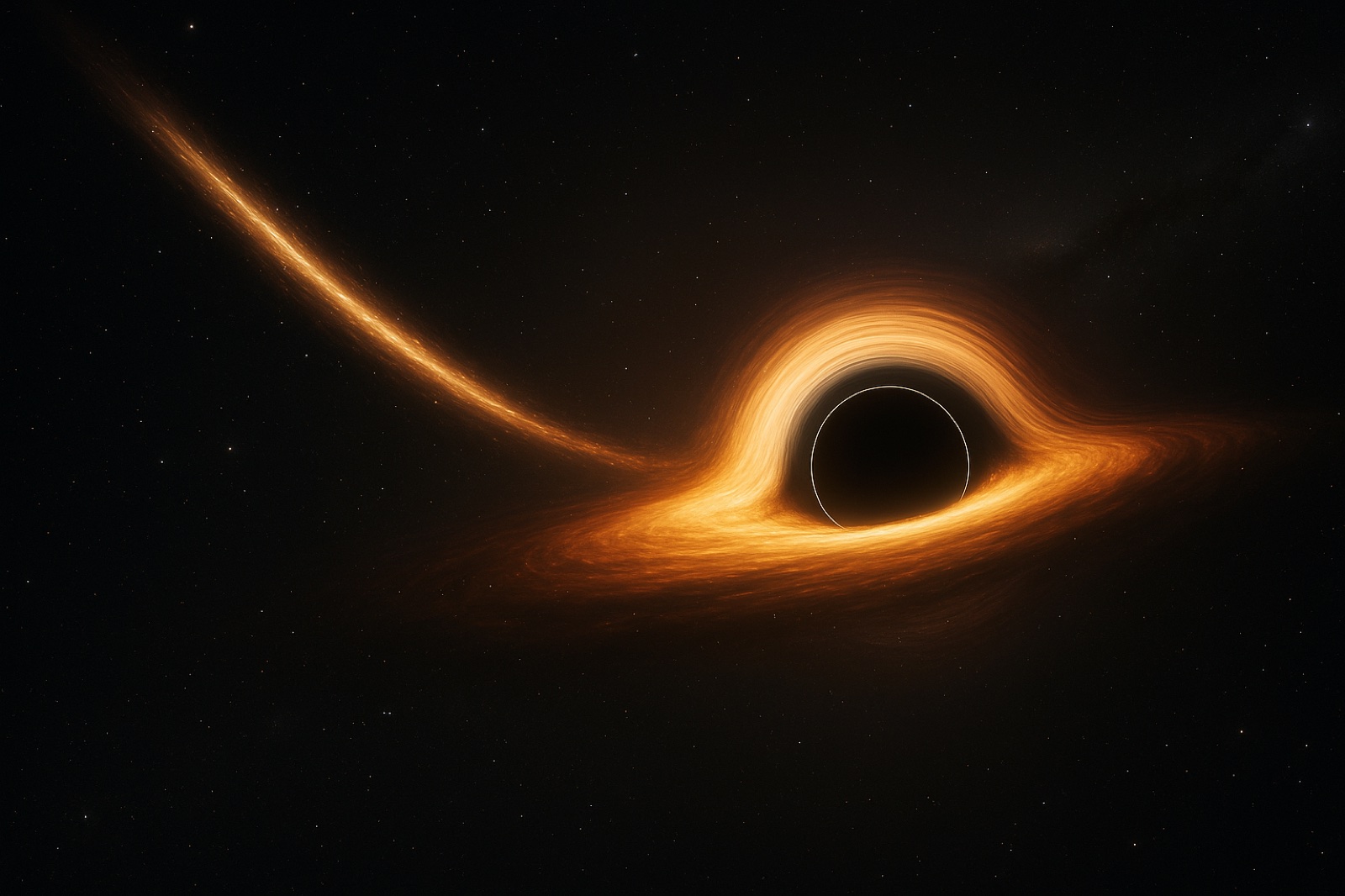
Somewhere in a galaxy far from its own core, a supermassive black hole spent an estimated 30,000 years doing something almost no black hole manages: staying completely invisible. No glowing disk. No hungry pull on nearby stars. Nothing. Then, one night in November 2025, it stopped hiding — because a star wandered too close, and the black hole tore it apart.
That single flash of light did what decades of black hole hunting couldn’t: it proved a dormant black hole could exist that far from where astronomers expect to find one, and it caught the whole thing on camera.
A Black Hole That Was Never Supposed to Be Findable
Most of what we know about supermassive black holes comes from watching them eat. An active black hole pulls in gas and dust, heats it to blistering temperatures, and glows brighter than an entire galaxy of stars combined. That glow is how telescopes usually find them.
A dormant black hole does none of that. It sits quietly, unfed, invisible against the dark. Scientists have long suspected that wandering, inactive black holes exist scattered through galaxies — ejected from their home cores by ancient mergers or gravitational slingshots — a companionless population that simulations have estimated could number in the tens of millions in our galaxy alone. Suspecting is not the same as finding one. A black hole that isn’t eating leaves no light to trace — until something forces its hand.
This one revealed itself 30,000 light-years — about 9.3 kiloparsecs — from the center of its host galaxy, farther out than any dormant black hole had ever been confirmed.
How an AI Program Caught It Red-Handed
The event that gave it away is called a tidal disruption event — astronomer shorthand for what happens when a star strays close enough for a black hole’s gravity to pull it apart, stretching it into a glowing stream of plasma before swallowing what’s left. It’s violent, it’s brief, and it produces a burst of light unlike almost anything else in the sky.
Catching one usually means already watching the right patch of sky at the right moment, near a known galactic center. This black hole broke that pattern. It was found by an AI program built at the University of Maryland — led by postdoctoral researcher Robert David Stein, with colleagues Suvi Gezari and Sylvain Veilleux — trained specifically to recognize the light signature of a tidal disruption event anywhere in the sky, not just clustered near the galaxy cores astronomers had always assumed to search. Running against nightly images from the Zwicky Transient Facility at Palomar Observatory, the program flagged the flare three months after it launched. The findings published in The Astrophysical Journal Letters on July 27, 2026, and were announced publicly on August 6.
Why a Wandering Black Hole Changes the Math
One confirmed detection sounds small. It isn’t. Every dormant black hole found off-center strengthens the case that our galaxy — and every galaxy — is carrying far more of these silent, wandering giants than telescopes have ever accounted for. It also means the tools astronomers use to count black holes across the universe may have been missing an entire category simply because they were built to look in the wrong place.
None of that is really what makes the story land, though. It’s not the math. It’s the timing. Thirty thousand years is roughly six times longer than all of recorded human history — and for every one of those years, this black hole sat completely unnoticed, doing nothing that gave it away. It didn’t reveal itself because someone finally pointed a strong enough telescope at it. It revealed itself because it collided with something.
What It Takes to Finally Be Seen
There’s something oddly familiar in that. Most of what people carry quietly — the things they’ve buried, downplayed, or simply learned to keep out of view — tends to work the same way. It doesn’t announce itself. It sits, unremarkable, sometimes for years, right up until life collides with it: a diagnosis, a loss, a conversation that goes further than planned. Then it’s suddenly, undeniably visible, and it can feel like it appeared out of nowhere. It didn’t. It was always there. The collision just made it impossible to keep ignoring.
It’s the same instinct that makes someone perform a busy, curated life to keep something quieter underneath from showing, or the same reason a reservoir of molten rock can sit undetected under a landscape people have walked for centuries — hidden isn’t the same as gone. Ancient wisdom has always made a stranger claim about that kind of hiding, though: that nothing has ever actually been invisible to God in the first place. The black hole wasn’t a mystery to the universe it moved through — it was only a mystery to us, the ones without the instruments to see it yet. Whatever a person keeps in the dark works the same way. It was never hidden from the love that made them. It was only hidden from everyone else’s view, and from their own ability to stop carrying it alone.
Maybe that’s the quieter comfort tucked inside a 30,000-year-old cosmic magic trick: nobody has to orchestrate their own reveal, and nobody has to dread it either. Whatever eventually comes into the light was never a surprise to begin with — not to the universe, and not to whatever is bigger than it.
One Question Worth Sitting With
If something invisible can sit undetected for 30,000 years and still be completely real the whole time — what does that change about how you think of the things people, including you, keep hidden? Does knowing it usually takes a collision to reveal something make you more patient with people who haven’t been “found out” yet — or more patient with yourself? Tell us in the comments.
Share This
- “A black hole hid 30,000 light-years from its galaxy’s center for so long that human civilization didn’t exist yet the last time it acted ‘visible.’ It only got caught because it ate a star. wild.”
- “Scientists just found a black hole that’s been sitting dormant for 30,000 years — completely undetectable — until it finally shredded a star and gave itself away. There’s something weirdly comforting about a hidden thing that was real the whole time.”
- “An AI program built to hunt black holes just found one nobody expected: dormant, wandering, 30,000 light-years off course, invisible for tens of thousands of years until it finally slipped up.”
Frequently Asked Questions
What is a dormant black hole?
A dormant black hole is a black hole that isn’t actively pulling in and heating gas or dust, so it produces no detectable glow. Because most black hole detection methods rely on that glow, dormant black holes are extremely difficult to find unless something forces them to interact with nearby matter.
What is a tidal disruption event?
A tidal disruption event happens when a star passes close enough to a black hole that the black hole’s gravity stretches and tears the star apart, producing a bright, short-lived flare of light. It’s currently the main way astronomers detect otherwise-invisible black holes.
How far away was this dormant black hole found?
It was located about 30,000 light-years (roughly 9.3 kiloparsecs) from the center of its host galaxy — farther from a galactic core than any confirmed dormant black hole before it.
Who discovered this dormant black hole?
It was found by an AI detection program developed at the University of Maryland, led by postdoctoral researcher Robert David Stein along with co-authors Suvi Gezari and Sylvain Veilleux, using nightly sky images from the Zwicky Transient Facility at Palomar Observatory. The findings were published in The Astrophysical Journal Letters on July 27, 2026.
Why does finding a wandering black hole matter?
It suggests that many more dormant, wandering black holes may exist throughout our galaxy and others than current telescopes have accounted for, since standard detection methods are built around watching active galactic centers rather than the wider galaxy.