 0
0
 0
0
Earth’s Day Length: A Slow Dance Through Time
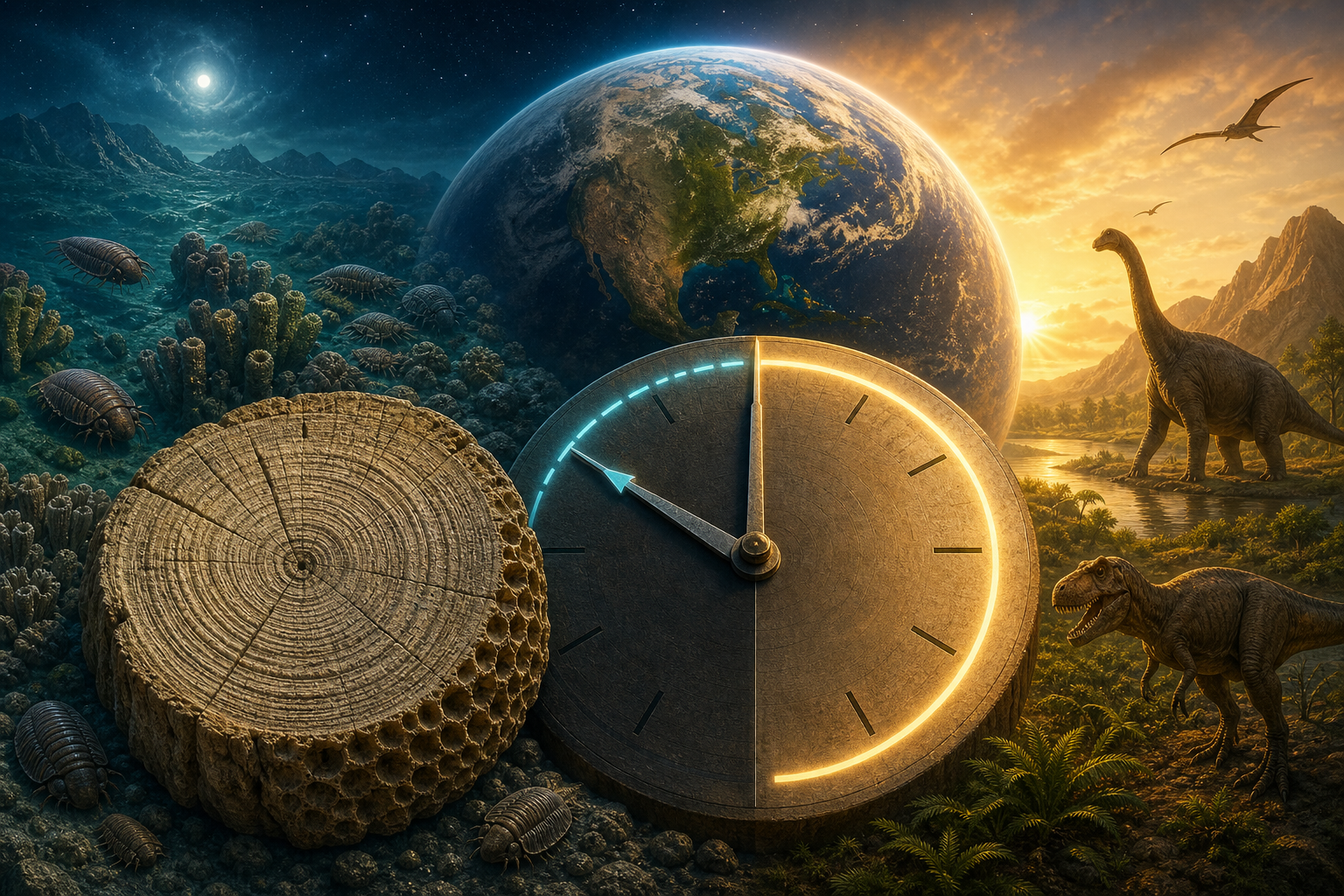
In a remarkable revelation that may alter our understanding of Earth’s geological history, scientists have confirmed that the length of a day on our planet is not a static concept. Over billions of years, Earth’s rotation has been gradually slowing down—a phenomenon primarily attributed to tidal friction caused by gravitational interactions with the Moon. This transfer of rotational energy is causing the Moon to drift into a higher orbit, a change that is small yet measurable.
Recent studies indicate that the current rate of this slowdown has lengthened the day by approximately 1.7 milliseconds per century in the last few decades, and about 2.3 milliseconds per century averaged over the past 2,700 years. These slight shifts accumulate over eons, leading to a fascinating conclusion: a day during the Mesozoic era was shorter than today, and even shorter days were found in the Paleozoic and Precambrian periods.
Fossil Evidence Unveils History
One of the cornerstones of this research comes from paleontologist John W. Wells, who, in 1963, published findings demonstrating how ancient corals record daily growth layers similar to annual rings in trees. By counting these layers in coral fossils from the Middle Devonian period—approximately 385 million years old—Wells discerned that ancient corals experienced nearly 400 days per year. This implies that back then, each day was roughly 21.9 hours long—far shorter than the modern 24-hour cycle.
As Wells extended his research into corals from the Pennsylvanian period, he discovered a pattern consistent with tidal physics: the Earth was indeed spinning faster in the distant past.
Insights from Deep Time
However, corals do not tell the complete story. For older periods, scientists utilize sedimentary layers and orbital patterns inscribed in ancient rock formations to further delve into Earth’s rotational history. For instance, research suggests that during the mid-Proterozoic era, the length of a day may have hovered around 19 hours, maintained for nearly a billion years due to a balance between the Moon’s slowing influence and other forces at play.
Although these findings may seem academic, they broadly transform our understanding of time itself. For example, a trilobite from the Cambrian period did not perceive the sun moving as we do today; its day lasted just 21 hours.
The Spiritual Reflection
From a Christian perspective, this evolution of our understanding of time offers a rich metaphor for the journey of faith. As we consider the passage of time, we are reminded of the Biblical teaching that "to everything there is a season, and a time for every matter under heaven" (Ecclesiastes 3:1). Just as the Earth has gradually shifted through different rhythms, our lives encompass moments of transition and change.
This scientific insight encourages us to think about the constancy of God through the years. While the universe spins and time ages, the essence of divine love and purpose remains unchanging.
Encouragement for Reflection
As we ponder these geological truths and their implications, let us consider how God invites us to reflect on the time we have. Each day, no matter how long or short, is an opportunity for growth, service, and love. Let this understanding inspire us to live mindfully, focusing on the values that lead to a fulfilling life—compassion, kindness, and faithfulness.
In a world constant with change, remember that our life’s journey is part of a larger narrative, one filled with purpose and wonder. Reflect on how you can make the most of your time today, lived in love and service to others.
If you want to want to know more about this topic, check out BGodInspired.com or check out specific products/content we’ve created to answer the question at BGodInspired Solutions
If positive Biblical wisdom matters to you, I’d love your support of the mission
Q&A about
Why does the length of an Earth day matter to my faith?
Understanding that the Earth has gradually slowed over billions of years can remind us of God’s divine design and the natural order He established. In John 1:3, it is emphasized that all things were made through Him, suggesting that God’s creation is intentional and unfolding in accordance with His will, inviting us to marvel at the complexity of His creation.
Can studying ancient coral fossils help strengthen my faith?
Yes, studying creation, like ancient coral fossils, offers opportunities to see God’s handiwork and encourages us to appreciate His artistry. Romans 1:20 points out that God’s invisible qualities are evident in creation, reminding us that His existence and nature can be understood through the things He has made.
How can I reconcile scientific findings about Earth’s history with my Christian beliefs?
Reconciling science and faith requires viewing both through the lens of God’s truth, which encompasses all knowledge. The Bible calls us to seek wisdom and understanding (Proverbs 2:6), and by exploring scientific discoveries, we can gain a deeper appreciation for God’s power and the intricate history of the world He created.
What can I learn about God’s sovereignty from Earth’s changing rotation?
The changing rotation of Earth can reflect God’s sovereignty over time and creation. Hebrews 13:8 states that Jesus Christ is the same yesterday, today, and forever, underscoring that, while the world evolves, God’s eternal nature remains constant, offering us peace and assurance in a world of change.