 0
0
 0
0
You’ve probably imagined your brain working like a checklist. First you notice something — a text lighting up your phone, a smell from the kitchen, a stop sign coming up fast. Then you think about it. Then you decide. Then you act. See, decide, do — in that order, like a relay race where one runner hands the baton to the next.
New research says that’s not actually how the brain makes decisions at all.
Engineers and neuroscientists at the University of Illinois Urbana-Champaign, led by professor Yurii Vlasov, spent time watching what happens inside the brain during the exact moment a decision gets made — down to the level of individual neurons firing. Their subjects were mice, navigating a virtual reality corridor, making small in-the-moment choices based on what they sensed around them. The scientists were specifically watching a region called the primary somatosensory cortex — the part of the brain that handles raw touch and sensory input, the part textbooks describe as the “front end” of the pipeline. Sense first. Decide later. That’s the assumption this region was built on.
Except that’s not what the recordings showed.
How the Brain Makes Decisions
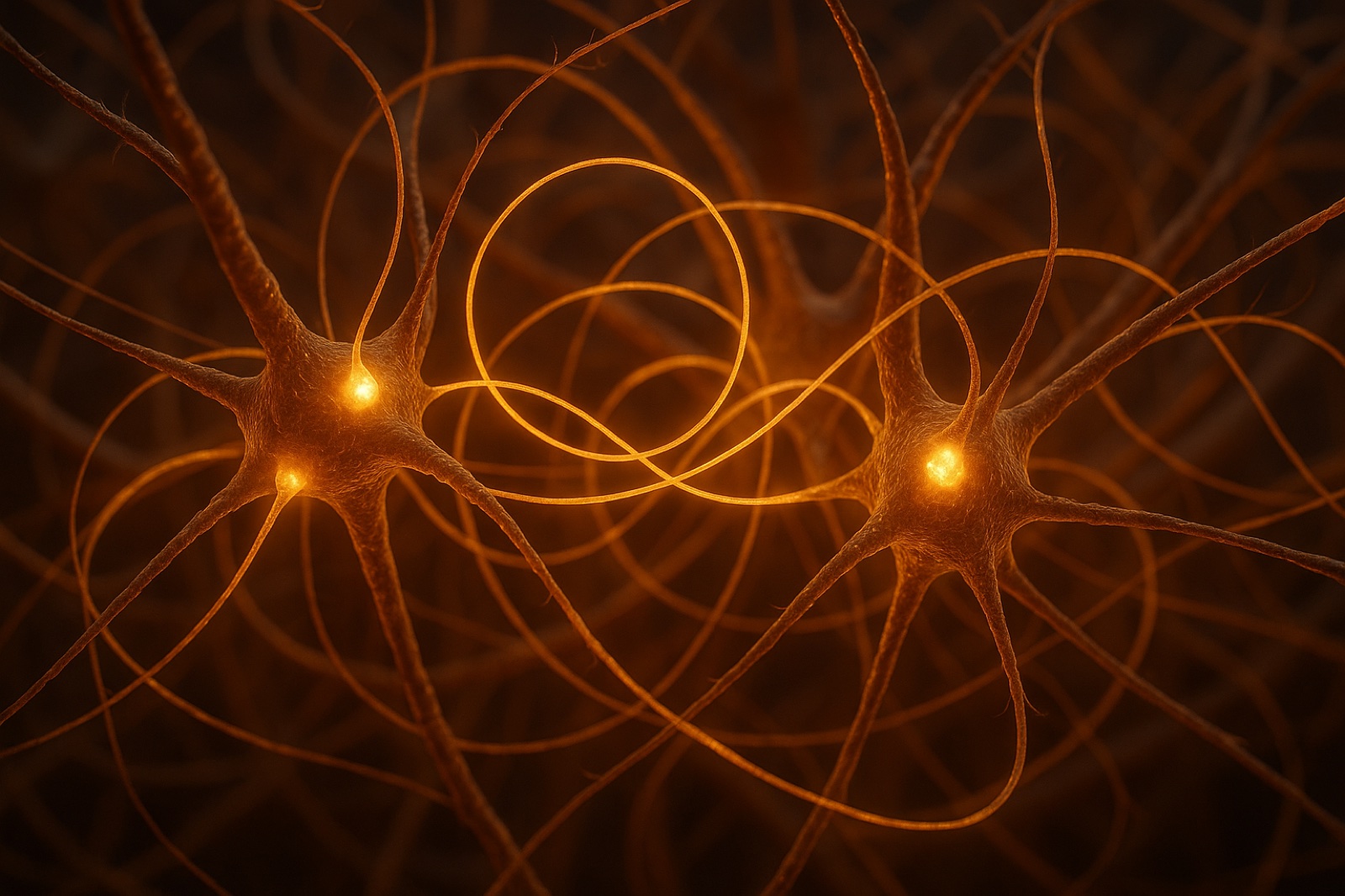
Instead of information flowing one direction — sense, then send it up the chain to be decided on — the researchers found something messier and more interesting. Decision-related activity was showing up back inside that early sensory region before the “deciding” part of the process had even finished. Signals were looping back down into the same neurons that were still processing what the mouse was sensing. The study describes it as “continuous communication across multiple brain areas instead of a simple one-direction flow.”
In plain language: the brain isn’t a relay race. It’s more like a group conversation where everyone is talking at once — sensing and deciding tangled together, feeding back into each other in real time, long before anything that looks like a clean, single decision has been reached.
If that sounds abstract, here’s the part that isn’t. Think about the last time you told yourself you’d skip the second helping, or send the hard email, or finally start the thing you keep saying you’ll start — and then watched yourself do the opposite before you’d even finished making the case to yourself. It can feel like there wasn’t really a decision at all. More like you were already leaning one way while some other part of you was still arguing for the other. This new research is one of the first times scientists have actually caught that tangle happening in real neurons, in real time.
It’s worth being careful here, because it’s easy to overreach with a finding like this. This was a study in mice, not humans, and the researchers themselves were careful to say it doesn’t hand anyone a blueprint for how free will works, or how to build smarter AI. What it does show — cleanly and specifically — is that the architecture of decision-making is a back-and-forth loop, not a one-way street. That’s a claim about circuitry and timing. It’s not a claim that your choices aren’t real, or that you’re not responsible for them.
But it does explain something a lot of people already suspected from the inside: that willpower alone was never going to be a complete answer for why we do the things we don’t want to do. Scientists have found the same pattern in other corners of the brain too — that the gap between what you intend and what you do isn’t a character flaw. It’s wiring.
The Tangle Isn’t New — Someone Described It Almost Two Thousand Years Ago
Long before anyone could record a single neuron firing, a writer whose letters have survived nearly two thousand years put this exact tangle into words — the frustration of wanting one thing clearly, and watching yourself do another, not because you’re lazy or weak, but because something in you seems to be pulling in two directions at once. He didn’t frame it as a character defect. He framed it as the human condition itself — and then, notably, he didn’t stop at describing the problem. He pointed past it, toward something outside the loop that could actually settle the negotiation instead of just narrating it forever. Not more effort. Not more guilt. Something bigger stepping into the tangle from outside it.
That idea — that the answer to an internal war isn’t winning harder, it’s help from somewhere outside the fight — shows up in other places you wouldn’t expect it too. A house divided against itself, it turns out, was never going to organize its way to peace. It needed something to unify it.
What This Actually Changes
Here’s the useful part. The next time you catch yourself already leaning toward the thing you said you wouldn’t do — the extra scroll, the snapped reply, the thing you swore you’d stop — you don’t have to read it as proof you’re broken or weak. Your brain was never built to hand off cleanly from sensing to deciding in the first place. It’s arguing with itself by design. That doesn’t mean you’re off the hook for what you do next. It just means the fight was never going to be won by gritting your teeth harder alone.
Maybe that’s a small kind of relief. Not permission to stop trying — just permission to stop being surprised that trying, by itself, was never quite enough. There’s a different definition of freedom worth sitting with here — one that was never about winning the internal argument through sheer force, but about something bigger reaching in and settling it.
Let’s Talk About It
Do you think knowing the brain works this way — as an ongoing tangle rather than a clean decision followed by an action — changes how much you blame yourself for the choices you don’t feel great about? Or does it not change anything at all? Tell us what you think in the comments.
Share This
- “Scientists just found proof that your brain doesn’t decide things in a straight line — it’s already arguing with itself before you’ve ‘decided’ anything. Explains a lot.”
- “New study: the brain doesn’t sense-then-decide, it does both at once, tangled together. So the next time you do the opposite of what you meant to do, it might just be wiring, not weakness.”
- “This one hit different: scientists caught the exact moment a brain argues with itself mid-decision. Somebody wrote about this exact feeling two thousand years before brain scanners existed.”
Quick Questions, Real Answers
What did the new brain study actually find? Researchers at the University of Illinois Urbana-Champaign recorded neural activity in mice making perceptual decisions in a virtual reality corridor. They found that decision-related signals loop back into the primary somatosensory cortex — an early sensory-processing region — while sensory information is still being processed, rather than waiting for a finished decision to be handed off. The brain regions involved are in continuous, two-way communication instead of a simple one-direction flow.
Does this mean the brain decides before you’re consciously aware of deciding? Not exactly, and it’s important not to overstate this specific study. What it shows is that the sensing and deciding processes overlap and feed back into each other inside the brain’s circuitry. That’s a finding about timing and architecture between brain regions, not a direct measurement of conscious awareness itself.
Does this prove humans don’t have free will? No. The researchers were explicit that this study doesn’t establish anything about free will or determinism — it describes how information moves between brain regions during a decision, not whether the decision itself was “really yours.” It also doesn’t offer a blueprint for building smarter AI, despite the temptation to draw that conclusion.
What is the primary somatosensory cortex? It’s the part of the brain that processes raw touch and physical sensation — traditionally understood as an early stop in a one-way chain that eventually leads to a decision elsewhere in the brain. This study found decision-related signals showing up there earlier and more actively than that older model predicted.
Was this study done on humans? No, it was conducted in mice. The researchers focused on a type of neural circuitry that’s old in evolutionary terms and broadly shared across mammals, which is why findings like this are often considered relevant to how human brains are likely wired too — but the direct data comes from mice, not people.