 0
0
 0
0
If you typed “dark night of the soul” into a search bar tonight, there is a good chance you are not doing research. You might be in one.
The things that used to light you up feel flat. Prayer, meditation, music, a walk you used to love: nothing lands. You aren’t sure what you believe anymore, or whether you’re going backward. And everyone online seems to say something different about what’s happening to you.
So let’s go back to where the phrase actually came from. It came from a man in a locked room about the size of a garden shed. And the poem he wrote is not what most people think it is.
What “Dark Night of the Soul” Actually Means
Today the phrase gets used for any hard season: a breakup, burnout, losing your faith, a spiritual crisis. That’s fair. Words grow.
But the original meaning is narrower and more hopeful. The dark night of the soul, as first described, is a season where the old ways of feeling close to something bigger stop working. Not because you failed. Because you are being moved somewhere the old ways can’t take you.
That’s the whole idea in one line: the dark is not the destination. It’s the road.
To see why, you have to meet the man who wrote it.
The Man in the Locked Cell
His name was Juan de Yepes. History knows him as John of the Cross. He was a Spanish friar, a small man, and a poet.
He was also trying to reform his religious order, to make it simpler and quieter. Not everyone in that order wanted to be reformed.
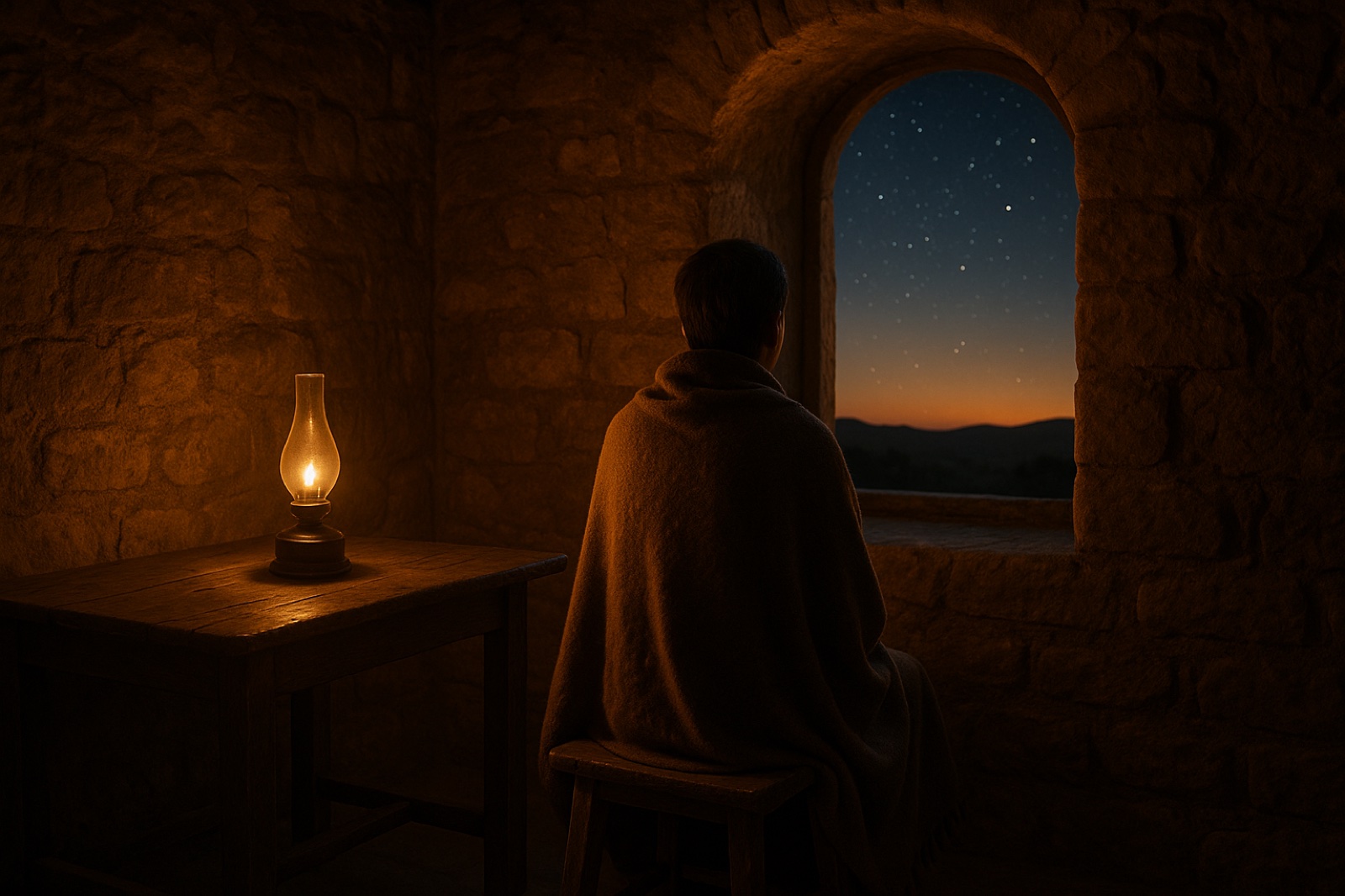
On the night of 3 December 1577, men from his own order took him by force and carried him to their priory in Toledo. They locked him in a tiny cell, roughly two metres by three (about six feet by ten). Early accounts say it had no proper window, only a slit high in the wall. He was whipped, fed little, and left alone through a freezing winter and a baking summer.
You will often read that he was held for nine months. The real number is a little less: about eight and a half. On the night of 16 to 17 August 1578, he escaped. The usual telling says he tied strips of cloth together and let himself down from a window in the dark.
Here’s the part that stops people. While he was in that cell, he was writing poetry. Some of the most beautiful love poetry in the Spanish language.
Scholars agree he composed a large part of his Spiritual Canticle in that cell. The short poem we now call “The Dark Night” is harder to date. Some think he wrote it in the cell too. Others think it came soon after he got out. Nobody knows for sure, and that’s worth saying plainly.
The Poem Is Not Sad
This is the thing almost nobody mentions. Read the poem itself, and it isn’t a cry of despair. It’s a love poem. A happy one.
It’s told by someone slipping out of a quiet house at night to meet the one they love. Here are a few of its lines, in a simple translation of the Spanish:
“On a dark night… I went out unseen, my house being now all still.”
“With no other light or guide than the one that burned in my heart.”
“O night that guided me! O night more lovely than the dawn!”
Read that last line again. A man who had just spent months in a dark cell called the night more lovely than the dawn. Not because darkness is good. Because the night was what got him out. The night was the guide.
Even the full title of the poem says this. Roughly translated, it’s “Songs of the soul that sings of the happy chance it had in passing through the dark night.” Happy chance. Passing through.
The Book That Stopped Halfway
Here’s a detail that changes how you might read your own season.
Years later, John wrote a long prose book explaining the poem, line by line. That book is what most people mean by Dark Night of the Soul. It’s where all the heavy, painful descriptions come from.
But he never finished it. The poem has eight stanzas. The book explains the first two, starts on the third, and then simply stops.
The six stanzas he never got to are the ones about light, about arriving, about rest. The poem ends with the speaker lying down at peace, “leaving my cares forgotten among the lilies.”
So if all you have ever heard about the dark night is the hard part, that’s not your fault. The famous book about it never reached the end. The poem did.
Dark Night of the Soul vs. Depression
This matters, so let’s be careful here.
John himself knew the dark night could look a lot like what he called “melancholy,” what we would call depression. In his book he warned readers not to mix them up. He said the two can show up together, and depression can make the night feel heavier. But they are not the same thing.
His main test was simple. In the dark night, a person loses the old comfort, but still cares. They still ache for the thing they can’t feel. They worry they’re going backward. That ache is a sign something is still alive and reaching.
Depression, by contrast, tends to flatten everything, including the caring.
If you have lost interest in almost everything for weeks, if sleep or eating has changed a lot, or if you have had thoughts of not wanting to be alive, please treat that as real and tell someone today. A doctor, a clinic, a trusted friend, or your local crisis line. Getting help is not a failure of faith. Having a dark night and having depression at the same time is common, and both deserve care.
What to Do If You’re in One
None of this costs money, and none of it needs a teacher or a therapist (though both are good if you can reach them).
- Stop grading yourself. Feeling nothing is not proof that you’re doing it wrong. John’s whole point was that the old feelings fading is part of the road.
- Keep a small, simple practice. Five quiet minutes a day. Sit, breathe, and don’t demand that anything happen. Showing up counts even when it feels empty.
- Name what you miss. Write one sentence: “I miss feeling ___.” The missing is the ache John was talking about. It means you’re still reaching.
- Tell one person. The dark night feels like a private thing. It doesn’t have to be. One honest conversation lightens it.
- Be patient with the timeline. Waiting without knowing how long is one of the hardest things a person can do. (There’s a reason waiting is so hard when you don’t know the ending.)
Led, Not Lost
John of the Cross didn’t believe the night was empty. He believed that when he couldn’t see anything, God was still doing the leading, and that the not-seeing was part of how he was being led. That’s why he could write “O night that guided me” from the far side of a locked door.
You don’t have to believe that tonight. But it’s worth knowing that the man who gave us these words wasn’t describing being lost. He was describing being walked somewhere in the dark by someone who could see the way.
He isn’t the only one who found something in the dark, either. Blaise Pascal, the French mathematician, had his own night that changed his life, and kept a record of it sewn into his coat for eight years.
A good place to start:
The Beginner’s Guide to Feeling God’s Presence Every Day
A short video guide for noticing God’s presence again in ordinary moments, even when it has felt far away for a long time.
Get the free guide
Free.
If you’d like a gentle way to see where you are right now, this short quiz can help: How Close Am I to God? It takes a few minutes and there are no wrong answers.
Where the Night Ends
The phrase “dark night of the soul” came out of a real room, a real winter, and a real escape. The man who lived it did not end up bitter. He ended up writing that the night was lovelier than the dawn, because of where it took him.
If you’re in the middle of yours, you are not at the end of the poem. You’re somewhere in stanza two. There are six more, and they are full of light.
Discussion Question
Do you think a hard season can lead somewhere good on its own, or does something have to be guiding it? Tell us what you think in the comments.
Share This
- “Dark night of the soul” comes from a love poem written by a man locked in a tiny cell. He called the night “more lovely than the dawn.” I didn’t know that. https://bgodinspired.com/?p=117936
- The famous book on the dark night of the soul was never finished. It explains the hard part and stops. The poem goes on for six more stanzas, all about light. If you’re in a dark season, this one’s for you: https://bgodinspired.com/?p=117936
- Feeling nothing doesn’t mean you’re doing it wrong. Worth reading if everything feels flat lately. https://bgodinspired.com/?p=117936
Questions People Ask About the Dark Night of the Soul
What does “dark night of the soul” mean?
“Dark night of the soul” describes a season when the old ways of feeling spiritually close or alive stop working, and a person feels empty, uncertain, or far away. The phrase comes from the 16th-century Spanish poet and friar John of the Cross, who described this night as a passage that leads somewhere, not a dead end.
Who wrote “Dark Night of the Soul”?
John of the Cross, a Spanish Carmelite friar and poet (1542 to 1591), wrote the poem known as “The Dark Night” and a later prose book explaining it. He was imprisoned by members of his own religious order in Toledo, Spain, from December 1577 until he escaped in August 1578. The poem was written either during that imprisonment or shortly after it; scholars are not certain which.
Is the dark night of the soul the same as depression?
No. John of the Cross himself warned that the dark night of the soul and melancholy (depression) are different things, though they can happen together. In his description, a person in the dark night loses old comfort but still deeply cares and longs for what they cannot feel, while depression tends to flatten caring itself. Anyone with lasting loss of interest, major changes in sleep or appetite, or thoughts of not wanting to live should talk to a doctor, clinic, or crisis line.
How long does a dark night of the soul last?
There is no fixed length for a dark night of the soul. John of the Cross did not give a timeline, and people describe seasons lasting weeks, months, or longer. Keeping a small daily practice, telling someone honestly, and not judging the empty feeling are commonly recommended ways to move through it.
Is the poem “Dark Night of the Soul” sad?
No. The original Spanish poem by John of the Cross is a joyful love poem about slipping out of a quiet house at night to meet the beloved. It calls the night “more lovely than the dawn” and ends in rest and peace. The heavy, painful descriptions most people associate with the phrase come from his unfinished prose commentary, which covers only the first two of the poem’s eight stanzas.