 0
 0
On 31 October 2026, four people walked out of a building in Houston, Texas, that they had not left in 378 days. No windows. No fresh air. No face but three other faces. For more than a year they had been living on Mars.
Sort of.
The NASA Mars simulation called CHAPEA (Crew Health and Performance Exploration Analog) does not send anyone to space. It builds a little piece of Mars inside a hangar at the Johnson Space Center and asks volunteers to live by that planet’s rules for a year. Then NASA watches what the rules do to a person.
This was the second crew to do it. Ross Elder was the commander, Ellen Ellis the medical officer, Matthew Montgomery the science officer and James Spicer the flight engineer. They went in on 19 October 2025. They came out 378 days later, which is almost exactly how long the first crew stayed in 2023 and 2024.
What the NASA Mars simulation actually asked of them
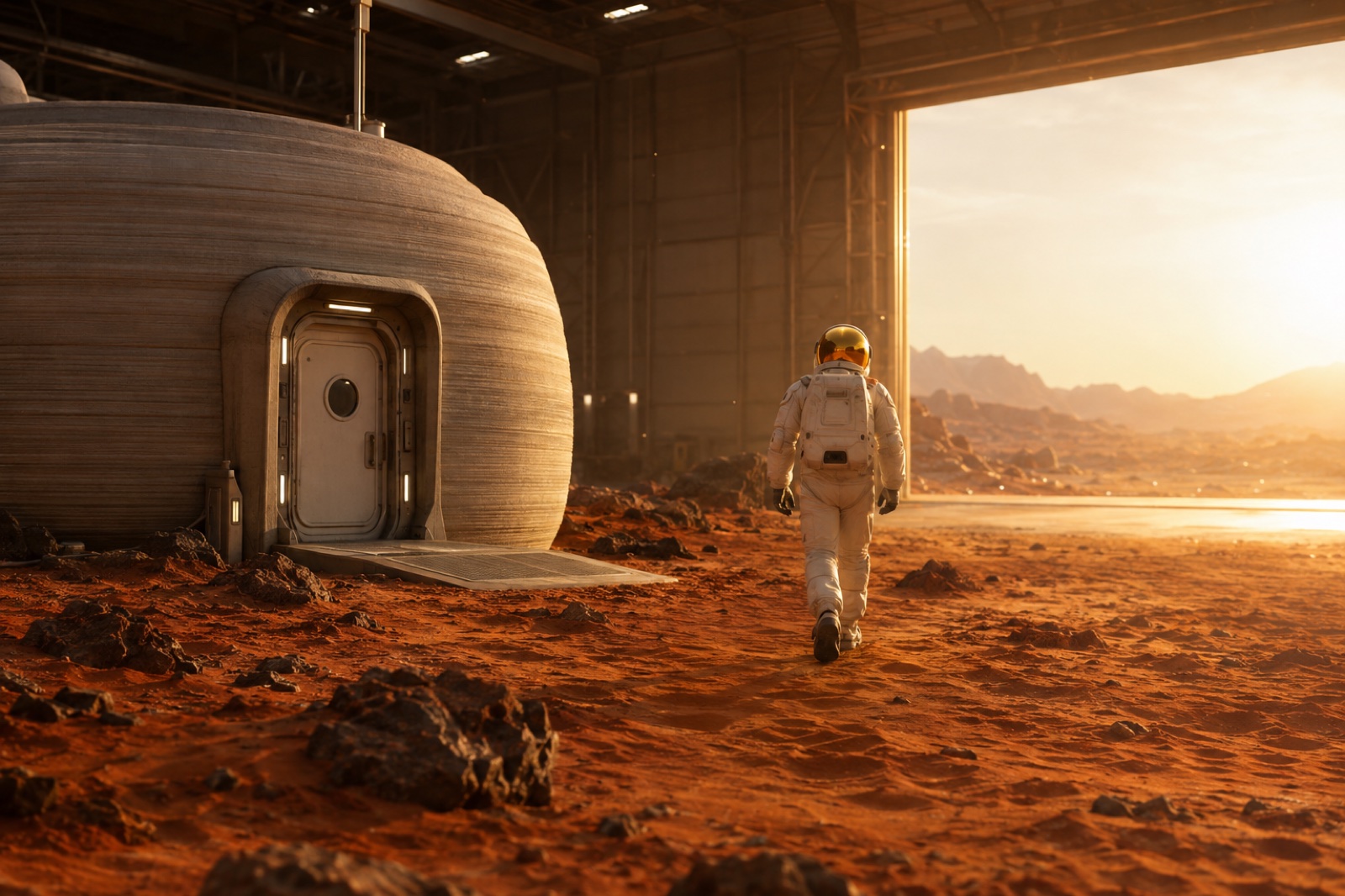
The habitat is a 3D-printed structure of about 1,700 square feet, or roughly 158 square metres. That is the floor space of a modest three-bedroom house. Four adults shared it for a year.
Inside were small private sleeping quarters, shared space for cooking, exercise and medical work, a technical area, two bathrooms and a garden. The garden was hydroponic, meaning the plants grew in water and nutrients rather than soil. NASA’s own photo captions show peppers thriving in it, and the crew harvesting vegetables they had grown themselves.
Outside the habitat’s airlock was a sealed room filled with red sand, built to look like the surface of Mars. The crew put on spacesuits, cycled through a pretend depressurisation and walked out onto it. NASA calls these “Marswalks.” They collected rock samples, did maintenance on the outside of the habitat and came back in through the airlock, exactly as a real crew would.
Then there was the silence. On Mars, a radio message to Earth can take many minutes to arrive, depending on where the two planets sit. NASA built that into the simulation, with communication delays of up to 22 minutes. Ask a question, wait, get an answer, wait again. The crew’s only link to family and friends was email, running on that same lag. One crew member, James Spicer, received more than 4,000 emails over the year, according to Texas Public Radio’s report on the crew’s exit.
The two weeks nobody could call home
Here is the part that did not make most headlines.
At one point during the year, the delays stopped being delays and became nothing at all. For two weeks the crew had no contact with the outside world. None.
This was deliberate. Roughly every two years, the sun passes between Earth and Mars. For a stretch of days, radio signals cannot get through. Any real Mars crew will live through that blackout, so NASA made this crew live through it too. NASA’s own CHAPEA page lists a podcast episode in which the crew discuss “navigating a simulated two-week communication blackout.”
Suzanne Bell, who studies crew behaviour for NASA, put it plainly to Texas Public Radio: “One of the important things is a sensory deprivation experience.” You cannot learn what two weeks of total silence does to four people by asking them to imagine it. You have to run it.
Ellen Ellis, the crew’s medical officer, summed up the whole year with a line that has a laugh in it and something heavier under the laugh. They were, she said, “analog astronauts living in captivity of our own free will.”
Why pretend at all?
It is a fair question. These four people were in Houston. Help was a door away. Why go through the whole thing?
Because the data NASA wants cannot be found any other way. The agency says the mission feeds decisions about how much food to pack, how much a crew can grow for itself, how to split up each day’s hours, how to plan communications and medical support, and what the trade-offs are when every kilogram costs a fortune to launch. Two weeks of medical checks and debriefs began the moment the crew stepped out.
Vanessa Wyche, the director of Johnson Space Center, said the communication delays “require patience, careful planning and greater independence.” Those are not things you can read about and then have. They have to be practised, under conditions that feel real, for long enough that they become the way you are.
That is the whole idea of a rehearsal. The place is pretend. The person who comes out of it is not.
It is also why NASA has been studying what a long trip does to a human body, from how the heart weakens when nothing pushes back to how a crew eats when the nearest shop is 225 million kilometres away. The machines have already proven they can stay. The Curiosity rover has passed 5,000 Martian days and is still climbing. The open question has always been us.
What happens to the Mars habitat next
Texas Public Radio reports that NASA plans to turn CHAPEA into a broader Moon and Mars Exploration Analog, pointed first at the planned lunar base, with a next year-long stay possibly beginning as soon as August 2027. NASA has not confirmed a start date, so treat that as a plan, not a promise.
If it happens, four more people will volunteer to live by the rules of somewhere they have never been.
Living by the rules of a place you have not reached
Strip away the spacesuits and this is a very ordinary thing to do.
A couple expecting their first child paints a room for a person who does not exist yet, and starts going to bed earlier. Someone planning to move abroad learns the language for a year, cooks the food and fumbles the greetings, long before they see the country. A person saving to leave a bad situation starts living on less now, so that later will be possible. None of them have arrived. All of them are already living there.
There is an old letter in the Bible that describes faith in almost exactly these terms. It talks about people who were promised a country they never got to see, and who lived their whole lives as strangers and travellers anyway, keeping its customs in a land that was not theirs. The letter’s point is not that they were fooling themselves. It is that the rehearsal made them into the kind of people who belonged there. God, it says, was not ashamed to be called theirs.
The CHAPEA crew would recognise that. For 378 days they kept Martian hours, ate Martian food and waited Martian minutes for a reply, inside a hangar in Texas. On 31 October they walked out. Mars is still 225 million kilometres away. But they are different, and that difference is the only thing NASA actually wanted.
If you want to know how you would hold up under that kind of year, the free How Resilient Am I? assessment takes a couple of minutes and is more honest than most of us would be about ourselves.
What you can borrow from a rehearsal year
You do not need a hangar. The crew’s year suggests a few things anyone can try, with no money and no spare room.
- Pick one rule of the place you are heading and keep it now. Not all of them. One. The bedtime, the budget, the daily walk. Live by it before you have to.
- Practise the silence on purpose. The crew could not call anyone for two weeks. Try one evening with the phone in a drawer. Notice what rushes in. That is the thing you are actually waiting to learn.
- Grow something. The crew’s peppers were not just food. A plant on a windowsill is a small daily reason to show up, and it does not care where you are.
- Write down what the waiting is for. The crew knew exactly why they were in there. Most of us wait without ever saying out loud what for.
Discussion question
NASA says the point of living on a pretend Mars is that it changes the people who do it. Do you think a rehearsal can really change a person, or is it only the real thing that counts? Share your view in the comments.
Share this
Four people just spent 378 days living by the rules of a planet they have never visited. No windows. Two weeks with zero contact. This explains why NASA thinks the pretending matters. https://bgodinspired.com/index.php/bgodinspired-news/bgodinspired-science-news/nasa-mars-simulation-378-days/
I did not know a NASA Mars crew had to go two full weeks with no contact at all, on purpose. This piece on the 378-day simulation made me think about what I am rehearsing for. https://bgodinspired.com/index.php/bgodinspired-news/bgodinspired-science-news/nasa-mars-simulation-378-days/
“Analog astronauts living in captivity of our own free will.” Four volunteers just left NASA’s Mars habitat after 378 days. Worth a read. https://bgodinspired.com/index.php/bgodinspired-news/bgodinspired-science-news/nasa-mars-simulation-378-days/
Questions and answers
What is NASA’s CHAPEA Mars simulation?
CHAPEA stands for Crew Health and Performance Exploration Analog. It is a NASA programme in which four volunteers live for about a year inside a 3D-printed habitat of roughly 1,700 square feet at the Johnson Space Center in Houston, Texas. The crew eats, works, exercises, grows crops, performs simulated spacewalks and communicates with delays, all under conditions designed to copy life on Mars. NASA uses the data to plan food, supplies, crew time and medical support for real long-duration missions.
How long did the second CHAPEA crew stay inside?
The second CHAPEA crew entered the habitat on 19 October 2025 and came out on 31 October 2026, a stay of 378 days. The first CHAPEA crew also spent 378 days inside, from June 2023 to July 2024.
Who was on CHAPEA Mission 2?
CHAPEA Mission 2 was crewed by Ross Elder as commander, Ellen Ellis as medical officer, Matthew Montgomery as science officer and James Spicer as flight engineer. All four are volunteers, not NASA astronauts, and they lived together in the habitat for 378 days.
Did the CHAPEA crew really lose contact with Earth?
Yes, on purpose. For two weeks during the mission the crew had no communication with the outside world at all. NASA included this to simulate the period when the sun sits between Earth and Mars and blocks radio signals, something any real Mars crew would face. For the rest of the year, messages ran with built-in delays of up to 22 minutes, and email was the crew’s only way to reach family.
Will there be a third CHAPEA mission?
NASA has not confirmed a third CHAPEA mission by that name. Texas Public Radio reported that NASA plans to convert the programme into a Moon and Mars Exploration Analog focused on a planned lunar base, with a further year-long stay possibly starting as soon as August 2027. That date is reported, not confirmed by NASA.
Sources: NASA CHAPEA programme page; Texas Public Radio, 2 November 2026; Honolulu Star-Advertiser, 1 November 2026.