 0
0
 0
0
A man sits down to the best meal of his life.
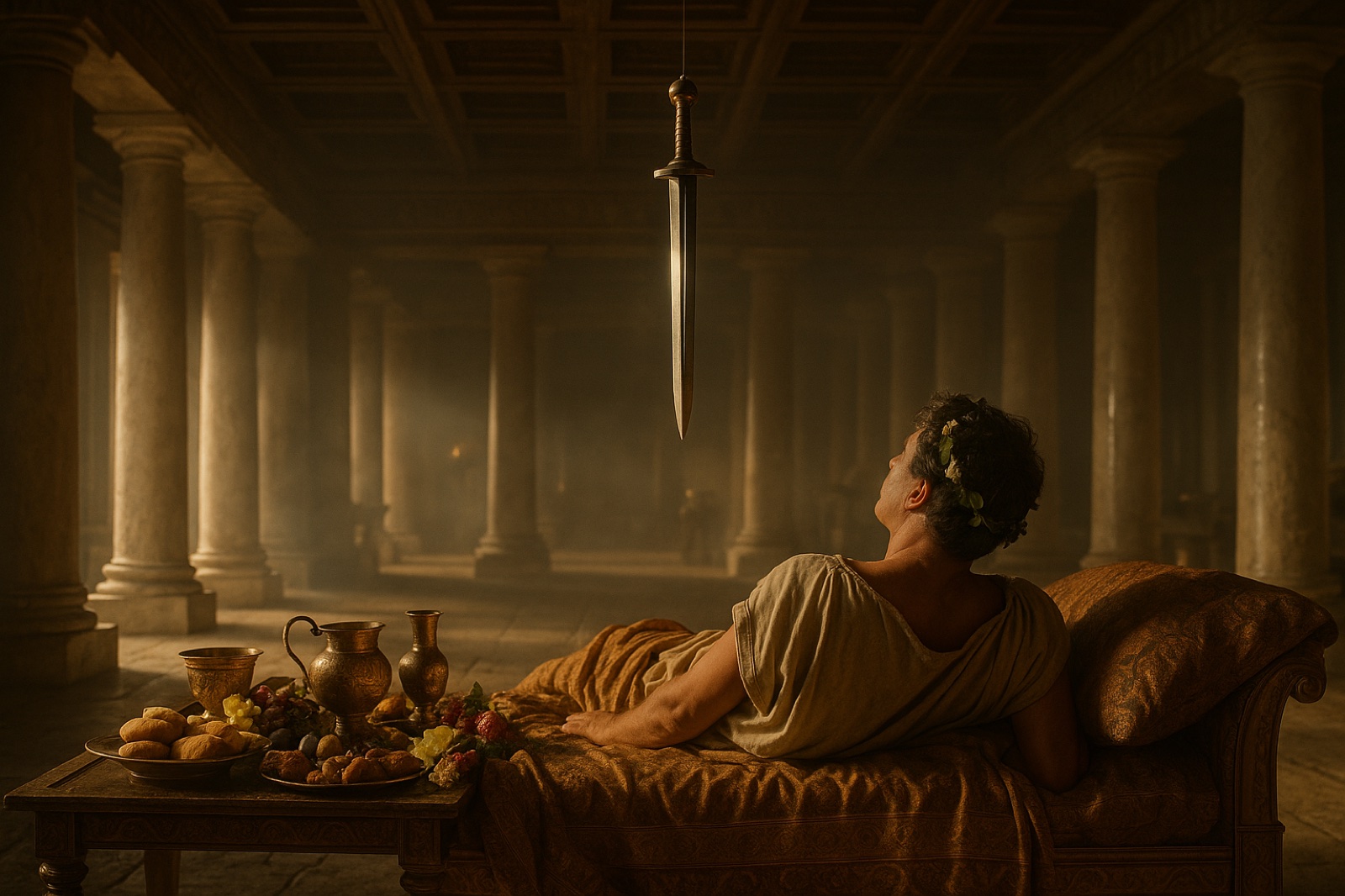
The couch under him is gold. The table is piled with the finest food in the city. Servants stand ready to bring him anything he nods at. There are flowers on his head and perfume in the air.
Then he looks up.
A sword is hanging from the ceiling, point down, right above his neck. The only thing holding it there is a single hair from a horse’s tail.
That is the sword of Damocles. People have been using the phrase for more than two thousand years, and most of us use it a little bit wrong. The real story has a detail almost nobody repeats: the sword never falls. Nothing happens to the man at all. And he still cannot eat one bite.
What Does the Sword of Damocles Mean?
The sword of Damocles means a danger that hangs over you all the time and could fall at any moment. It comes from an old story about a king who hung a real sword by a single horsehair over a guest’s head, to show him what it feels like to live with constant fear.
Today people say it about almost any threat that will not go away. A debt. A test result that has not come back. A job that might be cut. “It is hanging over me like the sword of Damocles.”
That use is fine. But the man who wrote the story down was making a sharper point than “danger is scary.” He was asking a question: can a person who is always afraid ever be happy, no matter how much they have?
His answer was no. The story is how he proved it.
The Sword of Damocles Story, as Cicero Told It
The version we have comes from the Roman writer Cicero, in Book 5 of his Tusculan Disputations, written in 45 BC. The story itself is older. It is thought to go back to Greek histories of Sicily that are now lost. Cicero’s telling is the one that survived, and it is the one everybody since has been repeating.
It goes like this.
Dionysius was the ruler of Syracuse, a rich Greek city on the island of Sicily. One of the men at his court was named Damocles. Cicero calls him a flatterer, one of the people who hung around the king telling him how wonderful he was.
One day Damocles went on and on about the king’s forces, his wealth, his power, his grand palace. Nobody, he said, had ever been happier.
Dionysius answered with an offer. In Cicero’s Latin it runs roughly like this: since this life pleases you so much, Damocles, would you like to taste it yourself and try my fortune?
Damocles said he would love to.
So the king gave him the full treatment. A golden couch with a beautiful embroidered cover. Side tables loaded with worked silver and gold. Servants picked for their good looks, told to watch his every nod. Perfume, garlands of flowers, burning incense, and the finest food that could be found. Cicero adds one short line here: Damocles thought he was a lucky man.
Then Dionysius gave one more order. A shining sword was let down from the ceiling, tied to a horsehair, so that it hung right over the neck of that happy man.
Cicero tells us what happened next, and it is very simple. Damocles stopped looking at the handsome servants. He stopped looking at the silver. He did not reach out his hand to the table. The flowers slid off his head. At last he begged the king to let him go, because, in Cicero’s words, he no longer wanted to be happy.
That is the whole story. No blood. No fall. The sword stays right where it is.
The King Who Hung the Sword Slept Behind a Moat
First, which king? Many retellings say it was Dionysius II, the son. Cicero’s own text points to the father. A few lines before the story, he describes a ruler who took power at twenty-five and held Syracuse for thirty-eight years. That fits Dionysius the Elder, who ruled from about 405 to 367 BC.
And here is the part the short version leaves out. Before Cicero ever gets to the banquet, he spends a page on how this king really lived.
- He would not let a barber near his neck. He taught his own daughters to shave him instead.
- Then he stopped trusting them with a blade. Once they were grown, he had them singe his hair and beard with red-hot walnut shells.
- He dug a wide trench around his bed. A little wooden bridge crossed it. Each night, after he shut the door, he pulled the bridge away himself.
- He was afraid to stand on a public platform. He gave his speeches from the top of a high tower.
Cicero sums it up in one line. Out of his hunger for power, the king had, in a way, locked himself in a prison.
So the sword was not a cruel trick played on a silly guest. It may have been the most honest thing Dionysius ever did. He was showing Damocles the inside of his own head. This is my dinner. Every night.
There is a sadder detail still. Damocles could beg to leave, and he walked out. Cicero says the king could not. He had done too much harm when he was young, and it was no longer open to him to turn back and give the people their freedom. Cicero puts it in one hard line: he could not be safe if he started to be sane.
What Most People Miss About the Sword of Damocles
Three things.
The sword never fell. Everything Damocles lost that day, the meal, the comfort, the pleasure, he lost to something that did not happen. The food was real. The danger stayed on the ceiling. The dread did all of its damage without the sword moving at all.
The story was about power first. It was not about bad luck. Cicero’s point was that the more a person has grabbed and has to guard, the less that person can rest. His closing line, roughly: nothing is happy for the one who always has some terror hanging over them. A couple of decades later the Roman poet Horace said the same thing in a poem. Fine feasts have no taste for a man with a drawn sword hanging over his head.
The meaning got wider later. The most famous modern use came in 1961, when John F. Kennedy told the United Nations that every person on earth was living under “a nuclear sword of Damocles, hanging by the slenderest of threads.” By then the phrase had come to mean any danger hanging over anyone, powerful or not. That is how most of us use it now.
It is one of those old stories where the detail everyone forgets is the one that matters, a bit like Pandora’s box, which was really a jar.
And Cicero himself? He wrote the book in a hard year. His daughter Tullia had died a few months before, and Rome had come under the rule of one man. About two years later, Cicero was hunted down and killed on the orders of his political enemies. The man who gave us the story knew something about swords overhead.
When the Sword Is Over Your Own Head
Most of us will never lie on a golden couch. But most of us know the horsehair.
Waiting for the doctor to call. Rent that is due before the pay comes in. Someone you love who is far away and not answering. The body keeps looking up. Food loses its taste. Sleep gets thin. We wrote a whole piece on why waiting is so hard, and the short version is that not knowing can be harder on a person than bad news they are sure of. Damocles would have agreed.
The story leaves a few things worth carrying.
- Notice what the dread is taking. Damocles lost a whole feast to something that never happened. Ask what is on the table in front of you right now. A meal. A child telling you about their day. A quiet evening. Take one bite of it anyway.
- Ask if you built the couch. Some swords come with the thing we are gripping: a position, an image, a secret. The king’s fear was the price of something he would not put down. Sometimes you can get up from the couch. Damocles did.
- Tell one person. Dionysius trusted nobody, and that was the real prison. Right after the sword story, Cicero tells another one. Two friends, known today as Damon and Pythias, were so loyal that one offered his own life as a pledge for the other. The king watched and said he wished he could be counted as their third friend. The man with everything wanted the one thing he could not buy.
If the dread is costing you sleep, our free Why Can’t I Sleep? assessment takes a few minutes and helps you see what is keeping you up.
But here is the honest problem. Damocles fixed his trouble by leaving. Plenty of swords cannot be walked away from. An illness. A bill. A loss you can see coming. What then?
Another King, Another Sword
Cicero’s answer was to be a good person. Live rightly, he argued, and no fear can touch your happiness. It is a noble answer. It is also hard to hold on to at three in the morning.
There is an older answer, and it comes from another king.
Centuries before Dionysius, a king named David was driven out of his own city. The one coming after him was his own son, who had taken the throne and gathered an army. David had no moat that night. No tower. No palace at all.
One of the old Hebrew songs carries a note at the top saying David wrote it while he was running from that son. He does not pretend in it. He says plainly how many people have turned against him. And then he says a very ordinary thing. He lay down, he slept, and he woke up again, because God was holding him up.
Put the two kings side by side. One had every wall that money could build, and he could not close his eyes. The other had lost every wall, and he slept. The sword over David was real, and it was still there in the morning. What was different was what he believed was holding him. It was not the hair.
That is another kind of peace than getting off the couch. It does not wait for the sword to come down off the ceiling.
A good place to start: if you would like that kind of steadiness in the middle of an ordinary, unfinished week, we made a short free guide called The Beginner’s Guide to Feeling God’s Presence Every Day. It is a simple video and companion PDF for noticing God in everyday moments, even when life feels chaotic. Get the free guide. Free.
The Hair Was Never the Point
The sword of Damocles is usually told as a story about danger. Read slowly, it is a story about attention. Same room, same feast, same man. He was delighted before he looked up and miserable after. Nothing in the room had changed except what he was looking at.
You may not get to choose whether something hangs over you this week. Most people do not. But the story leaves you with a real question, and it is worth more than the phrase. What are you counting on to hold?
Tonight there will be something on the table. Eat it while it is warm.
Discussion Question
Do you think a powerful person can ever really be at peace, or does having more always mean having more to fear? Tell us what you think in the comments.
Share This
I never knew this: in the sword of Damocles story, the sword never falls. Nothing happens to him. He just cannot eat. https://bgodinspired.com/?p=117927
The king who hung the sword of Damocles had his daughters shave him because he would not trust a barber, and he slept with a trench around his bed. The sword was him showing a guest what his own life felt like. https://bgodinspired.com/?p=117927
“Damocles lost a whole feast to something that never happened.” Good read if something is hanging over you this week. https://bgodinspired.com/?p=117927
Sword of Damocles: Common Questions Answered
What does the sword of Damocles mean?
The sword of Damocles means a danger that hangs over a person all the time and could fall at any moment. The phrase comes from a story told by the Roman writer Cicero, in which a king named Dionysius hung a sword by a single horsehair above a courtier named Damocles during a banquet, to show him what it feels like to live with constant fear. Today the phrase is used for any threat that will not go away, such as a debt, a pending decision, or a risk of disaster.
Who was Damocles?
Damocles was a courtier of Dionysius, the ruler of the Greek city of Syracuse in Sicily. The Roman writer Cicero describes Damocles as one of the king’s flatterers. After Damocles praised the king’s wealth and power and said nobody had ever been happier, Dionysius let him enjoy a royal banquet on a golden couch, then had a sword hung over his neck by one horsehair. Damocles could not enjoy the feast and begged to leave.
Did the sword of Damocles ever fall?
No. In the story as Cicero tells it in the Tusculan Disputations, the sword of Damocles never falls and Damocles is never hurt. He simply stops looking at the servants and the silver, does not reach for the food, and begs the king to let him go. The point of the story is that the fear alone was enough to ruin the feast.
Which Dionysius hung the sword over Damocles?
Many retellings name Dionysius II of Syracuse, but the text of Cicero’s Tusculan Disputations points to his father, Dionysius I, also called Dionysius the Elder. Just before the sword of Damocles story, Cicero describes a tyrant who took power at twenty-five and ruled Syracuse for thirty-eight years, which matches Dionysius the Elder, who ruled from about 405 to 367 BC.
Who first told the sword of Damocles story?
The oldest surviving version of the sword of Damocles story is in Book 5 of the Tusculan Disputations by the Roman writer Cicero, written in 45 BC. The story is thought to be older and to go back to Greek histories of Sicily that are now lost. Cicero used the story to argue that a person who lives under constant fear cannot be happy, however rich or powerful that person is.