 0
0
 0
0
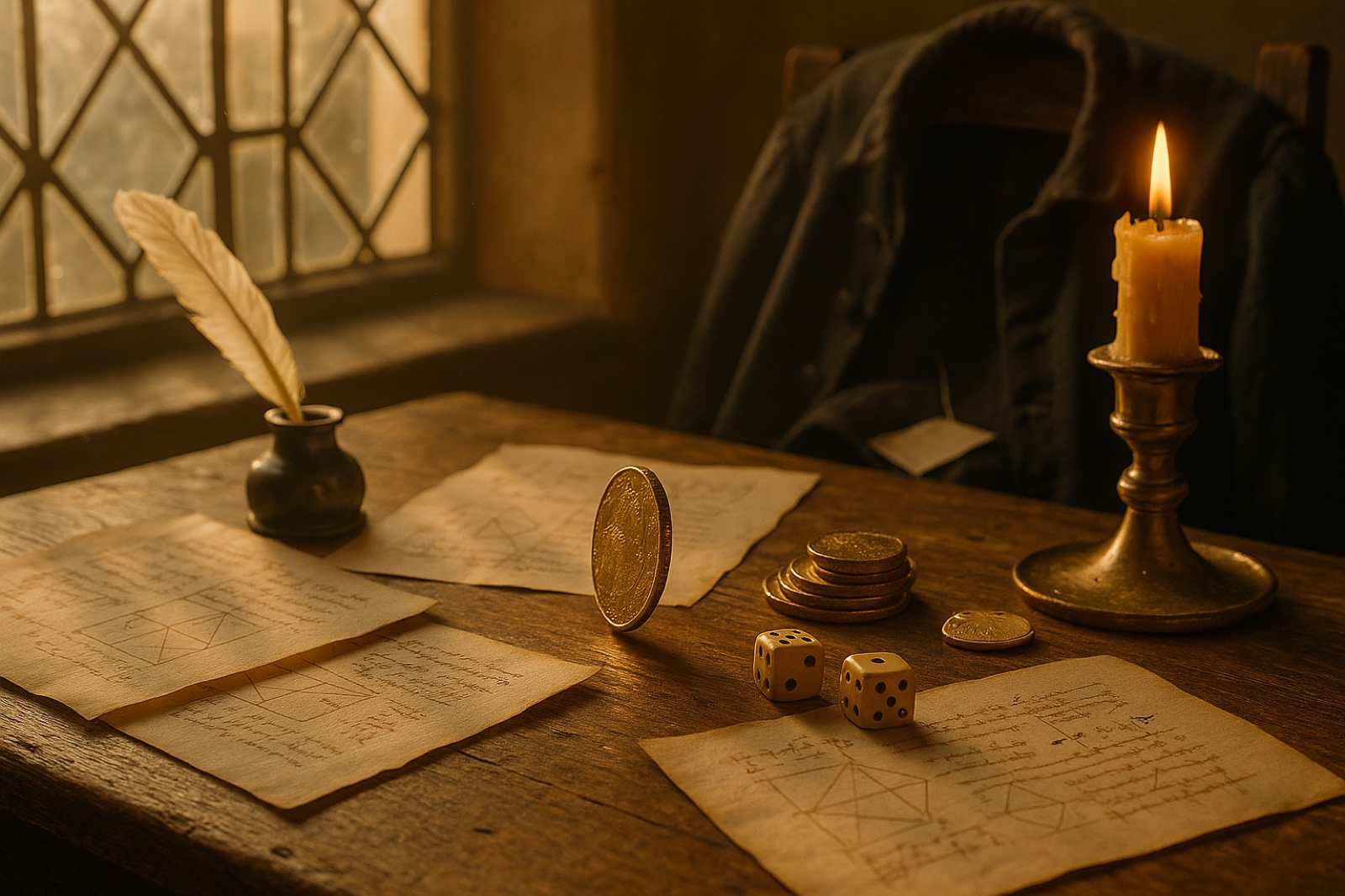
A coin is in the air. Heads, there is a God. Tails, there is not. You will not see how it lands until your life is over, and you have to call it now.
That is Pascal’s wager, one of the most famous arguments ever made about God. It is more than 350 years old, and people still look it up all the time. One keyword tool puts it at roughly 27,000 searches a month in the United States alone.
Most pages give you the bet and stop. This one gives you the bet, the three strongest objections to it, and two things that usually get left out: what Pascal wrote in the very next lines, and the note he kept hidden in his coat for the last eight years of his life. The note changes how the whole bet reads.
What Is Pascal’s Wager?
Pascal’s wager is an argument that says believing in God is the smart bet. If God is real, the believer gains everything. If God is not real, the believer loses very little. So, the argument goes, you should bet on God.
It comes from Blaise Pascal, a French mathematician who lived from 1623 to 1662. His version starts from an honest place. He does not claim he can prove God. He writes, “Reason can decide nothing here.” (The wager quotes on this page come from W. F. Trotter’s English translation of Pascal’s Pensées.)
Then he sets up the game. Either God is, or God is not. A coin is being tossed, he says, “where heads or tails will turn up.” And you do not get to sit this one out: “You must wager. It is not optional. You are embarked.”
In plain words: you are already on the boat. Living as if there is no God is a bet too.
People usually lay the wager out as four boxes:
- You bet on God, and God is real: you gain everything.
- You bet on God, and God is not real: you lose a little.
- You bet against God, and God is not real: you gain a little.
- You bet against God, and God is real: you lose everything.
Pascal’s own summary is shorter: “If you gain, you gain all; if you lose, you lose nothing.”
One small thing before we go on. The version most people hear leans hard on fear: believe, or else. Pascal’s page does not read that way. In Trotter’s translation of the wager, the words “hell” and “punishment” do not appear at all. He argues from what you could gain, not from what you will be made to suffer.
A Bet Written for Gamblers
The wager did not come out of nowhere. It came out of a card table.
In 1654 a gambler known as the Chevalier de Méré brought Pascal a puzzle. Two players have to stop a game before it is finished. How do you split the pot fairly? Pascal worked on it that summer in letters with another mathematician, Pierre de Fermat. Those letters are widely treated as the starting point of probability theory, the maths of chance.
So when Pascal later wrote about God, he reached for words that men like de Méré already used. Stakes. Odds. Heads or tails. What you stand to win. Pascal’s wager is a man who helped work out the maths of gambling, talking to gamblers in their own language.
He never finished the book it was meant for. The wager sits in a pile of notes found after he died. They were printed in 1670, eight years after his death, as the Pensées, which simply means “thoughts.”
The 3 Strongest Objections to Pascal’s Wager
The wager has been argued with for centuries. Three objections do the most damage.
1. Which God? The wager treats the choice like a coin with two sides. But the world holds many faiths, and they do not all ask for the same thing. In the 1700s the French writer Denis Diderot answered Pascal by pointing out that an imam could reason in exactly the same way. If the same bet works for every religion, it cannot tell you which one to pick. This is often called the many-gods objection, and it is a serious one.
2. You cannot choose to believe. Try it. Decide, right now, to believe it is raining when you can see the sun. You can say the words. You cannot make yourself believe them. Belief is not a switch.
3. It looks fake. A belief you pick in order to win a prize is not really belief. It is insurance. The American thinker William James made this point sharply in his 1896 lecture The Will to Believe. If we were in the place of the Deity, he wrote, “we should probably take particular pleasure in cutting off believers of this pattern from their infinite reward.”
These are fair hits. As a proof that God exists, Pascal’s wager does not work. But it was never built to be a proof. Remember where it started: “Reason can decide nothing here.”
What Pascal Wrote in the Very Next Lines
Here is the first surprise. That second objection, the one about not being able to choose what you believe, was not invented later by Pascal’s critics. Pascal wrote it into the wager himself.
Right after the bet, the doubting voice in his notes speaks up: “I am forced to wager, and am not free. I am not released, and am so made that I cannot believe. What, then, would you have me do?”
Pascal’s first word back is “True.”
He does not argue. He agrees that nobody can bet their way into believing. Then he says something strange for a mathematician. The way forward, he writes, is “not by increase of proofs of God, but by the abatement of your passions.” Not more arguments. Fewer things in the way.
He points to people who were once stuck in the same spot and tells the doubter to begin where they began, “by acting as if they believed.” Show up. Do what they do. See what it does to you.
Part of that advice is uncomfortable. Pascal says the habit will “deaden your acuteness,” which can sound a lot like “stop thinking so hard.” William James, for one, did not let that line pass.
Then come the last lines of the wager, and they are almost never quoted. Pascal tells the reader that if the argument seems strong, they should know “it is made by a man who has knelt, both before and after it, in prayer.”
So the most famous bet in history ends with its author on his knees, not at a card table. Even James, his critic, saw it. Pascal’s own belief, he wrote, “had far other springs.”
The Note Sewn Into His Coat
Pascal died in 1662. He was 39.
A few days later, according to an account passed down by a priest named Father Guerrier, a servant noticed that one spot in the lining of Pascal’s doublet, a close-fitting jacket, felt thicker than the rest. He opened the seam. Inside was a small folded parchment in Pascal’s handwriting. Folded inside the parchment was a sheet of paper with the same words on it.
The note is dated Monday, 23 November 1654. It gives the time: “From about half past ten in the evening until half past midnight.” Two hours. Then one word on a line by itself.
Fire
God of Abraham, God of Isaac, God of Jacob! not of philosophers and scholars.
Certainty, certainty, heartfelt joy, peace …
Joy, joy, joy, tears of joy.
(Those lines are from W. R. Shea’s English translation, which you can read in full here.)
The note is known today as the Memorial. His family seems to have known nothing about it. Guerrier’s account says that for eight years Pascal took care “to sew and unsew it every time he changed his dress.” The parchment has since been lost. The sheet of paper survives.
Read the second line again. “Not of philosophers and scholars.” That was written by a philosopher and a scholar, in the same year he helped work out the maths of chance.
To be exact about it, Pascal was already a religious man before that night. Writers often call it his “second conversion.” The poet T. S. Eliot, in his introduction to the Pensées, thought it “might be called his conversion simply.” Either way, the order matters. The night came first. The notes that hold the wager came in the years after it, while the Memorial was sewn into his clothes.
So Pascal did not reach God by placing a bet. Something reached him, on an ordinary Monday night, and he spent the rest of his life trying to get his friends to the door.
You Would Not Be Looking If You Had Not Been Found
There is one more line in those notes worth knowing. In a private meditation, Pascal imagines Jesus speaking to a person who is searching and worn out. It sounds nothing like a bet:
“Console thyself, thou wouldst not seek Me, if thou hadst not found Me.”
That is a very old idea, far older than Pascal. It says God is not the prize at the end of a clever argument. God is the one who comes looking first. On that view, the itch to ask the question at all, the thing that made you type “Pascal’s wager” into a search bar, is not you starting the search. It is a sign that something has already started toward you.
It is the same pattern in one of the oldest stories about pain ever written, where a man named Job asks why he is suffering and never gets an explanation. He gets company instead.
Seen this way, the wager is not a trick for buying faith cheaply. It is a mathematician telling a careful friend: you have run out of proofs, so stop standing outside. Come in and look around.
A good place to start: if you would rather notice God in an ordinary day than win an argument about God, we made a short free guide called The Beginner’s Guide to Feeling God’s Presence Every Day. It is a simple video and companion PDF for experiencing God in the plain moments of real life, no proofs needed. Get the free guide. Free.
So Is Pascal’s Wager a Good Bet?
As a proof, no. The objections stand, and Pascal himself agreed with at least one of them.
As a question, it still holds up. “You are embarked” is true no matter what you believe. Nobody gets to sit this one out. Not deciding is also a way of deciding.
The honest use of the wager costs nothing. You do not have to force yourself to believe anything. You only have to leave the question open, and act as if the answer matters. Read something. Ask someone you trust. Sit quietly for five minutes and see what is there. If you have questions you would rather ask in private, our free Bible Answers assistant (it opens in ChatGPT) will take any of them.
Old puzzles have a way of turning personal. The Ship of Theseus starts with planks and ends up asking who you are. Pascal’s wager starts with a coin and ends up asking what you are waiting for.
Pascal spent years working out the odds on that coin. But the thing he kept sewn into his clothes was not a sum. It was two hours he could not explain and never wanted to forget.
The coin is still in the air. It is worth looking up.
Discussion Question
Is Pascal’s wager a good reason to believe in God, a bad one, or just a good reason to start looking? Tell us which you would pick, and why, in the comments.
Share This
Did not know this: Pascal, the man behind Pascal’s wager, carried a secret note sewn into his coat for eight years. It was found after he died. https://bgodinspired.com/index.php/bible-resources/bible-answers/pascals-wager/
The best objection to Pascal’s wager (“you can’t just choose to believe”) is in the wager itself. Pascal wrote it down, and his answer starts with one word: “True.” Good read: https://bgodinspired.com/index.php/bible-resources/bible-answers/pascals-wager/
“Thou wouldst not seek Me, if thou hadst not found Me.” The man who wrote the most famous bet about God also wrote that. This piece on Pascal’s wager is fair to the doubters and still got to me. https://bgodinspired.com/index.php/bible-resources/bible-answers/pascals-wager/
Common Questions About Pascal’s Wager, Answered
What is Pascal’s wager in simple terms?
Pascal’s wager is an argument that believing in God is the wisest bet. Blaise Pascal, a French mathematician, said that reason cannot prove whether God exists, but everyone has to live one way or the other. If God is real, the believer gains everything. If God is not real, the believer loses little. Pascal summed it up in the words, “If you gain, you gain all; if you lose, you lose nothing.”
Who came up with Pascal’s wager, and when?
Pascal’s wager was written by Blaise Pascal, a French mathematician and thinker who lived from 1623 to 1662. It appears in a set of unfinished notes that were published in 1670, eight years after his death, as the Pensées. In 1654 Pascal had exchanged letters with Pierre de Fermat about a gambling problem, and those letters are widely treated as the beginning of probability theory. The wager uses the same language of stakes and odds.
What are the main objections to Pascal’s wager?
There are three main objections to Pascal’s wager. The many-gods objection says the bet cannot tell you which religion to choose, because, as Denis Diderot pointed out, an imam could reason the same way. The second objection says people cannot simply choose to believe something. The third says belief adopted to win a reward is not sincere; William James wrote in 1896 that a God might take “particular pleasure” in denying such believers their reward. The wager is not a proof that God exists, and Pascal did not present it as one.
Did Pascal believe in God because of his wager?
No. Pascal did not come to his faith through the wager. On the night of 23 November 1654 he had an intense religious experience lasting about two hours, which he recorded in a note now called the Memorial. He was already a religious man, and this night is often called his second conversion. The notes that contain the wager were written in the years after it, for doubting readers. The wager itself ends by saying its author had knelt in prayer before and after writing it.
What was the note found sewn into Pascal’s coat?
The note found in Pascal’s coat is called the Memorial. A servant found it in the lining of Pascal’s doublet a few days after he died in 1662. It was a small parchment with a paper copy folded inside, both in Pascal’s handwriting, dated Monday, 23 November 1654. It begins with the word “Fire” and the line “God of Abraham, God of Isaac, God of Jacob! not of philosophers and scholars.” Pascal had carried it for eight years. The parchment is now lost; the paper copy survives.