
 0
0
 0
0
Stand at the edge of the sea at night and you feel it. The water goes on past where you can see. Something is out there, and it is bigger than you.
Most of us know that feeling even far from any beach. A diagnosis. A debt. A child who won’t call back. Something huge that moves under the surface of your life, and you cannot get a hook into it.
The ancient world gave that feeling a body. They called it the sea monster. The Bible calls it Leviathan. And if you have ever typed “what does the Bible say about Leviathan” into a search bar, the answer is stranger and kinder than most people expect. One psalm says God made it to play.
What Does the Bible Say About Leviathan? The Short Answer
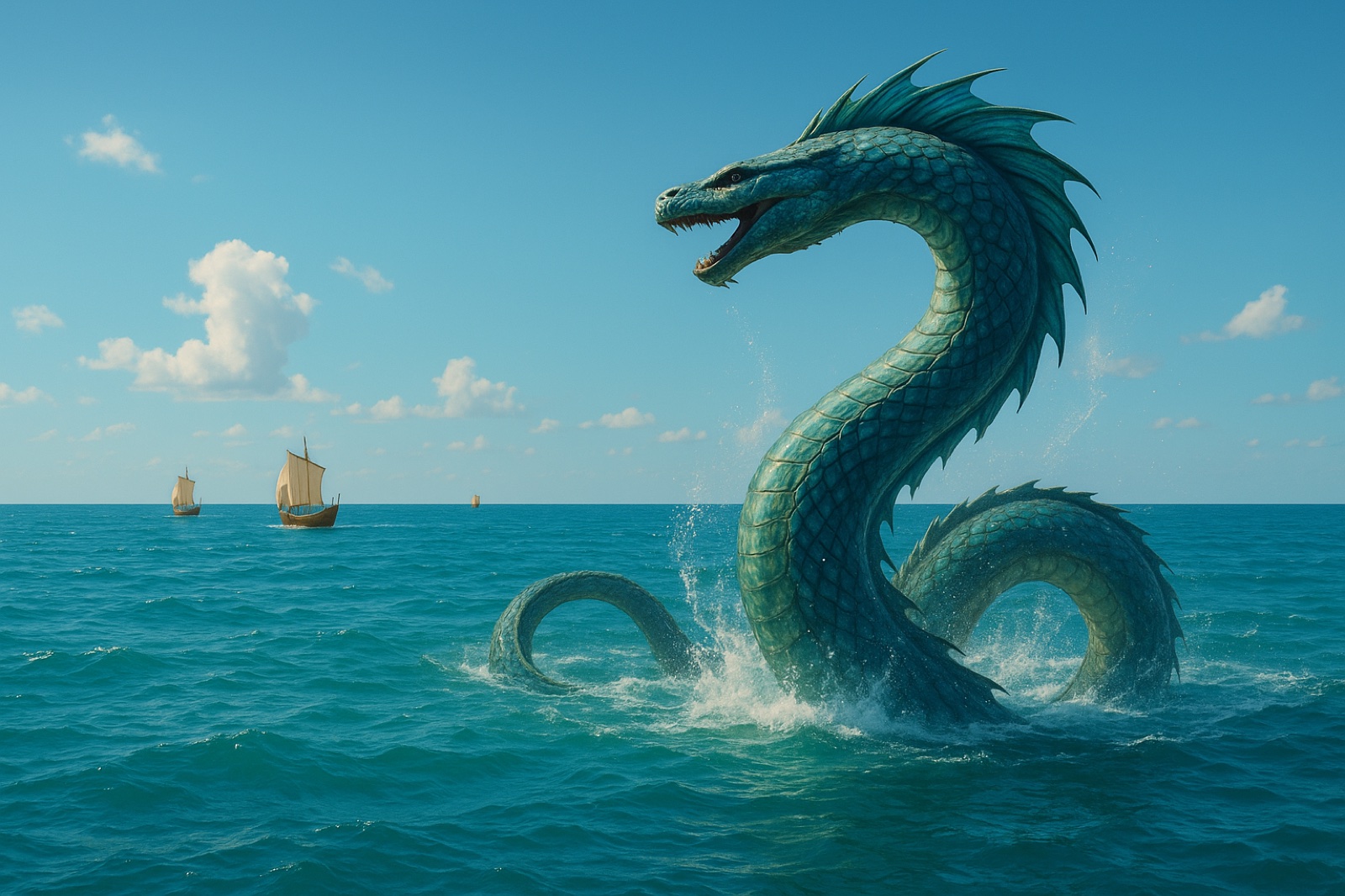
Leviathan is a great sea creature named six times in the Hebrew Bible. Here is every place it shows up:
- Job 3:8, in Job’s first speech of grief. (Your King James Bible hides it here. More on that below.)
- Job 41, a whole chapter where God describes Leviathan to Job.
- Psalm 74:14, which says God broke “the heads of leviathan in pieces.”
- Psalm 104:26, which says Leviathan was made “to play therein.”
- Isaiah 27:1, which names it twice, as “leviathan the piercing serpent, even leviathan that crooked serpent.”
Put those side by side and you get two very different pictures. In Job and Isaiah, Leviathan is terrifying: too strong for any person, a symbol of everything wild and against us. In Psalm 104, it is almost a pet. The interesting part is how the Bible gets from one picture to the other.
If something in your life feels like a sea monster right now, you might like a free guide we made for exactly that kind of season: a short video and companion PDF on feeling God’s presence in the ordinary, messy moments of real life.
The Sea Monster Everyone Already Knew
Leviathan was not invented by the Bible. Its first readers already knew the monster.
In the late 1920s, archaeologists began digging up a buried city on the coast of Syria called Ugarit. Among the finds were clay tablets more than 3,000 years old, written in a language close to Hebrew. One of those tablets remembers the storm god Baal striking down a sea monster called Lotan (also spelled Litan), described as the fleeing serpent, the twisting serpent, the mighty one with seven heads (you can compare the two texts here).
Now read Isaiah 27:1 again: “leviathan the piercing serpent, even leviathan that crooked serpent.” In Hebrew those phrases are nachash bariach and nachash aqallaton, the fleeing serpent and the twisting serpent. Same titles. Same monster. And Psalm 74:14 speaks of “the heads of leviathan,” plural. A many-headed serpent, just like the old story.
That matters because of what the Bible does with it. In the old stories, the sea monster is a rival power. It is chaos itself, and the gods have to fight it just to keep the world standing. The Bible borrows the monster, then quietly takes away its throne.
You can see it on the very first page. Genesis 1:21 says, “And God created great whales.” The Hebrew behind “great whales” is tanninim, the same word Psalm 74:13 translates as “dragons in the waters.” And the verb is bara, “created,” the special word Genesis 1 uses only for three things: the heavens and the earth, these great sea creatures, and human beings. At the dawn of the world, the sea monsters are not God’s enemies. They are God’s creatures. “And God saw that it was good.”
Job 41: A Whole Chapter on What You Cannot Tame
The longest look at Leviathan comes at the end of the book of Job. Job has lost his children, his wealth and his health. He has argued with his friends for chapter after chapter. When God finally answers, God does not explain the suffering. Instead, God takes Job on a tour of creation, and the tour ends in the sea.
“Canst thou draw out leviathan with an hook?” (Job 41:1). The questions keep coming. “Wilt thou play with him as with a bird? or wilt thou bind him for thy maidens?” (Job 41:5). In other words: could you keep this thing as a pet on a string, for the young girls of your house to play with?
The answer is obviously no. “None is so fierce that dare stir him up” (Job 41:10). No person on earth can handle Leviathan.
But listen to the tone of the chapter. It is not a threat. It sounds more like an artist showing you a favorite piece. “I will not conceal his parts, nor his power, nor his comely proportion” (Job 41:12). Comely means beautiful. God goes on for verse after verse about its scales, its teeth, its breath, and ends with something close to wonder: “Upon earth there is not his like, who is made without fear” (Job 41:33).
Here is the part your King James Bible hides. Back in Job 3:8, when Job curses the day he was born, the KJV reads, “Let them curse it that curse the day, who are ready to raise up their mourning.” The Hebrew word behind “their mourning” is livyatan. Leviathan. The King James margin even offers “a leviathan” as the alternative. So Job begins his grief by wishing someone would wake the monster and let chaos swallow the day of his birth. And God ends the book by showing Job that very monster, and showing that it has a Maker.
If you have ever wondered what Job was really given in place of an explanation, we walk through it in Why Does God Allow Suffering? What Job Actually Got. The short version: Job does not get an answer to why. He gets a bigger picture of who.
Psalm 104:26: The Same Words, Turned Upside Down
Now for the detail most Bible readers never see, because it only shows up in Hebrew.
In Job 41:5, the question “Wilt thou play with him?” is, in Hebrew, hatesachek-bo. The root is sachak: to laugh, to play, to sport.
In Psalm 104:26, Leviathan is the creature God made “to play therein.” In Hebrew, lesachek-bo. Same verb. Same little word attached to the end.
Job is asked: could you play with it? No. You would not survive the attempt. The psalm answers with the very same words: God made it for play.
There is an honest question about who is doing the playing. That little word bo can mean “in it” or “with it.” The King James, like most English Bibles, reads it as “in it,” meaning the sea: Leviathan was made to play in the water. But the ancient rabbis read it the other way. The Babylonian Talmud (Avodah Zarah 3b) pictures God’s day in four blocks of three hours. In the first, God studies the Torah. In the second, God judges the world, then moves from the seat of judgment to the seat of mercy. In the third, God feeds every creature, “from the horns of wild oxen to the eggs of lice.” And in the last three hours, God plays with Leviathan.
Either way, the picture flips. The creature no human can play with is, to God, something made for play. Leviathan is not a rival. It is not a threat to its Creator. It is a large, splashing part of a world God is enjoying.
And look at where the psalm puts it: “There go the ships: there is that leviathan.” Ships and sea monster, side by side, in one sentence. Everyday business and the thing everyone fears, moving through the same water. The very next verse says of every creature in that sea, “These wait all upon thee; that thou mayest give them their meat in due season” (Psalm 104:27). Even Leviathan waits to be fed.
What you cannot tame, God made to play.
So Is Leviathan a Crocodile, a Whale, or a Dinosaur?
People have tried to name the animal for centuries. The main readings are:
- A crocodile. Job 41’s hard scales, fearsome teeth and the impossibility of hooking it fit the Nile crocodile well, and many older commentators point there.
- A whale or great sea creature. Psalm 104 places it in the open sea among the ships, which fits a whale better than a river animal.
- A mythic serpent. Isaiah’s “crooked serpent” and Psalm 74’s many heads borrow the language of the old chaos-monster stories, so Leviathan may be as much a symbol as a species.
Honestly, nobody knows for sure, and the Bible may mean slightly different things in different places. The crocodile reading fits Job 41 best. The mythic reading fits Isaiah 27 best. What the Bible does not say is that Leviathan was a dinosaur. That idea is popular, but it reads modern science back into an ancient poem. We looked at that question carefully in What Does the Bible Actually Say About Dinosaurs?
If you want to dig through every passage yourself, our free Bible Answers AI assistant (it opens in ChatGPT) can take you through them verse by verse.
What You Cannot Tame Is Not Untamed
Here is where Leviathan swims into your own life.
Most of us are carrying something that feels like Job 41. Too big to hook. Too strong to argue with. You have tried to tie it down with plans and lists and late-night searching, and it just rolls over and keeps moving.
The Bible does not tell you that thing is small. Job 41 spends 34 verses insisting Leviathan is enormous. It does not tell you to pretend you can handle it, either. “Canst thou draw out leviathan with an hook?” is a question whose answer is no.
What it does tell you is where the monster lives. It lives in a sea God made, among creatures God feeds, inside a world God watches with delight. “There go the ships: there is that leviathan.” Your ordinary Tuesday and your biggest fear are moving through the same water, and none of it is outside God’s reach.
That is not a promise the thing will vanish. Leviathan is still out there in Psalm 104. It is a promise the thing is not in charge. The fear that feels like chaos to you is, to God, a creature. Something known. Something with a limit.
Centuries later, a boat full of fishermen watched that truth stand up in the middle of a storm. Jesus “rebuked the wind, and said unto the sea, Peace, be still. And the wind ceased, and there was a great calm” (Mark 4:39). Notice when the disciples got most afraid: after the calm. “What manner of man is this, that even the wind and the sea obey him?” (Mark 4:41). They had just watched someone speak to the sea the way you speak to something you made.
Actions to Take Today
- Name your Leviathan in one line. On your phone or a scrap of paper, write the one thing you cannot get a hook into right now. One sentence, no more. It takes two minutes.
- Read Psalm 104:24-27 out loud. It is four verses and takes under a minute. When you reach “there is that leviathan,” say your one line in its place. Then keep reading: “These wait all upon thee.”
- Do the one next thing that is actually yours. Job could not hook Leviathan, but he could still get up in the morning. Pick one small, concrete step on your one-line problem (send the text, make the call, put the papers in one pile) and do it in the next ten minutes. Leave the rest of the sea to God.
Journaling Prompts
- When did your Leviathan first start to feel too big to handle, and what changed that day?
- Where have you been expecting yourself to do what Job 41 says no person can do?
- What would you stop trying to control if you truly believed this thing lives inside God’s world, not outside it?
A Prayer for When Something Feels Too Big
God, there is something in my life I cannot get a hook into, and I am tired of pretending I can. You made the sea and everything in it, even the things that scare me. Help me believe that what feels like chaos to me is not out of your reach. Show me the one next step for today, and help me leave the rest with you. Amen.
Let’s Talk
Do you read Psalm 104:26 as Leviathan playing in the sea, or as God playing with Leviathan? Tell us which reading you lean toward in the comments below. We would love to hear how you see it.
And if this helped you breathe a little easier about the thing you cannot tame, the free guide below is a good next step: a short video and PDF about noticing God’s presence in the middle of ordinary, overwhelming days.
Share This
I always thought Leviathan was the scariest thing in the Bible. Then I read Psalm 104:26. God made it to play.
Job 41 asks if anyone could play with Leviathan. Psalm 104 uses the exact same Hebrew words to say God made it for play. The thing I can’t tame isn’t untamed.
“There go the ships: there is that leviathan.” My ordinary day and my biggest fear are moving through the same water, and God made all of it. (Psalm 104:26)
Leviathan Q&A
What does the Bible say about Leviathan?
The Bible names Leviathan six times: in Job 3:8, Job 41:1, Psalm 74:14, Psalm 104:26, and twice in Isaiah 27:1. It is described as a huge sea creature no human can capture or tame (Job 41), a many-headed monster God broke in pieces (Psalm 74:14), a “crooked serpent” God will punish in the future (Isaiah 27:1), and a creature God made “to play” in the sea (Psalm 104:26). In every passage Leviathan is powerful but always a creature, never God’s equal.
Is Leviathan a dinosaur?
The Bible does not say Leviathan is a dinosaur. Job 41 describes a scaled creature that cannot be hooked, which many readers connect to the crocodile. Psalm 104:26 places Leviathan in the open sea, which fits a whale. Isaiah 27:1 uses language from ancient serpent-monster stories. The dinosaur idea is a modern reading, not something the biblical text states.
What does “whom thou hast made to play therein” mean in Psalm 104:26?
Psalm 104:26 says Leviathan was made “to play therein,” meaning to play in the sea. The Hebrew phrase, lesachek-bo, can also be read “to play with it,” and the Babylonian Talmud (Avodah Zarah 3b) reads it that way, picturing God spending the last three hours of each day playing with Leviathan. Either reading shows the feared sea monster as a creature God made and enjoys, not a threat to God. The same Hebrew phrase appears in Job 41:5, where Job is asked whether he could play with Leviathan.
Is Leviathan the same as the Canaanite sea monster Lotan?
Leviathan shares its titles with Lotan (also spelled Litan), a seven-headed sea serpent described on clay tablets from the ancient city of Ugarit in modern Syria. Isaiah 27:1 calls Leviathan “the piercing serpent” and “that crooked serpent,” which in Hebrew match Lotan’s titles as the fleeing serpent and the twisting serpent. The Bible uses the same famous monster, but presents it as a creature under God’s authority rather than a rival power.
What is the “Leviathan spirit”?
Some Christian teachers today speak of a “Leviathan spirit” of pride or twisted communication, usually drawing on Job 41:34, which calls Leviathan “a king over all the children of pride.” The phrase “Leviathan spirit” does not appear in the Bible itself. In Scripture, Leviathan is a creature that God made, knows, and has power over.



