 0
0
 0
0
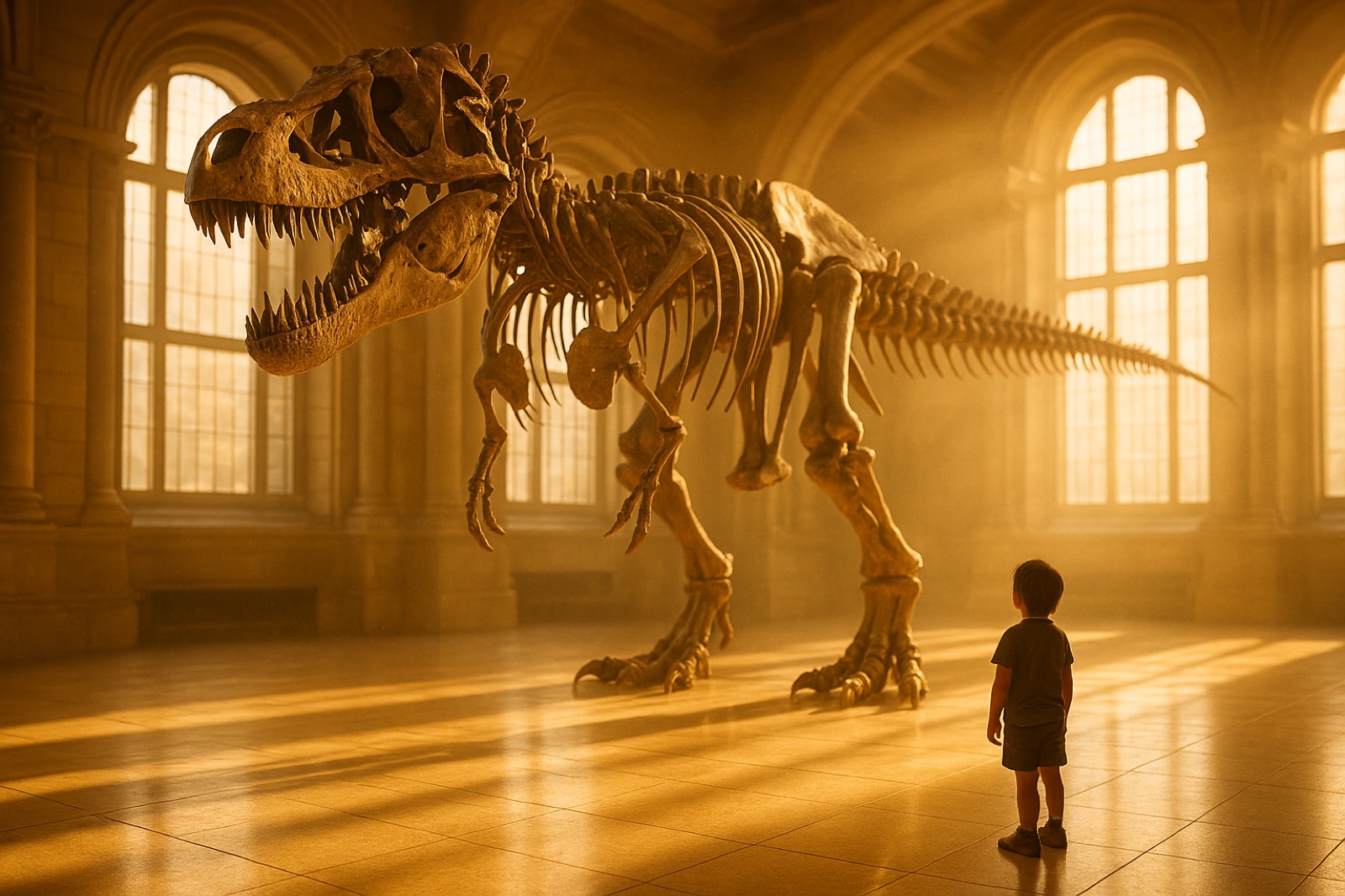
Your kid is buckled in the backseat, dinosaur toy in each fist, and out of nowhere comes the question: “Were there dinosaurs on Noah’s Ark?” Or maybe it’s not your kid at all. Maybe it’s you, standing in a museum in front of a fossil the size of a school bus, doing quiet math in your head that doesn’t line up with anything you were taught in Sunday school, and feeling a little guilty for even wondering.
Here’s the honest truth: most Christians freeze on this question. Not because the Bible is silent, but because we’ve been handed a false choice — pick the dinosaurs or pick your faith — and told we can’t have both. That choice was never actually in the text. It got added later, by people arguing past each other.
What Genesis Actually Says
Open to the first page of your Bible and you won’t find the word “dinosaur” anywhere. That’s not a dodge — it’s just history. The word didn’t exist until 1841, when a British scientist named Richard Owen coined it to describe fossils that didn’t fit any known category. Moses couldn’t have used a word that wouldn’t exist for another three thousand years.
But absence of the word isn’t absence of the animals. Genesis 1:24-25 says: “And God said, Let the earth bring forth the living creature after his kind, cattle, and creeping thing, and beast of the earth after his kind: and it was so. And God made the beast of the earth after his kind, and cattle after their kind, and every thing that creepeth upon the earth after his kind: and God saw that it was good.”
“Every thing that creepeth upon the earth after his kind.” That’s about as wide a category as language allows. A few verses earlier, Genesis 1:21 describes God creating “great whales, and every living creature that moveth” in the waters — and the Hebrew word translated “whales” there, tannin, shows up elsewhere in scripture describing massive, serpent-like creatures that don’t map neatly onto anything alive today (you’ll find the same word behind “dragon” and “sea monster” in other Old Testament passages). Whatever these ancient writers were picturing when they used that word, it wasn’t a modern whale swimming calmly in a nature documentary.
Then there’s Job 38-41, where God answers Job out of a whirlwind with a tour of creation designed to put Job’s questions in perspective — including Behemoth, “which I made with thee” (Job 40:15), an animal so massive its tail moves “like a cedar” and its bones are “like bars of iron.” Bible scholars have argued for centuries over exactly what Behemoth was. Some say hippopotamus. Some say something we no longer have a name for. The text doesn’t settle the zoology — but it doesn’t need to. The point of the passage isn’t “identify this animal.” It’s “look how small your certainty is next to how big I made the world” — the same kind of humbling, wonder-first reset researchers keep bumping into whenever they get close to explaining something as basic as time itself.
The Argument You Don’t Actually Have to Win
Here’s where most people expect this article to pick a side: young earth or old earth, six literal days or long ages, a global flood that buried every dinosaur or a local one that never touched them. Faithful, Bible-believing Christians have landed in every one of those camps, and they’ve been arguing about it since long before carbon dating existed.
That argument matters to some people, and if it matters to you, it’s worth studying honestly — not avoiding out of fear. But it’s a secondary question. It’s not what Genesis 1 was written to answer, and treating it like the whole point of the chapter is where most of the anxiety around this topic actually comes from.
Genesis 1 isn’t structured like a lab report. It’s structured like a song — seven days, each one following the same rhythm: God speaks, it happens, God sees that it’s good. Ancient readers would have recognized that pattern immediately as a very different kind of writing than a scientific timeline. It reads more like a hymn about order emerging from chaos than a chronology you could plot on a calendar. That doesn’t make it less true. It means its truth is aimed somewhere else.
Where Genesis 1 Is Actually Aiming
Ask Genesis 1 “how many years ago” and it won’t answer, because that’s not the question it came to answer. Ask it “who made all of this, and why,” and it answers immediately, clearly, on nearly every line: an intentional Creator, who looked at what He made — the great creatures of the deep, the beasts of the earth, the fish, the birds, eventually you — and called it good.
That’s the discovery underneath the dinosaur question, whether it’s coming from a curious eight-year-old or a doubting adult standing in a museum: you were never actually being asked to choose between trusting the fossil record and trusting God. Genesis 1:31 puts it plainly — “And God saw every thing that he had made, and, behold, it was very good.” Every thing. However long ago it walked the earth, however strange it looked, it was made on purpose, by Someone who was paying attention.
The fight over how old the earth is has convinced a lot of people that faith and honest science have to be enemies. They don’t. The same God who authored what’s true in Scripture authored what’s true in the ground under a paleontologist’s boots — the same way new research into how your own brain actually makes decisions hasn’t erased free will, it’s just added detail to a picture faith already assumed was true. When science and scripture seem to disagree, it’s usually because we’ve misunderstood one of them — not because reality is actually split in half.
What This Looks Like on Monday
The next time this question shows up — from a kid, a skeptical friend, or your own quiet doubt — you don’t need an airtight scientific theory to answer it well. You need permission to say something like: “I don’t know exactly how old the earth is, and good people who love God disagree about it. But I know who made it, and I know why: because He wanted to, and He looked at it and called it good. That includes the dinosaurs. That includes you.”
It’s the same false choice that shows up whenever people assume the Bible and modern life must be at war — the same instinct that makes people brace themselves before asking what the Bible actually says about alcohol, expecting a flat rule instead of the fuller picture that’s actually there. Genesis 1 rewards the same kind of second look.
That answer is honest. It doesn’t require you to fake certainty you don’t have. And it points to the actual object of faith — not a theory about rock layers, but a Person who made the rock layers and the seven-year-old asking about them.
3 Things to Do Today
- Write down your honest answer. Before you’re caught off guard by the question again, write one or two sentences you’d actually say — like the example above — so you’re not scrambling in the moment.
- Read Genesis 1 in one sitting. It takes about five minutes. Read it as the song it is instead of the science report you were taught to expect, and notice the rhythm: God speaks, it happens, God calls it good.
- Name one “unsolved” question you’ve been quietly afraid to bring to God. Not to resolve it today — just to stop carrying it alone. Bring it up in prayer, even if all you say is “I don’t understand this part yet.”
Journaling Prompts
- Where in your life have you assumed you had to choose between two things that might not actually be opposites?
- What’s one question about faith you’ve been avoiding because you’re afraid there’s no good answer?
- If God’s response to Job’s hardest questions was “look how big I made the world,” how might that reframe a question you’re currently stuck on?
A Prayer for the Questions You Can’t Fully Answer
God, I don’t have all the answers, and I’m tired of pretending I do. Thank You that You’re not asking me to. Thank You that the world is Yours — the ancient creatures, the fossils, the science I don’t fully understand, and the doubts I’ve been carrying quietly. Help me trust that You made it all on purpose, even the parts I can’t explain. Give me the honesty to say “I don’t know” without losing my grip on who You are. Amen.
If this kind of honest, unhurried faith is what you’re hungry for — not pat answers, but a real sense of God’s presence in the actual, complicated moments of your life — that’s worth pursuing on purpose, not just waiting to stumble into it.
Discussion Question
Do you think faith and science actually have to compete with each other — or do you think they can both be telling the truth about different questions? Drop your take in the comments — genuinely curious where people land on this one.
Share This
- “Just found out the word ‘dinosaur’ is younger than the Statue of Liberty. Genesis never had to compete with fossils — it was answering a completely different question the whole time.” 🦕
- “You don’t need a science degree to answer your kid’s dinosaur question. You need permission to say ‘I don’t know how, but I know who and why.'”
- “Job 38-41 is God’s answer to ‘why does this hard thing not make sense’ — and it’s basically a museum tour, not a lecture. Worth reading today.”
Frequently Asked Questions
Does the Bible mention dinosaurs by name?
No. The word “dinosaur” wasn’t coined until 1841, long after the Bible was written, so it never appears in scripture by that name. However, Genesis 1:24-25 describes God creating “every thing that creepeth upon the earth after his kind” and “beast of the earth after his kind,” language broad enough to include ancient creatures we’d now call dinosaurs, even though the text doesn’t single them out or name them specifically.
What does Job say about Behemoth, and is it a dinosaur?
Job 40:15-24 describes a massive creature called Behemoth, “which I made with thee,” with a tail like a cedar and bones like bars of iron. Bible scholars disagree on its identity — some suggest a hippopotamus, others suggest an animal unknown to modern science, and some see it as a poetic image rather than a single specific species. The passage’s purpose is to show the scale of God’s creative power, not to catalog zoology.
Do Christians have to believe in a young earth to believe the Bible?
No. Faithful, Bible-believing Christians hold a range of views on the age of the earth, including young-earth, old-earth, and framework interpretations of Genesis 1. This is considered a secondary theological issue, not a core matter of salvation, and Christians across these views affirm the same core truth: God intentionally created everything that exists.
Why doesn’t the Bible give a clear timeline for creation, including dinosaurs?
Genesis 1 is structured more like a poem or hymn — a repeating pattern of “God spoke, it happened, God saw it was good” across seven days — than like a scientific record. Its purpose is to answer who created the world and why, not to provide a dated timeline. That’s why sincere readers can walk away with different views on timing while agreeing completely on the chapter’s central point.
Can Christians trust both the fossil record and the Bible?
Yes. Many Christians hold that God, who is the author of truth in scripture, is also the author of truth found in creation itself — including the fossil record. When science and a particular reading of scripture appear to conflict, it’s often a sign that one or the other has been misunderstood, not that faith and honest evidence are permanently at odds.