 0
 0
Someone says the word “hell” at a funeral, or in a late-night argument, or in a comment under a video, and the room goes quiet. Most of us carry a picture of it from somewhere, a cartoon, a sermon, a movie, and we have never checked where the picture came from. So here is a plain question: what does the Bible say about hell?
The short answer starts with a surprise. In the King James Bible, the one English word “hell” stands in for four different words in the original languages. They did not mean the same thing. Once you see them separately, the whole subject gets clearer and, for many people, less frightening.
What Does the Bible Say About Hell? One Word, Four Originals
The Old Testament was written in Hebrew. The New Testament was written in Greek. Neither language has the word “hell.” When the King James translators worked, they used it for these four:
- Sheol (Hebrew). The place of the dead. Good and bad people alike went there.
- Hades (Greek). The Greek word that the New Testament uses for the same realm of the dead.
- Gehenna (Greek). A place of judgment, named after a real valley outside Jerusalem.
- Tartarus (Greek, as a verb). Used one time, about angels held for judgment.
Read “hell” in a verse and you are meeting one of these four. Which one it is changes the meaning completely.
Sheol and Hades: Where the Dead Wait
Psalm 16:10 says: “For thou wilt not leave my soul in hell; neither wilt thou suffer thine Holy One to see corruption.” The Hebrew word behind “hell” there is Sheol. The psalm is not describing flames. It is a person trusting that the grave will not be the last word.
The New Testament carries this idea forward with the Greek word Hades. In Revelation 1:18, Jesus says: “I am he that liveth, and was dead; and, behold, I am alive for evermore, Amen; and have the keys of hell and of death.” Notice who holds the keys. It is not a ruler of the underworld. It is Jesus, and the point is that death does not have the final say over anyone.
There is one passage where Hades is described with suffering in it: Luke 16:23, “And in hell he lift up his eyes, being in torments, and seeth Abraham afar off, and Lazarus in his bosom.” That is a story Jesus told, and people read it in different ways, so it is worth reading slowly instead of building a whole picture from one scene.
Gehenna: The Valley Outside the Wall
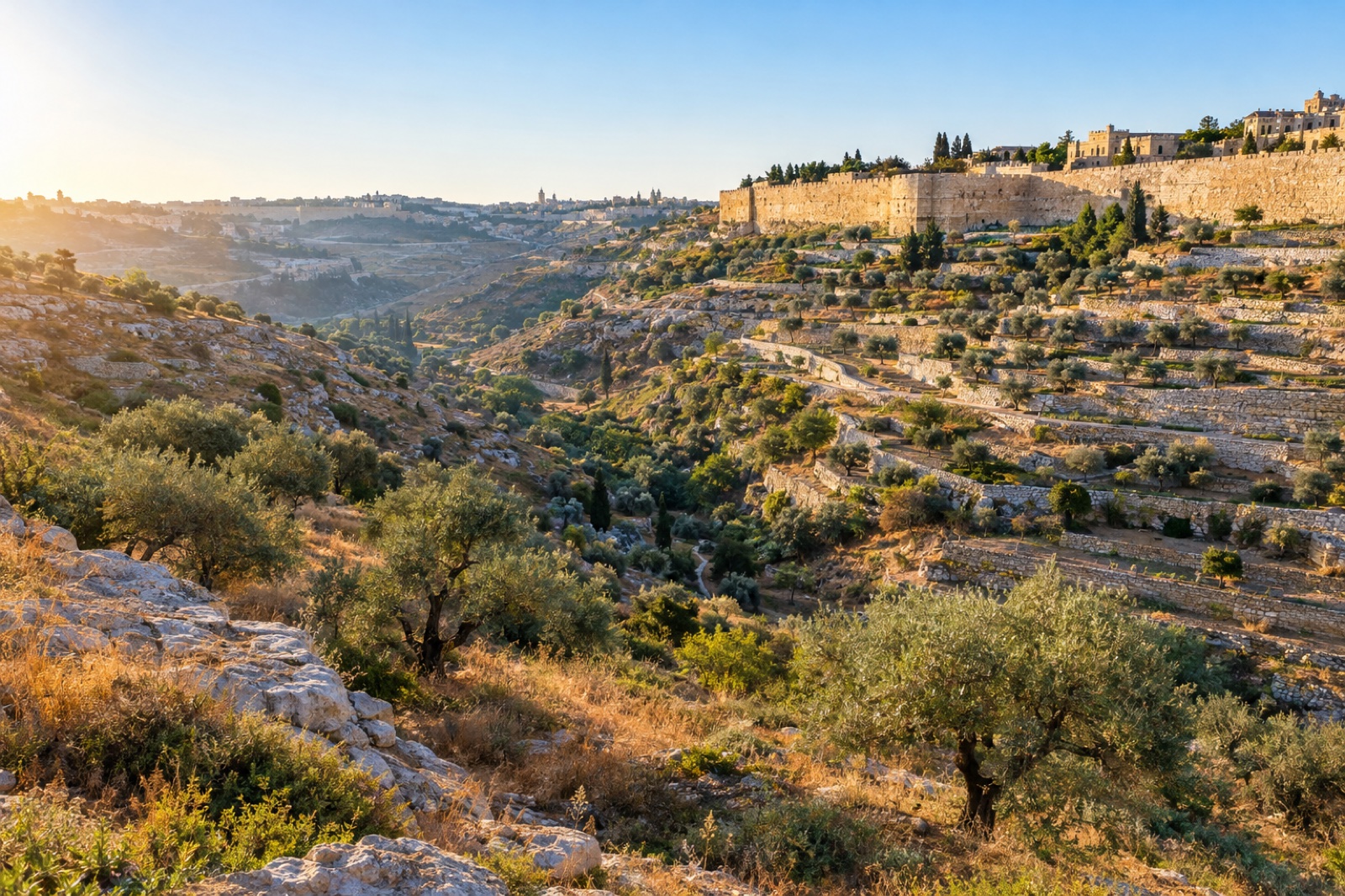
Gehenna is the word Jesus uses most when he warns about judgment. It is a Greek form of a Hebrew name, the Valley of Hinnom, a real place just outside Jerusalem. You can find it on a map today.
The valley had a dark history. Jeremiah 7:31 says: “And they have built the high places of Tophet, which is in the valley of the son of Hinnom, to burn their sons and their daughters in the fire; which I commanded them not; neither came it into my heart.” Later, King Josiah put a stop to it. 2 Kings 23:10 says: “And he defiled Topheth, which is in the valley of the children of Hinnom, that no man might make his son or his daughter to pass through the fire to Molech.”
So when Jesus’ listeners heard “Gehenna,” they did not picture a cartoon. They pictured a place they could walk to, tied to the worst thing their ancestors had done, and a place of judgment on cruelty.
One popular claim is worth setting aside. You will often hear that Gehenna was the city garbage dump, always burning. That is repeated everywhere, but the early sources do not document it. It shows up in much later writing. The honest position is that nobody can prove it, so it should not carry weight in the argument.
Who Did Jesus Aim It At?
This is the part most people have never noticed. Read the places where Jesus speaks of Gehenna and ask who is in the room. In Matthew 23:33, he is speaking to the religious leaders: “Ye serpents, ye generation of vipers, how can ye escape the damnation of hell?” The word behind “hell” there is Gehenna.
The sharpest warnings are not aimed at people who are struggling, doubting, or grieving. They are aimed at people who are comfortable, certain they are fine, and hard on everyone else. Strangely, the same Jesus is the one who sits with the people nobody else would sit with.
Tartarus: The One-Time Word
2 Peter 2:4 says: “For if God spared not the angels that sinned, but cast them down to hell, and delivered them into chains of darkness, to be reserved unto judgment.” The Greek verb behind “cast down to hell” appears only here in the entire New Testament. It is about angels, not about people, and it describes holding, not endless fire.
Where Christians Honestly Differ
It would not be fair to pretend everything here is settled. Christians have read these passages in three main ways across history. Some hold that judgment is endless suffering. Some hold that it is final destruction. Some hope that in the end everyone is restored. People who love the Bible and love God have landed in each place. This article does not tell you which one to pick. It asks you to know which word is on the page before you decide.
The Turn: A Warning Is a Kind of Love
Here is the shift. If most of the sharpest warnings in the Gospels were aimed at the comfortable, then the question to ask is not “Am I going to hell?” in a panic at 2 a.m. It is a quieter one: “Where am I so sure I’m right that I’ve stopped being kind?”
A warning from someone who loves you is not a threat. It is a person standing at the edge of a road saying “stop, look.” You can hear it that way. And you can stop being afraid of a picture you borrowed from a movie.
Actions to Take
- Look up one verse. Pick any verse in your Bible that says “hell” and search online for which original word it translates. It takes about two minutes.
- Name one person. Think of someone you have written off. Send them one short, kind message today, even just “thinking of you.”
- Read Matthew 23 slowly. Read it in one sitting and, each time Jesus corrects someone, ask who in your own life you have been judging the same way.
Journaling Prompts
- Where did your first picture of hell come from, and who gave it to you?
- What have you been so certain about that you stopped listening to the people who disagree?
- If a warning were a form of care, whose warning have you been ignoring?
A Prayer
God, I have carried a picture of hell for a long time and I never checked where it came from. Show me what is true, not what is scary. Where I have been hard on people, soften me. Where I have been afraid, remind me that you are the one who holds the keys. Help me listen to the warnings that are meant for me and let go of the ones I made up. Amen.
Discussion Question
Do you think the way hell is usually pictured helps people come to God or pushes them away? Share what you think in the comments.
Share This
- I always thought “hell” was one word in the Bible. It’s four. Sheol, Hades, Gehenna and Tartarus all got translated the same way.
- Jesus’ strongest words about Gehenna weren’t for people who were struggling. They were for people who were sure they were fine.
- Gehenna was a real valley outside Jerusalem. You can find it on a map.
Q&A
What does the Bible say about hell?
The Bible never uses a single word for hell. The English word “hell” in the King James Version translates four different original words: Sheol, Hades, Gehenna and Tartarus. Sheol and Hades refer to the realm of the dead. Gehenna refers to a place of judgment named after the Valley of Hinnom outside Jerusalem. Tartarus appears once, about angels held for judgment.
What is Gehenna in the Bible?
Gehenna is the Greek form of the Hebrew name Valley of Hinnom, a real valley outside Jerusalem. The Old Testament connects it with child sacrifice, which Jeremiah 7:31 and 2 Kings 23:10 condemn. Jesus used the name when he warned about judgment, and he spoke some of those warnings to religious leaders.
Is hell the same as the grave?
In many Old Testament verses, the King James word “hell” translates the Hebrew word Sheol, which means the place of the dead or the grave. Psalm 16:10 is an example. That meaning is different from Gehenna, the word Jesus uses for judgment.
Was Gehenna a burning garbage dump?
That claim is widely repeated, but it is not documented in the early sources. It appears in much later writing. What the Bible itself says about the valley is that it was a site of child sacrifice that King Josiah defiled.
Do all Christians agree about hell?
No. Across history, Christians have read the relevant passages as endless suffering, as final destruction, or as hope for eventual restoration for everyone. Each view has been held by sincere believers who take the Bible seriously.
If you want to go further, read Did Jesus Go to Hell Between Friday and Sunday?, Is “The Road to Hell Is Paved With Good Intentions” in the Bible?, and Near-Death Experiences in the Bible.