 0
 0
Someone dies, and the language changes at once.
People say “passed away.” They say “we lost him.” They say “she is in a better place.” They say it softly, and they mean well. But if you have ever stood in a quiet kitchen after the phone call, you know none of those words quite reach the thing itself.
So what does the Bible say about death? It is blunter than most of us, and kinder than most of us expect. It says the word plainly. It does not pretend death is small. And in one scene, it shows Jesus standing at a grave, crying, when He already knew what He was about to do.
What Does the Bible Say About Death? The Plain Answer First
The Bible describes death as a split in two. The body goes back to the ground, and the spirit goes back to God.
The first half comes from the story of the very first people. After they turned away from God, they heard this: “for dust thou art, and unto dust shalt thou return” (Genesis 3:19, KJV).
The second half comes from a writer looking back over a whole life: “Then shall the dust return to the earth as it was: and the spirit shall return unto God who gave it” (Ecclesiastes 12:7, KJV).
That is the quiet, factual part. Christians read the details differently, especially what happens between death and the final resurrection. But there is a bigger question underneath, and the Bible answers it in a way that surprises people: is death just part of life, or is it something else?
The Bible Never Calls Death Natural
Many of us were taught to say “it is just the circle of life.” That sounds peaceful. The Bible does not say it.
Here is how Paul puts it, in a chapter that is all about being raised from the dead:
“The last enemy that shall be destroyed is death.” (1 Corinthians 15:26, KJV)
An enemy. Not a friend, not a doorway you are meant to walk through calmly. Something that does not belong, and something that will be defeated.
The book of Hebrews goes further and says why Jesus came in a human body at all:
“Forasmuch then as the children are partakers of flesh and blood, he also himself likewise took part of the same; that through death he might destroy him that had the power of death, that is, the devil; And deliver them who through fear of death were all their lifetime subject to bondage.” (Hebrews 2:14-15, KJV)
Look at the last phrase. “All their lifetime subject to bondage.” The writer knew that the fear of death does not wait until the end. It leans on people for years, quietly, in the background of ordinary days. Part of the rescue, in this telling, is being freed from that fear while you are still alive.
So the Bible is not casual about death. If you have felt that death is wrong, that it should not be like this, you are not being unspiritual. You are agreeing with Scripture.
Jesus Called It Sleep, Then Said It Plainly
Now for the scene that shows how Jesus Himself handled it. A man named Lazarus, a close friend, has fallen ill in the village of Bethany. The message reaches Jesus. And then comes a detail that is easy to read past: “he abode two days still in the same place where he was” (John 11:6, KJV). Jesus stays where He is.
Then He tells His disciples:
“Our friend Lazarus sleepeth; but I go, that I may awake him out of sleep.” (John 11:11, KJV)
The disciples take that at face value. Sleep sounds like good news, a sick man resting. So Jesus drops the gentle word:
“Then said Jesus unto them plainly, Lazarus is dead.” (John 11:14, KJV)
Both words are in the same conversation. “Sleep” says that death is not the final word. “Dead” says that it is still real. Jesus will not let the softer word hide the harder one, and He will not let the harder one cancel the softer one either. Most of us pick one. The Bible keeps both.
Why Jesus Wept When He Knew How It Ended
When Jesus arrives, Lazarus has been in the tomb four days (John 11:17). Martha, his sister, meets Jesus on the road. Jesus promises, “I am the resurrection, and the life: he that believeth in me, though he were dead, yet shall he live” (John 11:25, KJV).
Now think about what Jesus knows at this moment. He has just said He will wake Lazarus up. He is minutes away from doing it. If anyone could skip the sadness, it is Him.
Here is what the text says He does:
“When Jesus therefore saw her weeping, and the Jews also weeping which came with her, he groaned in the spirit, and was troubled,” (John 11:33, KJV)
That word “groaned” is worth a pause. The Greek is embrimaomai, and it can carry a sense of strong, almost fierce feeling. Scholars differ on exactly what Jesus was stirred up about, whether the grief around Him, the damage death had done, or both. What nobody disputes is that this is not a calm man waiting for his cue.
And then the shortest verse in most English Bibles:
“Jesus wept.” (John 11:35, KJV)
He wept before the miracle, not after it. The promise was already in His hands, and He cried anyway. Whatever else that tells us, it tells us that knowing the ending does not make the loss feel small. If it did not for Jesus, it does not have to for you.
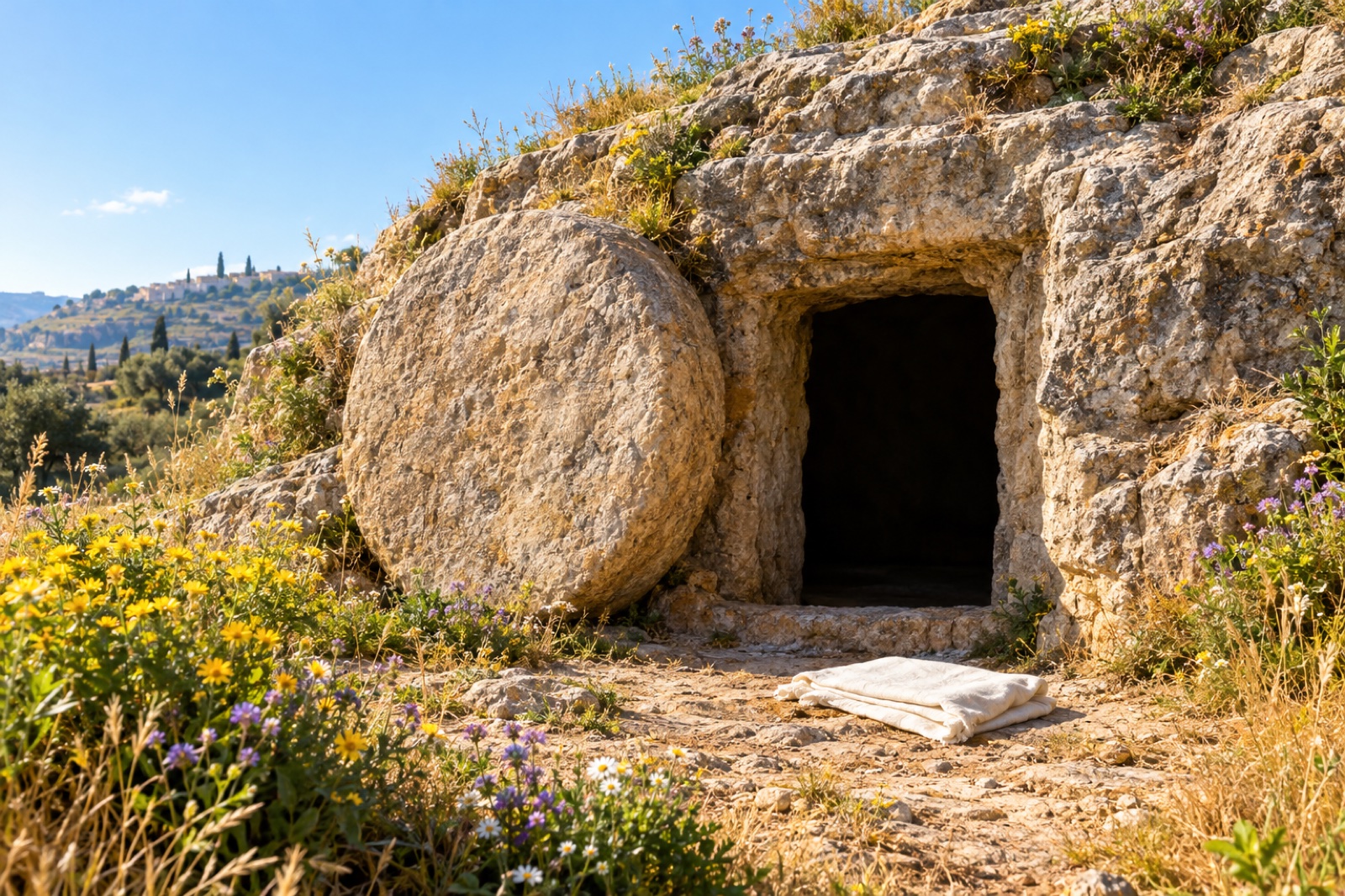
Then He walks to the tomb and says, “Lazarus, come forth” (John 11:43, KJV). That is where the Bible aims its answer to death. Not a cleverer way of saying it. A voice that death has to obey.
Sorrow Is Allowed. Hopeless Sorrow Is the Thing to Avoid
This is the line people quote at funerals, and it is often quoted wrong:
“But I would not have you to be ignorant, brethren, concerning them which are asleep, that ye sorrow not, even as others which have no hope.” (1 Thessalonians 4:13, KJV)
Some people hear that as “do not sorrow.” Read it again. Paul does not say do not sorrow. He says do not sorrow “even as others which have no hope.” The sorrow stays. What changes is the kind of sorrow, grief with a door in it.
If someone has told you that you should be over it by now, or that crying means your faith is weak, notice who is in the Bible’s best-known grief scene. Jesus is crying right alongside the people who are crying. He did not stand over them and correct them.
You can keep reading in the same direction. We looked at what the Bible says about heaven and at whether we will know each other there. Those pages pick up where this one stops.
Actions to Take
- Read the shortest verse in its scene. Open John 11:33-35 and read it slowly. It takes under a minute. Notice that the tears come before the miracle.
- Say the plain word once. The next time you talk about someone who has died, use the word “died” instead of “lost” or “passed.” Say it to a person you trust, or just say it out loud alone. Jesus used it plainly, and it often loosens something.
- Name them to someone who is grieving. Think of a person who lost someone this year. Send one message that uses the name of the one who died: “I was thinking about Daniel today.” You do not need to fix anything or say anything wise.
Journaling Prompts
- Which gentle phrase for death do you use most, and what is it protecting you from?
- Has anyone ever told you how you should be grieving? What did that do to the real thing you were feeling?
- If Jesus were standing beside you right now, what would you want Him to see about your loss that nobody else does?
A Prayer
God, I am tired of soft words that do not reach the place where this hurts. Thank You that Jesus called death what it is, and that He cried anyway. I do not understand all of it, and I still miss them. Please be near me in this, and help me grieve with hope in it, not without. Teach me to be gentle with myself and with the others who are hurting too.
What Do You Think?
Why do you think we reach for softer words when someone dies, when Jesus chose to say “dead” plainly? Tell us what you think in the comments below.
Share This
- Jesus knew he was about to raise Lazarus. He still cried at the grave. I never noticed the tears come before the miracle.
- 1 Thessalonians 4:13 does not say “do not grieve.” It says do not grieve like people with no hope. Those are different things, and I needed that today.
- The Bible calls death an enemy, not a natural part of life. If it has always felt wrong to you, the Bible agrees with you.
Questions About Death in the Bible (Q&A)
What does the Bible say about death?
The Bible describes death as the body returning to the dust and the spirit returning to God (Genesis 3:19; Ecclesiastes 12:7). It also treats death as an enemy rather than a natural part of life. First Corinthians 15:26 calls death “the last enemy that shall be destroyed,” and Hebrews 2:14-15 says Jesus took on a human body to free people from the fear of death. Christians differ on some details, but they agree that the Bible does not treat death as the final word.
Is death natural according to the Bible?
The Bible does not describe death as natural or as simply the circle of life. It first appears in Genesis 3 after people turn away from God, and the New Testament calls it an enemy to be destroyed (1 Corinthians 15:26). The Bible’s final picture, in Revelation 21:4, is a world with “no more death.” Because of this, grief over a death is not a failure of faith. It matches how the Bible itself describes the loss.
Why does the Bible call death sleep?
The Bible often uses sleep as a picture for the death of someone who belongs to God, because sleep is something a person wakes from. Jesus said, “Our friend Lazarus sleepeth; but I go, that I may awake him out of sleep” (John 11:11), and Paul wrote about “them which are asleep” in 1 Thessalonians 4:13. When his disciples misunderstood, Jesus also said “plainly, Lazarus is dead” (John 11:14). The word sleep describes hope. It does not mean death is not real.
Why did Jesus weep if He knew He would raise Lazarus?
The Bible does not give Jesus’ full reasons, but it shows that knowing a rescue was coming did not remove His sorrow. John 11:33 says He “groaned in the spirit, and was troubled,” and John 11:35 says “Jesus wept.” This happened before He called Lazarus out of the tomb in John 11:43. Many readers take it to mean that grief is a fitting response to death, even when hope is certain.
Should Christians grieve when someone dies?
Yes. First Thessalonians 4:13 tells believers not to grieve “even as others which have no hope,” which means grief itself is not forbidden, only grief without hope. Jesus wept at the tomb of Lazarus in John 11:35, even though He was about to raise him. The Bible gives no deadline for grief and does not treat tears as a lack of faith.