 0
0
 0
0
For decades, scientists knew Alzheimer’s disease killed brain cells. What they didn’t fully know was how — the exact mechanical sequence that turns a healthy, functioning neuron into a dead one. That gap just closed a little.
Researchers at King’s College London, working with the UK Dementia Research Institute, have identified a previously overlooked way brain cells die in Alzheimer’s disease and frontotemporal dementia. They gave it a name: karyoptosis. And if you’ve ever watched someone you love slowly stop recognizing you, the discovery is worth five minutes of your attention — not because it changes anything today, but because of where it quietly leads.
What Karyoptosis Actually Is
Published in Nature Communications, the study used computational algorithms to analyze roughly 3,000 individual brain cells taken from 28 patients who had either frontotemporal dementia or terminal-stage Alzheimer’s. The researchers were hunting for patterns of cell death that existing categories didn’t fully explain.
They found one. In the frontal cortex — the part of the brain responsible for reasoning, personality, and decision-making — 35% of cells from Alzheimer’s patients showed signs of this newly identified death process, compared to just 15% in healthy, age-matched brains. That’s more than double the rate, in the exact region where Alzheimer’s does its most visible damage.
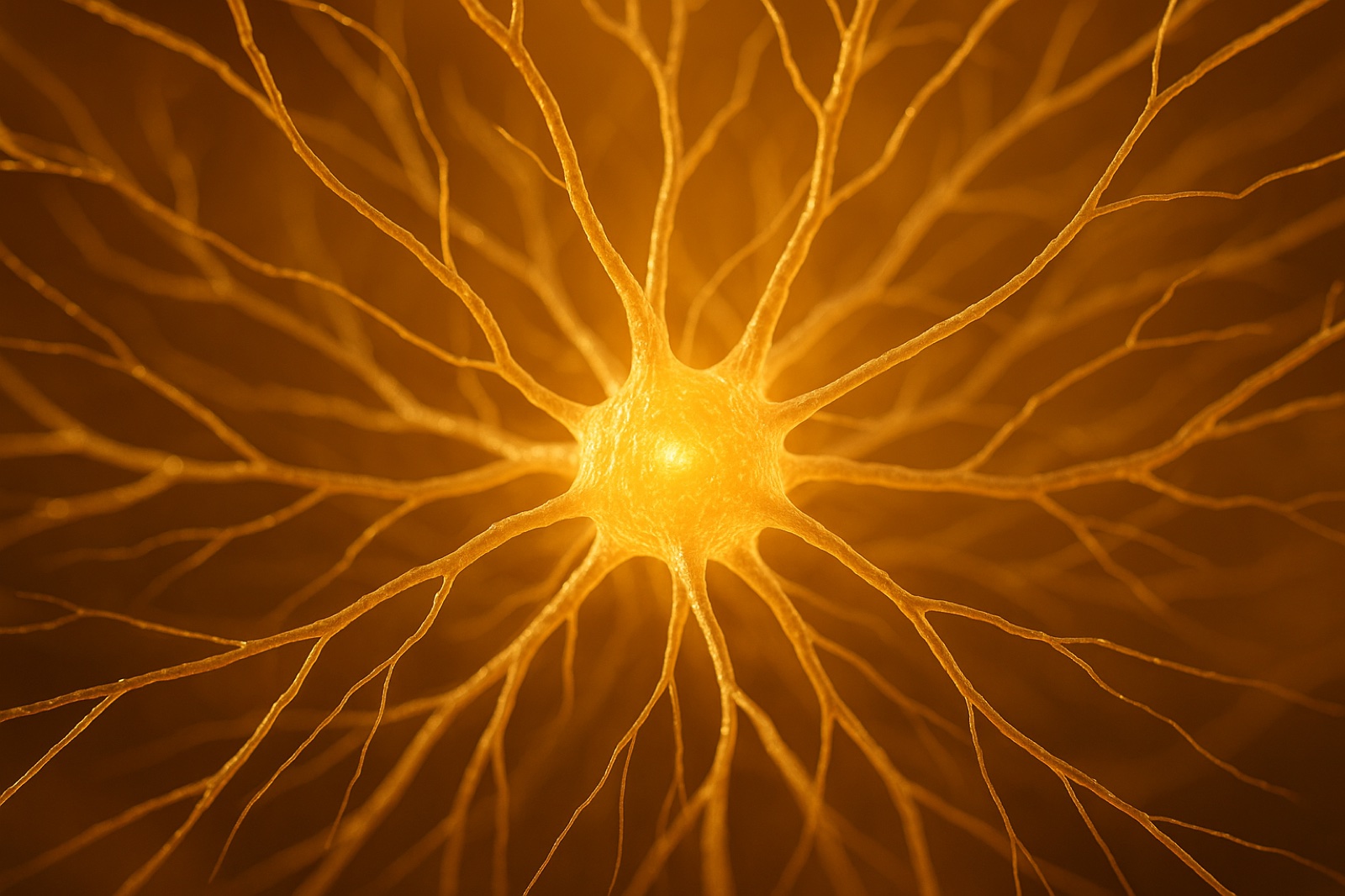
The name fits what the researchers actually watched happen under the microscope. “Karyo” comes from the Greek word for a cell’s nucleus — its control center, where the DNA lives. “Ptosis” is the medical term for something collapsing or falling away; it’s the same root behind apoptosis, the well-known process of “programmed cell death” your biology teacher may have mentioned. In karyoptosis, toxic proteins clump together inside the neuron and trigger a destructive chemical chain reaction. The nucleus itself — the part of the cell that holds its entire genetic identity — warps, shrivels, and eventually disintegrates.
The cell doesn’t just stop working. Its command center comes apart.
Why This Discovery Matters
Alzheimer’s research has spent years focused on amyloid plaques and tau tangles — the sticky protein buildups you’ve probably heard about in news coverage of the disease. Those are real and still matter. But plaques and tangles describe what accumulates in a diseased brain, not the precise mechanism that finishes a neuron off. Karyoptosis is a candidate for that missing piece.
That distinction has real, practical weight. If researchers can map the exact chemical steps between “toxic proteins clump together” and “nucleus disintegrates,” there’s a window in between — a point where the process could theoretically be interrupted before the cell is lost for good. That’s the direction the King’s College London team says this research opens up: not a cure, but a more precise target than science has had before. Alzheimer’s Research UK, which helped fund the work, called it a meaningful step toward treatments that could slow neuron loss rather than simply managing symptoms after the fact.
It’s a small, technical, unglamorous discovery — 3,000 cells, a percentage difference, a new Greek-derived name added to a long list of scientific terms most of us will never use again. That’s usually where these stories end: a specific finding, filed under “science news,” scrolled past by everyone except the researchers and the families desperate enough to search for it at 2 a.m.
But sit with what the discovery actually describes for a second, and it’s hard not to notice something underneath the biology.
The Part the Study Wasn’t Trying to Answer
What karyoptosis describes, in plain terms, is a cell losing the very structure that held its identity — the part of it that knew what it was. And that’s the exact fear sitting underneath every family’s experience of watching someone they love lose their memory. Not just “will they forget my name,” but something harder to say out loud: if the parts of a person that hold their memories are the parts breaking down, is the person underneath it still fully there? Are they still known, the way they were before? It’s a specific, disorienting kind of grief that doesn’t come from death — it comes from watching someone change so completely that they seem to be disappearing while still sitting right in front of you.
It’s an old question, older than neuroscience. Long before anyone could look at a brain cell under a microscope, people across nearly every culture and era wrestled with the same fear in different language: that being truly known — being held onto, being kept — might depend on something fragile. A memory that fades. A mind that ages. A body that eventually fails.
And across just as many centuries, the most persistent answer humanity has offered itself is that it doesn’t. That the thing holding a person together was never only the wiring inside their own skull. That something outside of a person’s own fading capacity can keep hold of who they are, even after their own grip has loosened. One of the oldest stories on record about being truly seen belongs to a woman alone in the desert who had every reason to believe she’d been forgotten — and found out otherwise. It’s one of the oldest comforts humanity keeps returning to — not that the science doesn’t matter, or that memory loss doesn’t cost something real and painful. It’s that being loved, being known, was never entirely dependent on a person’s own cells doing their job correctly in the first place.
What This Means the Next Time You Visit
The treatments this research might eventually lead to are still years away. Nobody currently sitting across the table from a parent or spouse who no longer places their face will benefit from karyoptosis research this year, or probably this decade.
But the next time you’re in that room — the one where someone asks your name for the third time in an hour — it might be worth remembering that the person in front of you hasn’t actually disappeared just because their brain can no longer hold onto the memory of you. Somewhere underneath the biology, something is still keeping hold of exactly who they are, in a way that doesn’t depend on either of you noticing it. Science just gave us one more precise, technical reason to believe that losing the memory was never the same thing as losing the person.
Discussion Question
If a future treatment could reliably interrupt karyoptosis before it destroys brain cells — meaning doctors could test for early signs of it in a healthy person’s brain, years before any symptoms appeared — would you want to know your own results, or would you rather not find out? Tell us what you’d choose in the comments.
Share This
- Scientists just found a brand new way brain cells die in Alzheimer’s. They named it karyoptosis — and the article that explained it stuck with me longer than I expected.
- The nucleus of the cell — the part that holds its entire identity — literally warps and disintegrates. Researchers just watched it happen for the first time and gave it a name.
- This started as a straightforward science story about Alzheimer’s research. It ended somewhere I didn’t expect. Worth the five minutes.
Frequently Asked Questions
What is karyoptosis?
Karyoptosis is a newly identified process of brain cell death, described by researchers at King’s College London and the UK Dementia Research Institute in a 2026 study published in Nature Communications. It happens when toxic protein clumps trigger a chemical chain reaction inside a neuron that causes its nucleus — the structure holding the cell’s DNA — to warp, shrivel, and eventually disintegrate.
How is karyoptosis different from other causes of Alzheimer’s-related cell death?
Most Alzheimer’s research has focused on amyloid plaques and tau tangles, the protein buildups that accumulate in a diseased brain. Karyoptosis describes a more specific mechanism: the exact sequence by which those toxic proteins ultimately destroy a neuron’s nucleus. It gives researchers a more precise target than the broader plaque-and-tangle picture alone.
How common is karyoptosis in Alzheimer’s patients?
In the study, 35% of cells from the frontal cortex of Alzheimer’s patients showed signs of karyoptosis, compared to 15% in healthy, age-matched brains — more than double the rate, concentrated in the brain region most associated with reasoning and personality.
Could this discovery lead to new Alzheimer’s treatments?
Researchers say identifying karyoptosis as a distinct mechanism opens the possibility of treatments designed to interrupt the process before a cell is destroyed, rather than only managing symptoms after neuron loss has already occurred. Any resulting treatment is still in early research stages.
Where was the karyoptosis research published?
The findings were published in the journal Nature Communications by researchers at King’s College London in collaboration with the UK Dementia Research Institute, with funding support from Alzheimer’s Research UK.