 0
0
 0
0
In November 2022, a retired print technician named David Smith sat at his kitchen table in a small town in East Yorkshire, England, cutting shapes out of paper. He wasn’t a mathematician. He didn’t have a research grant or a lab. He just liked playing with pattern — folding, cutting, rotating pieces of paper to see what would happen when you tried to tile a flat surface without any gaps or overlaps.
One of the shapes he cut out, a 13-sided form he nicknamed “the hat,” seemed to do something strange. It covered the surface completely. But no matter how far he extended the pattern, it never quite repeated itself. He didn’t have the math to prove that. So he emailed a few actual mathematicians who study exactly this kind of problem, attached his paper cutouts, and asked if he was crazy.
He wasn’t. He’d just solved a problem professional mathematicians had been chasing for roughly 50 years.
The Shape Mathematicians Searched 50 Years to Find
Here’s the problem Smith had accidentally stumbled into. Since the 1960s, mathematicians had wondered whether a single shape could tile an infinite flat surface using a pattern that never repeats — no matter how far out you zoomed. Not a checkerboard. Not a brick wall. Something that covers every inch of the plane and still never falls into a loop.
For a while, the closest anyone got used two different shapes together — the famous Penrose tiles from the 1970s, named for physicist and mathematician Roger Penrose. But a single shape that could do the job alone, nicknamed “the einstein” by researchers (from the German ein Stein, meaning “one stone” — it has nothing to do with the physicist Albert Einstein), stayed unsolved for decades. Some mathematicians suspected it might not exist at all.
Smith’s hat shape did exist. Once he sent his find to researchers Craig Kaplan, Chaim Goodman-Strauss, and Joseph Myers, they ran the formal proof and confirmed it in March 2023. Later that year, the same team found an even more elegant version, called “the spectre,” that solved the problem without needing a mirror-image copy at all.
A problem that had occupied professional mathematicians for half a century was solved by someone playing with paper at his kitchen table. It’s not the first time someone with no formal standing has quietly corrected what the experts spent years missing — that pattern shows up more than once, in more than one field.
What Happens When You Shine Light Through It
The story could have ended there — an interesting math trivia fact, filed away. Instead, in 2026, physicists in Japan decided to ask a different question entirely: what happens if you build something physical out of this shape, and shine light through it?
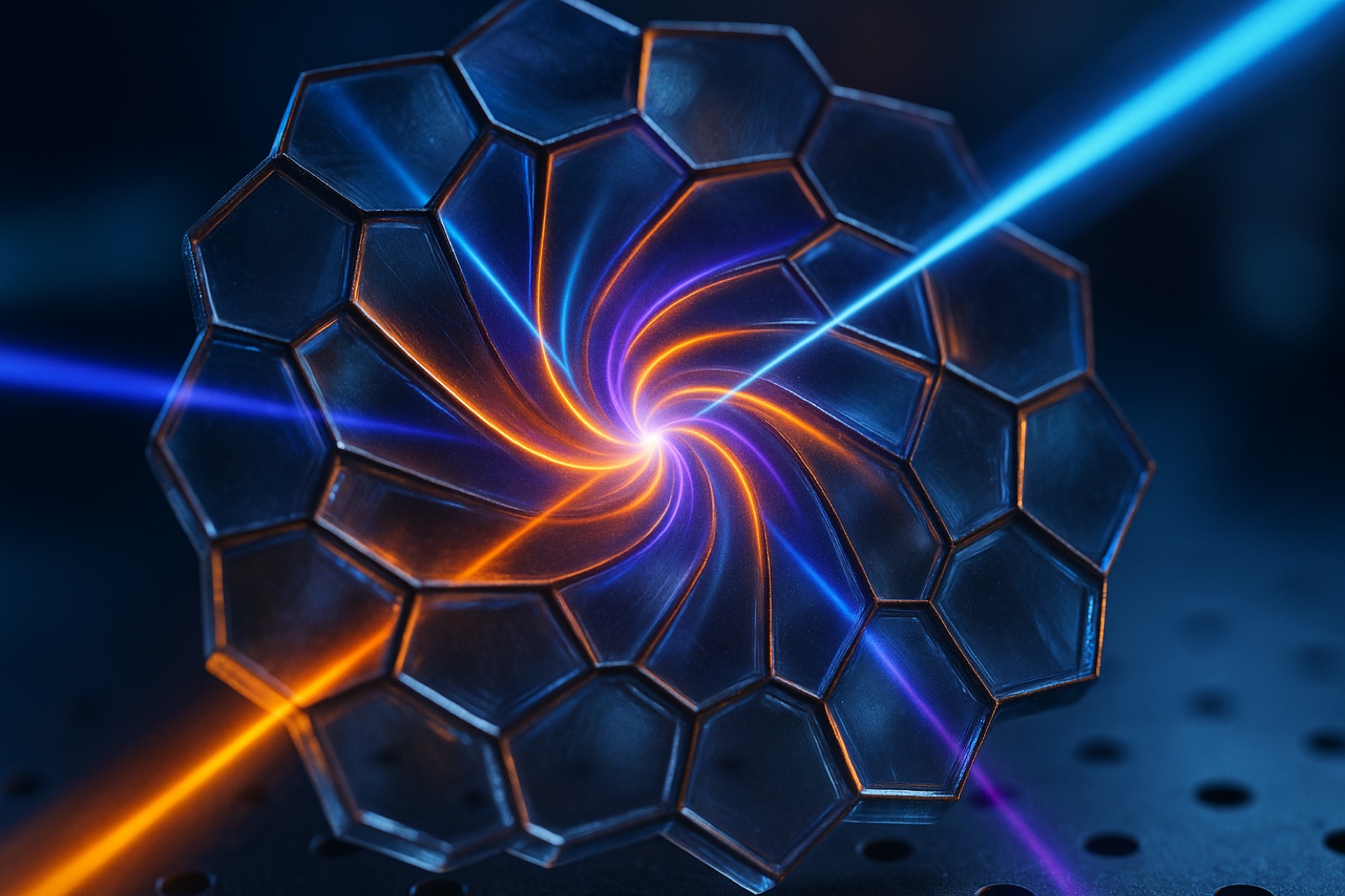
They built a photonic crystal — a material engineered at a microscopic scale to control how light moves through it — using the einstein tile’s exact geometry. Ordinary crystals, the kind used in phone screens, lasers, and fiber optic cable, are built from patterns that repeat. Light moves through them in predictable, repeating ways, because the material itself repeats.
The einstein tile crystal doesn’t repeat. And because it doesn’t, the light passing through it did something researchers hadn’t been able to produce on purpose before: it twisted into pinwheel-shaped patterns, unlike anything a normal, repeating crystal can generate. The results were published in Nature Communications, out of a collaboration involving the University of Tokyo and NTT’s Nanophotonics Center.
Nobody engineered that effect from scratch. It fell out of a shape that, for fifty years, nobody could even prove was possible — found by someone who wasn’t looking for it professionally at all.
The Pattern Underneath the Pattern
There’s an old idea, a lot older than tiling theory, that keeps showing up once you start noticing it: the thing dismissed as too plain, too ordinary, too unlikely to matter, turns out to be exactly the piece a much bigger picture was quietly waiting on. Ancient wisdom doesn’t usually put it in terms of shapes and light. It puts it in terms of people.
It’s the same shape as that overlooked hometown nobody expected anything good to come out of, and the whole idea of greatness arriving from exactly the place people had already written off. It’s the same shape as a woman abandoned in the wilderness with nothing, who became — against every expectation of who gets noticed and who doesn’t — the first person in the entire Bible credited with giving God a name. Not a king. Not a priest. A runaway nobody was looking for.
It isn’t a coincidence dressed up as one. It’s a pattern old enough to have a name long before David Smith ever picked up a pair of scissors — something bigger than any of us, working the exact same way it always has: through the thing everybody else had already decided wasn’t worth a second look.
Back to Whatever You’ve Already Written Off
You probably won’t think about aperiodic tiling again until the next headline about it. But it’s worth sitting with for a second: the shape currently rewriting what physicists thought light could do sat undiscovered in a pile of paper cutouts for fifty years, because nobody thought to look twice at it.
Maybe there’s something in your own life filed under “too plain to matter” right now — a season, a skill, a person, a version of yourself you’ve quietly decided isn’t worth a second look. If there’s a bigger design running underneath all of it — the kind that notices exactly the things everyone else overlooks — that’s not a small thing to sit with. It’s the whole reason some people spend their lives paying closer attention to the ordinary corners of an average day. If that’s something you’re curious about, there’s a simple way to start looking for it right where you already are.
A Question Worth Sitting With
Do you think the biggest discoveries usually come from experts following a plan, or from someone playing around without one? Tell us what you think in the comments.
If This Made You Think Twice
Share it with someone who needs the reminder:
- “A hobbyist solved a math problem that stumped professionals for 50 years, cutting paper shapes at his kitchen table. Then physicists found his shape bends light like nothing else on Earth.”
- “The ‘einstein tile’ isn’t named after the physicist. It’s German for ‘one stone.’ It just rewrote what light can do.”
- “Wild thought: the shape currently changing optics research sat unnoticed in a stack of paper cutouts for 50 years. Nobody thought to look twice.”
Common Questions
What is the “einstein tile”?
The einstein tile, nicknamed “the hat,” is a single 13-sided shape that can cover a flat surface completely without its pattern ever repeating, no matter how far it’s extended. It was discovered in November 2022 by David Smith, a hobbyist from East Yorkshire, England, and confirmed mathematically by researchers Craig Kaplan, Chaim Goodman-Strauss, and Joseph Myers. Its name comes from the German phrase “ein Stein,” meaning “one stone,” and has no connection to physicist Albert Einstein.
Why did mathematicians search for this shape for 50 years?
Mathematicians had long wondered whether a single shape, called a monotile, could tile an infinite flat surface using only a pattern that never repeats. Since the 1970s, non-repeating tilings were only known using at least two different shapes, like the Penrose tiles. Finding one shape that could do it alone remained unsolved for roughly five decades, and some mathematicians suspected it might be impossible.
How does the einstein tile bend light?
In a 2026 study, physicists built a photonic crystal using the einstein tile’s geometry, then tested how light moved through it. Because the pattern never repeats, light passing through it twisted into pinwheel-shaped patterns not seen in ordinary crystals, which are built from patterns that repeat predictably.
Who discovered the einstein tile?
David Smith, a retired print technician and hobbyist based in East Yorkshire, England, discovered the shape in November 2022 while experimenting with paper cutouts. He wasn’t a professional mathematician — he emailed his discovery to researchers who specialize in tiling theory, who confirmed mathematically that the shape did what he suspected.
What could the einstein tile be used for?
Researchers are still exploring practical applications, but early interest centers on optics. The einstein tile’s ability to twist light into patterns no repeating crystal can produce could eventually inform new kinds of sensors, lenses, or light-based computing components. The 2026 study on this light-bending property was published in Nature Communications.