 0
0
 0
0
Plastic doesn’t go away. That’s the whole problem with it. A grocery bag can outlast the person who used it by centuries. A water bottle tossed on a hiking trail will still be there, more or less intact, when your great-great-grandchildren are hiking the same trail. We’ve built an entire material civilization out of things engineered to never quit.
So it’s a strange kind of headline when scientists announce they’ve built a plastic that does the opposite on purpose — one that holds its shape completely until you tell it to stop existing, and then does exactly that, all the way down, in less than a week.
How a “Living” Plastic Actually Destroys Itself
Researchers publishing in ACS Applied Polymer Materials mixed dormant spores of an engineered bacteria, Bacillus subtilis, directly into polycaprolactone — a polymer already common in 3D printing and surgical sutures. While the spores are dormant, the material behaves like ordinary plastic: stable, durable, holding its shape under normal use.
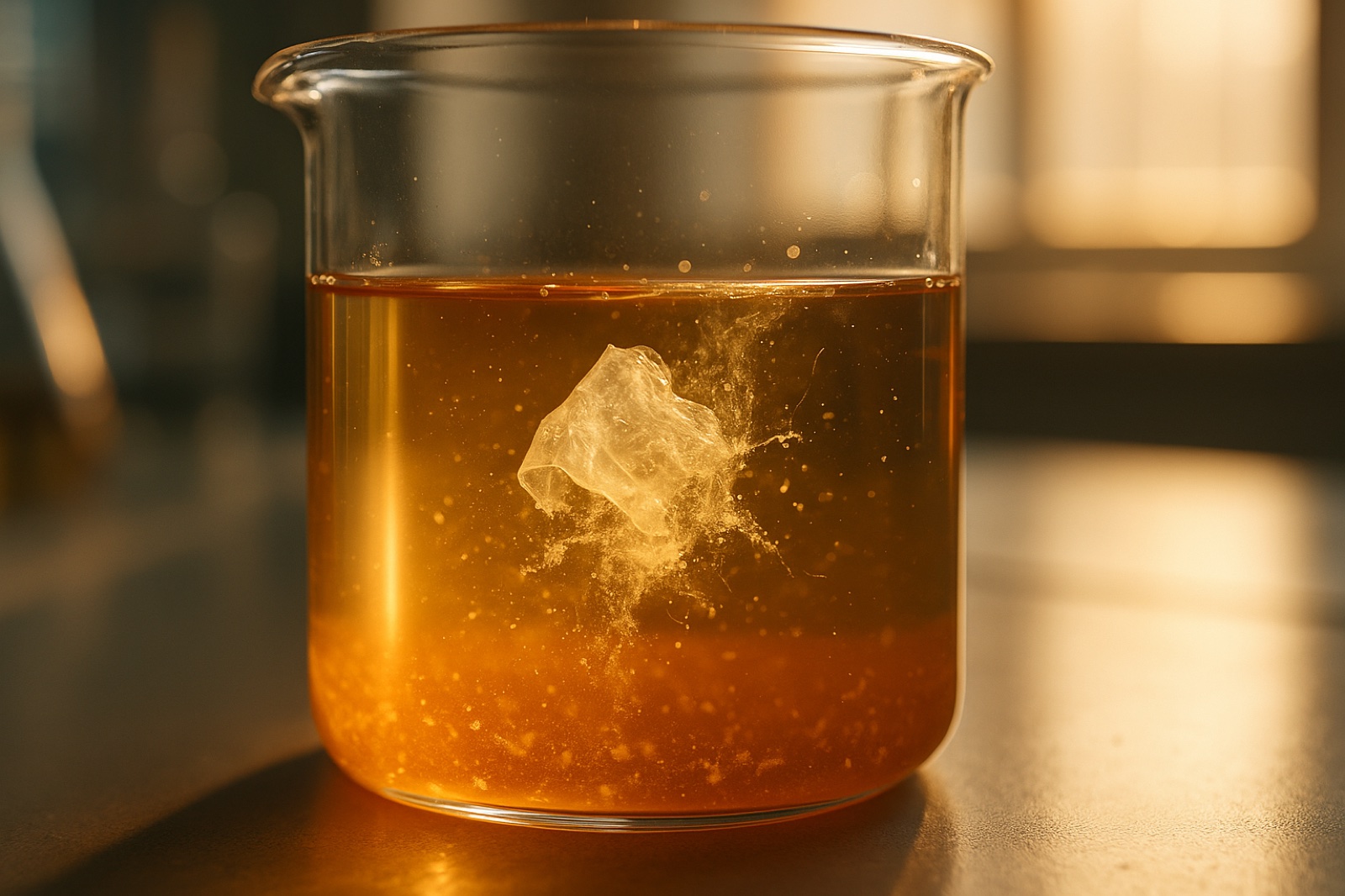
The trick is what happens when you don’t want it anymore. Add a nutrient broth heated to 122°F (50°C), and the dormant spores wake up. Once active, the bacteria produce two enzymes that work in sequence — the first cuts the plastic’s long polymer chains into shorter fragments, and the second chews those fragments down into monomers, the basic molecular building blocks that no longer behave like plastic at all.
Within six days of activation, the material is completely gone — not crumbled, not fragmented, gone. As a working demonstration, the team built a wearable plastic electrode out of the material. It performed exactly like a normal electrode should, then fully degraded within two weeks once triggered.
Why “No Microplastics” Is the Real Headline
Most plastics marketed as “biodegradable” don’t actually disappear — they fragment. Sun, heat, and friction break them into smaller and smaller pieces until they’re small enough to call microplastic, which is arguably worse than the original problem, since those fragments are now small enough to end up in soil, water, and eventually us.
This material sidesteps that outcome specifically because of how its two enzymes divide the labor. One cuts, the other finishes the job down to the molecular level — so there’s no stage where you’re left with “almost plastic” floating around. It either holds its form completely, or it’s fully reduced to its raw components. Nothing in between survives.
The researchers were candid that this is early-stage work — one polymer, demonstrated at lab scale. But the enzyme strategy itself isn’t polymer-specific in principle, and the team believes a similar two-enzyme approach could eventually be adapted to other plastics, including the kind used in single-use packaging.
Science Keeps Finding This Same Shape
It’s not the first time researchers have stumbled into a pattern that feels older than the discovery itself. A team studying the exact geological moment right before a continent splits in two reached for a word borrowed from childbirth to describe it, because nothing else quite fit. Another group tracing how life on Earth may have first sparked found their data mapping onto language written thousands of years before anyone had a microscope. Even neuroscientists studying how certain brains resist Alzheimer’s found themselves describing a process that already had a name, coined two thousand years earlier.
This living plastic fits the same shape. Here’s the part worth sitting with: the material doesn’t slowly wear down while lingering as debris. It holds its exact form, completely, right up until it’s triggered — and then it goes so decisively that nothing recognizable is left behind. What remains afterward isn’t scraps of “almost plastic.” It’s raw material, ready to become something else entirely.
That’s an old pattern, actually — older than polymer chemistry by a long way. Long before anyone thought in terms of monomers and enzymes, people who worked the land already understood something similar: a seed doesn’t become a plant by slowly improving itself. It becomes a plant by disappearing completely into the ground first. Nothing that still looks like a seed survives the process. What comes up afterward is something genuinely new, grown out of something that — functionally — no longer exists.
Every tradition that has seriously tried to describe real transformation eventually lands in the same place: lasting change costs the old form its life. Not a repair. Not an upgrade. An ending, completely, before something new begins. Ancient wisdom called that pattern sacred long before modern chemistry gave it an equation.
A Few Small Actions
- Next time you’re shopping, check if a product uses a compostable or bio-based plastic alternative — the market for these is growing fast, and buying decisions help fund the research.
- Swap one single-use plastic item in your routine this week for a reusable version — a small habit shift that adds up over a year.
- Share this story with someone who works in packaging, manufacturing, or sustainability — attention is part of what moves lab research toward real-world use.
You probably won’t think about spore-laced bioplastic again until the next headline comes along. But the next time something in your own life feels like it’s dissolving — a plan, a season, a version of yourself you’d gotten used to — it might be worth asking what’s forming underneath, instead of only mourning what’s disappearing. Nature keeps proving that endings and beginnings are often the same event, just seen from two different sides.
What Do You Think?
If you knew a version of your life had to fully end before the next one could begin, would you want to rush toward it — or slow it down as long as possible? Tell us in the comments.
Worth Sharing
- Scientists just built a plastic that fully disappears in 6 days — on command, no microplastics left behind. Wild what happens once you stop trying to make something last forever.
- Every “biodegradable” plastic you’ve heard of still leaves microplastic fragments behind. This one doesn’t. It just… finishes.
- The most interesting materials science story I’ve read all year isn’t about something new being built. It’s about something engineered to completely disappear, on purpose, once it’s done its job.
Quick Questions, Answered
What is “living plastic,” and how is it different from regular biodegradable plastic?
“Living plastic” refers to a material made by embedding dormant bacterial spores directly into a polymer (polycaprolactone, in this case). Unlike most biodegradable plastics, which slowly fragment into microplastics over months or years through sun and weather exposure, this material stays fully stable until deliberately activated, then breaks all the way down to molecular building blocks within days.
How long does it take for this plastic to fully break down?
Once activated with a heated nutrient broth (122°F / 50°C), the engineered bacteria fully degrade the plastic within six days. A wearable electrode prototype made from the material fully degraded within two weeks of activation.
Does this living plastic leave microplastics behind, like other biodegradable plastics do?
No. Two enzymes work in sequence — one cuts the polymer’s long chains into fragments, and the second breaks those fragments down into monomers, the basic molecular units. Because the process runs all the way to the molecular level rather than stopping at fragmentation, no microplastic residue is left behind.
What is this plastic actually being used for right now?
So far, researchers have only demonstrated it in a wearable plastic electrode, which functioned normally during use and then fully degraded once triggered. It’s an early proof-of-concept rather than a commercial product.
Could this replace regular plastic packaging in stores?
Not yet. The current research demonstrates one polymer (polycaprolactone) at lab scale. Researchers believe the two-enzyme strategy could, in principle, be adapted to other plastics — including packaging materials — but that adaptation hasn’t been done yet.