 0
0
 0
0
The moon looks like the stillest place in the solar system. No wind, no rain, no rustling leaves — just gray dust and silence. But it turns out the moon has been quietly rumbling this whole time, and scientists just figured out how to use those tremors to find something that’s been hiding underneath it for billions of years.
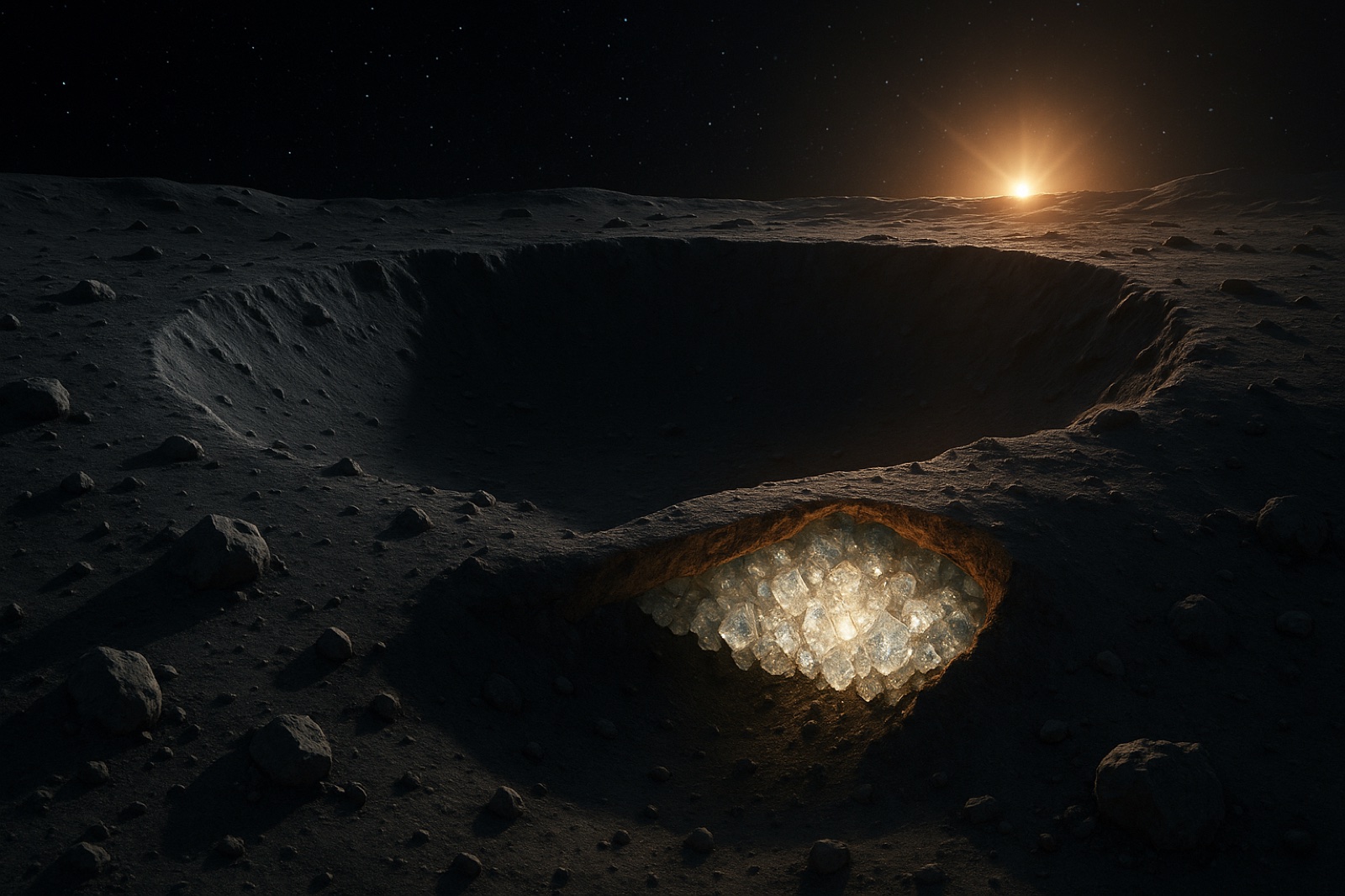
It’s called a moonquake, and researchers just discovered they can use it to map something no camera, rover, or orbiter has ever been able to see directly: frozen water buried hundreds of feet beneath the lunar surface.
What a Moonquake Actually Is
Earthquakes happen because our planet has an active core, shifting tectonic plates, and a lot of geological motion. The moon has almost none of that. It’s smaller, colder, and geologically quiet compared to Earth. But it still shakes — from meteorite impacts, from the extreme temperature swings between lunar day and night that cause rock to expand and crack, and from deep, slow-building stress inside the moon itself.
NASA first picked this up decades ago, when the Apollo missions left seismometers on the lunar surface that recorded thousands of moonquakes through the 1970s. For a long time, that data mostly told scientists about the moon’s internal structure — what it’s made of, how it’s layered. Nobody was using it to go treasure hunting.
That just changed.
How Scientists Turned Tremors Into a Map
A research team led by Dr. Nicholas Schmerr at the University of Maryland, working with Lawrence Berkeley National Laboratory and the University of Hawaii, published a study in the journal Science Advances on July 31, 2026, showing that seismic waves move differently through frozen ground than they do through dry, loose lunar soil.
That difference is the whole discovery. Frozen soil is denser and stiffer, so a seismic wave passing through it speeds up and changes shape in a measurable way. Dry regolith — the moon’s version of dirt — doesn’t behave the same way at all. By reading those differences the way a doctor reads an ultrasound, the team modeled ice deposits buried as deep as 2,625 feet — about 800 meters — under the moon’s permanently shadowed polar craters, without ever drilling a single hole.
Those polar craters matter because they never see sunlight. Some haven’t been touched by direct light in billions of years, which means anything frozen inside them has likely stayed frozen the entire time — including water ice that could have arrived on comets and asteroids long before anything was alive to notice.
Why Everyone Suddenly Cares About Lunar Ice
This isn’t just an academic curiosity. Water ice is one of the most valuable resources anyone could find on the moon, because it can be split into hydrogen and oxygen — oxygen to breathe, hydrogen to burn as rocket fuel. A confirmed, mappable source of lunar ice means future missions could stop hauling every drop of water and fuel from Earth, which is one of the most expensive parts of any deep-space mission.
NASA’s Artemis program is targeting the moon’s south pole for a crewed landing in 2028, largely because that’s where the best-known ice deposits are believed to sit. Before anyone lands, mission planners need to know where the ice actually is — and drilling test holes across the lunar south pole to check is slow, expensive, and can only sample one tiny spot at a time.
This seismic method offers something drilling can’t: a way to scan wide areas for ice from a distance, cheaply, before committing a lander to a specific site. China’s Chang’e-7 mission, which carries its own seismometer, is expected to touch down near Shackleton Crater — a top candidate site — later in 2026, and NASA has proposed a similar instrument for a future Artemis deployment. Both would put this method to its first real test on the actual lunar surface.
None of this ice was created by the discovery. It’s been sitting exactly where it is for longer than human history has existed. What changed is that someone finally learned to listen for it.
What It Took to Find What Was Already There
Here’s the part that’s easy to miss in a story about instruments and craters: nobody found this ice by looking harder. They found it by paying attention to what happened when the ground shook. The shaking didn’t damage anything or create the ice — it just exposed, in the data, something that had been true the entire time but invisible from the surface. It’s the same pattern behind a black hole that stayed completely undetected for 30,000 years until it finally disturbed something nearby enough to give itself away.
That’s an old idea showing up in a very new place. Long before anyone had a seismometer, people noticed that pressure and disruption have a way of surfacing what’s actually there underneath — that what’s real doesn’t stay hidden forever, and sometimes it takes being shaken for it to come into view. Ancient wisdom has said as much about people as much as about ground: character, faith, what someone is really made of — it tends to show up clearest not in the calm, but in the tremor.
The moon didn’t need to change to reveal its ice. It just needed the right kind of disturbance, and someone willing to read what came back.
A Quiet Kind of Discovery
There’s something fitting about the fact that this discovery didn’t come from a bigger telescope or a flashier mission. It came from paying close attention to vibration — to the parts of the story that are usually treated as noise. The moon has been rumbling for billions of years. It just took someone deciding that the rumble was worth listening to. It’s a little like researchers realizing certain math problems weren’t invented so much as found — waiting, already true, for someone patient enough to notice.
Somewhere under a crater that hasn’t seen sunlight since before the first humans existed, there’s ice that was always going to be found eventually. It was just waiting for the right kind of shaking.
Join the Conversation
If something in your life got “shaken” recently — a hard season, a loss, an unexpected disruption — did it end up revealing something about you that you didn’t fully know was there before? What was it?
Share This
- Scientists just figured out how to find hidden water ice on the moon by listening to moonquakes instead of drilling. Wild what shaking something can reveal. 🌕 https://bgodinspired.com/index.php/bible-resources/bible-and-science/moonquakes-reveal-hidden-ice-beneath-moon/
- The moon has been quietly rumbling for billions of years, and it turns out those tremors can map ice buried 2,600+ feet underground. Nobody found it by looking harder — they found it by listening when it shook. https://bgodinspired.com/index.php/bible-resources/bible-and-science/moonquakes-reveal-hidden-ice-beneath-moon/
- NASA and China are both racing to test a new way of finding lunar water ice: reading how moonquakes travel through frozen ground versus dry soil. No drilling required. https://bgodinspired.com/index.php/bible-resources/bible-and-science/moonquakes-reveal-hidden-ice-beneath-moon/
Common Questions About Moonquakes and Lunar Ice
What is a moonquake?
A moonquake is a tremor on the moon, similar to an earthquake, caused by meteorite impacts, extreme temperature swings between lunar day and night, and internal stress deep inside the moon. NASA first recorded them using seismometers left by the Apollo missions in the 1970s.
How do moonquakes reveal hidden ice on the moon?
Seismic waves from moonquakes travel differently through frozen ground than through dry, loose lunar soil. By measuring those differences, researchers from the University of Maryland, Lawrence Berkeley National Laboratory, and the University of Hawaii modeled ice deposits buried as deep as 2,625 feet beneath permanently shadowed polar craters, without drilling.
Why does lunar ice matter for future moon missions?
Water ice can be split into oxygen for breathing and hydrogen for rocket fuel, which means astronauts could rely on lunar resources instead of hauling everything from Earth. NASA’s Artemis program is targeting the moon’s south pole for a crewed landing in 2028, in part because that region is believed to hold the most accessible ice.
Which missions will test this ice-detection method?
China’s Chang’e-7 mission, carrying its own seismometer, is expected to land near Shackleton Crater later in 2026. NASA has proposed a similar seismic instrument for a future Artemis deployment to confirm ice locations before committing astronauts to a landing site.
When was this research published?
The findings were published in the journal Science Advances on July 31, 2026, by a team led by Dr. Nicholas Schmerr at the University of Maryland.