 0
0
 0
0
In 1931, a young physicist named Hans Bethe sat down with a pencil and a hard problem. He was in his mid-twenties. He wanted to understand a simple row of atoms, lined up in a single file, each one acting like a tiny magnet.
He solved it. And hidden inside his answer was something strange. The maths said that, in a world squeezed down to one line, little groups of particles could lock together and travel as one. Not glued. Not bonded like a molecule. Just held together by the way they push and pull on each other.
Today we call those groups Bethe strings. This month, a team in Austria said they had finally built them from scratch, out of atoms, and watched them crash into each other without falling apart.
But the story you may have seen, that nobody saw any sign of them for 95 years, is not quite true. The real story is a little longer, and a lot more interesting.
What Are Bethe Strings?
Picture a narrow hallway. It is so narrow that people can only walk in single file. Nobody can pass anybody. Nobody can step to the side.
Now imagine some of the people in that hallway start holding hands. Two, three, sometimes six or more in a chain. They are not tied together. They simply choose to stay close, and in a hallway that narrow, staying close is easy.
That is the rough idea of a Bethe string. It is a small cluster of particles that stays bound together, but only because they are trapped in one dimension. Give them room to spread out in every direction and the chain comes apart.
Bethe found these clusters in his equations. For a long time, that is mostly where they lived.
What Physicists Did in Innsbruck
The new work comes from the University of Innsbruck in Austria, in a lab led by physicist Hanns-Christoph Nägerl. Theory teams at the University of Amsterdam and the Technical University of Munich helped work out what the results meant. The study was published in the journal Nature Communications in 2026, under the title “Probing Bethe strings in an attractive one-dimensional Bose gas.” You can read the university’s summary through ScienceDaily.
Here is what they did, step by step.
- They took a cloud of cesium atoms and cooled it to a few billionths of a degree above absolute zero. That is colder than anything in nature.
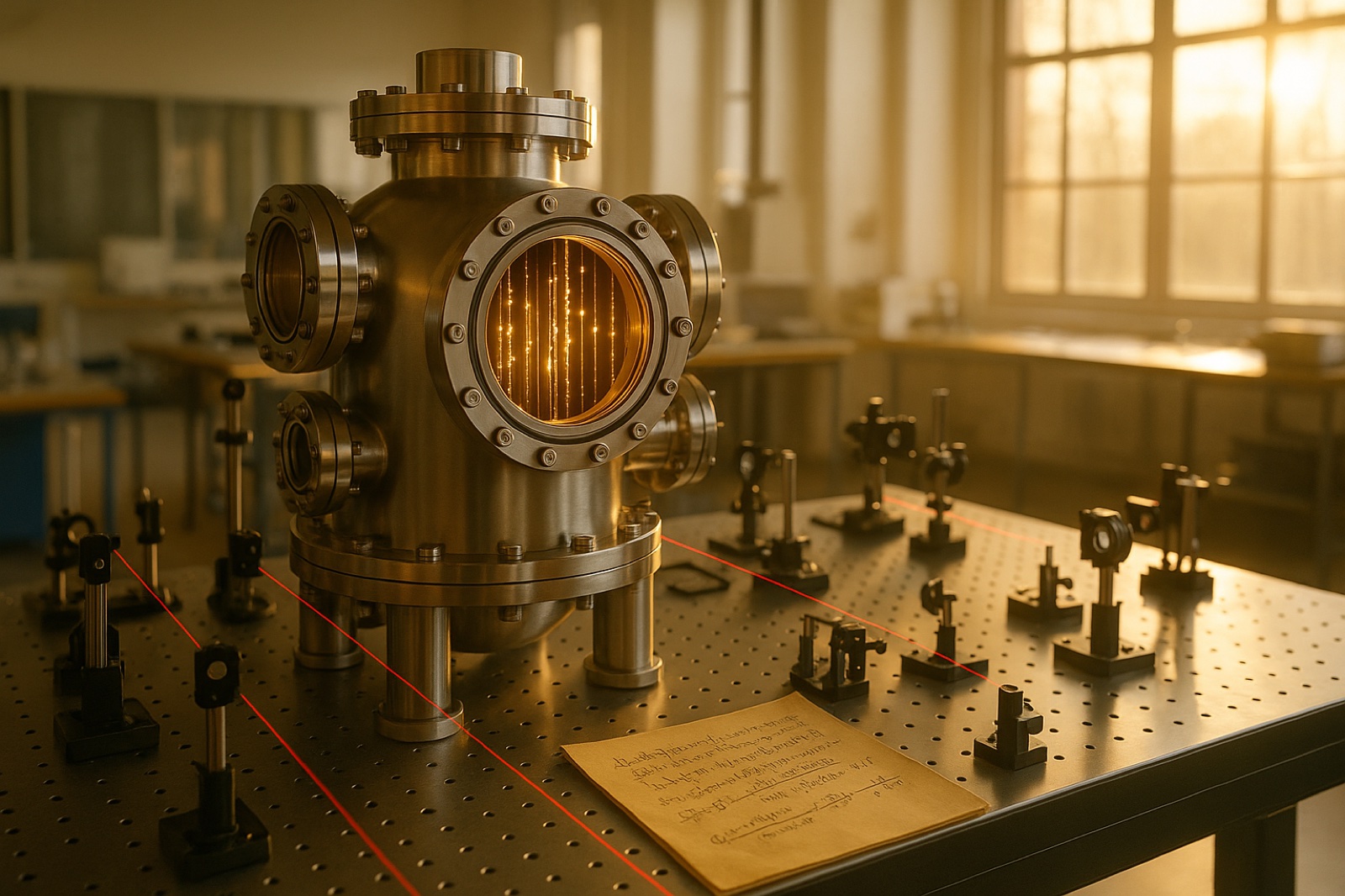
- They used light to split the cloud into several thousand very thin tubes. Inside each tube, the atoms could only move forward or back. That is the narrow hallway.
- They then flipped how the atoms treated each other. At first the atoms pushed each other away. Then the team switched them so they pulled together instead.
When the atoms started pulling together, they formed bound groups of different sizes. The biggest held six or more atoms.
How Do You Prove Something Is Holding Together?
This is the clever part. You cannot just look and see a Bethe string. The atoms are far too small and the whole thing is far too delicate.
So the team let the atoms go, in two different ways.
First, they let the atoms spread out while still trapped in their tubes. The strings bumped into each other, but they stayed together. “This is a remarkable feature of the strings: they can collide without breaking apart,” said Milena Horvath, the study’s first author.
Second, they switched the tubes off and let the atoms spread out in every direction. Now the strings had room to fall apart, and they did. When they broke, they gave off extra energy, and the atoms flew outward faster.
When the atoms were pushing each other away, both kinds of release looked about the same. When the strings were there, the second kind carried extra energy. That difference is the fingerprint. It is how the team knew the strings had been there.
It is worth being honest about one thing. Some headlines say the strings were “directly observed.” What the team actually measured was that energy difference, and from it they worked out that the strings must have formed. That is how a lot of good physics works, and it is solid. But it is a clue that points to the strings, not a photograph of them.
So Did Bethe Strings Really Wait 95 Years?
Not quite. And this is the part most retellings skip.
Bethe’s original 1931 problem was about magnets, that row of tiny atomic magnets. In 2018, a different team published a paper in the journal Nature called “Experimental observation of Bethe strings.” They had used a special crystal, a material whose atoms line up in chains, and very strong magnetic fields. By shining a kind of invisible light through it, they found the signal Bethe’s maths predicted.
So the first sighting came 87 years after the prediction, not 95. And the new Innsbruck press release says so itself: it notes that the strings had already been detected in solid magnetic materials.
What is new now is different, and in some ways bigger. In a magnet, a Bethe string is a pattern in the spins of atoms that stay put. In Innsbruck, the strings are made of real atoms that move. Scientists can now build them, tune them, and make them collide on purpose. “Now we can create them in the laboratory, manipulate them and make them collide,” said Sudipta Dhar, another of the authors.
That is a bit like the difference between spotting a rare bird once through binoculars and having a garden where you can watch it every day.
Science is full of ideas that had to wait. We wrote recently about an AI that found a CRISPR-like system nobody understands yet, and how CRISPR itself waited about twenty years for anyone to know what it did. And if you have ever wondered how much physicists still do not agree on, the largest survey of physicists ever done found the frontier far more open than most people think.
Why Would Anyone Trust Maths for 87 Years?
Think about what that means. For most of a century, the best reason to believe in Bethe strings was a set of equations written by one young man. Nobody could check them in the real world. Physicists kept them anyway. They taught them, built on them, and pointed later work at them. Bethe himself went on to win a Nobel Prize, in 1967, for a different discovery: how stars make their energy.
Holding on like that is not blind hope. The maths had earned trust. It kept being right in other places. So people wrote it down carefully, kept it safe, and waited for the tools to catch up.
There is a very old piece of wisdom that sounds a lot like this. A man who had been shown something that had not happened yet was told to write it down plainly, clearly enough that a person running past could read it, because it would take its time. And he was told to wait for it, even if it seemed slow, because it would come. People have leaned on that idea for thousands of years, in hospital corridors and long nights and seasons when nothing seemed to move. A promise does not stop being true because it is taking a while.
Bethe wrote his vision down in 1931. It was plain enough that other people could carry it. It waited. And this month, in a lab full of lasers in the mountains of Austria, it is being built.
What Comes Next for Bethe Strings
The team says the real value is what they can do now. “This opens new possibilities for studying how these collective quantum objects form and interact,” said Alvise Bastianello, one of the theorists. Physicists want to know how the strings form, how they behave when they crash together, and what that can teach us about other systems squeezed into one dimension.
Nobody knows yet where that will lead. That is fine. A lot of the most useful science started as a question nobody could answer at the time.
A good place to start:
The Beginner’s Guide to Feeling God’s Presence Every Day
A short video guide and companion PDF for noticing something bigger in the ordinary moments of a normal day, including the waiting ones.
Get the free guide Free.
One Question Worth Thinking About
Bethe’s idea waited 87 years before anyone saw a sign of it, and 95 before anyone could build it. Would you trust something that long with nothing but a page of maths to go on? What is something you have believed for years before you had proof? Tell us in the comments.
Share This
- “In 1931 Hans Bethe predicted particles could lock into chains in a 1D world. In 2026, physicists built those chains out of atoms and made them crash into each other. They didn’t break.”
- “The headlines say Bethe strings waited 95 years. Actually they were first spotted in a magnet in 2018. What’s new is that physicists can now build them on purpose. Better story, honestly.”
- “For 87 years the only reason to believe in Bethe strings was one young physicist’s maths. People kept it anyway. I keep thinking about that.”
Questions People Ask About Bethe Strings
What are Bethe strings?
Bethe strings are small groups of quantum particles that stay bound together while moving through a one-dimensional space, such as a very thin tube or a single chain of atoms. They are not held together by chemical bonds the way a molecule is. They stay together because of how the particles interact with each other, and they can only exist in one dimension. Physicist Hans Bethe predicted them mathematically in 1931.
Who discovered Bethe strings in 2026?
In 2026, a team at the University of Innsbruck in Austria, led by Hanns-Christoph Nägerl and working with theorists at the University of Amsterdam and the Technical University of Munich, created Bethe strings from ultracold cesium atoms. Their study, “Probing Bethe strings in an attractive one-dimensional Bose gas,” was published in Nature Communications.
Were Bethe strings ever seen before 2026?
Yes. Bethe strings were first reported experimentally in 2018, in a paper in the journal Nature titled “Experimental observation of Bethe strings.” That team found the strings as patterns of atomic spins in a magnetic crystal placed in strong magnetic fields. The 2026 Innsbruck work is different because it builds the strings from moving atoms in a gas, which lets scientists create, control and collide them.
How did scientists prove Bethe strings were there?
The Innsbruck team released their atoms in two ways. When the atoms spread out while still trapped in thin tubes, the strings collided but stayed intact. When the tubes were switched off and the atoms could spread in all directions, the strings broke apart and released extra energy, making the atoms spread faster. That extra energy, which did not appear when the atoms repelled each other, was the signature showing the strings had formed.
Why do Bethe strings matter?
Bethe strings matter because they let physicists study how groups of quantum particles form and behave together in one dimension, something that was mostly theory for decades. Being able to build and collide them in a lab gives scientists a controllable way to test ideas about collective quantum behaviour that also show up in magnetic materials and other one-dimensional systems.