 0
 0
It is late, and you have typed something honest into a box on a stranger’s website. A comment under a video. A search bar. Somewhere that will not answer back. You did it because there was nobody left to send it to.
When nobody cares about you, almost all the comfort on offer is written for a different problem. It is written for the person who feels unseen in a room full of friends. That is a real ache, and it deserves care. But it is not this one. This one is the night you look around and work out that there is genuinely no one whose morning would change if you were not in it.
There is a prayer in the Bible written from exactly there. It is Psalm 142. It is short, it is not famous, and it contains a line most people have never read once.
If You Only Have a Minute, Pray This
The rest of this page will still be here later. If tonight is the kind of night where words are expensive, start with these. Say them out loud if you can, because out loud is different.
God, I am saying it plainly, because there is no one else to say it to: nobody cares. I am not going to dress that up or make it sound better than it is. You already know where I am and what today was. So I am going to stop pretending I am fine, and just sit here with You, and ask You not to let go of me tonight.
That is a prayer. Not a rough draft of one. The psalm we are about to look at does the same thing in older words, and it was kept in the Bible on purpose.
Psalm 142 Has a Note Attached to the Top of It
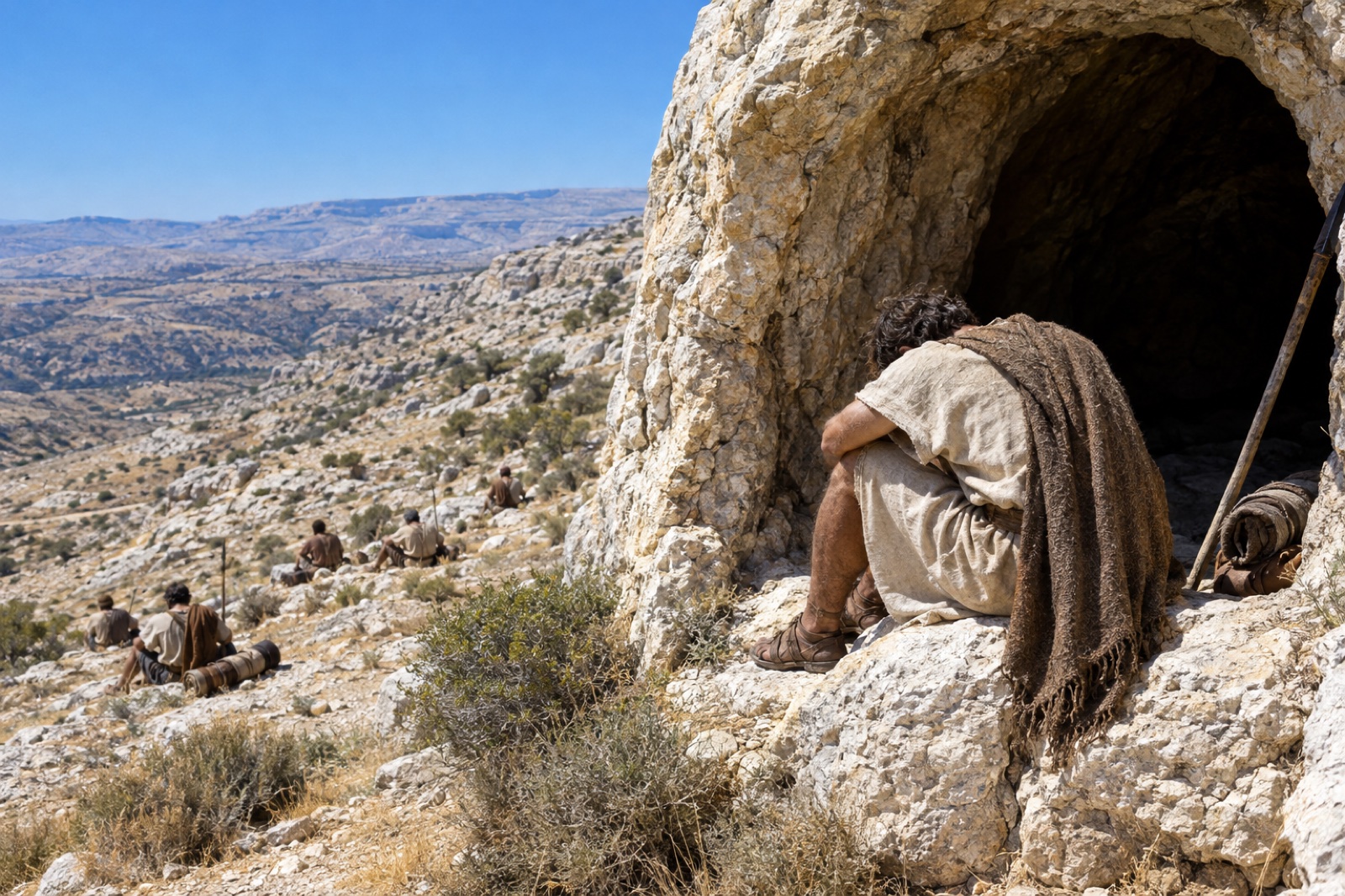
Most psalms carry a short line above verse 1 — a filing note left by whoever collected them. The one on Psalm 142 reads: “Maschil of David; A Prayer when he was in the cave.”
Two things are worth slowing down on.
The first is the word Prayer. Whoever filed this did not call it a poem, a song or a lament. They called it a prayer — which means that what you are about to read was considered an acceptable thing to say to God.
The second is Maschil. That one is harder, and honesty is better than confidence here: it is generally understood to mean something like a teaching piece or a contemplation, and translators openly admit the precise sense of the Hebrew word is not settled. But if it carries anything like the idea of instruction, then someone took the worst night of a man’s life and filed it as something other people were meant to learn from. Not hidden. Not tidied. Kept, as teaching.
He Wrote “No Man Cared for My Soul” With a Crowd Around Him
Here is the line. Psalm 142:4, in the King James wording:
“I looked on my right hand, and beheld, but there was no man that would know me: refuge failed me; no man cared for my soul.”
Read that again slowly. No man cared for my soul. That is in the Bible. Nobody edited it out, nobody softened it into “I felt a little isolated.” It is the flattest, bleakest sentence about loneliness in the whole book, and it is sitting inside something labelled as a prayer.
Now the part that genuinely surprised me, and that changes who this psalm is for.
The note says “when he was in the cave.” It does not say which cave. The Bible puts David in a cave twice while Saul was hunting him: the cave at Adullam in 1 Samuel 22, and a cave in the wilderness of En-gedi in 1 Samuel 24. We do not know which one the note means — and it turns out it hardly matters, because of what the text says about both.
Of Adullam, 1 Samuel 22:2 says that everyone in distress, everyone in debt and everyone discontented gathered to David there, “and there were with him about four hundred men.” Of En-gedi, 1 Samuel 24:3 says plainly that “David and his men remained in the sides of the cave.”
So whichever cave it was, he was not by himself. There were hundreds of people breathing in the dark a few steps away when he wrote that no man cared for his soul.
That is not a contradiction. It is the whole point, and it quietly takes the roof off this psalm. The man who wrote the Bible’s loneliest sentence had a crowd. Being surrounded had not touched it. Which means this prayer is not only for the person with literally nobody — it also belongs to the person with a full contact list and an empty chest, the one who comes home from an evening with friends somehow heavier than when they went out. Psalm 142 does not ask you to prove which kind of alone you are before you are allowed to pray it.
Verse 3 Already Answered Verse 4
The order of these two verses is easy to read straight past, and it is the hinge of the whole psalm.
Verse 4 is the one we just read: no man that would know me. But verse 3 — the sentence immediately before it — says this:
“When my spirit was overwhelmed within me, then thou knewest my path.”
He says the answer before he says the problem. Not “I was alone, and later God found me.” The knowing is already in place, in the past tense, before the complaint is even made. While he was overwhelmed — not after he recovered, not after he prayed well enough — his path was already known.
And notice what he does not do. He does not then go back and cancel verse 4. He does not write “but actually some people did care.” He leaves the terrible sentence standing. Both things are allowed to be true on the same page: nobody knew him, and God already knew his path.
“Refuge Failed Me.” One Verse Later: “Thou Art My Refuge.”
This is the turn, and it is hiding in a repeated word.
In verse 4 he says refuge failed me. Everywhere he had planned to run was gone — the people, the plan, the place. Then in verse 5, the very next line:
“I cried unto thee, O LORD: I said, Thou art my refuge and my portion in the land of the living.”
Refuge failed me. Thou art my refuge. The same English word, one verse apart, pointing in opposite directions.
A small note so this is not oversold: in Hebrew these are two different words — the first means roughly a place to escape to, the second a shelter you take cover in — so the echo belongs to the King James translators rather than to David. But the move underneath it is his, and it survives any translation. He does not argue himself out of the first sentence. He does not decide he was exaggerating. He takes the word that just broke in his hands and hands it to God anyway.
“Refuge failed me.” One verse later: “Thou art my refuge.”
That is what makes this a prayer and not just a record of a bad night. He is not waiting until he feels better to pray. He is praying with the complaint still in his mouth. Verse 2 calls it exactly that: “I poured out my complaint.” Complaint, in the Bible, is a recognised form of prayer.
And then the last line, verse 7, which is the strangest thing in the psalm. He is sitting in a cave — the safest place available to him, the thing keeping him alive — and he calls it a prison: “Bring my soul out of prison, that I may praise thy name.” He is honest enough to admit that the thing protecting him is also the thing holding him. Some of us are living in a cave like that right now: the job, the room, the arrangement that is genuinely keeping us going and is also slowly closing over us. He did not pretend to be grateful for it. He asked to be brought out.
What to Do in the Next Ten Minutes
Three things, easiest first. All of them are free, none of them need anyone else’s permission, and all three can be done tonight.
- Say the true sentence out loud, to God, not to the ceiling (one minute). Not a polished version. The actual words — “nobody cares about me” — addressed to God rather than muttered at the dark. Psalm 142:2 calls this pouring out a complaint, and it is filed in the Bible as prayer. You do not have to fix the sentence before you are allowed to say it.
- Put verse 3 where your eyes will land at 3am (three minutes). Write “then thou knewest my path” on whatever is nearest — the back of an envelope, a note on your phone screen, the inside of a cupboard door. The point is that the next time you wake at the worst hour, the first sentence available to you is one that was true before you woke up. If you do not know what to say after that, our free Bible Verse for How I Feel tool will hand you a verse that matches the state you are actually in, in about thirty seconds.
- Send four words to one person you stopped counting (ten minutes). Not an explanation. Not the whole story. Just “Thinking of you today.” Pick someone from a year ago, a neighbour, a nurse, a group you went quiet in. David’s cave was full of people he had stopped counting, and it is worth knowing that the people who go quiet when things get hard are usually not being cruel. If the message goes nowhere, you have lost four words. If it does not, you have found out something you could not have found out by thinking about it.
Three Things to Write Down
- When you say “nobody cares,” who are you deliberately not counting — and what disqualified them?
- Verse 4 says refuge failed. Name the refuge that failed for you. What exactly were you expecting it to carry?
- If your path was already known before you said a word, what have you been waiting to say out loud first?
A Prayer for When Nobody Cares About You
Pray this as it is, or change the words until they are yours.
God, I looked around tonight the way David did, and there was no one. I am not going to pretend that is fine or that I am handling it well, because You already knew my path before I opened my mouth. Everything I was going to run to has failed, so I am bringing You the word that broke and calling You my refuge instead. Bring my soul out of this. And until You do, stay here, because right now You are the only one who knows where I am.
One Question
Do you think saying “nobody cares” out loud makes it lighter to carry, or heavier? Tell us what you think in the comments — somebody reading this at 2am will be glad you did.
If You Want to Pass This On
- Psalm 142 was written by a man with about four hundred people camped around him who still wrote “no man cared for my soul.” The crowd was never the cure.
- “Refuge failed me.” One verse later: “Thou art my refuge.” He did not take the first sentence back. He just handed the word over.
- If nobody cares, you are allowed to say that to God in those exact words. Psalm 142 calls it pouring out a complaint, and the Bible files it as a prayer.
Questions and Answers
What is Psalm 142 about?
Psalm 142 is a short prayer of seven verses, credited to David and written while he was hiding in a cave from King Saul. It moves from total isolation — “no man cared for my soul” — to a direct statement of trust, “Thou art my refuge and my portion in the land of the living,” without ever taking back the first part. It ends with a request to be brought out of what he calls a prison.
Who wrote Psalm 142, and where was he?
The note above verse 1 reads “Maschil of David; A Prayer when he was in the cave.” It does not say which cave. The Bible places David in a cave twice while Saul hunted him: the cave at Adullam in 1 Samuel 22, and a cave in the wilderness of En-gedi in 1 Samuel 24. In both accounts he had men with him — 1 Samuel 22:2 counts about four hundred at Adullam, and 1 Samuel 24:3 says “David and his men remained in the sides of the cave.”
What does “no man cared for my soul” mean?
It is the second half of Psalm 142:4 in the King James Version: “I looked on my right hand, and beheld, but there was no man that would know me: refuge failed me; no man cared for my soul.” In plain terms it means: I looked for someone who would recognise me and take an interest in what happened to me, and there was no one. It is a statement of complete abandonment, left standing in the text rather than softened.
What does Maschil mean in the title of Psalm 142?
Maschil is a Hebrew term that appears in the titles of several psalms. It is generally understood to mean something like a teaching piece, an instruction or a contemplation, though translators and scholars are open about the fact that its precise sense is not settled. Whatever it means exactly, its presence indicates that the psalm was preserved as something to be read and learned from, not simply as a private record.
Is it wrong to tell God that nobody cares about me?
Psalm 142 does exactly that and the Bible keeps it, with a note at the top calling it a prayer. Psalm 142:2 describes the act as pouring out a complaint before God, which means complaint is treated as a legitimate form of prayer rather than a failure of faith. Saying the true, bleak sentence is not disrespect; in this psalm it is the opening move, and trust follows one verse later without the complaint ever being withdrawn.