 0
 0
For twenty-seven years, Renée Michel has made sure that nobody in her building suspects her of reading.
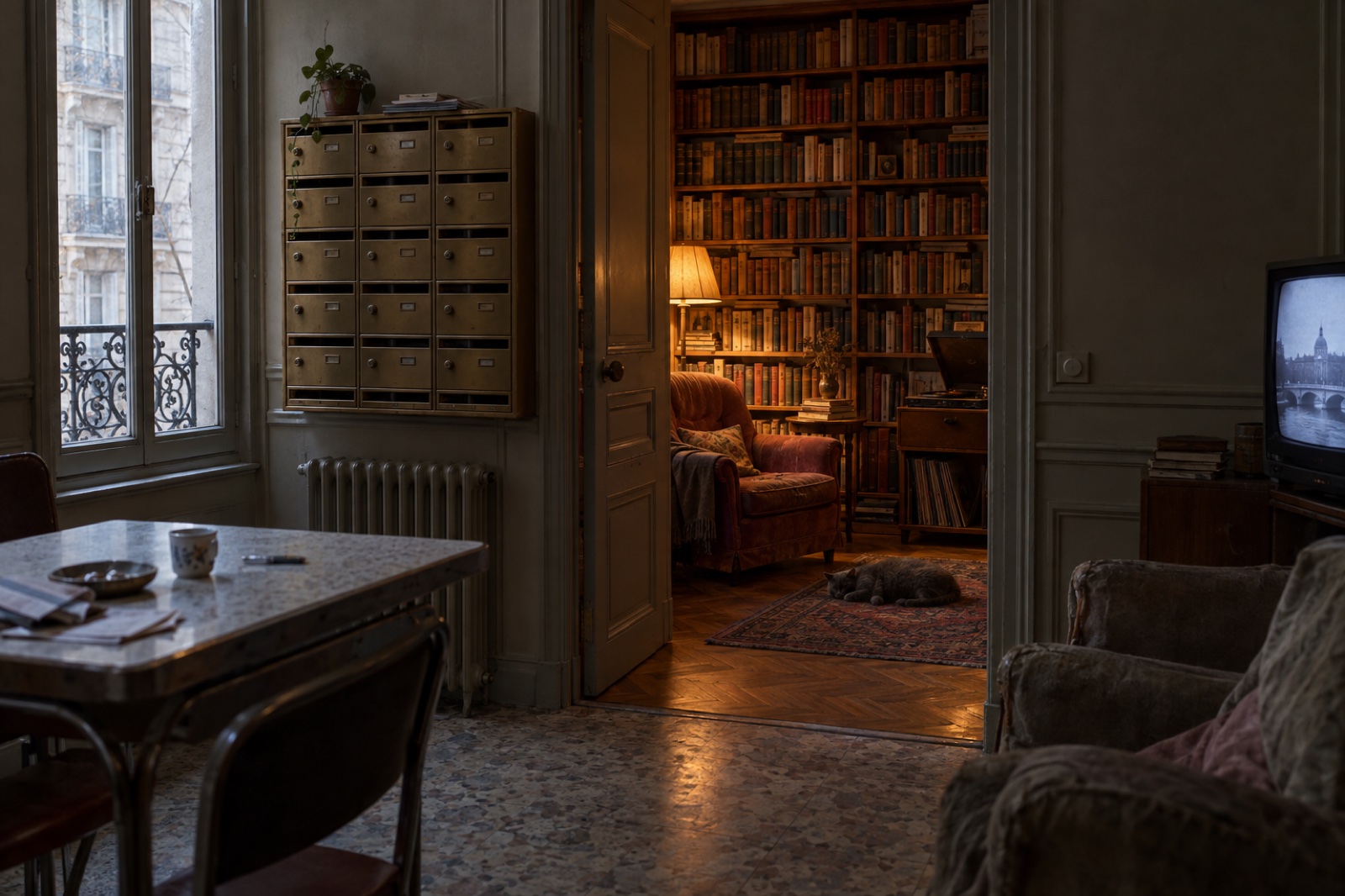
She is the concierge at 7 rue de Grenelle, a handsome Left Bank address in Paris, and she has built a whole character for the job. Out front: cheap food and the television on. In the back room: opera, Tolstoy, Husserl, and a cat she has named Leo after Tolstoy, because the joke had to go somewhere.
Ask about the Elegance of the Hedgehog meaning and you will usually get an answer about beauty. Beauty is in there. But the thing Muriel Barbery’s novel is actually built out of is narrower and stranger than that: two people who have each worked out, on their own, that being seen clearly is dangerous.
The book came out in France in 2006 as L’Élégance du hérisson, published by Gallimard, and in English in 2008 in Alison Anderson’s translation. It sat on the French bestseller list for about two years and has been carried into dozens of languages since. It is worth saying plainly what kind of book it is: almost nothing happens in it. Two voices alternate, chapter by chapter, and that is the engine.
The Elegance of the Hedgehog Meaning: Two People Hiding the Same Thing
Renée is fifty-four and widowed and has held the job for twenty-seven years. She hides because she has made a correct calculation about what happens to a concierge who reads phenomenology. Her building has an idea of what she is for, and the idea does not have room in it for a woman with opinions about Husserl.
Paloma Josse is twelve and lives on the fifth floor. Her father is a member of parliament. Her mother quotes Flaubert. Paloma hides exactly the same thing Renée hides, and she has a date: her thirteenth birthday, the sixteenth of June, on which she intends to kill herself, having first burned the apartment down.
Here is the part that took me a second read to see. The two disguises are identical and the two fears are opposites.
Renée hides to avoid being punished. Paloma hides to avoid being recruited. Renée’s building would make her pay for being clever; Paloma’s family would make her a credit to them, a bright girl with a bright future, folded neatly into the same performance she has already decided is empty. One of them is hiding from contempt. The other is hiding from applause. They put on the same mask for reasons that could not be further apart, and they live one staircase away from each other for years without either one saying so out loud.
There is something very old-fashioned about Renée’s version of it, and something very modern too. She is, in the most literal sense, a machine with a person hidden inside it — a service that answers the door, takes in parcels, and is never once suspected of thinking.
Paloma Keeps Two Notebooks, and Only One of Them Is Honest
This is the structural detail most people skim past, and it is where the book is cleverest.
Paloma does not keep a diary. She keeps two, running side by side. One is called Profound Thoughts. The other is called the Journal of the Movement of the World. And crucially, her plan is conditional — she is watching for something that would make her change her mind. She is not a child who has given up. She is a child running an experiment with a possible negative result, and writing up the data in two columns.
Watch which column holds what.
Profound Thoughts is where she builds the case for dying. Ideas, judgements, the detected emptiness of adults, the verdict that the whole thing is a fishbowl. It is sharp and often very funny and it is entirely made of thinking.
The Journal of the Movement of the World is where she records things she has watched move. A gesture. A body in motion. Something briefly, pointlessly beautiful.
Every argument for dying is in the first notebook. Everything that weakens the argument is in the second. A girl whose entire identity is that she thinks better than the adults around her is saved, in the end, by the column she treats as the minor one. Her ideas cannot talk her out of it. Only motion can.
Renée Does Not Come Out. She Gets Found Out.
A new tenant arrives: Kakuro Ozu, Japanese, cultured, warm, who takes the apartment of a celebrated food critic who has died upstairs. He is a distant relation of the filmmaker Yasujirō Ozu, which Renée — who loves those films — cannot entirely get over.
And then she slips. Within his hearing she lets out the first line of Anna Karenina, the one about happy families all being alike, and he calmly supplies Tolstoy’s next clause back to her.
The scene gets quoted as charming, and it is, but that is not what it is doing. Her reaction is not relief. It is mortification. She has not come out of hiding. She has been caught.
It happens to her twice, in fact, and both times it is somebody else’s attention that does it rather than her own courage. Paloma had already seen through her, just by watching her properly. Ozu does it by listening. In a novel entirely concerned with hidden inner lives, the hiding never once ends with a decision.
The cats are the quietest version of the same joke. Hers is Leo, for Tolstoy. His are Kitty and Levin, straight out of Anna Karenina. Two people had each named their animals out of the same book, lived a few metres apart for years, and neither of them knew.
The Ending, and the Complaint About the Ending
Readers still argue about how this book finishes, and the complaint deserves better than a reflexive defence.
Renée gets her happiness and then, almost immediately, dies. She is struck by a laundry van in the street outside the building, where she had gone to help a homeless man she had grown fond of. It is hard not to hear the machinery. The timing is too neat by half. And her death is the thing that finally stops Paloma from going through with her plan — which means the novel buys one character’s life with another character’s.
That last charge is the serious one, and it mostly sticks. The honest defence is not that the death is beautiful. It is this: Paloma had spent the entire book treating death as a thought experiment, and a thought experiment cannot be refuted by an argument. She needed the word never to stop being an abstraction. The book makes that happen the only way a book can, and it pays the full price for doing it.
And then there is the van itself.
Renée, who spent twenty-seven years concealing the fact that she read, dies the death of Roland Barthes. The French critic was knocked down by a laundry van in Paris in February 1980 and died of his injuries about a month later. Whether Barbery was reaching for that echo I cannot tell you — I can find no statement from her about it, and it would be dishonest to invent one. But the shape is exact. The most famous reader in France and the woman who kept her reading in a back room on the Left Bank go out the same way, under the same kind of van.
What the Book Finally Decides a Hidden Life Is For
Renée’s calculation was never wrong. Being seen does cost something. Her building really would have made her pay. She was right about the building; she was wrong about the arithmetic.
Because the novel is quite firm, by the end, about what a hidden inner life is worth on its own. Twenty-seven years of Tolstoy in a back room kept Renée sharp. It did not make her alive. What made her alive was a short handful of weeks in which somebody else knew.
The oldest story we have about people begins in the same place. Something goes wrong in a garden, and the very next thing that happens — before any punishment, before any explanation, before anyone has said a word about consequences — is hiding. Two people in the bushes, because being seen clearly had suddenly become dangerous.
And the first words spoken into that silence are not an accusation. They are a question. Where are you. God asks for a location.
It is worth noticing what kind of question that is. It is not “what have you done.” It is the question you ask when you are looking for someone. Renée spends the novel in the bushes of her own lodge, correctly afraid, and what finally undoes her is not bravery. It is somebody paying close enough attention to find her, and then having the patience to wait.
The book stops short of where that older story goes, and it is more respectful to say so than to pretend it does not. Barbery’s comfort is a phrase Paloma writes down: an always within never. Moments of beauty that interrupt time, inside a life that ends anyway. That is a real thing, and the novel earns it honestly — it is close to what the Japanese eye calls beauty in what is worn and passing, which is no accident in a book whose moral centre is a Japanese aesthete. It is also a smaller promise than the garden story makes, which is that God, having come looking, does not stop at the interruption. You can close The Elegance of the Hedgehog and find its answer too small. It is still asking precisely the right question.
Back in the Lodge
There is a small thing in this book that is easy to walk past.
Renée’s disguise is not laziness. It is skilled work. It is maintained daily, for decades, at real cost, and she is extremely good at it — nobody in that building ever built a better one. That is the part that sits with you afterwards. Not that she was hiding. How much of a life the hiding took, and how little it took to end.
One line of Tolstoy, said out loud by accident, in front of a man who happened to be listening.
If that lands somewhere personal — the particular ache of being surrounded by people all day and still unseen — there is a quieter piece on exactly that waiting whenever you want it.
Questions About The Elegance of the Hedgehog
What is The Elegance of the Hedgehog actually about?
Muriel Barbery’s The Elegance of the Hedgehog is about two people in the same Paris apartment building who each hide how intelligent they are. Renée Michel, the building’s fifty-four-year-old concierge, conceals a life of books, opera and philosophy behind the dull character her wealthy tenants expect of her. Paloma Josse, a twelve-year-old girl who lives upstairs, hides the same thing from a family that would put it on display. Neither knows about the other until a new tenant notices both of them.
What happens at the end of The Elegance of the Hedgehog?
At the end of The Elegance of the Hedgehog, Renée is killed by a laundry van in the street outside her building, shortly after a friendship with the new tenant Kakuro Ozu has drawn her out of hiding. She had gone out to help a homeless man she had grown fond of. Her death devastates Paloma — and it is what finally stops Paloma from carrying out her plan to kill herself on her thirteenth birthday.
Why is it called The Elegance of the Hedgehog?
The title comes from a line in Paloma’s journal. Watching the concierge, Paloma writes that Madame Michel has the elegance of a hedgehog: bristling and apparently unapproachable on the outside, but inwardly refined and quietly fond of solitude. The phrase describes Renée’s deliberate disguise, and the novel takes its name from the gap between the outside and the inside.
Is The Elegance of the Hedgehog worth reading?
The Elegance of the Hedgehog divides readers, and the split is almost always over the same two things. The first is its long digressions into philosophy, art and Japanese cinema, which some readers find delightful and others find showy. The second is the ending, which a good number of readers consider too convenient. If you enjoy a novel that stops to think out loud, it is worth your time. If you want a plot that moves, it will frustrate you. The book is carried almost entirely by its two voices.
Your Turn
Does Renée’s death earn its place, or is it the one move Barbery could not resist? Plenty of readers think the timing is a cheat. Plenty think it is the only honest ending available. Tell me which side you land on in the comments — and whether it changed how you read Paloma’s final notebook entry.
Share This
Just realised the concierge in The Elegance of the Hedgehog dies exactly the way Roland Barthes did — hit by a laundry van in Paris. A woman who hid her reading for 27 years gets the death of France’s most famous reader. I am not okay.
The thing nobody warns you about The Elegance of the Hedgehog: Renée never actually comes out of hiding. She gets found out. Twice. By a girl who watched her properly, and a neighbour who finished her sentence.
Paloma keeps two notebooks in The Elegance of the Hedgehog. One is for her profound thoughts. One is for things she has seen move. She builds her entire case for dying in the first one — and the second one is what saves her.