 0
 0
Somewhere in our own galaxy, a black hole is firing a beam of matter almost straight at us.
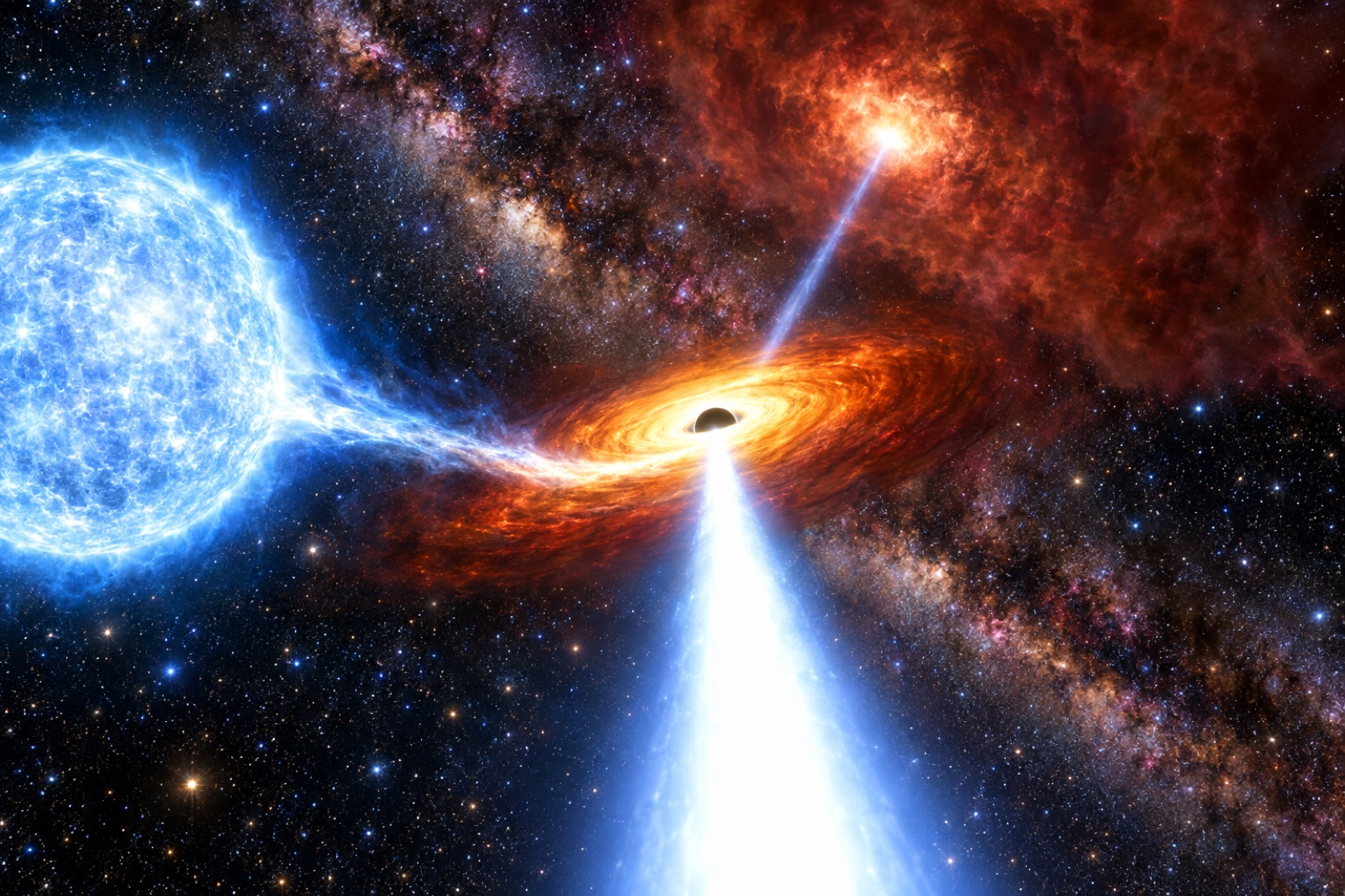
Astronomers have just confirmed it as the first microblazar ever found in the Milky Way. That is a mouthful, so here is the short version: a small black hole, eating a star, with one of its jets pointed our way.
And the strangest part is not the black hole. It is that this thing was first spotted in 1983, written into a catalogue, and then mostly forgotten for decades.
What Is a Microblazar?
To understand the first microblazar, start with its big cousin, the blazar.
Some galaxies have a giant black hole at their centre, millions or billions of times heavier than our Sun. When those black holes feed, they can blast out two narrow jets of matter in opposite directions, moving at close to the speed of light.
Most of the time we see those jets from the side. But now and then, one jet happens to point almost straight at Earth. When that happens, the jet looks far brighter than it really is, a bit like the difference between seeing a torch from the side and having someone shine it right in your eyes. Astronomers call that kind of object a blazar.
Until now, every known blazar sat in a far-off galaxy, powered by one of those giant black holes. That distance is a real problem. As Benito Marcote of ASTRON and JIVE in the Netherlands put it, “Those blazars are too far away to image in detail.”
A microblazar is the same idea, shrunk down. Instead of a giant black hole at the heart of a galaxy, it is a small black hole, the leftover of a single dead star, feeding on a living star right next to it. According to the University of Amsterdam, scientists predicted these objects about thirty years ago. Nobody had confirmed one in our galaxy until this one.
Meet IRAS 18293-0941
The object has a name only a catalogue could love: IRAS 18293-0941.
Here is what the research team found:
- A black hole about ten times the mass of our Sun, according to the University of Amsterdam.
- A hot, massive companion star circling it about every 11.4 days.
- The black hole pulls gas off that star into a spinning disc. Some of that gas is thrown out in two jets just before it falls in.
- The system sits roughly 12,000 light-years away, inside our own galaxy.
- One jet points almost straight at Earth. Reports put its speed at about three quarters of the speed of light.
The study, led by Josep Martí of the University of Jaén in Spain, with researchers from Spain, the Netherlands and Argentina, was published in the journal Astronomy & Astrophysics in September 2026. You can read the University of Amsterdam’s summary of the discovery.
And no, it is not a danger to us. “In the firing line” makes a good headline, but at that distance this beam is something astronomers measure, not something anyone on Earth will ever feel.
Hiding in Plain Sight Since 1983
This is the detail most headlines skipped.
IRAS 18293-0941 was not discovered this year. The IRAS satellite first picked it up in 1983, as a warm glow of dust in infrared light. It went into a catalogue as one more entry among many.
Why did nobody notice what it was? Because it sits behind so much dust that ordinary telescopes cannot see it at all. In Martí’s words, “It sits behind so much dust that it is essentially invisible in ordinary optical images.” He summed up the whole story in one line: “Everything about IRAS 18293-0941 was hiding in plain sight.”
Over the years, radio telescopes kept seeing a bright, compact core that seemed to shine from one side only, a hint of a jet. It took a huge joint effort to put the clues together: radio images from the MeerKAT telescope in South Africa and the European VLBI Network, plus optical, X-ray, gamma-ray and infrared data. As co-author Jakob van den Eijnden of the University of Amsterdam said, “No single telescope could have told the whole story.”
The Jet You Can See and the Jet You Can’t
Every jet like this comes in a pair. So where is the second one?
It points away from us, and that makes it very hard to see. The same effect that makes the near jet look extra bright makes the far jet look extra faint.
But the far jet gave itself away by hitting something. On its way out, it crashes into a dense cloud of gas and dust. Where it strikes, it leaves a bright spot, heating the dust and lighting up the gas. Researcher Pedro Luque-Escamilla described it neatly: “The jet does the accelerating. The cloud does the shining.”
That collision may matter far beyond this one object. The team thinks particles at the impact site may be pushed to enormous energies, possibly in the “peta-electronvolt” range. The University of Amsterdam says that would make the system roughly 100 times more powerful than the Large Hadron Collider, the biggest particle machine humans have built. If that holds up, microblazars could help explain where some of the fastest particles in our galaxy come from, a question that has puzzled scientists for more than a century.
The researchers are careful here, and it is worth being careful with them. The high energies are described as “likely,” not proven. And there is one open puzzle: blazars are expected to flicker quickly in brightness, and this one does not seem to. Martí has suggested the thick cloud around it could be smoothing those quick changes out. That is a reasonable idea, but it is still an idea.
If you enjoy stories where the answer was sitting in old data all along, you might also like how astronomers found a planet that may have been born from a dead star, a clue that sat in a Hubble file since 1999. Or how scientists learned that the matter which filled the newborn universe flows like a liquid.
Two Ways to Be Seen
Step back and look at how this object finally got noticed.
One jet got seen because it was aimed straight at the people watching. The other jet got seen only because it slammed into something. Everything else about the system sat behind the dust, in a catalogue, for more than forty years.
That is how it works out there. And if we are honest, it is how a lot of us feel it works down here, too. You get noticed if you point all your light at the right people. Or you get noticed when something crashes. The rest of the time, it can feel like you are an entry in a list that nobody reads.
There is a very old conviction, much older than any telescope, that runs the other way. It says you were never waiting to be found. That before you aimed anything at anyone, before anything in your life went bang, God already saw you clearly, dust and all, and was not looking away.
You do not have to believe it to notice how different it is from the way the sky works.
A good place to start:
The Beginner’s Guide to Feeling God’s Presence Every Day
A short video guide and companion PDF to help you notice God in the ordinary moments of real life, including the quiet, overlooked ones.
Get the free guide
Free.
Meanwhile, 12,000 light-years away, the black hole keeps feeding, the star keeps circling every eleven days, and the cloud keeps shining where the far jet hits it. It was doing all of that in 1983, when it was just a line in a catalogue. It just took us a while to look properly.
Q&A: The First Microblazar in the Milky Way
What is a microblazar?
A microblazar is a small, star-sized black hole feeding on a companion star, with one of its jets pointed almost directly at Earth. It is a smaller version of a blazar, which is a giant black hole at the centre of a distant galaxy whose jet points toward Earth. Scientists predicted microblazars about thirty years ago, and IRAS 18293-0941 is the first one confirmed in the Milky Way.
How far away is the microblazar IRAS 18293-0941?
The microblazar IRAS 18293-0941 is roughly 12,000 light-years from Earth, inside the Milky Way. It is a black hole of about ten times the Sun’s mass, orbited by a hot, massive companion star roughly every 11.4 days. It poses no danger to Earth.
Why wasn’t IRAS 18293-0941 noticed sooner?
IRAS 18293-0941 sits behind thick clouds of dust that make it almost invisible to ordinary optical telescopes. The IRAS satellite first recorded it in 1983 as an infrared source, but it was not identified as a microblazar until a multi-telescope study, published in Astronomy & Astrophysics in 2026, combined radio, optical, X-ray, gamma-ray and infrared observations.
Can a black hole jet pointed at Earth hurt us?
No. The jet from the microblazar IRAS 18293-0941 points roughly toward Earth, but the system is about 12,000 light-years away. At that distance the jet is something astronomers can detect and study with telescopes, not something that affects life on Earth.
Could microblazars explain where cosmic rays come from?
Possibly. In IRAS 18293-0941, the jet pointing away from Earth crashes into a dense gas cloud, and researchers think particles there are likely accelerated to peta-electronvolt energies. That would make objects like this a candidate source of some of the highest-energy particles in the Milky Way. The researchers describe this as likely, not yet proven.
Discussion Question
This black hole was catalogued in 1983 and only understood in 2026. Do you think there are other “hiding in plain sight” discoveries already sitting in old data, waiting for someone to look again? What would you want scientists to go back and check? Share your thoughts in the comments below.
Share This
“There’s a black hole in our own galaxy with a jet pointed almost straight at Earth. It was first spotted in 1983, then sat in a catalogue for decades before anyone realised what it was.”
“Favourite line from the new microblazar discovery: ‘The jet does the accelerating. The cloud does the shining.’ One jet is seen because it points at us. The other only because it hits something.”
“Some things aren’t hidden. They’re just waiting for someone to look properly.”