 0
0
 0
0
You’re in a meeting. Someone confident, someone with a title, says something that’s just… wrong. Not maliciously wrong — just off. Half the room nods along because they don’t know any better, and you happen to know better. You have maybe three seconds to decide what to do with that.
Correct them right there, in front of everyone, and you look sharp — but they look small, and they’ll remember who made them look small a lot longer than they’ll remember what you actually said. Say nothing, and the wrong information stands, repeated as fact by people who trusted the wrong voice in the room. Or there’s a third option, the one that takes more restraint than either of the first two: wait. Catch them after. Say it quietly, one person to another, where nobody has to lose face for the truth to land.
Almost two thousand years ago, a woman named Priscilla faced that exact fork in the road — except the stakes weren’t a meeting agenda. They were the accuracy of the gospel being taught to a growing city. And the person she’d need to correct wasn’t a peer. He was, by every account, one of the most gifted public speakers the early church would ever produce.
The Preacher Who Was Missing Something
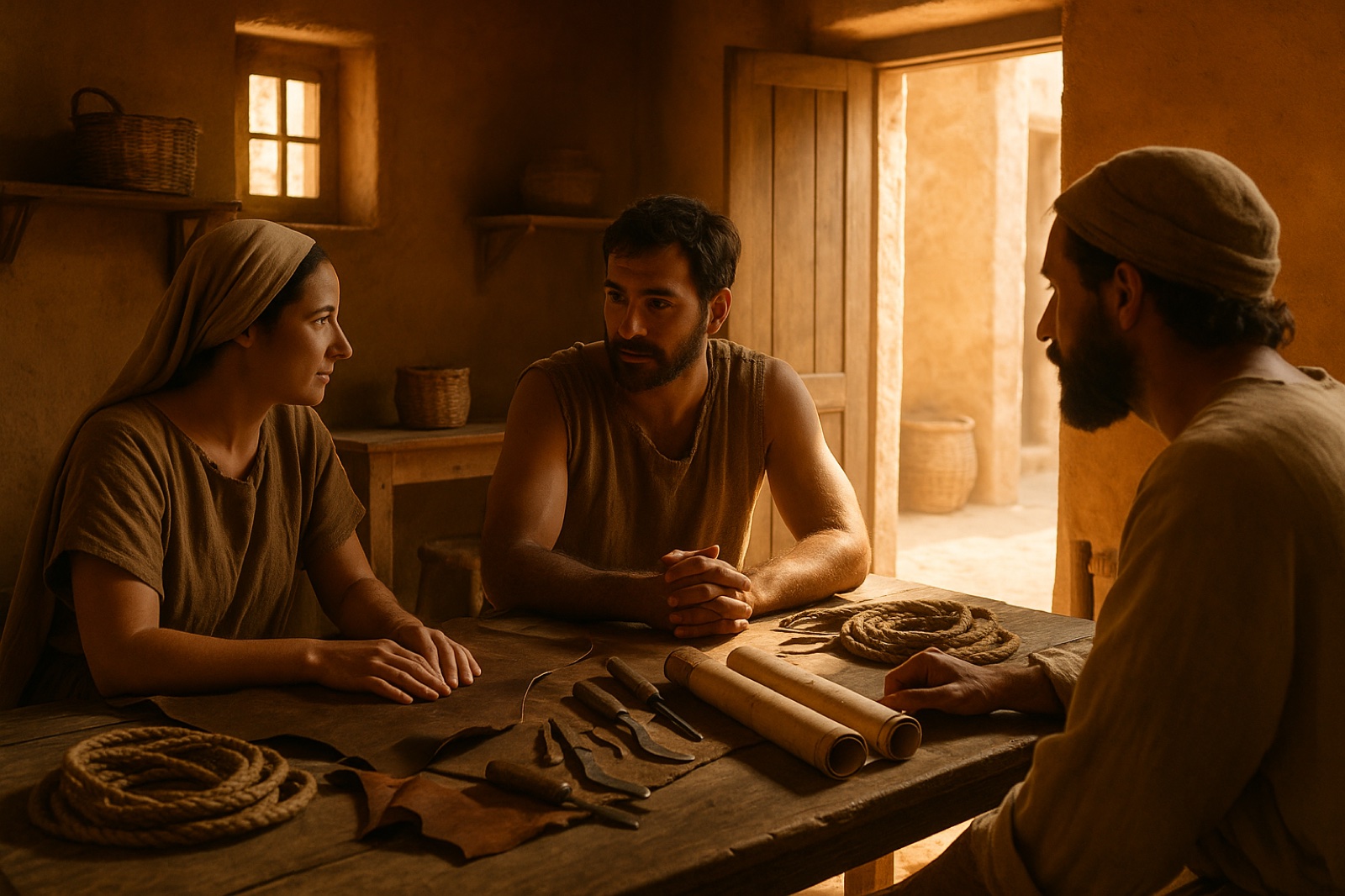
By the time Priscilla and her husband Aquila settled in Ephesus, they’d already lived through a lot together. They were Jewish tentmakers, a trade that meant working with your hands — cutting, stitching, and stretching heavy leather and cloth into shelter. Sometime around AD 49, Emperor Claudius expelled the Jews from Rome, and Priscilla and Aquila landed in Corinth, where they crossed paths with a traveling rabbi named Paul, who happened to share their exact trade (Acts 18:1-3). They worked together, lived together, and somewhere in that shared workshop, a friendship became a partnership in something much bigger than tents.
Paul eventually brought them to Ephesus and left them there while he continued traveling (Acts 18:18-19). Their partnership with Paul is its own remarkable story — you can read more about what Aquila’s side of that ministry looked like here. But it’s in Ephesus that this story turns to a man named Apollos.
Scripture describes Apollos in language it rarely uses for anyone: “an eloquent man, and mighty in the scriptures… fervent in the spirit,” teaching “diligently the things of the Lord” (Acts 18:24-25). He wasn’t a fringe figure or a fraud. He was talented, trained, and drawing real crowds in the synagogue. There was just one problem — his theology had a gap. He knew “only the baptism of John,” meaning he was preaching a version of the gospel that stopped short of the fuller truth of what Jesus’s death, resurrection, and the gift of the Spirit actually meant. He was teaching accurately as far as he knew — he just didn’t know the whole thing yet.
What Priscilla Didn’t Do
Here’s where the story usually gets rushed past, and where it deserves to slow down. Priscilla and Aquila were in that synagogue. They heard the gap in his teaching. And by every social convention of the ancient world, they had every reason to stay quiet: he was the trained public teacher, they were tradespeople. He was a man in a culture where a woman correcting a man’s public religious teaching would have been almost unthinkable. He had the platform. They had a workshop.
They didn’t interrupt him. They didn’t stand up in the synagogue to publicly set the record straight, even though that would have been the fastest way to be seen as right. Instead, Scripture says something remarkably restrained: “they took him unto them, and expounded unto him the way of God more perfectly” (Acts 18:26, KJV).
They took him aside. Privately. Into their home, most likely — the same home that had already become a gathering place for believers (1 Corinthians 16:19, Romans 16:3-5). And there, one-on-one, they filled in what he was missing.
The result tells you everything about whether it worked. Apollos didn’t get defensive. He didn’t dig in or discredit the tentmakers who’d corrected him. He went on to Achaia, where Scripture says he “helped them much which had believed through grace” and “mightily convinced the Jews… shewing by the scriptures that Jesus was Christ” (Acts 18:27-28). The correction didn’t diminish him. It’s part of what made him more effective. Because it happened in private, he got to receive the fuller truth without losing the room. He walked out with his dignity intact and his message complete.
The Detail Easy to Miss: How She’s Named
Here’s the part of this story that rewards a second look. Priscilla and Aquila are named together six times across the New Testament, written by two different authors — Luke in Acts, Paul in his letters. In four of those six mentions, including the verse about correcting Apollos, Priscilla is named first (Acts 18:18, 18:26, Romans 16:3, 2 Timothy 4:19). That’s backwards from the naming convention of the time, where the husband’s name almost always came first as a matter of course.
That’s not a scribal accident repeated by two separate writers. It’s a pattern consistent enough that it reads as exactly what it looks like: in this partnership, Priscilla’s teaching gift was, if anything, the more prominent of the two. And yet — this is the detail worth sitting with — Aquila is never dropped from the sentence. He’s never made invisible so Priscilla’s contribution can stand out more clearly. They’re named as a pair, every time, and within that pair her voice is never diminished, but neither is his.
It’s easy to build a devotional lesson entirely around Priscilla correcting Apollos and skip right past this. But the two details belong together. This is a couple that managed to avoid two very different, very common failures at once: the failure of correcting someone in a way that costs them their dignity, and the failure of a partnership where one person quietly disappears so the other can shine. Priscilla and Aquila did neither. They corrected without humiliating, and they succeeded without erasing.
Scripture is full of women whose real contribution gets easy to overlook if you’re only skimming for the headline. Rahab’s story works the same way — a single verse can carry a lot more weight than it first appears to.
None of this required Priscilla to stop being who God made her to be in order to make room for her husband, either. Martha wrestled with a version of this same tension in Luke 10 — the pull between doing something visible and doing the thing God actually asked for.
Why This Matters for a Life Without a Stage
Most of us have quietly absorbed the idea that influence needs a platform to count — a title, a following, a byline, a name people already know. But the most theologically significant correction recorded in the entire early church didn’t happen from a pulpit. It happened at a kitchen table, delivered by someone the Bible never once calls an apostle, an elder, or an ordained anything. Just a tentmaker who knew the truth and cared more about Apollos getting it right than about being the one who got to say it in front of a crowd.
That’s the real turn in this story: God was never waiting for Priscilla to get a bigger platform before He’d use what she knew. He needed her willing to use it in the room she was already standing in, with the person right in front of her, without needing credit for it to count. If you’ve ever felt like your knowledge, your gift, or your quiet correction of something doesn’t matter because nobody’s watching — this is the story that says otherwise. The way of God was made “more perfect” for one of history’s great preachers around a table nobody was filming.
And the naming pattern adds a second layer worth carrying into your own relationships, whether that’s a marriage, a business partnership, or a friendship where you do most of the quiet, unglamorous work. You don’t have to choose between being genuinely gifted and staying genuinely humble. You don’t have to disappear for someone else to be seen, and you don’t have to eclipse someone else to be seen yourself. Priscilla and Aquila are proof that real partnership can hold both names, in whatever order the moment actually calls for — no one erased, no one diminished.
Actions to Take This Week
- Send the private message you’ve been holding back. Think of one thing — a correction, a piece of context, an encouragement — you’ve noticed but haven’t said because it felt safer to stay quiet in public. Text or message that person privately today, the way Priscilla pulled Apollos aside.
- Check how you’re naming your own partners. Look at your last few emails, texts, or a shared project — are you crediting the people who build things alongside you, or letting your own name stand alone? Add one name back in today where it belongs.
- Name one piece of knowledge you’re sitting on. Write down one thing you understand that someone in your life doesn’t yet — and send them two honest sentences about it before the day ends, without waiting to be asked.
A Prayer for the Quiet Correction
God, I don’t always know what to do with what I know. Sometimes I stay quiet when I should say something, and sometimes I want the credit more than I want the truth to land well. Give me Priscilla’s restraint — the wisdom to pull someone aside instead of calling them out, and the patience to let the truth be more important than being right in front of an audience. Help me use what You’ve given me right where I am, even when no one’s watching, and help me name the people who build things with me instead of standing alone. Thank You for not waiting on a stage to use me. Amen.
A Question Worth Sitting With
Do you think a private correction, delivered with care, is ever more powerful than a public one — even when the public one would prove you right faster? What would change if you believed that?
We’d love to hear where you land — drop your answer in the comments.
Share This
- “Priscilla didn’t need a pulpit to change history. She needed a kitchen table and the courage to say something true, quietly.”
- “The most important theology correction in the early church happened in private, from a tentmaker, to one of the greatest preachers of the age. #Priscilla”
- “You don’t need the spotlight for your knowledge to matter. You need the room you’re already standing in.”
Questions People Ask About Priscilla in the Bible
Who was Priscilla in the Bible?
Priscilla was a first-century Jewish tentmaker, married to Aquila, who became close ministry partners with the apostle Paul and personally instructed the preacher Apollos in Ephesus. She’s mentioned six times in the New Testament, always alongside her husband.
Why is Priscilla sometimes named before Aquila?
In four of the six New Testament mentions of the couple (Acts 18:18, 18:26, Romans 16:3, 2 Timothy 4:19), Priscilla is named first — unusual for the era, when husbands were almost always named first. Many scholars read this as reflecting her prominent teaching role in their shared ministry.
What did Priscilla and Aquila teach Apollos?
Apollos was accurately teaching what he knew, but he only understood “the baptism of John” — an incomplete picture of the gospel. Priscilla and Aquila privately explained “the way of God more perfectly” (Acts 18:26), most likely filling in the full meaning of Jesus’s death, resurrection, and the Holy Spirit.
Was Priscilla a pastor or teacher in the early church?
The Bible doesn’t assign her a formal title like apostle or elder, but it does show her actively teaching sound doctrine to a gifted public preacher — a level of theological involvement Scripture records for very few women, or men, by name.
What can Priscilla and Aquila teach us about marriage?
Their partnership models something rare: neither spouse disappears so the other can shine. Priscilla’s teaching gift is evident, but Aquila is never dropped from the story. They’re consistently named as a team, with both contributions honored.