 0
0
 0
0
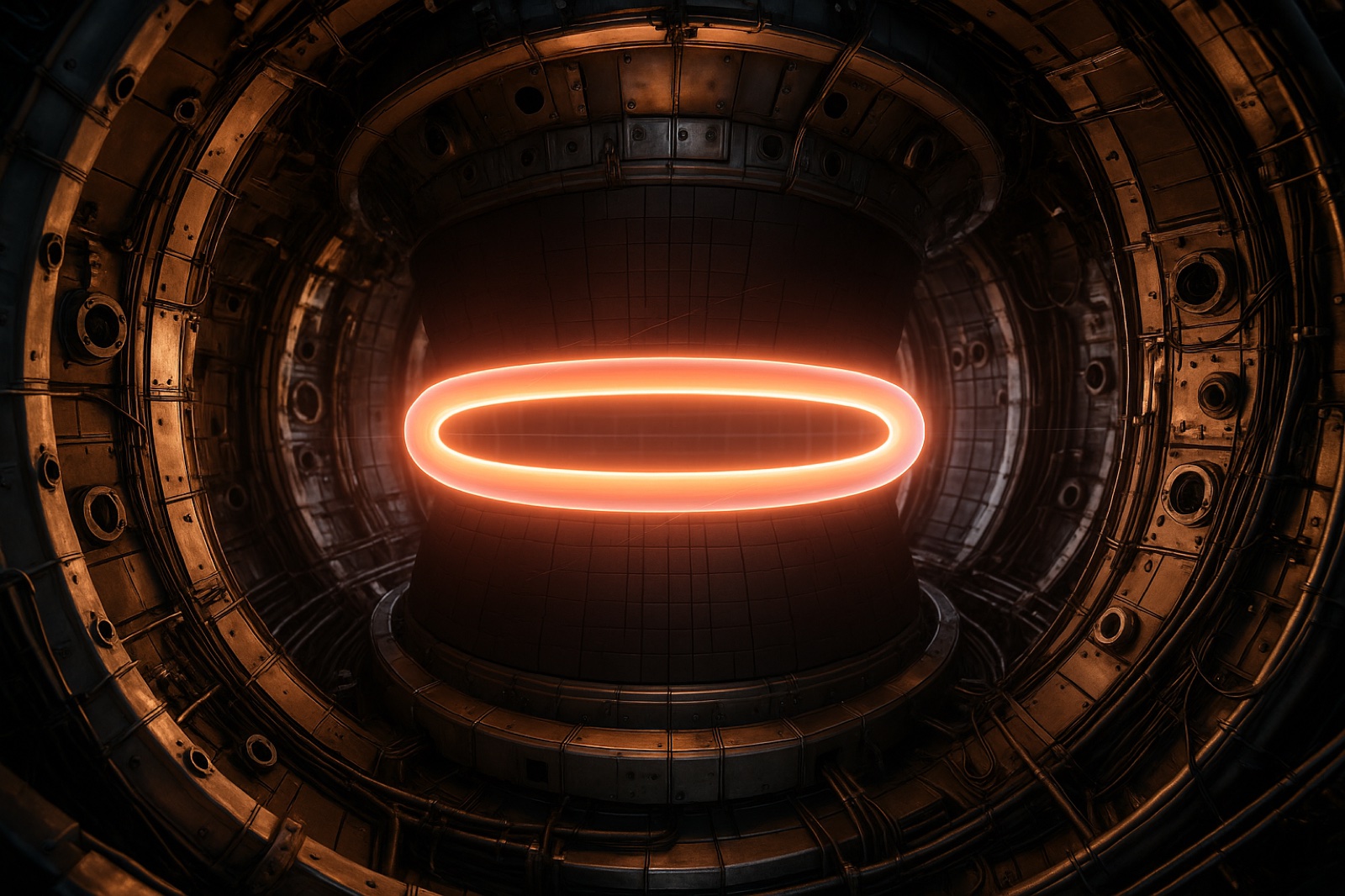
Somewhere in San Diego there is a metal ring with a gas inside it that is not really a gas any more. It has been heated until the atoms come apart. The laboratory that runs it describes the particles in there as hotter than the core of the sun.
That fuel is held up by magnets, in mid-air, touching nothing. And it does not always cooperate. It can start to go wrong in a few thousandths of a second — faster than any person can react.
This month a Princeton team described what their AI fusion plasma control framework did about that. It watched the fuel, saw one specific kind of failure coming about 200 milliseconds before it arrived, and quietly changed the conditions so that it never arrived at all.
That is the headline everyone ran. The more interesting part is sitting underneath it.
What a Tearing Mode Actually Does
The failure has a name: a tearing mode.
Picture the hot fuel as a smooth, fast-moving ring. A tearing mode is what happens when the magnetic structure holding that ring stops being smooth. Little islands open up inside it. The heat leaks where it should not. Left alone, the tear can grow until the whole reaction simply stops.
It is not an explosion. A machine like this does not melt down — pull the plug and the fuel cools and disappears almost instantly. But a tear ends the run. Months of preparation, gone in a moment, and nobody gets the data they came for.
Here is the problem that has never had a good answer. A normal control system can only see a tearing mode once it has already begun. By then the machine is not preventing anything. It is reacting to something that has already started to break.
AI Fusion Plasma Control and the 200 Milliseconds That Made Headlines
The framework is called PACMAN, short for Prediction And Control using MAchiNe learning. It is not one clever model. It is a socket — a way for several different AI models to plug straight into the machine’s real control system, read what the fuel is doing, and issue orders back.
Across five separate experiments on the DIII-D National Fusion Facility, that socket let AI models do five different jobs. One took full control of the heating. One watched for sudden bursts of energy at the edge of the fuel. One tracked waves stirred up by fast particles. One steered the density and the spin toward numbers the researchers had chosen.
And one predicted a tearing mode roughly 200 milliseconds ahead of time and stopped it from forming.
Two hundred milliseconds is about how long it takes you to blink. It is not long. But it is an eternity compared to reacting after the fact, and it is the whole difference between preventing a tear and cleaning up after one.
The work was published in the journal Nuclear Fusion in July 2026, and the laboratory walked through the results publicly this month.
The Part Almost Nobody Reported
Now for the thing that is easy to miss.
The 200-millisecond trick is not new. Back in 2024, Princeton researchers had already shown on this same machine that an AI could forecast a tearing mode a few hundred milliseconds out and adjust the settings to dodge it. It made news then too.
So if the prediction is not the new thing, what is?
The answer is boring in the way that important things usually are. It stopped being a demonstration.
Egemen Kolemen, one of the researchers behind it, put it plainly in the laboratory’s announcement: the modular design “is what turns AI plasma control from a series of one-off demonstrations into infrastructure.”
Read that again, because it is the actual story. A one-off demonstration is a stunt. Somebody proves a thing can happen once, under good conditions, with the right people in the room. Infrastructure is different. Infrastructure is the thing that keeps working on an ordinary Tuesday when nobody is watching and nobody is impressed.
The framework is built to be moved. Different sizes of machine, different shapes, different instruments — including machines that have not been designed yet. That portability is the point. We have seen the same gap in other corners of technology, where a system that works brilliantly is not the same thing as a system anyone can actually use.
It Runs Again. And Again. And Again.
There is one more detail, and it is the one that has stayed with me.
Andy Rothstein, the paper’s lead author, described how the framework actually behaves: “The whole PACMAN framework typically runs in about 20 milliseconds, and it’s not running once. It’s running again and again and again.”
Twenty milliseconds. Then twenty more. Then twenty more. All day. Whether anything is going wrong or not.
So the dramatic save — the 200 milliseconds, the tear that never happened — was not really a moment of genius. It was what a loop produces when it has been running quietly the entire time. The save is visible. The loop is not. But the loop is the reason the save exists.
Two other things sit around that loop, and both of them are limits.
The first is that the machine enforces its own hardware safety boundaries no matter what any AI model recommends. The model can ask for anything. The limits were set before the experiment began, and they do not negotiate.
The second is that a human still decides what “good” means. As the team put it, however sophisticated the controllers get, in the end it is a human operator who sets the parameters for that control. The AI owns the split-second moves. It does not own the goal.
There is a very old idea shaped almost exactly like this. Long before anyone could measure a millisecond, people writing about God kept describing care in the same three parts: an attention that never stops running rather than a rescue that shows up once, mercy spoken of as something renewed every single morning, and an answer that arrives before anyone has finished getting the words out. Limits set in advance, out of love rather than restriction. A goal chosen by someone who actually knows where the whole thing is going.
It is a strange thing to find that design at the bottom of a control system paper. But there it is.
What Holds
Fusion is still hard. Five experiments on one machine is not a power station, and nobody involved is pretending otherwise. The honest summary is that a difficult control problem got a little less difficult and a lot more portable.
Still, something about it is worth carrying around.
We tend to admire the catch — the last-second stop, the near miss, the story you can tell afterwards. Almost none of that is where the safety actually lives. The safety lives in the unglamorous loop that ran ten thousand times before the moment anyone noticed, and in the boundaries someone had the sense to fix before there was any pressure to move them.
That is true of a machine holding star-hot fuel in mid-air. It is also, more or less, true of a week.
And if you enjoy this kind of scale — things too fast or too old or too far away to picture properly — you might like our free How Old Is the Universe? Explorer, which walks the whole timeline out in a way you can actually hold in your head. It pairs oddly well with a story about 20 milliseconds. And for a different flavour of the same thing, there is the question of why a major AI programme picked the name it did.
A Question for You
Here is what I keep turning over. We are getting comfortable letting machines make decisions we are physically too slow to make ourselves — in reactors, in cars, in hospitals. That trade seems clearly worth it here, where the alternative is a ruined experiment.
Where would you draw the line? Which split-second decisions should stay with a person even if a machine would objectively make them better? Tell me in the comments — I would genuinely like to know where other people put that boundary.
Share This
If any of this was worth your time, pass it on:
- An AI just stopped a fusion plasma from tearing itself apart 200 milliseconds before it happened. But the 200 milliseconds isn’t the news. The news is that it stopped being a demo. https://bgodinspired.com/index.php/bgodinspired-news/ai-fusion-plasma-control-200ms/
- “It’s not running once. It’s running again and again and again.” A fusion control loop that runs every 20 milliseconds, all day, whether anything is wrong or not. The dramatic save is just what a quiet loop looks like from outside.
- Favourite detail from this: no matter what the AI recommends, the machine enforces safety limits that were set before the experiment began. The limits don’t negotiate. Honestly a good rule for more than reactors.
Questions People Ask
What is AI fusion plasma control?
AI fusion plasma control is the use of machine learning models to monitor and steer the superheated fuel inside a fusion device in real time. Fusion fuel can become unstable within a few thousandths of a second, which is faster than a human operator can react. Princeton Plasma Physics Laboratory and Princeton University built a framework called PACMAN, short for Prediction And Control using MAchiNe learning, that lets several AI models plug into a tokamak’s control system, read plasma measurements, and issue commands in roughly 20 milliseconds. Results from five experiments were published in the journal Nuclear Fusion in July 2026.
What is a tearing mode in a fusion reactor?
A tearing mode is an instability in which the magnetic structure confining fusion fuel breaks up and forms magnetic islands inside the plasma. Heat escapes through those islands, and if the tear grows the fusion reaction can end entirely. A tearing mode is not a meltdown — a tokamak’s fuel cools and disappears almost immediately once power is cut — but it destroys the experimental run. Conventional control systems can only detect a tearing mode after it has already started, which is why predicting one in advance matters.
How far in advance can AI predict a plasma instability?
In experiments on the DIII-D National Fusion Facility in San Diego, the PACMAN framework predicted a tearing mode roughly 200 milliseconds before it would have formed and adjusted the plasma so that it never formed. An earlier Princeton result reported in 2024 forecast tearing modes up to about 300 milliseconds ahead on the same machine. These figures come from specific experiments on one device and should not be read as a general guarantee for every fusion machine.
Do humans still control an AI-run fusion experiment?
Yes. In the PACMAN framework the artificial intelligence handles split-second adjustments, but a human operator sets the parameters and goals the control system is aiming for. The system also applies hardware safety limits regardless of what any AI model recommends, so the machine’s physical boundaries are fixed in advance and cannot be overridden by a model’s suggestion.
Does this mean fusion power is ready?
No. The PACMAN results cover five experiments on a single research tokamak, not a working power station. The significant claim the researchers make is about portability rather than power output: the framework’s modular design is intended to work on tokamaks of different sizes, shapes and instrumentation, including machines that have not yet been built. Fusion energy on the electricity grid remains a much larger unsolved engineering problem.