 0
0
 0
0
Here is a simple question. If you turned on more lights on a dark street, would fewer people get hurt there?
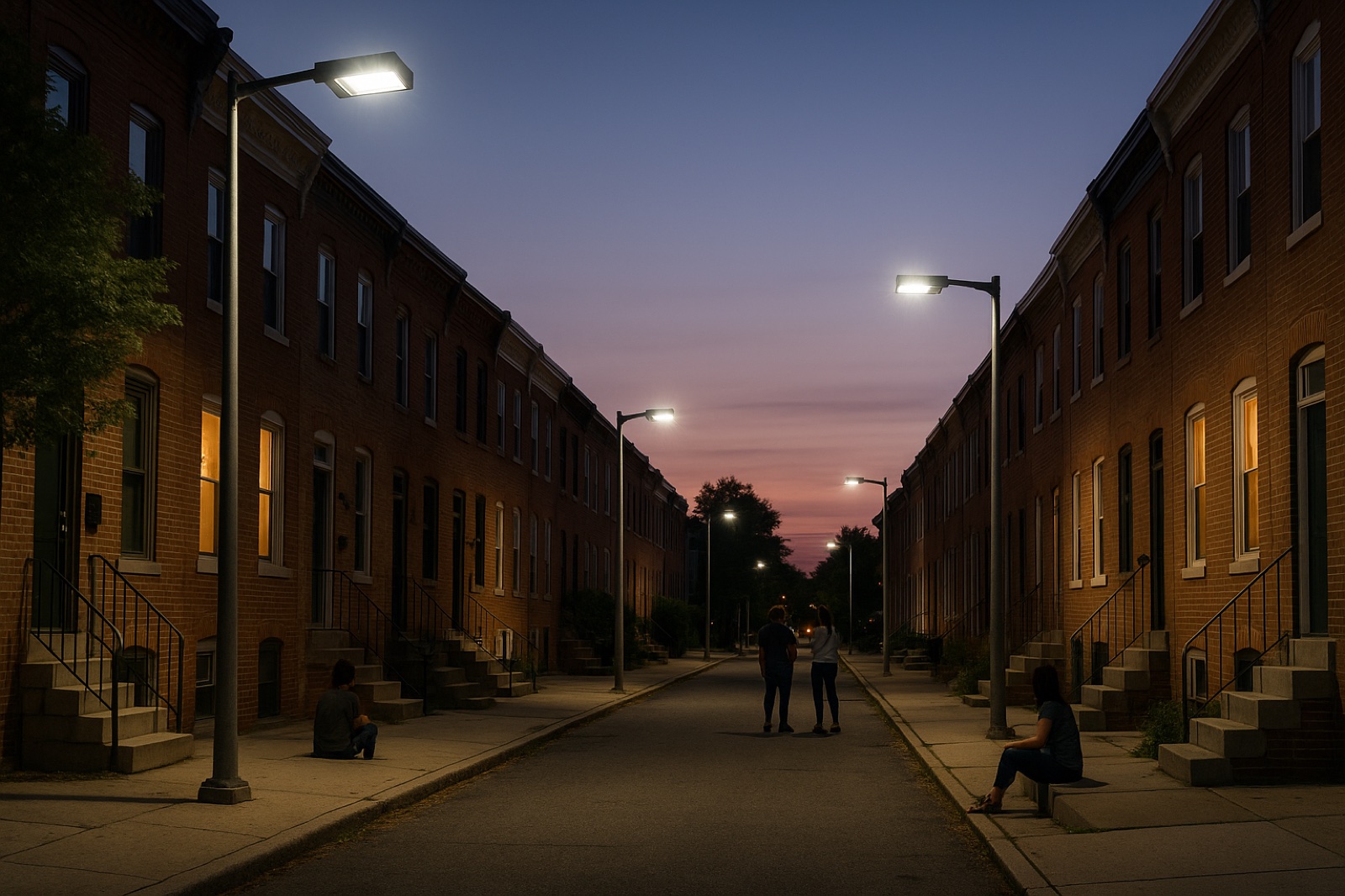
The city of Newark, New Jersey, tried it at scale. Between 2019 and 2021, more than 1,500 old sodium streetlights in the city’s worst nighttime crime spots were swapped for brighter LED lights. Researchers at Rutgers University–Newark then tracked what happened. The answer to the question is yes. Street lighting and crime are connected, and the drop was big.
But the most important thing the study found is not the headline number. It is what happened next.
What the Newark Street Lighting Study Found
The study was published in the Journal of Quantitative Criminology. The researchers tracked nighttime crime in the places that got the new lights, using a design built to separate the effect of the lights from everything else going on in the city.
Here is what the researchers reported:
- Violent crime dropped by nearly 46 percent in the areas that got the brighter lights.
- Burglaries dropped by 58 percent.
- Crime did not simply move next door. The researchers found no sign that it was pushed into nearby streets.
The lights did not go up at random. A local team called the Newark Public Safety Collaborative studied five years of nighttime violent crime — assaults, robberies, murders and sexual assaults — to find the exact spots where darkness and danger overlapped. The power company PSE&G, city officials, residents and dozens of community groups all worked together to choose where the lights would go.
The researchers say it was the first study of its kind to measure the effect across a whole city, rather than one neighbourhood or one housing block at a time.
Why Brighter Lights Change What Happens at Night
It is not magic. Light changes who can see what.
When a corner is dark, a person planning harm can guess that nobody is watching. When the same corner is bright, that guess gets harder to make. Neighbours can see the street from their windows. People walking by can see faces. Police driving past can see more.
Light also changes how people use a place. When a street feels safer, more people walk on it, sit outside, and stay out a little longer. And a street full of ordinary people is a hard place to do something you don’t want seen.
Newark is not the only place this has been tested. In New York City, a randomised experiment that began in 2016 put bright temporary lights in 80 public housing developments. Researchers later reported a 36 percent drop in nighttime outdoor serious crime in the places that got the lights. Newark’s study adds something new: it shows the effect across a whole city.
The Part Most Headlines Skip: The Effect Faded
This is where the story gets more interesting.
In Newark, the big drop in violent crime was strongest for about six months. Then it faded. The lights were still on. The poles were still standing. But over time, the effect wore off.
Alejandro Gimenez-Santana, who leads the Newark Public Safety Collaborative at Rutgers, put it plainly: “The effect was not permanent. Lighting alone is not the solution.”
So what is? Gimenez-Santana pointed to things like “community-led cleanups, violence interruption efforts, neighborhood engagement and coordination among public safety partners.” And he added this: “The more you engage community organizations and residents to become active co-producers of safety, the more likely you are to obtain better outcomes.”
Read that again. Co-producers of safety. Not the people the lights were put up for. The people who make the light matter.
A new light is a change. At first, everyone notices it. People who planned to do harm change their plans. But a light on a pole is still just a light on a pole. After a while, it becomes part of the background. What keeps a street safe over years is not only what shines on it. It is who is there.
What Actually Keeps a Street Safe
There is something quietly beautiful about where this study landed.
We usually think of light as a thing — a bulb, a lamp, a pole. The Newark data says that works, but only for a season. The light that lasts turns out to be people. The neighbour who knows your name. The shop owner who keeps an eye on the corner. The person who sweeps the pavement, runs the youth football game, or checks in on the elderly woman at the end of the block.
One of the oldest ideas in the world says exactly this — that people themselves are meant to be the light in a place, and that a light is lit to be seen, not hidden under something. It was said about two thousand years ago to a crowd of farmers and fishermen, not engineers. Maybe that is how God has always preferred to light a dark street: not with a fixture, but with a person who stays.
What You Can Do on Your Own Street
You don’t need a city budget to act on this. Most of these cost nothing:
- Learn three names. Know the names of at least three neighbours. People who know each other watch out for each other. (There is even a word for the moment you realise every stranger on your street has a life as full as yours — sonder.)
- Be outside sometimes. Sitting on a step, walking in the evening, or chatting at the gate puts ordinary eyes on the street.
- Turn on your porch or doorway light if you have one. A small light still helps.
- Report broken streetlights. Most cities and councils have a phone line or website for it. A dark stretch often stays dark only because nobody called.
- Join or start something small. A clean-up, a shared meal, a walking group. The Newark researchers say this kind of thing is what keeps the gains from fading.
If fear has made you want to stay inside, that is understandable. But the study points the other way: the streets that stay safest are the ones where people keep showing up. If you want to understand why people in a crowd so often freeze instead of helping, this look at the bystander effect is worth a read.
The Light That Stays On
Newark proved that turning on the lights makes a real difference. Nearly half of the violent crime in those spots went away. That matters. Those are real people who got home safe.
But the study also proved something harder to measure. A light can change a street for a season. People change it for good.
So maybe the best question isn’t “How bright is my street?” Maybe it’s “Who on my street would notice if something was wrong — and am I one of them?”
Discussion Question
Newark’s brighter lights cut violent crime by nearly half — but the effect faded after about six months without community involvement. What do you think makes a street feel truly safe: better lighting, more police, or neighbours who know each other? Share your answer in the comments below.
Share This
Post 1: Newark put brighter lights on its most dangerous streets and violent crime dropped nearly 46%. Then it faded. The researchers’ conclusion? “Lighting alone is not the solution.” People are. https://bgodinspired.com/index.php/bgodinspired-news/street-lighting-and-crime-newark/
Post 2: I didn’t expect a street lighting study to make me want to go meet my neighbours. But that’s exactly where this one lands. https://bgodinspired.com/index.php/bgodinspired-news/street-lighting-and-crime-newark/
Post 3: Brighter lights cut burglaries by 58% in Newark — and crime didn’t just move next door. But the part that stuck with me is why the effect wore off, and what actually keeps a street safe for years. https://bgodinspired.com/index.php/bgodinspired-news/street-lighting-and-crime-newark/
Questions People Ask About Street Lighting and Crime
Does better street lighting reduce crime?
Yes, according to several studies. A Rutgers University–Newark study published in the Journal of Quantitative Criminology found that installing brighter LED streetlights at nighttime crime hot spots in Newark, New Jersey, reduced violent crime by nearly 46 percent and burglaries by 58 percent. A separate randomised experiment in New York City public housing developments, which began in 2016, found a 36 percent drop in nighttime outdoor serious crime where temporary bright lights were added.
How long does the crime reduction from brighter street lights last?
In the Newark study, the drop in violent crime was strongest for about six months after the brighter LED lights were installed and then dissipated over time. Alejandro Gimenez-Santana, who heads the Newark Public Safety Collaborative at Rutgers University–Newark, said the effect was not permanent and that lighting alone is not the solution. The researchers concluded that community-based efforts are needed to sustain the benefit.
Does street lighting just move crime to another area?
The Newark street lighting study found no evidence that crime was displaced into nearby areas when brighter LED lights were installed at crime hot spots. The reduction in violent crime and burglary in lit areas was not offset by an increase in crime on surrounding streets.
Why do brighter lights make streets safer?
Brighter street lighting makes it easier for neighbours, passers-by and police to see what is happening, which makes people planning harm less confident they can act unseen. Better lighting also encourages more people to walk, sit and spend time outside, and a street with more ordinary people on it is harder to commit crime on. Researchers also link good lighting to a stronger sense of community and safety among residents.
What can residents do to make their street safer without spending money?
Residents can make a street safer by getting to know their neighbours by name, spending time outside where they can see the street, reporting broken streetlights to the local council or city, leaving a doorway or porch light on, and joining or starting small community efforts such as clean-ups or walking groups. Researchers behind a Newark street lighting study found that community involvement is what sustains safety gains after new lighting is installed.