 0
0
 0
0
Every October, a lot of people type the same question into their phones: when is the Hunter’s Moon?
Here is the short answer. The Hunter’s Moon is full on Monday, October 26, 2026, at 04:12 UTC. In the Americas, that moment lands on the night of Sunday, October 25. Either way, the moon will look full for about a day on each side. So you get two good nights to see it.
But the name is the more interesting part. It sounds old and a little wild. And where it actually comes from is not quite what most people repeat.
When Is the Hunter’s Moon in 2026?
The exact moment of full moon is 04:12 UTC on October 26, 2026. Here is what that looks like in a few places:
- Los Angeles: 9:12 p.m., Sunday, October 25
- New York: 12:12 a.m., Monday, October 26
- London: 4:12 a.m., Monday, October 26 (UK clocks go back the day before)
- Lagos: 5:12 a.m., Monday, October 26
- Nairobi: 7:12 a.m., Monday, October 26
- Manila: 12:12 p.m., Monday, October 26
Don’t worry if the exact time is in the middle of your day. You can’t see the difference between “full” and “almost full” with your eyes. The best plan is simple: go outside around sunset on the evening of October 25 or October 26 and look east. The moon will be coming up as the sun goes down.
The Hunter’s Moon is the full moon that comes right after the Harvest Moon. This year the Harvest Moon was September 26, so the Hunter’s Moon is the next one, one month later.
Is the 2026 Hunter’s Moon a supermoon?
It depends on who you ask. On October 26 the moon will be about 368,900 km (about 229,200 miles) away. That is a bit closer than average. Some sky guides call that close enough to be a supermoon. Others use a stricter line and say 2026 has only three supermoons: January, November, and December. The closest full moon of the year is December 24.
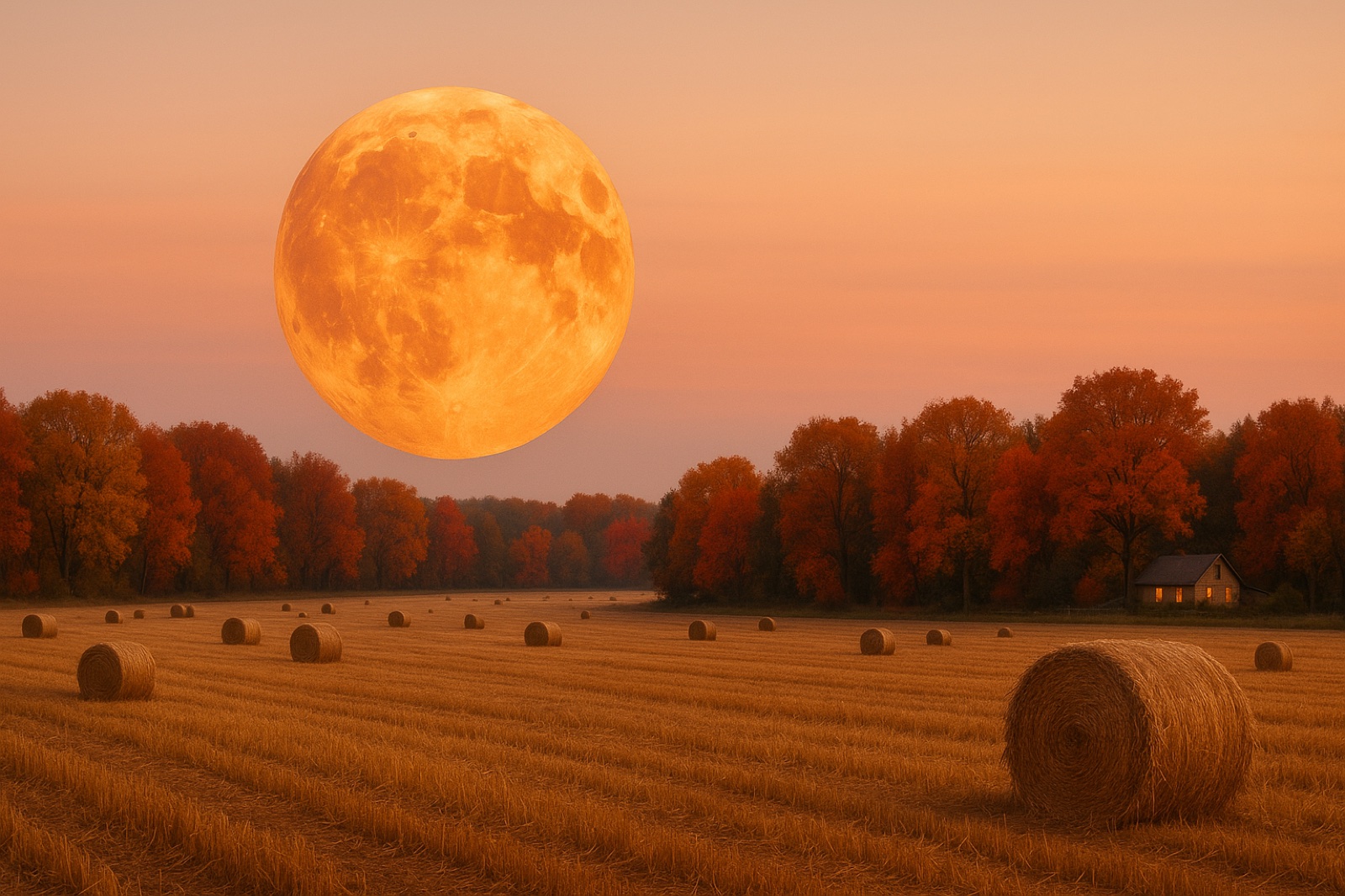
So the honest answer is: maybe, depending on the definition. And either way, it won’t look very different to your eye. What you will notice is how big and orange it looks when it is low near the trees and rooftops. That happens with every full moon at moonrise. The air near the ground filters out the blue light and leaves the warm colors.
Why Is It Called the Hunter’s Moon?
The usual story goes like this. By October, the fields are cut. The crops are in. The animals have fattened up all summer. With the fields bare, hunters could see better. And the bright moon gave them light in the evening to hunt and to get meat stored before winter.
That story makes sense. But here is the part almost nobody mentions.
You will often read that the name comes from Native American tradition. Maybe some of it does. But the oldest written use of “Hunter’s Moon” that dictionary makers have found is not American at all. The Oxford English Dictionary points to an English paper called The British Apollo, from 1710. It doesn’t credit hunters or scholars. It credits the name to “the country people.”
In other words, nobody really invented it. Farm families and village folk were already calling it that, out loud, long before anyone wrote it down. It is a name that came up from the ground, from people who lived by the seasons because they had to.
That is worth holding loosely. The truth is we don’t know exactly who said it first. What we do know is that it was a working name, not a fancy one. It described what the light was for.
Why the Hunter’s Moon Seems to Rise So Early
Here is something you can actually check for yourself.
On most nights of the year, the moon rises about 50 minutes later than it did the night before. So a few nights after a full moon, it is coming up long after dark.
But around the Harvest Moon and the Hunter’s Moon, in places like Europe, Canada, and the northern United States, that gap shrinks. The moon may rise only about half an hour later each night. That means several evenings in a row where the moon comes up soon after the sun goes down.
For people with no electric lights, that was a big deal. It meant extra light, right after sunset, for a string of nights in a row. Just when there was the most to do before the cold came.
The reason is all about angles. In autumn, the moon’s path meets the evening horizon at a low, shallow slant. So each night it doesn’t have to “drop” very far below the horizon. Closer to the equator, the effect mostly fades. And in the southern half of the world, the same effect shows up in March and April instead, because that is their autumn.
What the Hunter’s Moon Was Really About
It is easy to hear “Hunter’s Moon” and think of something a little scary. Cold nights. Shorter days. Winter coming.
But that is not how the people who named it saw it. To them, this moon was not a warning. It was help. It was light, given at the very time they needed to get ready.
Think about how different that feels. Winter was coming either way. The moon did not cause it and could not stop it. What the moon did was give people a little more time, a little more light, to prepare. The fear was real. But so was the light.
Most of us don’t hunt or fill a cellar anymore. But we still know that feeling. The bill that is coming. The hard season at work. The change in the family that we can see on the horizon. And most of us still fall into one of two traps. We pretend it’s not coming. Or we stare at it in fear and freeze.
The country people who named this moon did neither. They looked up, saw the light, and went to work.
There is a very old piece of wisdom about this. It says to go and look at the ant. The ant has no boss standing over it. No one tells it what to do. And still, all summer, it quietly gathers its food. It doesn’t panic about winter. It just gets ready, a little at a time, while the light is good.
People of faith have long believed that the moon was not an accident in the sky. That it was set there for the seasons on purpose. That the light comes when it is needed because Someone meant it to. You don’t have to believe that to enjoy the moon. But it’s a lovely thought to carry outside with you on a cold October night: that the light was given, and given right on time.
How to Watch the Hunter’s Moon
You don’t need anything special. Here’s all it takes:
- Pick your night. October 25 or 26, 2026. If it’s cloudy, try the night before or after.
- Go out around sunset. Look east. The moonrise is the best part.
- Find something low on the horizon. Trees, rooftops, hills. The moon looks biggest when it is next to things you know the size of.
- Give it ten minutes. Watch it lift and change from deep orange to pale gold to bright white.
- Do one small “getting ready” thing. In the spirit of the name, pick one thing you’ve been putting off before the season changes, and start it that night. Just one.
If you love noticing how autumn quietly works, you might also like why leaves change color. The yellow was hiding in the leaf all summer long.
Questions People Ask About the Hunter’s Moon
When is the Hunter’s Moon in 2026?
The 2026 Hunter’s Moon is full on Monday, October 26, 2026, at 04:12 UTC. In North and South America that is the evening or late night of Sunday, October 25. The moon looks full for about a day before and after, so the evenings of October 25 and 26 are both good times to watch it rise in the east around sunset.
Why is it called the Hunter’s Moon?
The Hunter’s Moon is the first full moon after the Harvest Moon, usually in October. By tradition, it was named for the bright evenings it gave people to hunt and store meat before winter, when fields were cut and animals were well fed. The oldest written use of the name found by the Oxford English Dictionary is in an English paper, The British Apollo, from 1710, which says the name came from “the country people.”
Is the October 2026 Hunter’s Moon a supermoon?
Sources disagree. On October 26, 2026, the moon is about 368,900 km from Earth, a little closer than average, so some guides call it a supermoon. Others use a stricter definition and count only the January, November, and December 2026 full moons as supermoons. The difference in size is very hard to see with the naked eye.
Why does the Hunter’s Moon look orange?
The Hunter’s Moon looks orange mainly when it is low near the horizon, right after it rises. Its light passes through more of Earth’s air at that angle, and the air scatters away much of the blue light, leaving warm orange and red tones. As the moon climbs higher in the sky, it turns pale gold and then white. This happens with any full moon at moonrise.
Why does the Hunter’s Moon rise soon after sunset several nights in a row?
Most of the year, the moon rises about 50 minutes later each night. Around the Harvest Moon and Hunter’s Moon, in northern places such as Europe, Canada, and the northern United States, the moon’s path meets the evening horizon at a shallow angle, so it may rise only about 30 minutes later each night. This gives several evenings in a row of bright moonlight soon after sunset.
Let’s Talk About It
The people who named the Hunter’s Moon saw it as light to get ready by, not a sign of a hard winter. When you look at something hard coming in your own life, do you tend to see the warning first, or the light? Tell us in the comments. We’d love to hear.
Share This
“Hunter’s Moon is Oct 25–26. The name was first written down in 1710 and credited to ‘the country people.’ It wasn’t a warning about winter. It was light to get ready by. 🌕” https://bgodinspired.com/index.php/nature-and-creation/hunters-moon-2026/
“Didn’t know this: around the Hunter’s Moon the moon rises only about 30 minutes later each night instead of 50, so you get several bright evenings in a row right after sunset. Going out to watch it rise this year.” https://bgodinspired.com/index.php/nature-and-creation/hunters-moon-2026/
“Winter comes either way. The Hunter’s Moon was never about the cold. It was about the light you get before it.” https://bgodinspired.com/index.php/nature-and-creation/hunters-moon-2026/