 0
0
 0
0
If the news has been sitting heavy on your chest lately, you are not imagining it, and you are not alone. The fear of war is now one of the biggest worries on the planet. That is not a hunch. It is what the United Nations found when it asked around 1,300 people who study risk for a living what worries them most.
Their answer surprised even the people who ran the survey. War did not just rise. It jumped.
This article is for anyone who reads the headlines and feels their stomach drop. We will look at what the report actually says, what it does not say, and what you can do with a fear this big when you cannot control any of it.
What the UN Global Risk Report Found About the Fear of War
The UN Global Risk Report, published on 15 September 2026, asked people from governments, international bodies, charities, businesses and universities in every region of the world to rate 28 risks. They scored each one on how likely it is, how bad it would be, and how soon it might arrive.
Here is what stood out:
- Large-scale war climbed 16 places since 2024. That was the steepest rise of any risk on the list.
- It now sits at the top of people’s fears. Two years ago it was in the top five in just one region. Now it is in the top five in six of the seven regions surveyed, and in the top ten in all of them.
- People expect it sooner. 36% of respondents think its effects could reach a large share of humanity within a year. 76% think so within seven years.
- The world feels unready. 86% said the money spent on reducing risks is not enough.
The UN Secretary-General summed it up plainly: “The prospect of large-scale war is seen as far more important and far more immediate than it was two years ago.”
If you have felt that shift in your own body, now you know why. The people whose job it is to watch the horizon felt it too.
What the Report Does Not Say
This part matters, and most headlines skip it.
It is a survey of fear, not a forecast. The report measures what informed people perceive. It does not predict that a war will happen on a certain date. A worry climbing a list is not the same as the thing itself arriving.
War is not the only thing at the top. The same report calls failure to act on climate change “the single most important” of all 28 risks. So war is not alone up there. It is the risk that moved the most.
The report’s own authors warn that attention moves around. This is the quiet detail worth sitting with. Six years after the pandemic, fear of pandemics fell further than any other risk on the list. Did the danger go away? Not really. People just stopped looking at it. The authors warn that “political will and resources can follow where attention goes rather than where the danger actually lies.”
Read that again, because it cuts both ways. If a risk can fall down the list just because we stopped looking at it, then a risk can also climb the list partly because we cannot stop looking at it. Our fear follows our eyes. And our eyes follow the headlines.
That does not make the fear of war foolish. It makes it human. But it does mean the size of the fear in your chest is not a clean measure of the danger at your door.
Why War News Hits So Hard
War news is a special kind of heavy. There are a few reasons for that.
- It is huge and far away at the same time. Your mind knows it matters. Your hands know there is nothing to do. That gap is where anxiety grows.
- It never finishes. A storm passes. A war story just keeps updating, so your brain never gets the “all clear.”
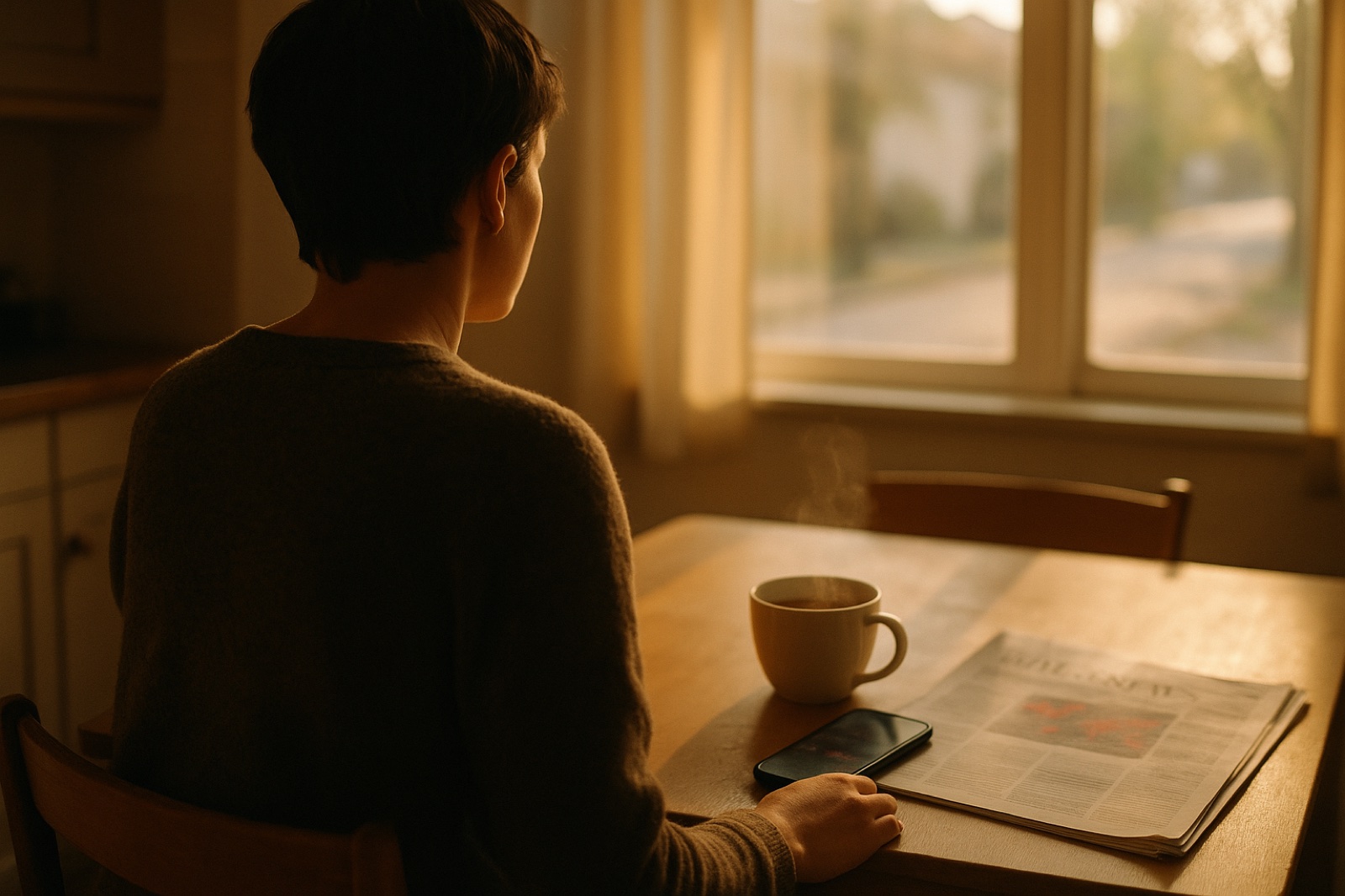
- It arrives in your pocket. Most of us now meet the news on a phone, one scary update at a time. If you have ever found yourself reading the same grim story at midnight, here is why you can’t stop doomscrolling, and why it is not about willpower.
And for some readers, war is not far away at all. If you live near conflict, or your family does, this is not a headline. It is your life. Nothing here is meant to make that smaller.
How to Carry a Fear You Cannot Fix
You cannot stop a war from your kitchen table. But you are not powerless over what the fear does to you. Here are a few things that help, and none of them cost money.
- Pick your news times. Check the news once or twice a day, on purpose, instead of letting it find you all day long. You will still be informed. You will just be less flooded.
- Keep news out of the last hour before sleep. Fear read at night tends to stay awake with you.
- Ask, “Is there anything for me to do today?” If yes, do it: check on a friend, give to a relief effort if you can, pray if you pray. If no, you are allowed to put it down until tomorrow. Our guide on how to stop worrying about things you can’t control goes deeper on this.
- Turn toward the people near you. The report found that people see working together as the best defence against big risks. That is true in a kitchen as much as at the UN. Fear shrinks when it is shared.
- Notice how much it is costing you. If the worry is eating your sleep, your appetite or your focus, it may help to take this free, private How Anxious Am I? assessment and see where you really are.
The Other Half of an Old Line About War
There is a phrase people reach for whenever the world feels like it is on fire: “wars and rumours of wars.” It usually gets said in a low voice, as a warning. As if it means, see, it is all falling apart.
But it is only half of the sentence. It comes from an ancient teaching, spoken two thousand years ago to people living under occupation, who had every reason to be afraid. The full line reads:
“And ye shall hear of wars and rumours of wars: see that ye be not troubled: for all these things must come to pass, but the end is not yet.”
See that ye be not troubled. The words that get quoted as a threat were first spoken as comfort. Not “there will be no wars.” Not “look away.” Just this: you will hear hard news, and you do not have to let it own you. There is something bigger holding the story than the story itself.
Maybe that is the real gap between the fear on the list and the life in front of you. The headlines tell you what might happen. They cannot tell you who you will be while you wait.
Living Well While the World Is Worried
The report lands on a choice. As the Secretary-General put it, “the choice is ours.” That is true for nations. It is also true for you, on a much smaller and much more real scale.
You can know the risks and still eat dinner slowly. You can care about the world and still sleep. You can stay informed and still be kind to the person next to you today.
That is not ignoring the world. It might be the steadiest way to live in it.
Discussion Question
Do you think following the news closely makes people better prepared for big world events, or just more afraid of them? Tell us what you think in the comments below.
Share This
Post 1: The UN says fear of war jumped 16 places in two years. The part nobody mentions? The report itself warns that fear follows attention, not always danger. Worth a read if the news is keeping you up: https://bgodinspired.com/index.php/bgodinspired-news/fear-of-war-un-global-risk-report/
Post 2: “Wars and rumours of wars” is only half the sentence. The other half is “see that ye be not troubled.” I needed that today. https://bgodinspired.com/index.php/bgodinspired-news/fear-of-war-un-global-risk-report/
Post 3: If world news is sitting heavy on you lately, this helped me: what the new UN risk report actually says, what it doesn’t, and how to carry a fear you can’t fix. https://bgodinspired.com/index.php/bgodinspired-news/fear-of-war-un-global-risk-report/
Questions People Ask About the Fear of War
What did the 2026 UN Global Risk Report say about war?
The 2026 UN Global Risk Report, published on 15 September 2026, surveyed around 1,300 people from government, international organisations, civil society, business and academia. Large-scale war climbed 16 places since 2024, the steepest rise of any of the 28 risks assessed, and now ranks in the top ten concerns in every region surveyed. 36% of respondents think its effects could reach a significant share of humanity within a year, and 76% within seven years.
Is a world war going to happen soon?
No one can say for certain. The UN Global Risk Report is a survey of how informed people perceive risk, not a prediction that a war will happen on a given date. It shows that fear of large-scale war has risen sharply since 2024. The report’s own authors also note that attention to a risk can rise and fall for reasons other than the danger itself.
How do I stop being anxious about war in the news?
Anxiety about war in the news often eases with a few simple habits: checking the news at set times instead of all day, avoiding news in the hour before sleep, asking whether there is anything to actually do today, and talking about the fear with people nearby. If the worry is affecting sleep, appetite or focus, speaking with someone you trust or a health professional can help.
What does “wars and rumours of wars” mean?
“Wars and rumours of wars” is a phrase from the Gospel of Matthew in the Bible. It is often quoted as a warning sign, but the full King James Version sentence continues: “see that ye be not troubled: for all these things must come to pass, but the end is not yet.” In context, it is words of comfort telling frightened listeners not to be shaken by news of war.
What is the biggest global risk in 2026?
In the 2026 UN Global Risk Report, large-scale war showed the biggest rise and now ranks in the top five risks in six of the seven regions surveyed, while failure to act on climate change was described as the single most important of the 28 risks assessed. Respondents saw joint action between governments as the most effective way to reduce these risks.