 0
0
 0
0
Someone at work makes a decision that sends a whole team the wrong way. Someone online explains a thing they clearly don’t understand to people who understand it even less. And somebody shakes their head and says it: “Well, that’s the blind leading the blind.”
We all know what it means. But the blind leading the blind meaning has a twist most people never hear. The words in English come from Jesus. And when Luke wrote them down, Jesus did not aim them at “those people over there.” He aimed them at the people listening. Which, today, is us.
What Does “The Blind Leading the Blind” Mean?
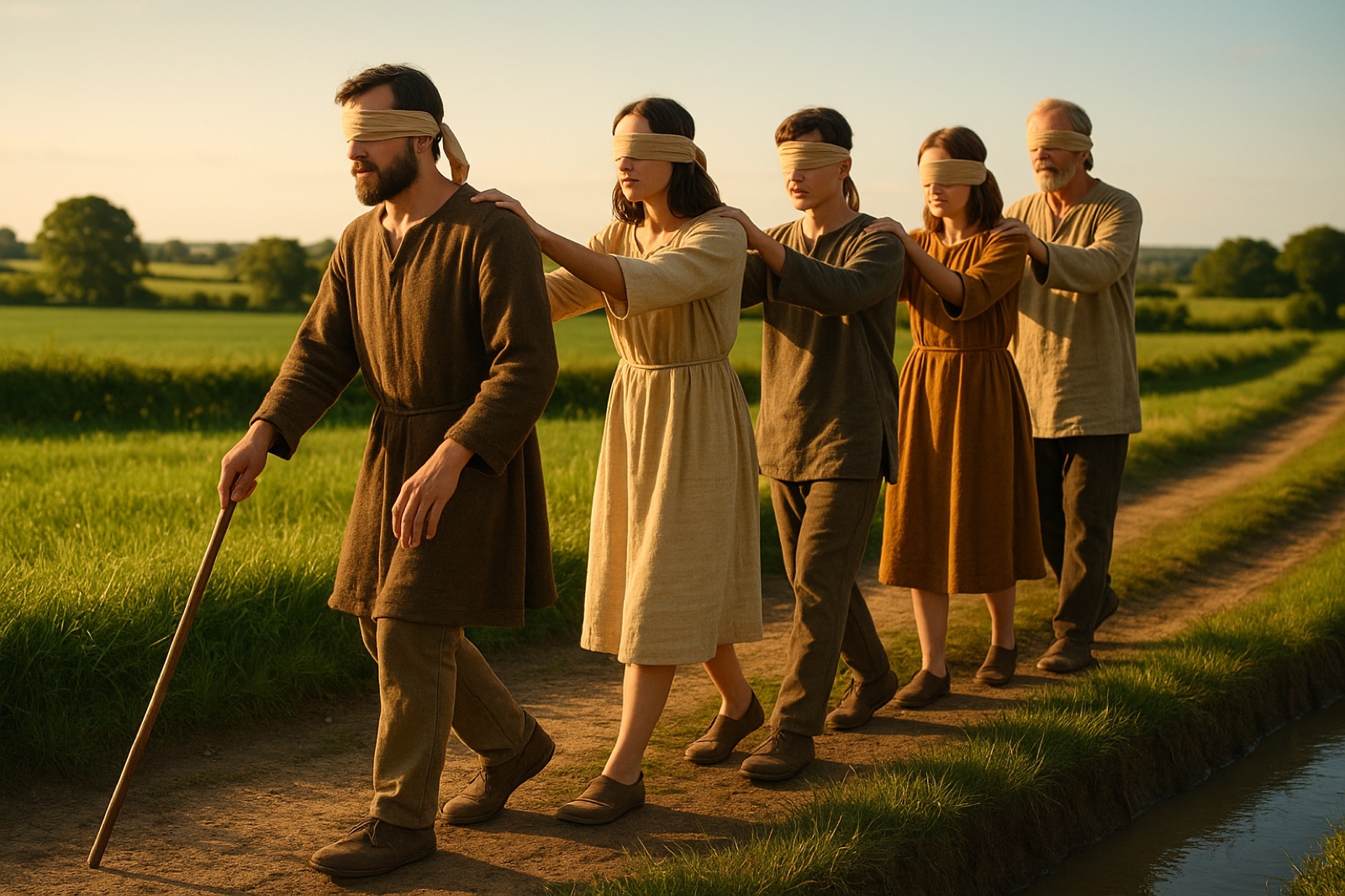
In everyday speech, “the blind leading the blind” means someone who doesn’t know what they’re doing is guiding other people who don’t know either. Nobody in the line can see where they’re going, so they all end up in trouble together.
It is almost always said about someone else. A boss. A government. A group chat. A parent at the school gate giving advice they read once. That is the part worth noticing, because the man who gave the phrase to the English language used it very differently.
The Painting Everyone Pictures
When people look this phrase up, many of them picture a painting. In 1568, the Flemish painter Pieter Bruegel the Elder painted six blind men walking in a line, each holding the shoulder or the staff of the man ahead. The first one has already fallen into a ditch. The second is falling on top of him. The rest are still walking, faces turned up, with no idea what is about to happen.
The painting hangs today in the Museo di Capodimonte in Naples, Italy. It is painted in distemper (a kind of glue-based paint) on linen. Doctors who have studied it over the years say Bruegel gave each man a different, real eye condition. These were not cartoon blind men. Bruegel had looked closely.
And here is the detail most people walk past. Behind the men, in a calm, bright village, stands a church. Its spire points straight up, while the line of men tips down toward the ditch. Bruegel left no note explaining it, but it’s hard not to read something into it. The men are walking right past the church. Being near religion did not keep them out of the ditch.
Bruegel didn’t make the picture up. He took it from a verse in the Gospel of Matthew.
Where Jesus Said It: Matthew 15
The story starts with dirty hands. A group of religious experts, scribes and Pharisees, came all the way from Jerusalem to ask Jesus one question:
“Why do thy disciples transgress the tradition of the elders? for they wash not their hands when they eat bread.” (Matthew 15:2, KJV)
This wasn’t about germs. It was a religious washing rule, handed down over time, and these men treated it as a test of whether you were truly clean before God. Jesus answered with a question of His own, asking why they broke God’s actual commandment for the sake of their tradition. Then He turned to the crowd and said what really makes a person unclean is not what goes into the mouth, but what comes out of it.
His disciples were nervous. They came to Him and said, in effect, “You know you offended them, right?” And Jesus said this:
“Let them alone: they be blind leaders of the blind. And if the blind lead the blind, both shall fall into the ditch.” (Matthew 15:14, KJV)
Notice two things. First, the leaders weren’t ignorant people. They were the experts. The most trained, most careful religious people in the room. Their problem was not that they knew too little. It was that they were sure they could see.
Second, notice what Jesus told His disciples to do: “Let them alone.” Not “fight them.” Not “expose them.” Just don’t follow them into the ditch.
The Moment Right After
Here is the part that almost never gets quoted. Straight after Jesus called the experts blind, Peter asked Him to explain what He meant. And Jesus said:
“Are ye also yet without understanding?” (Matthew 15:16, KJV)
His own friends, the ones standing safely on the “right” side, didn’t get it either. They had just heard a line about blind guides, and they still couldn’t see the point. It is gentle and a little funny. And it quietly takes away the comfort of thinking blindness is always someone else’s problem.
Luke Points It at the Listener
Luke records the same saying, but he places it somewhere surprising. It is not in an argument with religious leaders. It is in Jesus’s teaching to His own followers, in the same talk where He tells them to love their enemies and stop judging:
“Can the blind lead the blind? shall they not both fall into the ditch? The disciple is not above his master: but every one that is perfect shall be as his master.” (Luke 6:39-40, KJV)
And then, in the very next breath:
“And why beholdest thou the mote that is in thy brother’s eye, but perceivest not the beam that is in thine own eye?” (Luke 6:41, KJV)
A mote is a speck of dust. A beam is a wooden plank. In Luke, the blind guide is not a Pharisee. It is anyone who tries to fix someone else’s eye while carrying a plank in their own. The very saying we use to point at others is set right next to Jesus asking us to check our own eyes first.
Look at verse 40 again, too. “Every one that is perfect shall be as his master.” You become like whoever you follow. That makes the question of who leads you one of the biggest questions in your life.
Did Jesus Say It First?
Not exactly, and it’s worth being honest about this. The English phrase comes from Jesus’s words in the Gospels. But the picture itself is older and shows up in more than one culture.
An ancient Hindu text, the Katha Upanishad, generally thought to be older than the Gospels, describes fools “thinking themselves wise and learned” who wander about “like the blind led by the blind.” A Buddhist teaching called the Canki Sutta pictures a row of blind men, each holding the one in front, where none of them can see. The Roman poet Horace also used the image of a blind man wanting to show the way.
That does not take anything away from Jesus. It shows something true about people everywhere. Across very different places, people noticed the same danger: the most lost person is the one who is sure they’re not.
The Upanishad’s words “thinking themselves wise” sound a lot like what Jesus said to some Pharisees in John 9, just after He healed a man born blind:
“If ye were blind, ye should have no sin: but now ye say, We see; therefore your sin remaineth.” (John 9:41, KJV)
Being blind was never the problem. Saying “we see” when you don’t is the problem. And what Jesus brought that was new was not the warning. It was the cure. He did not only point at the ditch. He offered to be the Guide who can actually see. (He was patient about it, too. In Mark 8 there’s a blind man Jesus healed in two stages, and the first stage left him seeing people “as trees, walking.” Here’s why Jesus healed that blind man in two steps, and what it means if your own sight is still a bit blurry.)
What This Means for You Today
Most of us aren’t leading a crowd. But we are leading someone. A child watching how we handle money. A friend who copies how we talk about our spouse. A younger coworker learning what “normal” looks like from us. And we are all following someone too, often without ever choosing to.
So the honest question Jesus leaves behind is not “who around me is blind?” It is two quieter questions:
- Who am I following, and can they actually see where they’re going?
- Where am I saying “I see” when I really don’t?
That second one is hard. It’s the parent who is sure they know what their teenager is feeling. The person who has decided what a friend “really meant.” The believer who is certain about a verse they have never read in context. It isn’t wicked. It’s just human. And the fix Jesus gives is wonderfully simple: deal with your own eye first, and walk behind Someone who can see.
If you want to hear these teachings in Jesus’s own words, there’s more in the eye for an eye meaning, another saying Jesus took and pointed somewhere nobody expected. You can also ask follow-up questions in our free What Jesus Teaches AI assistant (it opens in ChatGPT).
Actions to Take
- Name your guides. Take two minutes and write down three voices you follow most: a person, a podcast, a feed, a friend. Next to each, write one place they’ve led you this month. Just notice.
- Find one plank. Think of someone whose “speck” annoys you right now. Ask yourself honestly: is there a version of the same thing in me? Write one sentence about it.
- Say “I don’t see this yet.” Before the day ends, say it out loud in one real conversation where you’ve been acting more certain than you are. It feels small. It’s the opposite of falling in the ditch.
Journaling Prompts
- When did you last follow someone confidently and later realize they couldn’t see either? What made them easy to follow?
- Where in your life are you most likely to say “I see” when you really don’t?
- Who is quietly holding your shoulder right now, following you, and what would you want them to see?
A Prayer
God, I’m quick to spot who’s lost and slow to notice when I am. Show me where I’ve been saying “I see” when I don’t. Help me take care of the plank in my own eye before I reach for anyone else’s. And, Jesus, I want to walk behind You, because You can see the road and I can’t always. Lead me, and lead the people who are following me.
Discussion Question
When people say “the blind leading the blind,” they almost always mean someone else. Do you think the phrase would mean something different if we used it the way Luke did, about ourselves? Share your thoughts in the comments below.
Share This
- “The blind leading the blind” was never only about other people. In Luke, Jesus says it right before telling us to check our own eye first. That changes it.
- Being blind wasn’t the problem. Saying “we see” when we don’t was the problem. (John 9:41)
- Bruegel painted six blind men walking toward a ditch, right past a church. Being near religion didn’t keep them out. Following the right Guide would have.
Q&A: The Blind Leading the Blind
What does “the blind leading the blind” mean?
“The blind leading the blind” describes a situation where someone who doesn’t understand something is guiding others who don’t understand it either, so they all end up making the same mistake. The phrase comes from Jesus’s words in Matthew 15:14 and Luke 6:39, where He said that if the blind lead the blind, both fall into the ditch.
Where is “the blind leading the blind” in the Bible?
The saying appears in Matthew 15:14, where Jesus describes the Pharisees as “blind leaders of the blind” after an argument about ritual hand-washing, and in Luke 6:39, where Jesus asks, “Can the blind lead the blind? shall they not both fall into the ditch?” In Luke, the saying comes right before Jesus’s teaching about removing the beam from your own eye before the mote from someone else’s.
Who was Jesus talking about when He said “the blind leading the blind”?
In Matthew 15, Jesus was talking about the scribes and Pharisees who had criticized His disciples for eating without ritual hand-washing. In Luke 6, the same saying is part of Jesus’s teaching to His own followers, placed next to the warning about the mote and the beam, so it applies to anyone who tries to guide or correct others without first seeing clearly themselves.
Did Jesus invent the phrase “the blind leading the blind”?
The English phrase comes from Jesus’s words in the Gospels of Matthew and Luke, but the image is older. The Katha Upanishad, an ancient Hindu text, compares fools who think themselves wise to “the blind led by the blind,” and the Buddhist Canki Sutta pictures a line of blind men holding onto each other. What is distinctive in the Gospels is that Jesus turns the warning toward His own listeners and offers Himself as a guide who can see.
What is the Bruegel painting “The Blind Leading the Blind”?
“The Blind Leading the Blind,” also called “The Parable of the Blind,” is a 1568 painting by the Flemish artist Pieter Bruegel the Elder. It shows six blind men walking in a line toward a ditch, with the first already fallen, and a village church in the background. It is painted in distemper on linen, is based on Matthew 15:14, and hangs in the Museo di Capodimonte in Naples, Italy.