 0
0
 0
0
Pick up an empty plastic water bottle and think about where it goes next. Into a bin, maybe. Onto a pile somewhere. Plastic like this does not rot the way an apple core does. It just waits.
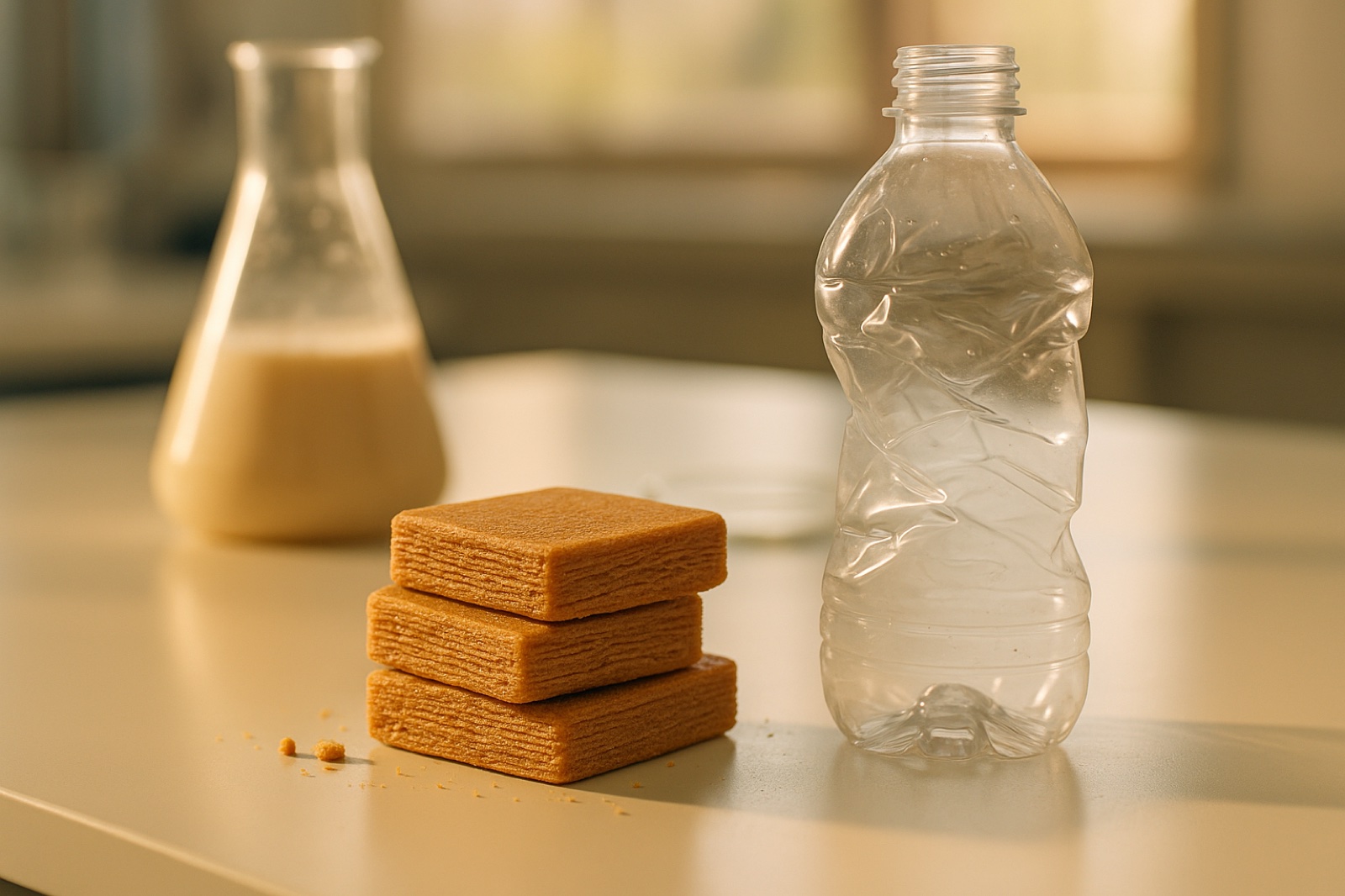
Now picture that same bottle ending up as a cookie.
That is not a joke or a thought experiment. A team at Southern Illinois University Carbondale has made real cookies made from plastic bottles and crop waste. They are small, square, protein-rich, and printed layer by layer. The team calls them µBites, said “microbites.” They showed the work at the American Chemical Society’s big autumn science meeting in Chicago in late August 2026, and the story has been travelling ever since.
Here is how it works, what is actually inside, and the part most headlines skip: nobody has eaten one yet.
How Do You Make Cookies Made From Plastic?
You do not grind a bottle up and bake it. The plastic never goes near the oven. It gets taken apart first, and then something alive rebuilds it into food.
Step one uses a plastic called PET. That is the clear, light plastic of most drinking bottles. The team mixes it with farm leftovers, like corn stalks and leaves. Then they hit the mix with water and oxygen under strong heat and very high pressure. The method is called oxidative hydrothermal dissolution, and it was developed by Ken Anderson, a geology professor at the same university. It breaks the long plastic chains into much smaller pieces.
Step two is where it gets strange. Those small pieces become food for yeast. The yeasts have been reprogrammed so they can live on that mix. As they grow, they make proteins, fats, acids, vitamins and flavour compounds.
Step three is the kitchen part. Those ingredients get mixed with fibre, starch and a sweetener. Then a 3D printer lays the dough down, one thin layer at a time, into a cookie.
According to ScienceAlert’s reporting, the full process takes 33 steps and a day or two per batch. More than half of the carbon in the waste ends up in the food.
The Yeast Doing the Work Is the Kind That Makes Bread Rise
This is the detail most people read straight past. The yeasts on the job include baker’s yeast.
People have used yeast to raise bread and brew drinks for thousands of years. It is about the most ordinary living thing in a kitchen. Now a version of it can feed on what is left of a bottle.
It gets better. The team says the vanilla flavour in the cookies is made from plant waste. And the cookies’ beta-carotene, the orange pigment your body turns into vitamin A, is made from ethylene glycol. Ethylene glycol is one of the two building blocks the plastic itself is made from.
So a bit of the nutrition in that cookie was, not long ago, part of a bottle.
“Microbes are very clever,” said Lahiru Jayakody, the microbiologist who leads the project. “So, we are using their traits to solve the problems we created.”
We have written before about bacteria that MIT engineers turned into working living circuits. This is the same big idea, pointed at a dinner plate: let tiny living things do a job no machine does as neatly.
Has Anyone Actually Eaten One?
No. Not yet.
That matters, so it is worth being clear. The team says it has tested the cookies both in its own lab and through accredited outside labs. Those checks looked for toxic chemicals, heavy metals, allergens and germs that make people sick. Jayakody says the cookies came back free of all of them.
But checking a food in a lab is not the same as people eating it. The team still needs formal approval before real taste tests can start. So far, people have only smelled the cookies in a blind test. They gave the smell high ratings, and participants said they would be willing to eat the cookies in places where food is scarce.
It is also not finished. For now, the starch, fibre and sweetener are still added from outside. The goal is to have microbes make those too. The researchers also admit a big open problem: they do not yet know how to make the whole system work in microgravity, the near-weightless conditions of space.
So the honest headline is not “plastic is now food.” It is “a working recipe exists, it passed the safety checks so far, and the first bite has not happened.”
Why NASA Wanted Food Made From Waste
The project grew out of NASA’s Deep Space Food Challenge. That contest asked teams to find ways to make food on long missions. Out there, there is no farm, no fridge, and no supply truck.
On a long trip, everything you bring has to be used again. Packaging, scraps and leftovers are not rubbish. They are the only raw materials you have.
The same thinking works on Earth. Jayakody has pointed to places like submarines and disaster relief, where food can run out and waste is right there. The team also points to projections that global food demand could rise by 35 to 56 percent by 2050. That makes it worth asking what else could become food.
One honest limit: this is a food technology, not a plan to clean up the world’s plastic. A lab that turns some bottles into cookies does not empty the oceans. If you want the other side of the plastic story, there is a good read on how nature built its own zero-waste plastic millions of years before we did. There is also the surprise that one plastic-eating enzyme turned out to destroy penicillin too. Plastic keeps surprising the people who study it.
Sweetness Out of the Strong
There is an old story about a strong young man who kills a lion with his bare hands on a country road.
Some days later he walks past the same spot. Bees have moved into the lion’s body. There is honey inside. He scoops some out and eats it as he walks.
Later, at his own wedding feast, he turns it into a riddle for the guests. Out of the eater came something to eat. Out of the strong came something sweet. Nobody at the table could solve it on their own.
That story has been told for around three thousand years. It carries one of the oldest things people have believed about God: that what feeds us often shows up in the last place we would think to look. Sometimes it is inside the very thing we had already filed under danger, or under waste.
It is hard not to think of that riddle while looking at a cookie that started life as a bottle.
The Bottle in Your Hand
None of this means you should feel fine about throwing plastic away. Using less is still better than using more.
But the next time you drop a bottle in the bin, it is worth knowing that somewhere, a little yeast is being taught to see it differently. Not as the end of something. As the start of a meal.
Maybe that is the most useful thing a strange science story can do: make you look twice at what you had written off.
What Do You Think?
If µBites passed every safety test and tasted good, would you eat a cookie that started out as a plastic bottle? Or is there a line where “made from waste” stops feeling like a good thing? Tell us where you land in the comments.
Share This
Scientists made cookies out of old plastic bottles and corn stalks. The yeast doing the work is the same kind that makes bread rise. Nobody has taken a bite yet. https://bgodinspired.com/?p=115391
The vitamin A in these cookies was made from part of a plastic bottle. I did not expect a science story to change how I look at my recycling bin. https://bgodinspired.com/?p=115391
A good reminder that the things we write off are not always finished. A team taught yeast to turn plastic waste into real food, and the story behind it is stranger and more honest than the headlines: https://bgodinspired.com/?p=115391
Questions People Ask About Cookies Made From Plastic
Can you really make cookies from plastic?
Yes, in a laboratory. Researchers at Southern Illinois University Carbondale break down PET plastic bottles and crop waste with water, oxygen, heat and high pressure. Then they feed the pieces to engineered yeasts, including baker’s yeast. The yeasts make proteins, fats, vitamins and flavours, which are mixed with fibre, starch and sweetener and 3D-printed into cookies called µBites. The plastic itself is never baked.
Are cookies made from plastic safe to eat?
Early safety checks are positive, but no human taste tests have happened yet. The Southern Illinois University Carbondale team says µBites cookies were tested in its own lab and by accredited third-party labs. The researchers report no toxic chemicals, heavy metals, allergens or food pathogens. Formal approval is still needed before people can eat them in a study.
What are µBites?
µBites, pronounced “microbites,” are protein-rich, 3D-printed cookies developed by microbiologist Lahiru Jayakody’s team at Southern Illinois University Carbondale. Their ingredients are made by engineered yeasts fed on broken-down PET plastic and agricultural waste. The project was presented at the American Chemical Society Fall 2026 meeting in Chicago and began as part of NASA’s Deep Space Food Challenge.
Why did NASA support research into food made from plastic?
The µBites project grew out of NASA’s Deep Space Food Challenge, which looked for ways to produce food on long space missions with no farming, no refrigeration and no resupply. On such missions, packaging and waste are the only spare raw materials. The researchers say the same approach could help in submarines and disaster relief, though making it work in microgravity is still an unsolved problem.
Does turning plastic into food solve plastic pollution?
No. Turning PET bottles into cookie ingredients is a food-production technology, not a large-scale way to remove plastic from the environment. The process currently takes 33 steps and a day or two per batch, according to ScienceAlert’s reporting. Using less plastic and recycling more remain the main ways to tackle plastic pollution.
Sources: American Chemical Society press release, August 2026; ScienceAlert; New Food Magazine.