 0
0
 0
0
For a long time, doctors gave one answer to a simple question: can the heart heal after a heart attack?
The answer was no. Not really. A heart attack kills heart muscle, and dead heart muscle stays dead. The body patches the hole with scar, and you live with that patch for the rest of your life.
Then a team in Sydney, Australia, looked closer. Not at hearts from people who had died, but at living tissue, taken during surgery from patients whose hearts were still beating. And they saw something nobody had seen in a human heart before.
After a heart attack, the heart tries to grow new muscle.
It just can’t grow enough.
What the Scientists Actually Found
The study came out of the University of Sydney, working with the Baird Institute and Royal Prince Alfred Hospital. It was published in the journal Circulation Research, under the title “Human Hearts Intrinsically Increase Cardiomyocyte Mitosis After Myocardial Infarction.”
That title sounds hard. Here it is in plain words: after a heart attack, human heart muscle cells start dividing more. Dividing is how cells make new cells. So the heart is not just sitting there, broken. It is trying to rebuild.
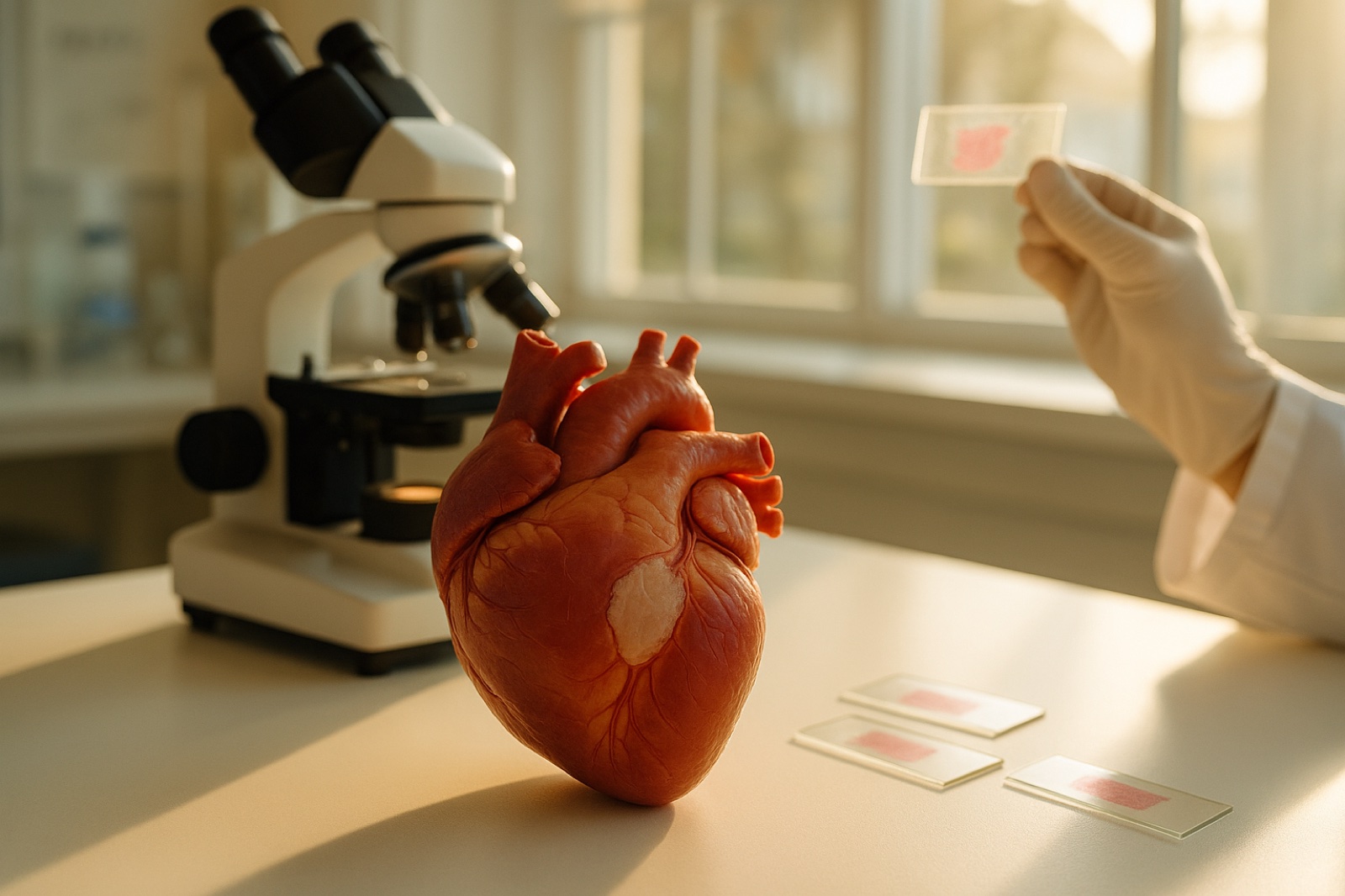
Here is how they checked. Some patients with heart disease need bypass surgery, where surgeons give blood a new route around a blocked artery. During those operations, with the patients’ consent, the team collected small tissue samples from two places: parts of the heart that had been damaged, and parts that were still healthy. Then they compared them. The method was developed by Professor Paul Bannon and Professor Sean Lal.
The damaged areas showed more muscle cells dividing. This had already been seen in mice. This was the first time it was shown in people.
“Our research shows that while the heart is left scarred after a heart attack, it produces new muscle cells, which opens up new possibilities,” said Dr Robert Hume, the study’s first author.
So Why Doesn’t the Heart Heal After a Heart Attack?
Because the repair is far smaller than the damage.
A heart attack can destroy up to a third of the muscle cells in the heart, according to the University of Sydney team. The new cells the heart makes are real, but they are nowhere near enough to replace that loss. Dr Hume was careful to say so himself:
“Although this new discovery of regrowing muscle cells is exciting, it isn’t enough to prevent the devastating effects of a heart attack.”
That line matters. This study does not show that heart attacks heal on their own. It does not mean someone living with heart failure can grow their lost muscle back today. What it shows is that the ability is there, switched on, working quietly at a small scale. The researchers’ hope is to find ways to turn it up. As Professor Lal put it: “Ultimately, the goal is to use this discovery to make new heart cells that can reverse heart failure.”
The team has already found several proteins in these human samples that were earlier linked to heart repair in mice. That is a starting point, not a treatment.
The Clue That Came From Cold War Bomb Tests
Here is the part most news stories left out. The Sydney study was not the first hint that human hearts can make new muscle. That hint came from a strange place: nuclear bomb tests.
In the 1950s and early 1960s, above-ground nuclear tests pushed extra carbon-14 into the air all over the world. That carbon got into plants, then food, then people. Every new cell a person made during those years took in a little of it, and the level changed year by year. So a cell carries a kind of date stamp showing roughly when it was made.
In 2009, a team at the Karolinska Institutet in Sweden used that date stamp on human heart muscle cells. They published what they found in the journal Science. Heart muscle cells do renew, but slowly. About 1% of them are replaced each year at age 25. By age 75, it drops to about 0.45% a year. Over a whole normal lifetime, fewer than half of your heart muscle cells are ever swapped out.
Put the two studies side by side and you get a clear picture. Your heart is always renewing itself, just very slowly. After a heart attack, it speeds that renewal up. But a slow builder working a little faster still cannot rebuild a third of a house in a few weeks.
What Grows Back Instead: The Scar
So what fills the gap? Scar tissue.
In the weeks after a heart attack, the body clears away the dead muscle and lays down scar, made mostly of a tough protein called collagen. And here is something worth knowing: the scar is not the enemy. It is an emergency patch. A weakened heart wall that never scarred could tear. The scar holds it together.
But a scar can’t do what muscle does. Healthy heart muscle squeezes about once a second, every second, for your whole life. Scar tissue doesn’t squeeze. It is stiff. It just sits there while the muscle around it works harder to make up for it. Over time, that extra strain can stretch and tire the rest of the heart, which is one of the ways a heart attack can later lead to heart failure.
That is the real problem. The heart does try. It reaches for new muscle. But the fastest, safest thing the body can do is harden the wound, and a hardened place, however protective, cannot beat.
If you want to understand more about how the heart works alongside the rest of the body, our piece on how heart and kidney disease feed one loop is a good next read. And for the strange way strong emotion can hit the heart muscle directly, see what doctors now know about broken heart syndrome.
A Heart of Stone, a Heart of Flesh
There is something about this picture that feels familiar, and not only to cardiologists.
Most of us have done the same thing on the inside. Something hurts us badly, and we don’t grow back soft. We scar. We go a little hard in that spot, because hard feels safe. And it is, in a way. The hard place holds us together. But it stops moving with the rest of us. Everything around it has to work harder.
People noticed this long before anyone could look at heart tissue under a microscope. One of the oldest pieces of writing we have about the human heart is a promise made to people who had been through a great deal: that God would take out their heart of stone and give them a heart of flesh. Not a tougher scar. Not a better patch. A living heart that could beat again.
What stands out, reading it next to this study, is that the promise was never “try harder to regrow.” The heart already tries. It always has. The hope was that what it cannot finish on its own could be finished for it.
What This Means If You or Someone You Love Has Had a Heart Attack
This research is early. It won’t change anyone’s treatment this year. But a few things are worth holding onto:
- Keep following your care plan. The medicines and follow-up you were given after a heart attack exist to protect the muscle you still have. Nothing in this study replaces them.
- Ask about cardiac rehab if it is offered. Many hospitals run programmes that teach safe exercise and recovery after a heart attack.
- Walk, if your doctor says it’s safe. Gentle, regular walking costs nothing and is one of the most common parts of heart recovery everywhere in the world.
- Don’t wait on warning signs. Chest pain or pressure, pain spreading to the arm, jaw or back, sudden shortness of breath, or a cold sweat all need urgent help.
- Give the hard places some attention too. Recovery is not only physical. Fear and low mood after a heart attack are common, and talking to someone you trust is a real part of healing.
Discussion Question
The Sydney team hopes to one day “turn up” the heart’s own repair instead of replacing the heart. Do you think medicine’s future is more about helping the body heal itself, or about building replacements? Tell us what you think in the comments.
Share This
Post 1: Scientists just watched human heart muscle try to regrow after a heart attack. First time ever seen in people. It can’t grow enough on its own yet, but the ability is there. https://bgodinspired.com/index.php/bgodinspired-news/bgodinspired-health-news/heart-heal-after-heart-attack/
Post 2: Didn’t know this: the proof that your heart replaces its own cells came from carbon left in the air by Cold War bomb tests. About 1% a year at 25. Wild. https://bgodinspired.com/index.php/bgodinspired-news/bgodinspired-health-news/heart-heal-after-heart-attack/
Post 3: After a heart attack, the heart tries to grow new muscle, but what mostly grows is stiff scar. It holds the heart together but can’t beat. Kind of how a lot of us handle getting hurt, too. https://bgodinspired.com/index.php/bgodinspired-news/bgodinspired-health-news/heart-heal-after-heart-attack/
Questions People Ask About Heart Healing
Can the heart heal after a heart attack?
Only partly. A heart attack can destroy up to a third of the heart’s muscle cells, and the body mainly repairs the damage with scar tissue, which is stiff and does not pump. A 2026 University of Sydney study published in Circulation Research found that human heart muscle cells do start dividing more after a heart attack, but the researchers said this natural regrowth is not enough to prevent the damage.
Do human heart cells regrow after a heart attack?
Some do. Researchers at the University of Sydney studied living heart tissue collected during bypass surgery and found more heart muscle cells dividing in damaged areas than in healthy areas. It was the first time this had been shown in humans rather than mice. The amount of new muscle is far too small to replace what a heart attack destroys, so it does not reverse heart attack damage today.
How fast does the human heart replace its muscle cells?
Very slowly. A 2009 study from the Karolinska Institutet, published in Science, used carbon-14 left in the atmosphere by Cold War nuclear bomb tests to date human heart muscle cells. It found about 1% of heart muscle cells are renewed each year at age 25, dropping to about 0.45% a year at age 75, and fewer than half are replaced over a normal lifetime.
Why does the heart form scar tissue after a heart attack?
Scar tissue forms because the body needs to close the damaged area quickly. After heart muscle dies, it is cleared away and replaced mostly with collagen, a tough protein that keeps the weakened heart wall from tearing. The scar protects the heart but cannot contract, so the surrounding healthy muscle has to work harder, which over time can contribute to heart failure.
Does this research mean heart failure can be reversed?
Not yet. The University of Sydney researchers say their long-term goal is to amplify the heart’s natural ability to make new muscle cells and eventually reverse heart failure. They have identified several proteins in human heart tissue that were previously linked to heart regeneration in mice, but no treatment based on this discovery exists yet.
Source: University of Sydney, “Human heart regrows muscle cells after heart attack” (study published in Circulation Research); Bergmann et al., “Evidence for cardiomyocyte renewal in humans,” Science, 2009.