 0
0
 0
0
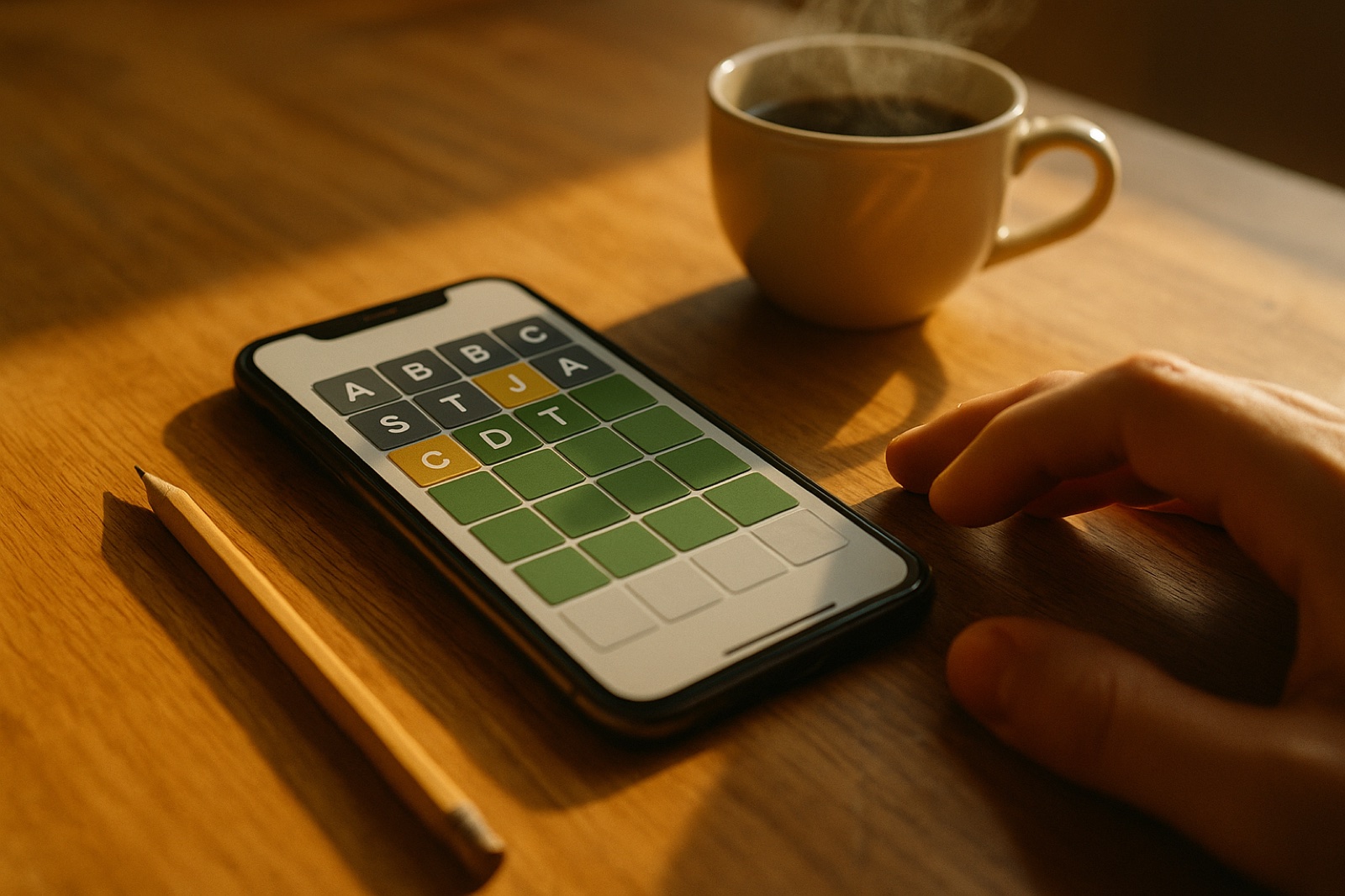
You have three green letters, one yellow, and three guesses left. Every instinct says the same thing: type the word you think it is. Most of us do. And a lot of the time, that is exactly how the streak dies.
A small team at Binghamton University in New York went looking for the best Wordle strategy using maths instead of hunches. Their method won roughly 99 games out of 100. The common approach they tested it against won about 90. The whole difference comes down to one idea that sounds backwards the first time you hear it.
The best guess is often not the word you think is right. It is the word that teaches you the most.
What the Wordle Study Actually Found
The paper is called “Solving Wordle Using Information Theory.” It was published on 6 April 2026 in the Northeast Journal of Complex Systems, written by Talal Aladaileh, Donald Stephens, Mallak Alqaisi and Congyu “Peter” Wu. It did not start as a grand research project. It started as homework: Wu challenged a class to use information theory to solve a real problem, and this group picked the word game millions of people play over breakfast.
They compared two ways of choosing your next word:
- The letter way. Pick words packed with the most common letters, like E, A and R. This is roughly what most careful players already do.
- The information way. Pick whichever word will, on average, shrink the list of possible answers the most, whether or not that word is likely to be the answer itself.
Then they played every possible answer with both. As StudyFinds reported, the team ran all 2,315 words that could be a Wordle answer through each strategy. The information way solved about 99% of them. The letter way managed about 90%.
That gap sounds small until you play every day. Over a year of daily games, it is roughly the difference between losing three dozen puzzles and losing three or four.
Why the “Right” Guess Is Often the Wrong One
Every Wordle guess comes back as five coloured tiles: grey, yellow or green. That is 243 possible colour patterns for a single guess. A great guess is one that could land on lots of different patterns, because each pattern points to a different, smaller pile of answers. A weak guess is one where most answers would give you the same colours back, so you learn almost nothing.
As the Binghamton team put it when the paper came out: “a guess doesn’t have to be the most likely answer; it simply has to be informative.”
Here is what that looks like at the kitchen table. Say you know the answer ends in -IGHT, and you have four guesses left. It could be FIGHT, LIGHT, MIGHT, NIGHT, RIGHT, SIGHT or TIGHT. That is seven words.
If you guess them one at a time, each wrong guess rules out only itself. Four guesses, seven words. You win a little more often than a coin flip.
Now try something that feels silly. Type FILMS. It cannot possibly be the answer. But it tests F, L, M and S all at once. If one of those lights up, you know the word and win on the next guess. If none of them do, only NIGHT, RIGHT and TIGHT are left, and you still have three guesses for three words. You cannot lose.
The “wasted” guess is the one that guarantees the win. (Hard Mode will not let you do this, because it forces you to reuse the letters you have found. That is a big part of why Hard Mode is hard.)
How to Use the Best Wordle Strategy Without a Computer
An honest note first: the study’s method is not something you can do in your head. It runs as a small program. You type in the colours after each guess, and it works out the most informative next word. Machines are very good at this kind of counting, and they keep getting better at things we thought were ours, which is part of what an AI beating humans on a creativity test actually means.
But the idea behind it works fine for a person with a pencil:
- Open with five different common letters. In the simulations, the information method settled on TARES as its fixed first word. Plenty of other openers with common, non-repeating letters do nearly as well.
- Do not spend early guesses on letters you have already ruled out. A grey letter is used up. Every tile should be asking a new question.
- When you are stuck in a family of look-alikes like -IGHT, -OUND or -ATCH, spend one guess on a word that tests several of the missing letters at once, even if it cannot be the answer.
- Save “go for it” guesses for the end, when only one or two words are really left.
The Limits the Researchers Admitted
This is the part that rarely makes the headlines, and it is the most interesting part.
The 99% strategy is not perfect play. The authors describe it as “greedy,” which means it only looks one guess ahead instead of planning several moves in advance. Earlier research has already shown that a fully planned approach can solve every word on the answer list in five guesses or fewer. So this study did not find the best possible way to play. It found a simple rule that gets very close.
The authors also flag a stubborn weak spot: words made of the same letters in a different order, like LEAST, SLATE, STALE and STEAL. And they note they have not yet compared their method against more advanced solvers, including ones built with machine learning.
That is a refreshing thing for researchers to say out loud. They could have called it “the solution.” They called it a good step, and showed you where it runs out.
And it does run out. Every Wordle eventually reaches a point where the information is gone, the clues have said all they can say, and you have to choose. Good searching gets you to that point with the best odds. It does not remove the moment of choosing.
A World Built to Be Searched
What stays with you after reading this study is not really the maths. It is the attitude.
The losing player wants to be right, right now. The winning player is willing to be wrong on purpose, as long as being wrong teaches something. One is trying to look clever. The other is trying to find out.
Wordle hides one word a day and then gives honest clues to anyone patient enough to ask good questions. It is a strangely generous design. The mystery is not there to shut you out. It is there so that the finding feels like something.
There is an idea in one of the oldest wisdom books people ever wrote down that fits this almost too well: that hiding things is the glory of God, and searching them out is an honour. Read that way, a world full of things we do not understand yet is not a trick being played on us. It is an invitation, set up so that looking is worth doing and discovery is a real joy.
A five-letter puzzle is a small place to notice that. But small places are usually where we notice things.
Tomorrow’s Puzzle
So tomorrow morning, when you are stuck on the fourth row with a handful of look-alike words, try the strange guess. Type the word that cannot win. Watch what it tells you.
It is a nice habit to practise somewhere that costs nothing, because it pays off in places that cost a lot more: asking the question before insisting on the answer. It is also a quiet five minutes of real focus, which is rarer than it used to be, and there is a reason attention spans feel so short lately.
And if you have already finished today’s Wordle and want one more, we built a free daily word game of our own, with a Bible-word twist. Same five minutes. Same satisfying click when the last tile turns green.
Discussion Question
Would you rather protect your streak by always guessing a word that could win, or play the smarter odds with a guess you know is “wrong”? Tell us which kind of player you are in the comments.
Share This
- Researchers found a Wordle strategy that wins about 99% of the time. The trick is to stop guessing the word you think is right and guess the one that teaches you the most. https://bgodinspired.com/
- Stuck on -IGHT with four guesses left? Don’t guess NIGHT. Guess FILMS. It can’t win, but it guarantees you will. https://bgodinspired.com/
- My favourite part of the 99% Wordle study isn’t the strategy. It’s the researchers admitting where it falls short. More of that, please. https://bgodinspired.com/
Questions People Ask
What is the best Wordle strategy?
The best-tested simple Wordle strategy is to choose each guess for how much it will narrow down the possible answers, not for how likely it is to be the answer. A 2026 study from Binghamton University, published in the Northeast Journal of Complex Systems, used a measure called Shannon entropy to pick the most informative guess each turn. Across all 2,315 possible Wordle answers, that approach won about 99% of games, compared with about 90% for a strategy based on guessing words full of common letters.
What is the best starting word for Wordle?
In the 2026 Binghamton University study on solving Wordle with information theory, the entropy-based method chose TARES as its fixed opening word. Other solvers that use different scoring rules land on different openers, and the difference between the top candidates is small. A strong starting word uses five different, common letters, so that the colour feedback rules out as many possible answers as it can.
Why does guessing a word that can’t be the answer help in Wordle?
A word that cannot be the answer can still test several unknown letters at once. For example, if a Wordle answer ends in -IGHT and could be FIGHT, LIGHT, MIGHT, NIGHT, RIGHT, SIGHT or TIGHT, guessing those words one by one only rules out one word per turn. Guessing FILMS tests F, L, M and S together. With four guesses left, guessing FILMS guarantees a win, while guessing the candidate words one at a time wins only a little more often than half the time.
Does the information theory Wordle strategy work in Hard Mode?
Only partly. Wordle’s Hard Mode requires every guess to reuse the green and yellow letters already revealed, which blocks the most powerful move in the information theory approach: spending a guess on a word that cannot be the answer in order to test new letters. Published reports on the 2026 Binghamton University study do not describe results for Hard Mode.
Can Wordle be solved every time?
With perfect planning, yes. Earlier research has shown that a fully planned strategy can solve every word on Wordle’s original answer list in five guesses or fewer. The 2026 Binghamton University strategy is simpler and does not reach that level: its authors describe it as “greedy” because it only looks one guess ahead, and it won about 99% of games rather than all of them.