 0
0
 0
0
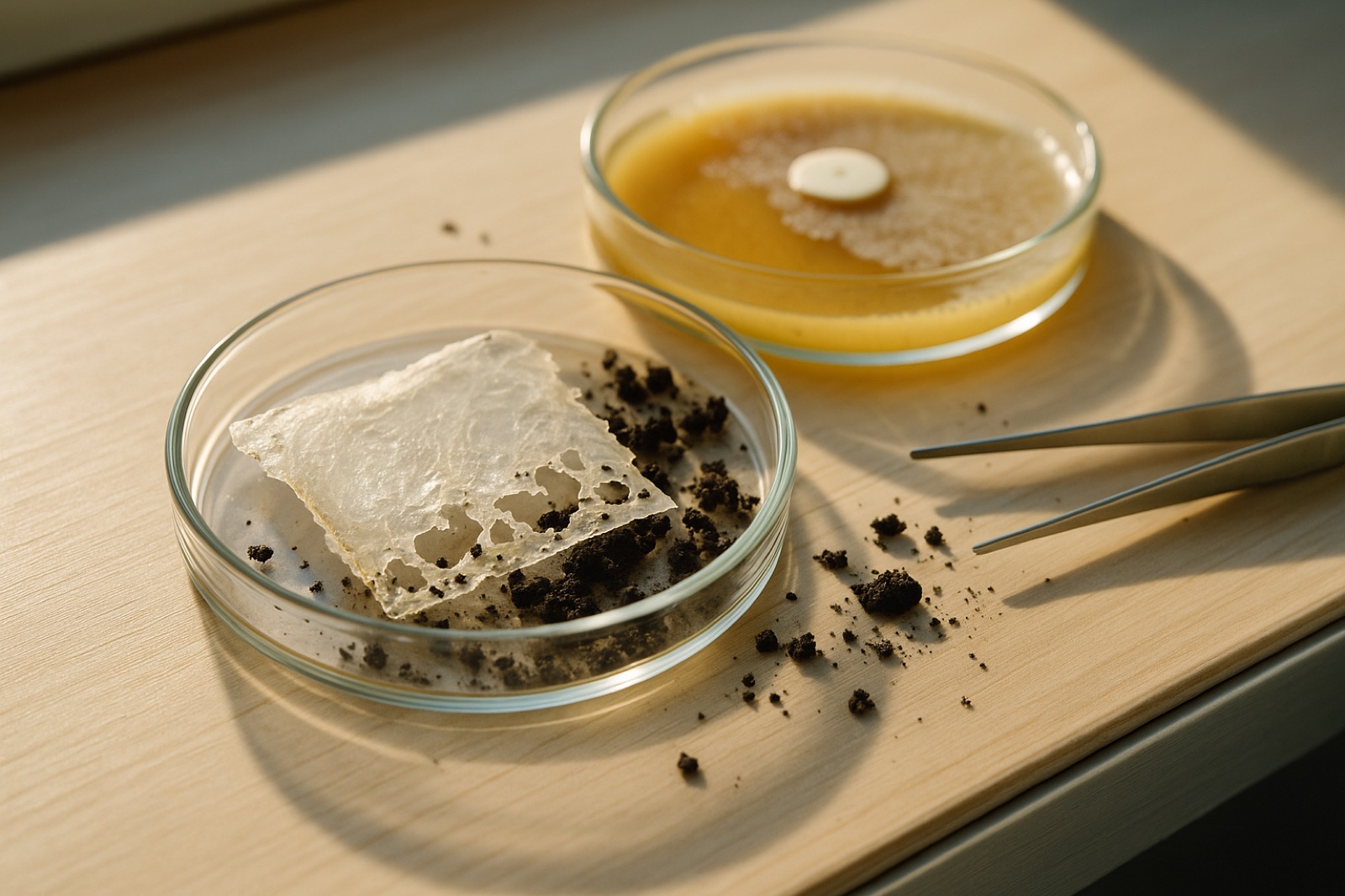
In the forest of a German university’s botanical garden, researchers buried squares of thin plastic film about ten centimetres down in the humus layer, then walked away. Not for a weekend. For the better part of a year.
When the team at the University of Konstanz went back to see what the soil bacteria had done to that film, they found a plastic-eating enzyme nobody had described before. Its active site is unusually wide and open — a groove rather than a narrow tunnel — which is why the lab started calling it the Pac-Man enzyme. It really does take the plastic apart.
It also destroys penicillin.
And the detail that slipped underneath the cleanup headlines is this: going by the numbers printed in the paper itself, it is far better at the second job than the first.
What a plastic-eating enzyme actually does
The plastic here is not a shopping bag. It is a newer kind of bioplastic called a long-chain aliphatic polyester — LCAP for short — made from plant oils and built with weak points that living things can actually cut.
That design is the whole trick, because most plastic has no such weak points. In the same soil trial, ordinary HDPE — the stiff plastic of milk bottles and water pipes — showed effectively no breakdown at all. Cellulose, the plain material of paper and plant walls, was gone in about eighty days. The bioplastic films took somewhere between 250 and 330 days to disappear completely.
So the honest version of “plastic-eating” is closer to slow chewing than to eating. Nearly a year, in warm damp soil, for a thin film.
To find out which organism was doing the work, the team sequenced everything alive in that soil instead of trying to grow one species in a dish. Out of that pile of genetic code came a single gene, catalogued as GID54916, producing an enzyme they named LCPH1. It belongs to a group of bacterial enzymes called family-VIII esterases. Esterases cut one specific kind of chemical bond — the ester bond — and a long-chain polyester is, structurally, a chain of ester bonds. The enzyme snips that chain into pieces small enough for a bacterium to absorb.
It is better at destroying penicillin than at eating plastic
When the researchers purified LCPH1 and tested it directly, they measured how fast it worked on each material. On the polyester, they calculated a specific activity of 0.5 units per milligram of protein. On penicillin G, they calculated 8.92 — and the penicillin was almost entirely gone within twenty-four hours.
Those two figures come from different tests on different substances, so they are not a clean like-for-like race. But the direction is not subtle. The enzyme that made headlines as a plastic-eater is, in a tube, a considerably more capable antibiotic-destroyer. It flattened ampicillin too — another member of the penicillin family — stripping both drugs of their power to kill bacteria.
Which means we named the thing after the job we were hoping it would do.
Why one protein can do both jobs
It is not switching between two skills. It is doing one thing to two different targets.
Penicillin’s entire mechanism sits in a small square of atoms called the beta-lactam ring. Break that ring and the drug is inert. That is exactly what the enzymes called beta-lactamases do, and it is the single most common reason antibiotics stop working. Family-VIII esterases have long been noted for carrying a catalytic motif that matches the one used by a class of those beta-lactamases. The chemistry is a cousin of the chemistry.
What normally stops such an enzyme is shape. EstB, the best-studied member of this same family, cannot get at beta-lactams at all — its channel is too tight. LCPH1’s is not. Its groove is open enough to take in a long plastic strand, and a groove that can accept a whole polymer chain has no trouble accepting a small drug molecule.
The cleanup ability and the resistance ability are not two features. They are one feature, seen from two sides.
What this does not mean
Precision matters more than drama here, so: this is laboratory activity plus a structural resemblance. It is not a measurement of anything happening out in the world.
The paper does not show that this enzyme is driving antibiotic resistance anywhere. What it shows is that a protein filed away as a plastic-degrader turned out to have an antibiotic-destroying ability nobody had thought to test for. The authors are careful about the wider implication too — they write that it is tempting to speculate whether this duality might lead to a co-selection of antibiotic-resistant microbes in the “plastisphere,” the film of life that grows on plastic debris, as a result of plastic exposure. Tempting to speculate is a very different sentence from demonstrated, and they did not pretend otherwise.
There is a quieter implication in the paper, though, and it may be the most useful thing in it. If one enzyme can sit in both categories, the catalogues may be wrong in both directions. Some sequences filed as antibiotic-resistance genes might mainly be doing plastic chemistry. Some filed as plastic-degrading enzymes might have an unnoticed talent for penicillin. We have been sorting these proteins by the use we assigned them — and the proteins never agreed to the filing system.
None of that is a reason to be afraid of a compostable bag. It is a reason to be careful about what we assume a thing is for.
The detail almost nobody repeats
Tucked into the paper is a small structural note that is easy to read straight past. LCPH1 carries what is called a lipobox motif in its signal peptide — a tag telling the cell to attach a lipid to the finished protein and pin it to the membrane.
The bacterium does not release this enzyme into the water and hope for the best. It builds it, sends it outward, and then keeps it anchored to its own outer surface. The researchers suggest this holds the enzyme and its food in the same place, and stops the cell from losing an expensive tool to the current.
Whatever the reason, the picture is worth sitting with for a second. The organism carries this two-edged tool permanently fastened to its own skin.
The oldest observation about a tool this sharp
The enzyme has no opinion about any of it. It cuts one kind of bond. Whether that counts as cleaning up a forest or undoing a century of medicine depends entirely on what the bond happened to be holding — and that gets decided somewhere outside the enzyme.
There is a very old letter, written thousands of years before any laboratory existed, that gets stuck on exactly this. It looks at the most double-edged tool a person owns — the mouth — and notices that blessing and cursing come pouring out of the same opening. And it does not shrug. It says a spring should not be able to give sweet water and bitter water from the same place, then points out that ours does, and flatly refuses to smooth the contradiction over. For a text people have read as wisdom from God for a very long time, it is remarkably unwilling to call that normal.
Which is a strange thing to hear echoed on a laboratory bench in Konstanz: the sharpest tools do not arrive with their direction built in. That part gets decided somewhere else.
What the researchers do next
They are not gloomy about it. David Schleheck, one of the scientists behind the work, has said he finds the result encouraging — soil bacteria appear to be adapting to break down polyester plastics faster than anyone expected them to. For a world with a plastic problem, that is genuinely good news, and it stays good news with everything above sitting right next to it.
Both things are true at once, which is really the whole point. The same open groove that lets a soil bacterium chew through a buried film is the groove that lets it shrug off a drug we spent a century learning how to make. We do not get to keep one and discard the other. What we get to decide is what we do with a thing once we know what it actually is — which is, and always was, a different question from what we hoped it would be.
Worth remembering the next time something turns up with a friendly nickname. If you like watching that kind of double-edge show up in biology, we have written before about queen bees that survive pesticides by pushing the poison into their own eggs, and about a natural enzyme that read a form of DNA it was never designed to read. On the hopeful side of the same story, scientists recently restored an antibiotic that superbugs had already beaten — not by inventing a new drug, but by removing what had been getting in its way.
Questions People Are Asking
What is the Pac-Man enzyme?
The Pac-Man enzyme is the nickname for LCPH1, a bacterial enzyme described by researchers at the University of Konstanz in The ISME Journal in 2026. It was found by sequencing the microbes in forest soil that were breaking down buried bioplastic film. The nickname comes from its unusually wide, open active site. LCPH1 breaks down long-chain aliphatic polyester bioplastics, and it also breaks down the antibiotics penicillin G and ampicillin.
Does the plastic-eating enzyme cause antibiotic resistance?
There is no evidence that it currently does. The study showed that the enzyme LCPH1 destroys penicillin G and ampicillin under laboratory conditions, and that its structure resembles the beta-lactamases that make bacteria resistant to those drugs. The authors describe the wider possibility — that plastic in the environment could indirectly favour antibiotic-resistant microbes — as speculation, not as a measured finding.
How long does bioplastic take to break down in soil?
In the University of Konstanz trial, films of long-chain aliphatic polyester bioplastic buried about ten centimetres deep in forest soil took roughly 250 to 330 days to break down completely. For comparison, cellulose in the same conditions broke down in about eighty days, while HDPE, a common conventional plastic, showed effectively no breakdown at all.
Why can one enzyme break down both plastic and penicillin?
Because both jobs involve cutting a similar kind of chemical bond. A polyester is a long chain of ester bonds, and penicillin’s active part is a small ring called a beta-lactam ring. Family-VIII esterases, the group LCPH1 belongs to, carry a catalytic motif matching the one used by a class of beta-lactamases — the enzymes that destroy penicillin. LCPH1’s active site is open enough to admit both a long polymer strand and a small drug molecule.
Should I stop using bioplastics?
The study gives no reason to. It examined an enzyme produced by soil bacteria, not a risk carried by the plastic itself, and it did not test or measure any effect on human health. The finding is about how scientists classify bacterial enzymes and about what happens in soil where plastic is breaking down. Compostable and plant-based plastics remain far more degradable in soil than conventional plastics like HDPE.
What Do You Think?
We named this enzyme after the job we wanted it to do, and it turned out to be better at a job nobody wanted at all. Is that just a harmless nickname — or does what we call a new technology quietly shape how carefully we look at it? Tell us where you land in the comments.
Share This
Scientists buried bioplastic in a forest for most of a year and found the enzyme eating it. Then they measured what else it eats: penicillin. And it is better at that. https://bgodinspired.com/index.php/bible-resources/bible-and-science/plastic-eating-enzyme-destroys-penicillin/
We called it the “Pac-Man enzyme” because it chews through plastic. The lab numbers say its stronger talent is destroying antibiotics. We named it after the job we were hoping for. https://bgodinspired.com/index.php/bible-resources/bible-and-science/plastic-eating-enzyme-destroys-penicillin/
The cleanup ability and the antibiotic-resistance ability turned out to be the same feature seen from two sides — one groove, two very different outcomes, and the difference decided entirely by what it happens to bite. Really good read on why the sharpest tools never come with a direction built in: https://bgodinspired.com/index.php/bible-resources/bible-and-science/plastic-eating-enzyme-destroys-penicillin/
Source: Lerner et al., “Bacterial family-VIII esterase displays dual activities: hydrolysis of polyester bioplastics and β-lactam antibiotics,” The ISME Journal, 2026.