 0
0
 0
0
A transistor is a switch. It either lets a signal through or it blocks it. Your phone holds billions of them, and they flip billions of times a second. That is the whole trick behind modern computing.
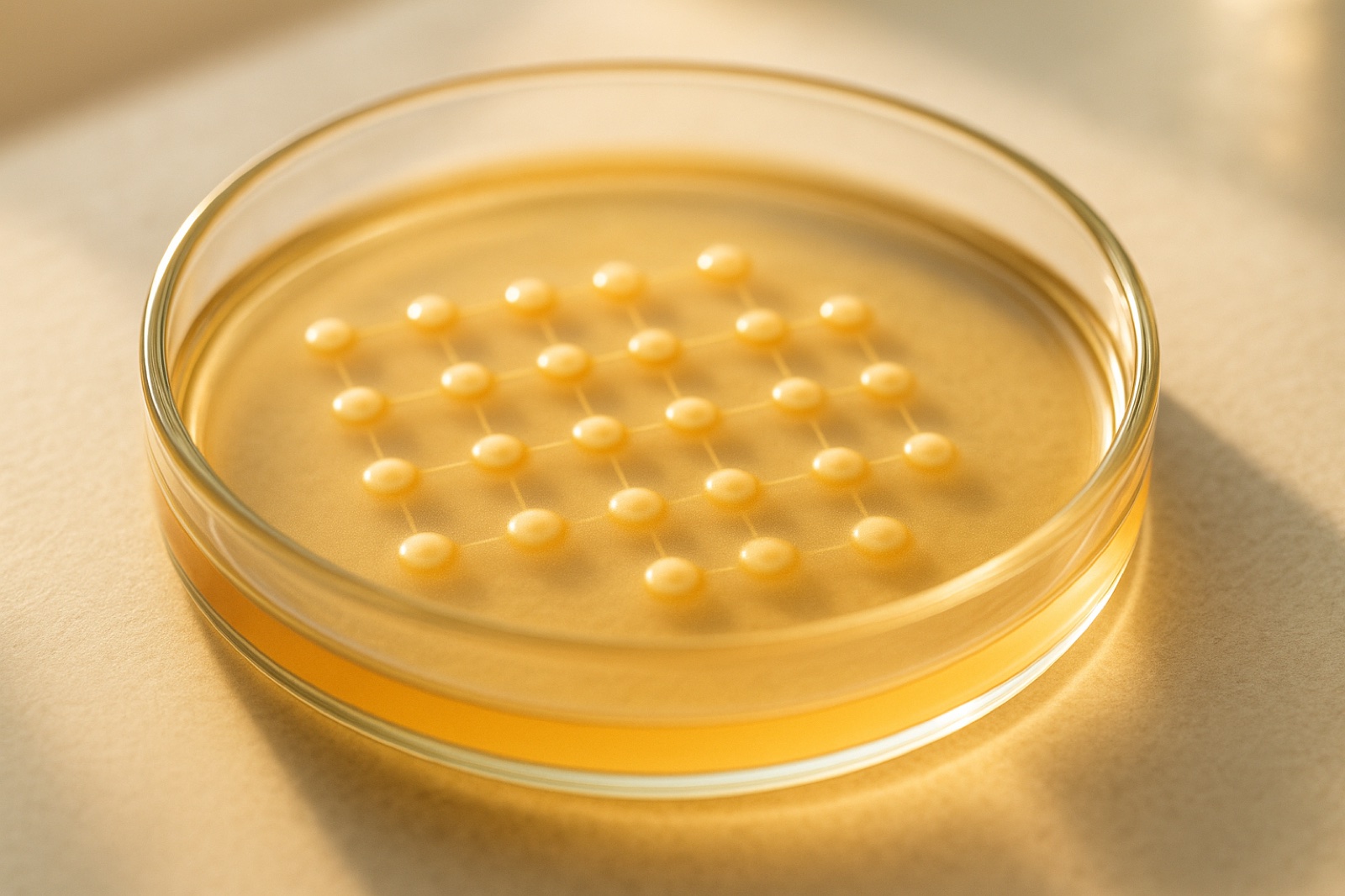
Engineers at MIT have now built switches out of something stranger: living bacteria. They call them living transistors. The team printed colonies of bacteria onto a plate of soft jelly, spaced a few millimetres apart, and let chemical signals travel between the colonies instead of electricity travelling down wires.
The arrangement performed real calculations. That is the genuinely surprising part.
But sitting just behind the excitement is a quieter question, and most people feel it before they can name it. If something alive can be wired in as a component, what is left of the difference between a creature and a part?
The research answers that. Just not in the direction anyone expected.
What MIT’s Living Transistors Actually Do
The work came out of the lab of Christopher Voigt, who heads MIT’s Department of Biological Engineering, with lead author Hamid Doosthosseini and co-author Haorong Chen. It was published in the journal Nature Chemical Biology, and MIT announced it on 17 August 2026.
The organism is Pantoea agglomerans — an ordinary bacterium that already lives on the surfaces of plants. Nothing exotic. The team engineered five versions of it: two that behave like transistors, and three more that pass signals along between them, doing the job the copper does on a circuit board.
Instead of controlling electric current, the engineered cells control the flow of small signalling molecules. One molecule arrives, the cell decides whether the message continues, and another molecule carries it onward. That is a switch, in every sense a computer cares about.
The colonies are printed onto agar — the soft jelly used to grow microbes — roughly five millimetres apart. That gap is deliberate. Close enough for a signal to reach the next colony, far enough that signals do not smear into each other.
From those five strains the team built OR gates, IMPLY gates, multi-input gates, two-input adders and demultiplexers. The largest circuit wired 24 colonies together. In plain terms: a small, wet, growing computer.
Voigt’s summary of what it can do is blunt: “Computationally, there’s nothing that your iPhone can do that these circuits couldn’t do.”
Read that sentence too quickly and you will walk away with the wrong idea entirely. The next number is the one that matters.
The Number That Almost Never Makes the Headline
Each calculation takes about eight hours.
Not eight nanoseconds. Not eight seconds. Eight hours — long enough to sleep through, with time to spare.
So Voigt’s claim is true and modest at the same time. Anything your phone can compute, these circuits could also compute. Eventually. Given enough colonies, enough jelly, and enough of your life spent waiting for the answer.
He is careful about what the actual goal is: “We’re not trying to replace computers, but rather put computational control into biology.”
That is the honest version of this story, and it is the part that keeps getting stripped out on the way to the headline. Nobody at MIT is building a bacterial laptop. They are trying to give living things the ability to make simple decisions on their own — so that one day a coating of engineered bacteria on a plant’s roots or leaves might notice drought or a pest and respond to it with no one watching.
A slow computer is fine for that. Plants are slow too.
Why the Computer Had to Be Spread Out
Here is the detail that stayed with me, and it is in almost none of the coverage.
You might reasonably ask why the circuit had to be spread across two dozen separate colonies on a plate at all. Why not load the whole program into a single cell and be done with it?
Because the cell cannot carry it. Pack too many circuits into one bacterium and you overwhelm the machinery it uses to make proteins — the same machinery it needs for the ordinary business of staying alive. There is also only a limited supply of the biological parts these switches are built from, which caps how complicated any single one of them can get.
Sit with that for a moment. The reason this is a circuit board and not a cell is that the cell has a prior commitment. Most of what it has, it has already spent on being alive. You can borrow a little of it. You cannot have all of it.
So the engineers worked around that limit instead of through it. They broke the computer into pieces small enough that no single organism ever had to stop being an organism. The five-millimetre gaps between the colonies are not a design flaw. They are the space life insisted on keeping.
It is worth putting that beside two things we have written about before. A study found that a single brain cell can out-compute an entire artificial network. And IBM packed 100 billion transistors onto one chip — more than your brain has neurons — and it still could not do the one thing that mattered. The pattern keeps repeating. We measure living things against machines, and the comparison quietly breaks in the same place every time.
What the Cell Would Not Give Up
There is a fear underneath the excitement about research like this, and it is worth naming plainly, because most people carry a version of it that has nothing to do with bacteria.
It is the fear of being reduced to what you do. Of turning out to be a component after all — valued while you function, and only while you function. Anyone who has ever been measured purely by output knows that feeling. It usually arrives on a Monday.
But look at what actually happened on that plate. The bacteria could be borrowed. They could not be converted. Something in a living thing keeps a portion back for the plain work of being alive, and no amount of clever engineering could reach it. The team did not defeat that limit. They built around it, five millimetres at a time.
There is a much older idea that says the same thing, written down long before anyone could print a colony onto jelly: that a living thing was made on purpose, by God, and that its worth was never the same thing as its usefulness. What you produce is something you do. It is not something you are. Strange to find that idea sitting inside a laboratory result — but there it is, in the gaps between the colonies.
If that question is closer to the surface than usual for you today, we built a free What Is My Purpose? assessment that takes about ten minutes and asks you to believe nothing at all to use it.
The Line Was Never Thin
None of this takes anything away from what MIT built. It is real, it is clever, and it will almost certainly end up on the roots of a crop somewhere long before it ends up anywhere near you.
What it changes is the shape of the worry. The line between a creature and a component did not turn out to be thin. It turned out to be stubborn — so stubborn that the only way to build the circuit at all was to leave the living part alone.
If you have been running this week on the quiet assumption that you are worth roughly what you produced, that is a limit worth borrowing.
Even a bacterium gets to keep something back.
What Do You Think?
If a living cell can be wired into a working circuit, does that make it more like a machine — or does it show how much of a living thing can never be used that way? There is no obvious right answer, and we would genuinely like to hear yours. Leave a comment below.
Share This
- MIT wired living bacteria into a working computer. Each calculation takes eight hours. The reason it’s that slow is the best part: a cell can only spare so much of itself before it stops being alive. https://bgodinspired.com/index.php/bible-resources/bible-and-science/living-transistors-mit-bacteria/
- Turns out you can’t turn a bacterium into a computer chip. You can only borrow a corner of one. Most of what a living cell has, it has already spent on being alive. https://bgodinspired.com/index.php/bible-resources/bible-and-science/living-transistors-mit-bacteria/
- “Computationally, there’s nothing that your iPhone can do that these circuits couldn’t do.” — MIT’s Christopher Voigt, on bacteria that take eight hours to do one sum. Both halves of that are true, and the second half is the interesting one. https://bgodinspired.com/index.php/bible-resources/bible-and-science/living-transistors-mit-bacteria/
Questions People Are Asking
What are living transistors?
Living transistors are bacteria engineered to work as switches inside a biological circuit. Instead of controlling the flow of electric current the way a silicon transistor does, an engineered bacterial cell controls the flow of small signalling molecules, deciding whether a chemical message passes on to the next component. MIT researchers built them using Pantoea agglomerans, a bacterium that grows naturally on plant surfaces.
How fast are MIT’s bacterial computers?
Very slow. According to MIT, a circuit made from these engineered bacterial cells takes roughly eight hours to perform a single calculation. A silicon transistor in a phone switches billions of times per second. The bacterial circuits are not intended to compete with electronics on speed; the goal is to put simple computational decision-making inside living systems.
Can bacteria really do the same calculations as a computer?
In principle, yes, but extremely slowly. MIT’s Christopher Voigt has said that computationally there is nothing an iPhone can do that these circuits could not also do. The MIT team built OR gates, IMPLY gates, multi-input gates, two-input adders and demultiplexers from five engineered bacterial strains, and their largest circuit connected 24 bacterial colonies. The practical limit is time, not logic.
Why did MIT spread the circuit across many bacterial colonies instead of one cell?
Because a single cell cannot carry that much. Loading too many engineered circuits into one bacterium overwhelms the protein-making machinery the cell needs for its own survival, and there is only a limited supply of the biological parts these circuits are made from. So the researchers printed separate colonies onto agar jelly about five millimetres apart, which also stops the chemical signals from interfering with one another.
What could living bacterial circuits be used for?
The most-cited application is agriculture. Engineered bacterial circuits could one day coat a plant’s roots or leaves, detect a threat such as drought or a pest, and automatically trigger a response — for example, producing a fungicide on the spot. Because plants respond over hours and days rather than nanoseconds, the slowness of bacterial computation is much less of a problem in that setting.