 0
0
 0
0
Most of us know the feeling of standing in a line we don’t think we belong in.
A clinic waiting room. A queue for help. The back row of a church, close to the door, because you’re not sure you should be there at all. Part of you believes you need to sort your life out first. Then maybe God will be glad to see you.
Now here is a question people type into search bars every day: why did Jesus get baptized? If Jesus never sinned, why would he step into a river meant for people saying sorry for their sins?
It’s a fair question. John the Baptist asked it first, standing right there in the water. And the answer has a lot to say to anyone who feels like they’re standing in the wrong line.
Why did Jesus get baptized if he had no sin?
Here is the short answer, before we go deeper.
The Bible never says Jesus was baptized because he needed forgiveness. Hebrews 4:15 says he was tempted “in all points” like we are, “yet without sin.” And the Gospels never show him confessing anything at the river, even though everyone else there was.
What Matthew does record is Jesus’s own reason, in his own words: “thus it becometh us to fulfil all righteousness” (Matthew 3:15). And the Gospels show three things happening in that moment:
- Jesus stood with ordinary people. He went into the same water, in the same place, as the crowds confessing their sins.
- He said yes to what God was doing through John. He treated John’s call as God’s call.
- God spoke his identity out loud. “Thou art my beloved Son, in whom I am well pleased” (Mark 1:11) came before Jesus had preached a single sermon.
Each of those is worth slowing down for.
Matthew chapter 3 is where the grown-up Jesus steps into the story. If you’d like to hear the whole Gospel of Matthew from beginning to end, it’s yours free as an immersive PDF and a 28-chapter audiobook:
What John’s baptism was for
To see why this puzzled John, you have to see who was already in the water.
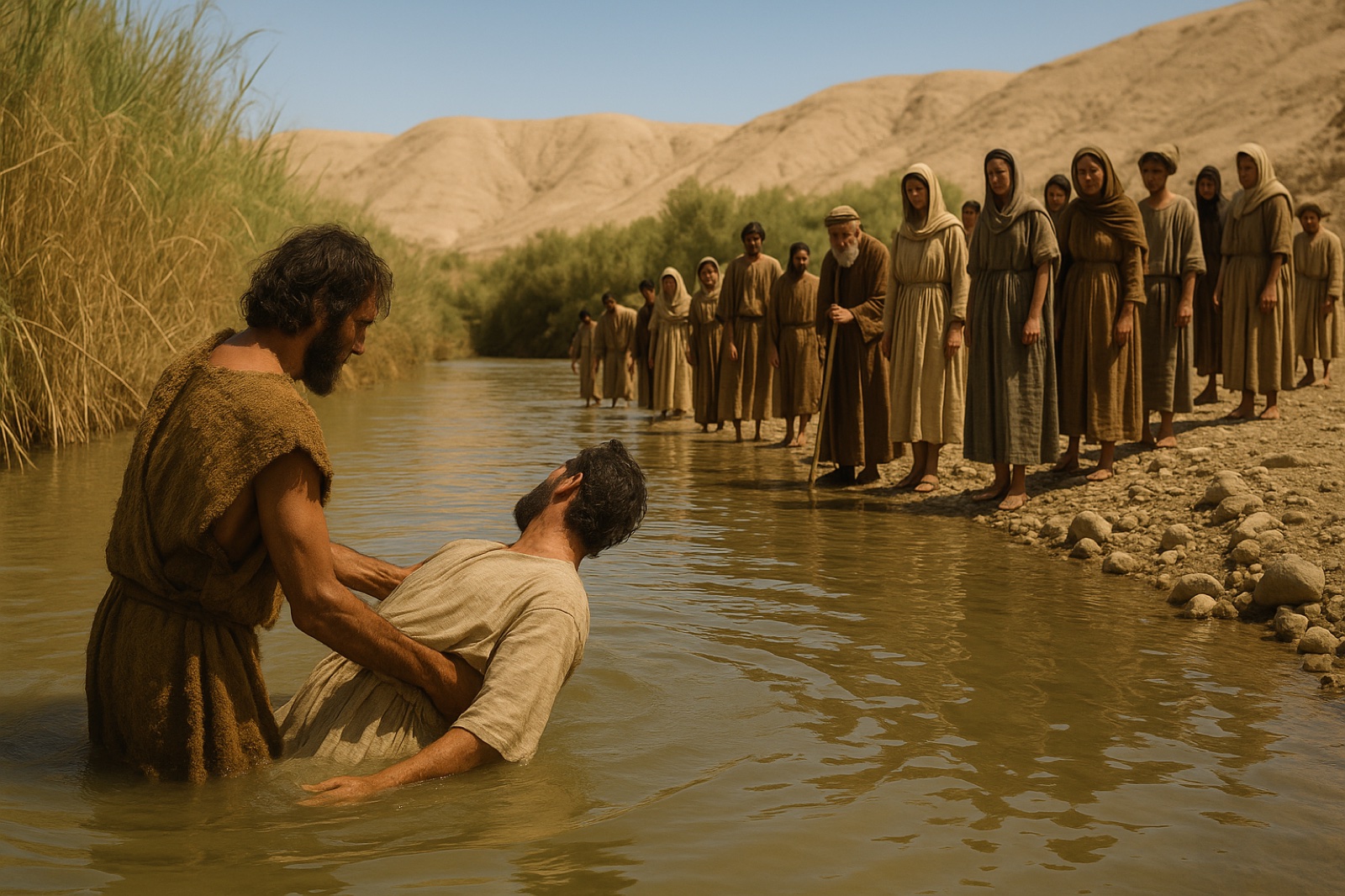
John was a fierce, unusual prophet living out in the wilderness. He wore camel’s hair and ate locusts and wild honey. And people came to him from everywhere. Matthew says crowds came from “Jerusalem, and all Judaea, and all the region round about Jordan,” and they “were baptized of him in Jordan, confessing their sins” (Matthew 3:5-6).
Mark is even more direct. John preached “the baptism of repentance for the remission of sins” (Mark 1:4).
So this was not a gentle ceremony. It was a public admission. Walking into that river said, in front of your neighbours: I have gone the wrong way, and I want to turn around. That turning is what the Bible’s word for repentance really means. We unpacked it in what the Greek word metanoia really means.
That is the line Jesus walked into.
John tried to stop him
Matthew tells us what happened when Jesus arrived:
“Then cometh Jesus from Galilee to Jordan unto John, to be baptized of him. But John forbad him, saying, I have need to be baptized of thee, and comest thou to me?” (Matthew 3:13-14, KJV)
The Greek wording suggests John didn’t just object once. It paints a man who kept trying to stop it. That’s why many modern translations say John “tried to prevent” him.
Notice what John says, too. He doesn’t say, “You don’t need this.” He says, “I need this from you.” The most famous preacher of repentance in the land stood in the river and admitted he was the one in need.
John had spent his whole ministry telling people to get ready for someone greater. Now that someone was standing in front of him, asking to be treated like everyone else.
What “fulfil all righteousness” most likely means
Jesus answered: “Suffer it to be so now: for thus it becometh us to fulfil all righteousness. Then he suffered him” (Matthew 3:15).
In plain words: Let it happen. This is the right thing for us to do.
Let’s be honest here. Jesus doesn’t explain this sentence any further, and Bible teachers have never fully agreed on exactly what it means. Anyone who says the answer is simple is saying more than the text does. But Matthew leaves some clues.
Clue one: Jesus says “us.” Not “me.” He pulls John into it. This is something the two of them do together, each doing the part God gave them.
Clue two: Matthew uses “righteousness” for John’s work. Later in the same Gospel, Jesus says, “John came unto you in the way of righteousness” (Matthew 21:32). In Matthew, righteousness is often about doing what God asks. John’s baptism was the path God had opened. Jesus walked down that path instead of around it.
Clue three: Isaiah had already described a servant who stood with the guilty. Isaiah 53:12 says this servant “was numbered with the transgressors; and he bare the sin of many.” Matthew 3 never quotes that verse. But many Christians over the centuries have seen the river as the first place Jesus let himself be counted among sinners, long before the cross.
Put together, the most careful answer is this: Jesus wasn’t washing away his own sin. He was saying yes to God’s plan, and he was choosing to stand where sinners stand.
He stood in the same line
Luke tells the moment in a single sentence, and it’s easy to miss what it says:
“Now when all the people were baptized, it came to pass, that Jesus also being baptized, and praying, the heaven was opened” (Luke 3:21, KJV)
“When all the people were baptized… Jesus also.” Luke doesn’t set Jesus apart. He places him with the crowd. And just a few verses earlier, Luke shows us who was in that crowd: tax collectors (“publicans”) and soldiers, asking John what they should do to change (Luke 3:12-14). Not the respectable people. The ones everybody knew had a past.
Luke also adds two small words no other Gospel writer includes: “and praying.” Jesus was talking to God while he stood in that water. Heaven opened while he prayed.
What God said before Jesus preached a single sermon
Then came the voice.
“And straightway coming up out of the water, he saw the heavens opened, and the Spirit like a dove descending upon him: And there came a voice from heaven, saying, Thou art my beloved Son, in whom I am well pleased.” (Mark 1:10-11, KJV)
Look at the timing. At this point the Gospels record no sermons from Jesus. No healings. No crowds following him. Mark doesn’t show him preaching until after John is put in prison (Mark 1:14). Luke says Jesus “began to be about thirty years of age” (Luke 3:23), and the Gospels tell us very little about those thirty years.
So “in whom I am well pleased” was not a reward for a successful ministry. The ministry hadn’t started. Those words were spoken over a man standing wet in a river of repentance, in the same line as everyone else.
A few more details are worth seeing:
- In Mark and Luke, the voice speaks to Jesus: “Thou art.” Matthew records it as “This is my beloved Son” (Matthew 3:17), words for others to hear. Jesus heard it personally, and it was also public.
- The words echo older scripture. Psalm 2:7 says, “Thou art my Son.” Isaiah 42:1 describes God’s servant: “mine elect, in whom my soul delighteth; I have put my spirit upon him.” At the river, the Spirit comes down and the voice speaks. Those two old passages seem to meet in one moment.
- Mark uses a strong word. Where the King James says the heavens “opened,” Mark’s Greek word means torn or split. Mark uses that same word again at the very end, when “the veil of the temple was rent in twain” as Jesus died (Mark 15:38). Heaven tears open at the start of Jesus’s ministry, and the temple curtain tears at the end. Both times, someone names him as the Son of God (Mark 15:39).
The very next word was “if”
Here’s the part most people read straight past.
Mark says that right after the voice, “immediately the Spirit driveth him into the wilderness” (Mark 1:12). In Matthew, Jesus goes without food for forty days. Then the tempter shows up, and his first words are:
“If thou be the Son of God, command that these stones be made bread.” (Matthew 4:3, KJV)
In Matthew’s Gospel, those words sit only a few lines after “This is my beloved Son.” The very first attack goes straight at what God just said. Not at Jesus’s plans. Not at his teaching. At his identity. If you really are who that voice said you are… prove it.
And Jesus doesn’t prove it. He doesn’t make the bread. He answers with scripture: “Man shall not live by bread alone, but by every word that proceedeth out of the mouth of God” (Matthew 4:4). Jesus had just heard a word come from God. He chose to live on that word instead of earning it all over again.
We looked at what Jesus did when he came back out of that wilderness in Why Does God Isolate You? Jesus Came Out Looking for Company. It’s a good companion to this story.
What Jesus’s baptism means for you
Here’s where the old story walks into your own life.
Many of us live as if God’s approval sits at the end of a long road. Fix your habits. Stop the thing you keep doing. Pray more, read more, fail less. Then maybe you’ll be welcome.
But look at the river again.
The one person who didn’t need that line got into it anyway. Jesus didn’t wait for sinners to clean up and come to him. He walked down to the water where they already were and stood beside them. If you’ve ever felt you’re in the “wrong” line with God, you’re standing exactly where Jesus chose to stand.
The words of love came before the work. It’s true that Jesus isn’t like us. He had no sin, and we do. But that’s the good news, not the catch. The New Testament says Jesus stood in our place so we could share in his. Paul writes, “For ye are all the children of God by faith in Christ Jesus. For as many of you as have been baptized into Christ have put on Christ” (Galatians 3:26-27). The love spoken over Jesus at the river is the love God offers you through him. You don’t earn it by performing. You receive it.
And that love will be questioned. The “if” came for Jesus, and it will come for you. If God really loved you, would your life look like this? If you were really forgiven, would you still feel this way? Jesus didn’t answer by trying harder to prove it. He leaned on what God had already said.
So the question “Why did Jesus get baptized?” starts as a puzzle about Jesus. It ends as an answer to a quieter question you may be carrying: Am I allowed to stand here? Yes. Jesus stood there first.
If this has you wondering about your own baptism, we looked at that question honestly in Is Baptism Necessary for Salvation?
“Jesus got in the line for sinners. Heaven spoke while he stood there.”
Actions to Take
- Read the scene in one sitting (3 minutes). Open Matthew 3:13 through 4:4 and read it straight through. Watch “This is my beloved Son” turn into “If thou be the Son of God.” Seeing how close they sit changes the story.
- Catch your own “if” (2 minutes). Finish this sentence on paper or in your phone’s notes: “If God really loved me, then ___.” Whatever you write is the “if” you’ve been living under. Next to it, write Galatians 3:26: “For ye are all the children of God by faith in Christ Jesus.”
- Stand beside someone (5 minutes). Think of one person who feels like they’re in the “wrong line” right now: ashamed, behind, or left out. Send them a short message that asks for nothing and gives no advice. Something like: “Thinking of you today. You’re not on your own.” That’s what Jesus did at the river. He went and stood with people.
Journal Prompts
- Where in your life do you feel like you’re standing in the “wrong line,” somewhere you believe you don’t belong?
- What do you think you’d need to fix before God could be pleased with you? Where did that list come from?
- If God spoke one sentence over you today, before you’ve done anything at all, what do you most need it to say?
A Prayer
God, I’ll be honest: I often feel like I have to clean myself up before I can come to you. Thank you that Jesus didn’t wait for people to get it right, but walked into the river and stood right beside them. When the “if” whispers that I’m not really loved, help me stop trying to prove myself and rest in what you’ve already said. Let me hear, even a little, the love you spoke over Jesus, and let it change how I treat the people standing in line next to me. In Jesus’s name, amen.
Discussion Question
Why do you think God said “in whom I am well pleased” at the very start of Jesus’s ministry, instead of at the end after all the miracles? Share what you think in the comments below.
If this story is new to you, or you’d like to keep reading past the river, the whole Gospel of Matthew is free as an immersive PDF and audiobook:
Share This
“Jesus had no sin to confess, and he still got in the line with everyone who did. I’ve never read his baptism the same way since.”
“God said ‘in whom I am well pleased’ before Jesus preached one sermon. The very next voice he heard said ‘IF thou be the Son of God.’ Love came first. Then the if.”
“Standing in a line you don’t think you belong in? Jesus chose that line on purpose. Matthew 3:13-17.”
Questions and Answers
Why did Jesus get baptized if he had no sin?
Jesus was not baptized to have his own sins forgiven. Hebrews 4:15 describes him as “without sin,” and the Gospels record no confession from him at the Jordan River. According to Matthew 3:15, Jesus said his baptism was “to fulfil all righteousness,” meaning it was the right thing to do in obedience to God’s plan. By being baptized, Jesus stood alongside the ordinary people who were coming to John the Baptist to confess their sins, and the Gospels record that a voice from heaven then called him God’s beloved Son.
What does “fulfil all righteousness” mean in Matthew 3:15?
In Matthew 3:15, Jesus tells John the Baptist, “thus it becometh us to fulfil all righteousness,” after John tries to stop him from being baptized. Jesus does not explain the phrase further, and Bible teachers do not all agree on its exact meaning. Clues within Matthew’s Gospel point to doing what God asks: Matthew 21:32 says John came “in the way of righteousness,” so being baptized by John was a way of obeying God’s call. Many Christians also connect the phrase to Isaiah 53:12, where God’s servant is “numbered with the transgressors,” and see Jesus’s baptism as his choice to stand with sinners.
Who baptized Jesus, and where did it happen?
Jesus was baptized by John the Baptist in the Jordan River. Mark 1:9 says Jesus “came from Nazareth of Galilee, and was baptized of John in Jordan.” John was a prophet who preached in the wilderness of Judaea and baptized crowds of people who came confessing their sins. Matthew 3:14 records that John tried to stop Jesus, saying, “I have need to be baptized of thee, and comest thou to me?”
What did God say at Jesus’s baptism?
After Jesus was baptized, a voice from heaven spoke. Mark 1:11 records the words as “Thou art my beloved Son, in whom I am well pleased.” Luke 3:22 gives nearly the same words, and Matthew 3:17 records them as “This is my beloved Son, in whom I am well pleased.” The Gospels also say the Spirit came down upon Jesus like a dove. These words came before Jesus began his public preaching, which Mark 1:14 places after John the Baptist was put in prison.
How old was Jesus when he was baptized?
Luke 3:23 says that Jesus “began to be about thirty years of age” around the time of his baptism. Luke uses the word “about,” so the Bible gives an approximate age rather than an exact number. In the Gospels of Matthew, Mark and Luke, Jesus’s baptism in the Jordan River marks the beginning of his public ministry.