 0
0
 0
0
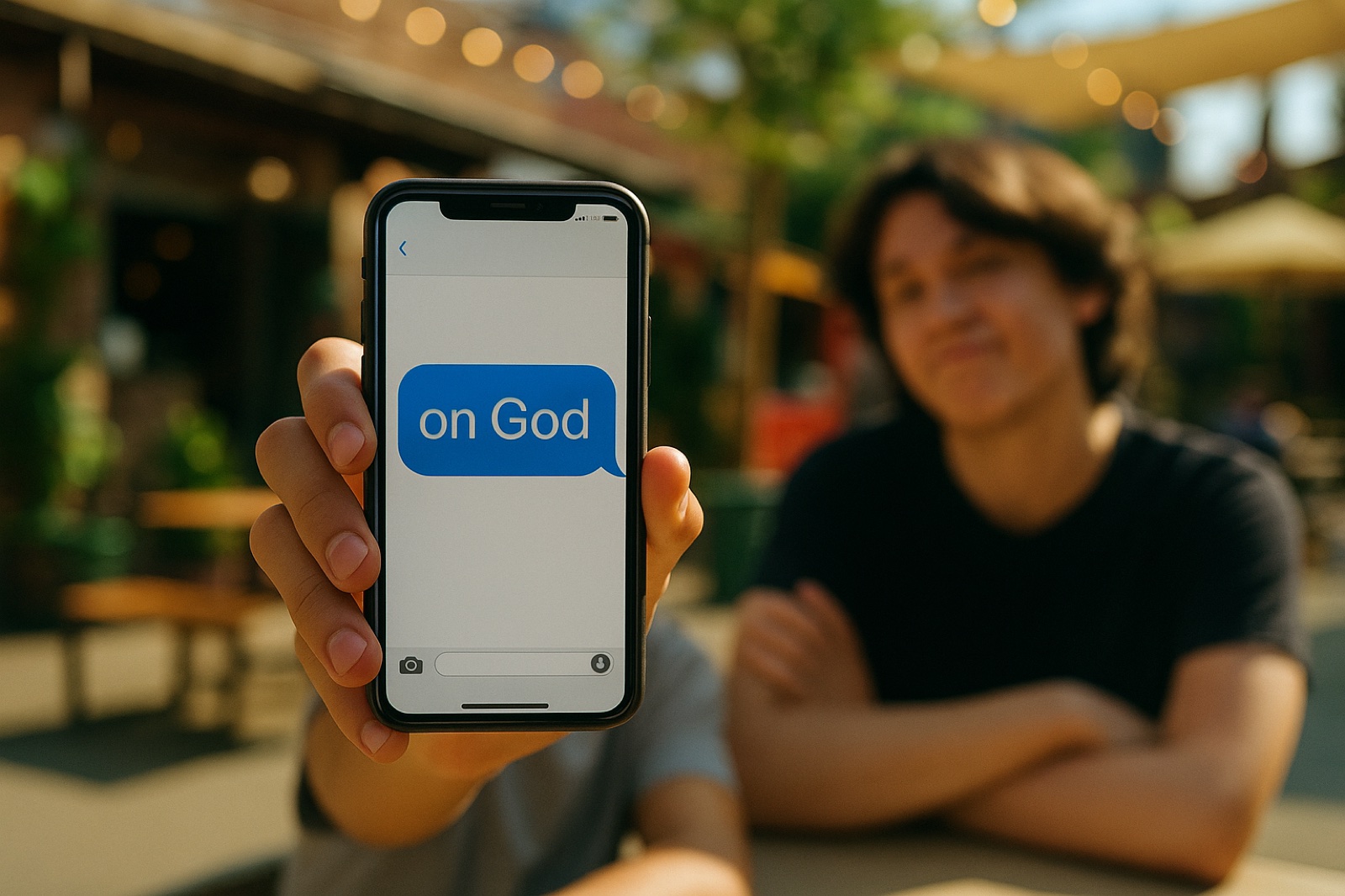
“I didn’t eat your chips. On God.”
It comes out fast. In the group chat, at the table, in the middle of an argument about who was right. Maybe you type “ong” without thinking about it at all.
And then, sometimes, a little thought follows it. Wait. Is it a sin to say “on God”? Did I just use God’s name to win an argument about chips?
If you searched that question, you are not in trouble for asking it. It is actually a very good question. And the honest answer takes you somewhere most people never look: not to a list of banned phrases, but to the reason anyone ever needs to swear in the first place.
Is It a Sin to Say “On God”? Start With What It Means
“On God” is short for “I swear to God” or “I swear on God.” It means I am telling the truth. I am not lying. You can believe me. Most slang guides trace it to Black American speech, and it spread worldwide through hip-hop and social media. People use it for big things and tiny things alike.
So “on God” is not a curse word. It is an oath. It calls on God as a witness that what you are saying is true.
That matters, because the Bible never mentions this slang. But Jesus did talk about oaths. And what Jesus said is stronger than most of us expect.
What Jesus Actually Said About Swearing
In the middle of the Sermon on the Mount, Jesus says this (Matthew 5:33-37):
“Again, ye have heard that it hath been said by them of old time, Thou shalt not forswear thyself, but shalt perform unto the Lord thine oaths: But I say unto you, Swear not at all; neither by heaven; for it is God’s throne: Nor by the earth; for it is his footstool: neither by Jerusalem; for it is the city of the great King. Neither shalt thou swear by thy head, because thou canst not make one hair white or black. But let your communication be, Yea, yea; Nay, nay: for whatsoever is more than these cometh of evil.”
Notice first what “swear” means here. It is not about rude words. It is about promises backed up by something bigger than you: heaven, the earth, a holy city, your own head.
“On God” fits right in that list. It is the modern version of “by heaven.”
And Jesus says, “Swear not at all.” Not “swear carefully.” Not at all.
That sounds like a rule. But look at the reasons Jesus gives, one after another. Heaven is God’s throne. The earth is God’s footstool. You cannot even change the colour of one hair on your own head. In other words: none of the things you swear by are yours to bet with. Everything already belongs to God.
To see why Jesus pressed this so hard, you need to know what swearing had turned into.
People Had Built a System of Loophole Oaths
Later in the same Gospel, Jesus describes how some religious teachers of the day handled oaths (Matthew 23:16-17):
“Woe unto you, ye blind guides, which say, Whosoever shall swear by the temple, it is nothing; but whosoever shall swear by the gold of the temple, he is a debtor! Ye fools and blind: for whether is greater, the gold, or the temple that sanctifieth the gold?”
Read that slowly. Swear by the temple? It is nothing. It does not count. Swear by the gold of the temple? Now you owe it.
People had created a ranking. Some oaths were binding. Some sounded holy but had a secret exit. So you could swear something with a straight face, and later say, “Well, I only swore by the temple.”
That is the world Jesus stepped into. Oaths were no longer a way to make truth stronger. They had become a way to hide lies inside religious language.
Jesus shuts the whole thing down in one line (Matthew 23:21): “And whoso shall swear by the temple, sweareth by it, and by him that dwelleth therein.” There is no small oath. There is no exit. It is all God’s.
The Loudest Oath in the Gospels Was a Lie
Here is a detail almost everyone reads past.
On the night Jesus was arrested, a servant girl said Peter had been with Jesus. Peter said no. Then someone else said it. Matthew 26:72 says, “And again he denied with an oath, I do not know the man.”
Then a third time. Matthew 26:74: “Then began he to curse and to swear, saying, I know not the man. And immediately the cock crew.”
Stop there for a moment. The most heated swearing in the whole Gospel of Matthew comes from Peter, cursing and swearing at once. And it is wrapped around the biggest lie of his life.
That is not a coincidence. The more Peter needed to be believed, the louder his oaths got. The oath was not proof of truth. It was a sign of pressure.
And look at who was standing on trial just a few steps away. That same night, the high priest said to Jesus, “I adjure thee by the living God, that thou tell us whether thou be the Christ” (Matthew 26:63). Jesus did not add an oath of his own. He simply answered, “Thou hast said.”
One man swore and lied. The other man just said yes.
But Doesn’t God Swear Oaths in the Bible?
Yes. And this is where the easy answer gets more interesting.
Hebrews 6:13 says, “For when God made promise to Abraham, because he could swear by no greater, he sware by himself.” Paul, too, calls God as a witness. In Galatians 1:20 he writes, “Now the things which I write unto you, behold, before God, I lie not.” In 2 Corinthians 1:23 he says, “Moreover I call God for a record upon my soul.”
So the Bible does not treat every serious oath as evil. Then why would God swear at all? God’s word does not need backup.
Hebrews answers that too:
“For men verily swear by the greater: and an oath for confirmation is to them an end of all strife. Wherein God, willing more abundantly to shew unto the heirs of promise the immutability of his counsel, confirmed it by an oath” (Hebrews 6:16-17).
God swore for us. Not because God’s promise was weak, but because people have learned not to trust words. God stooped down to speak our language of assurance, so that we “might have a strong consolation” (Hebrews 6:18).
That is a kind thing to do. And it tells you exactly what an oath is: a patch for a world where plain words are not trusted.
It is worth being honest that Christians have not all agreed on how far “swear not at all” reaches. In the 1600s, many Quakers went to prison rather than swear an oath in court, because they took Matthew 5 and James 5:12 literally. Laws were later changed so people could make a solemn “affirmation” instead, and many courts around the world still offer that choice. Most other Christian traditions have read Jesus as aimed at casual and deceptive swearing, not at every solemn promise. Sincere believers stand on both sides.
Here is what nearly all of them share, though: Jesus was not handing us a word to avoid. Jesus was describing a kind of person.
The Turn: “On God” Means Plain Words Stopped Working
Think about how this slang grows.
First you say “for real.” Then that stops being enough, so it becomes “no cap.” Then “on God.” Then “on everything.” Each new phrase is needed because the last one wore out.
That is the exact problem Jesus named. When your yes needs an oath attached, it is because somewhere, somehow, a plain yes stopped being believed. By them, or by you.
The Quakers put it simply: if you have to swear to be telling the truth, it suggests you might not be telling the truth when you don’t swear.
Now read Matthew 5:37 again: “But let your communication be, Yea, yea; Nay, nay: for whatsoever is more than these cometh of evil.”
The Greek behind “of evil” can mean “from evil” or “from the evil one,” and translations differ. But either way, Jesus is not calling you evil for adding “on God.” Jesus is saying the need for it comes from somewhere broken: a world full of lies, where everyone has been burned, where nobody’s word is quite enough.
And here is the part that feels like freedom. Jesus is not telling you to try harder to be believed. Jesus is inviting you to become someone who doesn’t have to prove it.
Picture that. No escalating. No swearing on things that aren’t yours. You just say “yes,” and the people around you know yes means yes, because your life has been saying it for you all along.
“The goal isn’t a cleaner oath. It’s a yes that doesn’t need one.”
So Should You Stop Saying “On God”?
If you have used “on God” a hundred times, hear this clearly first: God is not waiting to catch you on a slang word. This passage is not a trap. It is an invitation to a lighter way to live.
That said, there are two good reasons to let the phrase go, gently.
The first is about God’s name. “On God, this burger is the best” uses the most important name there is as a sound effect. We looked at that more closely in what taking the Lord’s name in vain really means, and why the Hebrew word there is about how you carry God’s name, not just how you say it.
The second is the one Jesus actually pressed. If you notice yourself reaching for “on God” most when you are least sure you’ll be believed, that is worth paying attention to. The phrase is not the problem. It is a signal.
And if you are wondering about rougher words too, the Bible’s concern there follows the same pattern. It is less about the words themselves and more about what they do to people.
Actions to Take
- Catch it once. The next time “on God,” “I swear,” or “no cap” is about to come out, just say the sentence without it. Notice how it feels to let a plain yes stand on its own.
- Find the pressure point. Scroll back through one chat where you used “on God” or “I swear.” Ask one question: was I trying to be believed because I’d let this person down before? That answer takes a minute and tells you a lot.
- Keep one small word today. Pick something tiny you’ve said you’ll do, such as a reply, a return call, or showing up on time, and do it exactly as you said. A trusted yes is built out of small kept ones.
Journaling Prompts
- With whom do you feel the strongest need to add “I swear” to what you say? What is going on in that relationship?
- Is there a place where your yes has stopped meaning yes, even to yourself? What would it take to rebuild it, one small promise at a time?
- How would your days feel different if you never had to prove you were telling the truth?
A Prayer You Can Pray Right Now
God, I’ve been swearing on things that were never mine to bet with, sometimes just to win, sometimes because I was scared nobody would believe me. Thank you that you are not standing over me waiting to catch a word. Make me the kind of person whose yes is enough, starting with the small things today. And where people have stopped trusting my word, help me rebuild it honestly, one kept promise at a time.
Discussion Question
Do you think phrases like “on God” and “I swear” make people more believable, or less? Tell us what you think in the comments.
If this stirred up more questions about the Sermon on the Mount, you can explore them with our free What Jesus Teaches AI assistant. It opens in ChatGPT and is free to use.
Share This
- I looked up whether it’s a sin to say “on God.” Jesus said “swear not at all,” but the point wasn’t the phrase. It was becoming someone whose plain yes is enough.
- The loudest swearing in the Gospel of Matthew is Peter, and it’s wrapped around the biggest lie of his life. The more you need to be believed, the louder the oath gets.
- “The goal isn’t a cleaner oath. It’s a yes that doesn’t need one.”
Questions People Ask
Is it a sin to say “on God”?
The Bible never mentions the slang phrase “on God,” which is short for “I swear to God.” It is an oath, and in Matthew 5:34-37 Jesus said “Swear not at all” and “let your communication be, Yea, yea; Nay, nay.” Christians differ on how literally to apply that. Many read Jesus as targeting casual or deceptive oaths rather than one specific phrase. Either way, the heart of the teaching is honesty: being a person whose simple yes can be trusted without backing it up with God’s name.
What does “on God” mean in slang?
“On God” is slang for “I swear to God” or “I swear on God.” People say it, or type “ong,” to insist that they are telling the truth. Slang guides trace the phrase to Black American speech, and it spread widely through hip-hop and social media, especially among younger people. Because it calls on God as a witness, it works as a form of oath rather than a curse word.
What does Matthew 5:37 mean?
Matthew 5:37 reads, “But let your communication be, Yea, yea; Nay, nay: for whatsoever is more than these cometh of evil.” Jesus spoke it after telling his listeners not to swear by heaven, earth, Jerusalem or their own heads. At the time, some teachers ranked oaths so that certain oaths did not count, as Matthew 23:16-22 describes. Jesus rejected that system and taught that a person’s ordinary yes or no should be fully reliable, making extra oaths unnecessary.
Why did God swear an oath if Jesus said not to swear?
Hebrews 6:13-18 explains that when God made a promise to Abraham, there was no one greater to swear by, so God swore by God’s own self. Hebrews says people “swear by the greater” and that an oath ends arguments, and that God confirmed the promise by an oath to give believers “a strong consolation.” The oath was a kindness to people who find it hard to trust words, not a sign that God’s word needed support. This is why many Christians do not see every solemn oath as forbidden.
Can Christians swear an oath in court?
Christians disagree on this question. In the 1600s many Quakers refused to swear any oath, including in court, because of Matthew 5:34 and James 5:12, and some were imprisoned for it. Laws later allowed a solemn affirmation instead of an oath, and many courts around the world still offer that option. Most other Christian traditions accept solemn oaths, pointing to Paul calling God as witness in Galatians 1:20 and to God’s oath in Hebrews 6.