 0
0
 0
0
Some buildings skip the 13th floor. Some people won’t sit thirteen at a table, and plenty of us feel a small flicker of unease when the 13th of the month lands on a Friday. Even if you don’t believe in luck, the number has a reputation. So it’s natural to wonder where that came from, and whether the Bible is behind it. What is the number 13 meaning in the Bible, really?
The honest answer surprised me. The Bible never calls 13 unlucky. And the one time Scripture does mark a 13th day for disaster, the story ends with a sentence that might change how you look at every day you’ve been dreading.
Number 13 Meaning in the Bible: The Short Answer
The Bible does not teach that 13 is unlucky, cursed, or dangerous. No verse warns against it, and no law or prophet treats it as a bad omen. In fact, Scripture doesn’t give the number 13 a fixed meaning at all, the way it clearly does with numbers like seven or twelve.
Thirteen does show up, but mostly as a plain count. Ishmael was “thirteen years old” when he was circumcised (Genesis 17:25). The word of the LORD first came to Jeremiah “in the thirteenth year” of King Josiah’s reign (Jeremiah 1:2). Solomon spent seven years building the temple (1 Kings 6:38), but “was building his own house thirteen years” (1 Kings 7:1). That last one is a quiet detail worth noticing: the king took almost twice as long on his own palace as on God’s house. Scripture doesn’t comment. It just lets the numbers sit side by side.
What about the idea that 13 means rebellion? That comes mostly from the Victorian writer E. W. Bullinger, whose book Number in Scripture linked 13 with rebellion, partly because of Genesis 14:4: “Twelve years they served Chedorlaomer, and in the thirteenth year they rebelled.” It’s an observation people have built on, but the Bible itself never says “13 means rebellion.” It’s worth holding loosely, the same way we’ve suggested with other number meanings, like the number 4 meaning in the Bible.
Did the Fear of 13 Come From the Last Supper?
You’ll often hear that the fear of 13 started at the Last Supper, because thirteen people sat at the table: Jesus and the twelve disciples, one of whom, Judas, would betray Him. Matthew does describe that evening simply: “Now when the even was come, he sat down with the twelve” (Matthew 26:20).
But that link is a popular explanation, not something the Gospels say. No writer in the New Testament points to the number of people at the table as the problem. The betrayal came from a choice in Judas’s heart, not from the head count. And the dread of Friday the 13th in particular is a much more recent superstition. It’s very hard to find in writing before the last couple of centuries, which is long after the Bible was finished.
So the fear of 13 is real enough in our culture. It just didn’t come from Scripture.
The One 13th Day the Bible Marked for Disaster
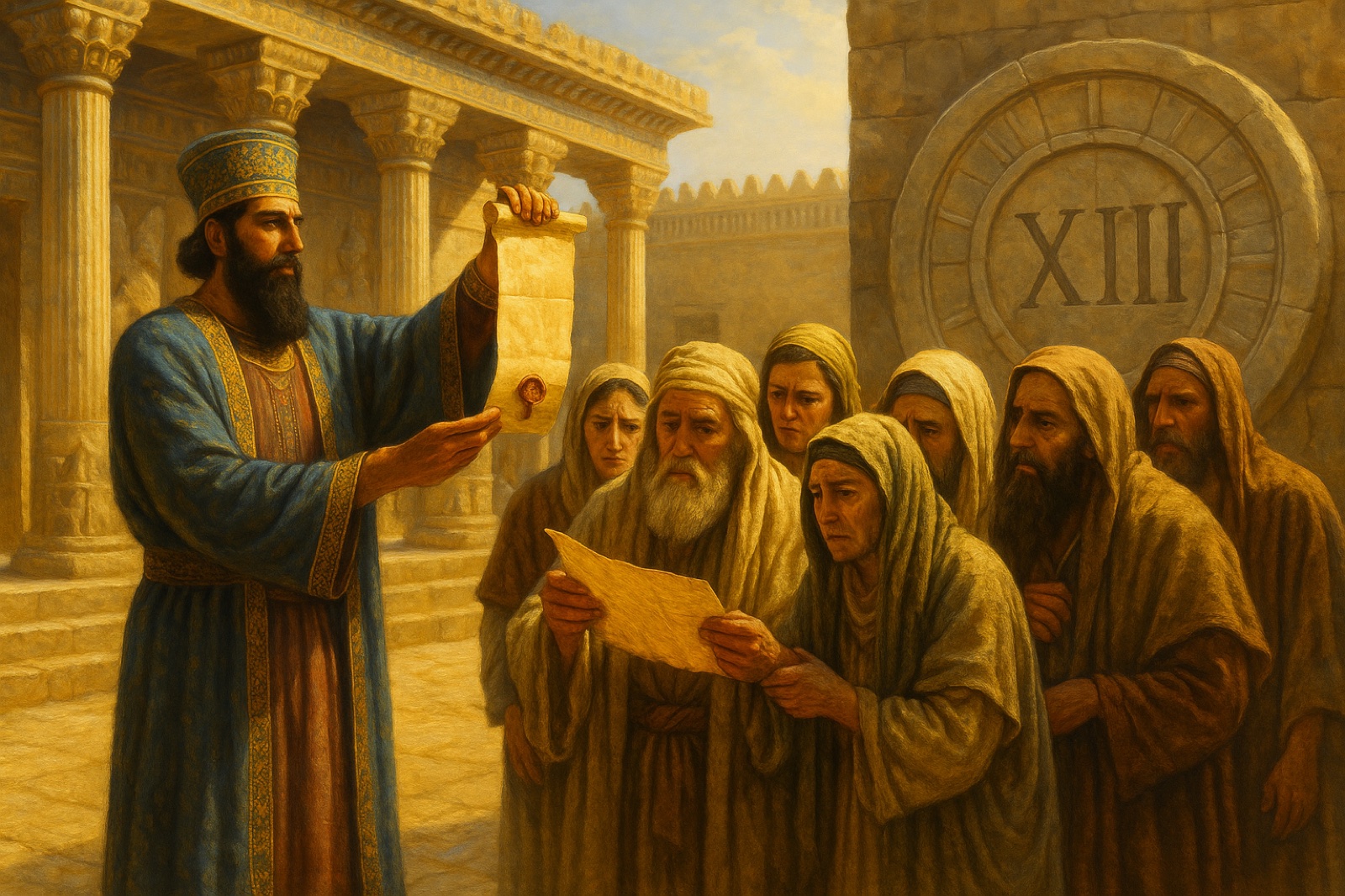
There is a place in the Bible where a 13th day really is set aside as a day of doom. It’s in the book of Esther, a book that famously never names God even once (we explored that in The Book of the Bible That Never Mentions God Once).
Haman, a powerful official in the Persian empire, hated the Jewish people and wanted them wiped out. The way he chose the date is the detail most people read straight past:
“In the first month, that is, the month Nisan, in the twelfth year of king Ahasuerus, they cast Pur, that is, the lot, before Haman from day to day, and from month to month, to the twelfth month, that is, the month Adar.” (Esther 3:7, KJV)
Haman didn’t pick the date by reason. He picked it by casting lots, a kind of dice. He let chance choose the time. The lot pointed to the month of Adar, and the decree that followed named the 13th day. Letters went out across the empire “to destroy, to kill, and to cause to perish, all Jews, both young and old, little children and women, in one day, even upon the thirteenth day of the twelfth month, which is the month Adar” (Esther 3:13, KJV).
Think about how that must have felt. A whole people had a date circled on the calendar, months ahead, with their names on it. Every day brought them closer to the 13th.
“Though It Was Turned to the Contrary”
You probably know some of what happens next. Esther, a young Jewish woman who had become queen, risked her life to go before the king. Haman’s plan came apart. The Jewish people were given the right to defend themselves.
Then the 13th day arrives, and the Bible slows down to describe it:
“Now in the twelfth month, that is, the month Adar, on the thirteenth day of the same, when the king’s commandment and his decree drew near to be put in execution, in the day that the enemies of the Jews hoped to have power over them, (though it was turned to the contrary, that the Jews had rule over them that hated them;)” (Esther 9:1, KJV)
Though it was turned to the contrary. That little phrase in brackets is the whole story. The day that was supposed to be the end became the day of rescue. By the next day they “rested, and made it a day of feasting and gladness” (Esther 9:17, KJV). Esther 9:22 calls it “the month which was turned unto them from sorrow to joy, and from mourning into a good day.”
And here’s the part that fits so well with our question about luck. The feast that came out of it is still kept today, and it’s named after the dice Haman threw: “Wherefore they called these days Purim after the name of Pur” (Esther 9:26, KJV). The celebration carries the name of the lot. It’s as if the story wants us to remember that the man who trusted chance lost, and the day set for disaster became a day of joy.
Proverbs puts it in one line: “The lot is cast into the lap; but the whole disposing thereof is of the LORD” (Proverbs 16:33, KJV). Haman could roll the dice. He couldn’t decide what the day would hold.
What the Number 13 Means for the Days You Dread
This is where the number 13 stops being trivia.
Most of us don’t fear Friday the 13th. But most of us do have a date on the calendar we’re dreading. A hospital appointment. A court date. The anniversary of a death. The day the rent is due and the money isn’t there. The first day back after something went badly wrong. We count down to it, and it starts to feel like the date itself is against us.
Esther 9:1 doesn’t promise that every hard day will turn out the way we hope. The Bible is honest that some days are just hard. But it does tell us something steady: no date belongs to chance. The day Haman’s dice pointed him to was not his to own. David said the same thing in a prayer: “My times are in thy hand” (Psalm 31:15, KJV). Not in luck’s hand, not in a number’s hand, and not in the hand of whoever is against you.
So the number 13 meaning in the Bible isn’t “bad luck.” If it means anything, it’s this: the day you’ve been dreading can be “turned to the contrary.” And even when it isn’t turned the way you’d choose, it was never in the hands of chance. That’s the same thread we found when we looked at what 555 means in the Bible: God doesn’t speak through codes and digits. God deals with people, one name and one day at a time.
A good place to start:
The Beginner’s Guide to Feeling God’s Presence Every Day
A simple daily rhythm to help you notice God with you in ordinary moments, including the days you’ve been dreading.
Get the free guide Free.
Actions to Take Today
- Name your “13th.” Open your phone’s calendar and find the date you’re dreading most right now. In the event notes, type: “My times are in thy hand. Psalm 31:15.” When the reminder pops up, you’ll see a promise instead of just a deadline.
- Read Esther 9:1 out loud, with your date in it. Say it slowly, then add your own line: “On the day I’ve been dreading, it can be turned to the contrary.” It takes less than a minute.
- Tell one person about your date. Esther didn’t face her day alone; she asked her people to stand with her first. Send one message to someone you trust: “I’ve got something hard coming up on [date]. Would you pray for me that day?”
Journal Prompts
- What day or event are you counting down to with dread right now? Write down what you’re most afraid will happen.
- Where in your past did a day you dreaded turn out differently than you feared? What did that day teach you?
- Haman trusted chance to choose his day. What do you find yourself trusting instead of God when you’re anxious about the future?
A Prayer for the Day You’re Dreading
God, there’s a day coming that I’m afraid of, and I keep counting down to it. I’m grateful that no date belongs to luck, and that my times are in your hand. You turned a day of fear into a day of joy for Esther’s people, and I’m asking you to be with me on mine, whatever it holds. Help me walk into it knowing I’m not walking into it alone.
Let’s Talk About It
Why do you think so many people still feel uneasy about the number 13, even if they don’t believe in luck? I’d love to hear what you think. Leave a comment below.
Share This
- The Bible never calls 13 unlucky. The one 13th day marked for disaster in Scripture was timed by a roll of the dice, and Esther 9:1 says it “was turned to the contrary.”
- Haman cast lots to time his plan to destroy a whole people. His decree named the 13th. The feast that came out of it is still named after his dice: Purim. Chance lost.
- Whatever date you’re dreading: “My times are in thy hand.” (Psalm 31:15)
Q&A: Number 13 Meaning in the Bible, Common Questions Answered
What does the number 13 mean in the Bible?
The Bible does not give the number 13 a fixed symbolic meaning, and it never calls 13 unlucky. The number appears mostly as a plain count, such as Ishmael being thirteen years old at his circumcision (Genesis 17:25) and Solomon spending thirteen years building his own house (1 Kings 7:1). Some Bible teachers, following E. W. Bullinger’s book Number in Scripture, link 13 with rebellion because of Genesis 14:4, but Scripture itself never states that meaning.
Is 13 an unlucky number according to the Bible?
No. The Bible does not teach that 13 is unlucky, and no verse warns against the number. The Bible also rejects the idea of luck controlling events: Proverbs 16:33 says, “The lot is cast into the lap; but the whole disposing thereof is of the LORD.” The modern superstition about 13 did not come from Scripture.
Did the fear of 13 come from the Last Supper?
The idea that thirteen people at the Last Supper (Jesus and the twelve disciples) caused the fear of 13 is a popular explanation, not a teaching of the Bible. Matthew 26:20 says only that Jesus “sat down with the twelve,” and no New Testament writer connects the number of people at the table with Judas’s betrayal or with bad luck.
Where does the 13th day appear in the book of Esther?
In the book of Esther, Haman cast lots, called Pur, to choose a time to destroy the Jewish people. The lot pointed to the month Adar, and his decree set the thirteenth day of that month (Esther 3:7, 3:13). Esther 9:1 records that on that thirteenth day “it was turned to the contrary,” and the Jewish people were saved. The festival of Purim, named after the lots Haman cast (Esther 9:26), celebrates that reversal.
How should a Christian think about Friday the 13th?
A Christian does not need to fear Friday the 13th, because the Bible teaches that days are held by God, not by luck or numbers. Psalm 31:15 says, “My times are in thy hand.” A helpful response to any date that feels threatening is to bring it to God in prayer rather than to treat the date itself as dangerous.