 0
0
 0
0
On 28 September 2026, a spacecraft that left Earth more than three years ago came back. It passed 8,640 km above the Indian Ocean and then it was gone again. The European Space Agency (ESA) had even told skywatchers in Australia that, with the right telescope or binoculars, they might be able to follow it across the sky on its way in.
The spacecraft is called Juice. It is going to Jupiter. And the Juice Earth flyby raises a fair question. If you are trying to reach a planet that is, on average, about 800 million km away, why are you back where you started?
The answer is one of the strangest facts in space travel. It also turns out to be a very old idea.
What Happened During the Juice Earth Flyby?
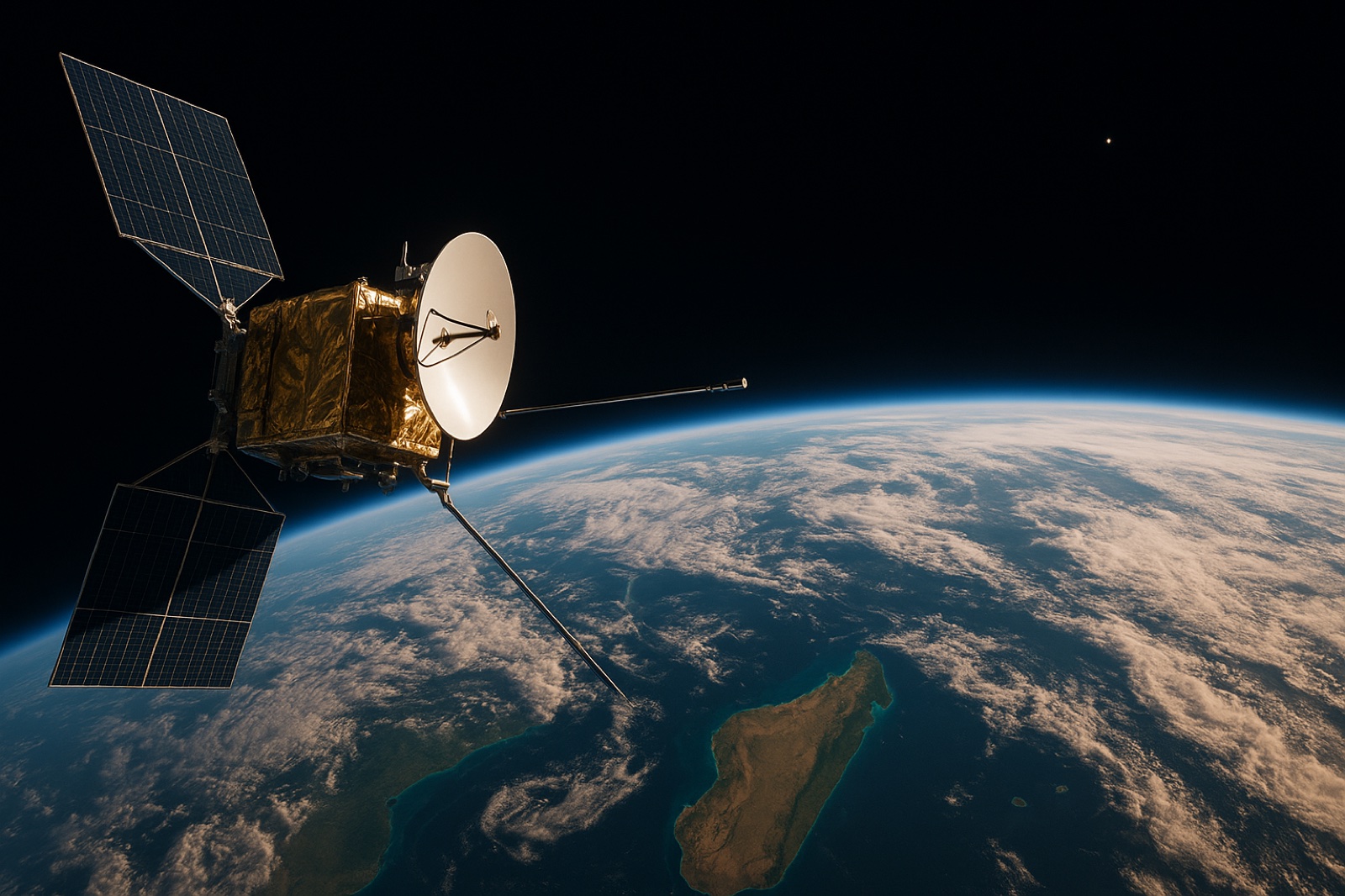
Juice is short for Jupiter Icy Moons Explorer. ESA launched it in April 2023. Its job is to study three of Jupiter’s big moons: Ganymede, Callisto and Europa.
The closest point of the flyby came at 11:45 UTC. As Juice swung past, Earth’s gravity bent its path by about 20 degrees and added about 3.5 km per second to its speed. No engine did that. The planet did.
The flight team had set aside six chances to correct the course on the way in. They needed one small nudge, four weeks out. “Thanks to our very careful planning, we used only a small amount of the propellant reserved for this flyby,” said Angela Dietz, Juice’s Spacecraft Operations Manager, in ESA’s report on the flyby.
There is one detail that is easy to read past. The night before, Juice flew through Earth’s shadow. It runs on sunlight, and ESA’s plan had it in the dark for about eight and a half hours, living on its battery. Then it came out the other side, switched on its ten science instruments, and practised on the one world we already know well. One of its navigation pictures shows Madagascar.
Why Can’t Juice Fly Straight to Jupiter?
You might guess the looping route is somehow faster. It is not. ESA says so plainly. A straight flight, the agency wrote before the flyby, “would have been much quicker.”
The problem is what the straight road costs. According to ESA, without an enormous rocket, sending Juice directly would take “an impossible 60 000 kg of onboard propellant.” And that is before the second problem. A spacecraft going that fast needs a huge amount more fuel to slow down at the other end. Without it, Juice would sail right past Jupiter.
So the mission planners used something that costs almost nothing. When a spacecraft passes close to a planet, the planet’s gravity pulls on it and changes its speed and direction. The planet is already racing around the Sun, and the spacecraft borrows a tiny bit of that motion. This is called a gravity assist.
Here is the whole road Juice is taking:
- April 2023: launch from Earth.
- August 2024: a flyby of the Moon and then Earth.
- August 2025: a flyby of Venus.
- September 2026: back past Earth. This is the one that just happened.
- January 2029: past Earth one last time.
- July 2031: planned arrival at Jupiter.
That is more than eight years. Careful flying saves fuel, and in space, saved fuel is everything. It is the same quiet reason the Roman Space Telescope may now last 22 years.
The Flyby That Slowed Juice Down on Purpose
This is the part most reports skip, and it is the best part.
In August 2024, Juice made the first combined Moon-and-Earth flyby anyone had ever tried. The Moon sped it up a little, by 0.9 km per second measured against the Sun. Then Earth slowed it down by 4.8 km per second.
Read that again. A spacecraft trying to get to Jupiter used its first trip home to hit the brakes.
Slower, Juice began to fall inward, toward Venus and toward the Sun. That is the opposite direction from Jupiter. ESA called it a “braking” manoeuvre, and it called the trip by way of Venus a “shortcut.” The agency said that slowing Juice down at that point was “actually more efficient” than speeding it up, and that the manoeuvre saved roughly 100 to 150 kg of propellant.
So for a year, a machine built for the cold, dim edge of the Solar System flew toward the heat.
The Long Way Was Not the Easy Way
Nobody should pretend the long road was gentle.
Near Venus, the Sun is far stronger than anything Juice will feel at Jupiter. To get through, the spacecraft turned its big main antenna toward the Sun and hid behind it like a sunshade.
Then, on 16 July 2025, about 200 million km from Earth, Juice went silent. For nearly 20 hours the team sent commands into the dark with no way to know if any of them had arrived. The cause was a tiny software bug. An onboard timer counts up and restarts from zero once every 16 months. One function happened to be reading it at the exact moment it restarted, and the signal amplifier stayed switched off.
“Losing contact with a spacecraft is one of the most serious scenarios we can face,” Dietz said afterward. They got it back. Six weeks later, on 31 August 2025, Juice flew past Venus as planned.
Eight years is a long time to wait for a first look at Jupiter’s moons, and space work is often like this. Most of the people involved spend their time on the slow middle part. The Artemis II astronauts who flew farthest from Earth are now coaching the crews who will land.
The Short Road Was Real. It Just Couldn’t Be Finished.
It is tempting to tell this story as “the long way was secretly the fast way.” It wasn’t. The straight line really was quicker. Juice simply could not carry what the straight line demanded.
One of the oldest travel stories people still tell has the same shape. A crowd of freed slaves walks out of Egypt. There is a short road to where they are going, up along the coast. In the story, God leads them the long way round instead, through the desert, and the story gives the reason. The short road ran through war. People who had been free for only a few days would have seen the fighting and gone straight back.
Notice what that story does not say. It does not say the long road was nicer, or that slow is always good. It says the short road was real, and that these people, at that moment, could not have finished it. The long way was the one they could actually complete.
That is a careful claim, and it is worth keeping it careful. Not every delay is a hidden plan. Sometimes late is just late. Juice’s 20 hours of silence were a bug, not a strategy. But some long roads are long because someone counted what you were carrying.
What This Means If You Keep Ending Up Back Where You Started
Most of us know the feeling of passing the same spot again. Back in the same town. Back in a parent’s house. Back at the job you tried to leave. Starting the same course a second time.
From the outside, it looks like a circle. So does Juice. Three years of travel, and there it was again, over the Indian Ocean.
But it did not leave the way it came. It left 3.5 km per second faster and pointed 20 degrees a different way. A circle and a spiral look the same if you only watch one spot. The difference is what you leave with.
So here is a small, honest question for the next time you find yourself back at a place you thought you had left: am I passing this spot with more than I had last time? A little more skill. A little less fear. One more person on your side. If the answer is yes, you are not going in circles.
And if the answer is no, that is useful too. Even Juice needed one small correction on the way in. Coming back around is when you get to make it.
If waiting is the hard part for you, our free How Patient Am I? quiz is a gentle place to start.
A good place to start:
The Beginner’s Guide to Feeling God’s Presence Every Day
A simple guide to noticing God in ordinary moments, including the long stretches where nothing seems to be moving.
Get the free guide. Free.
Juice will be back once more, in January 2029. Then Earth will throw it outward for the last time. If all goes to plan, it reaches Jupiter in July 2031, having come home three times before it finally got away.
Somewhere out past the Moon right now, it is already on its way. It just looks, for the moment, like it is going nowhere.
Discussion Question
If a short road and a long road both lead to the same place, is the short one always the better choice? Tell us what you think in the comments below.
Share This
“A probe bound for Jupiter just flew back past Earth on purpose. The straight road was quicker. It just could not be finished. https://bgodinspired.com/index.php/bgodinspired-news/bgodinspired-science-news/juice-earth-flyby/”
“I did not know this: in 2024 the Juice spacecraft used Earth to slow down and fall toward Venus, the opposite direction from Jupiter. The space agency calls that a shortcut. Space travel is strange and I love it. https://bgodinspired.com/index.php/bgodinspired-news/bgodinspired-science-news/juice-earth-flyby/”
“For anyone who feels like they keep ending up back where they started: this piece is about a spacecraft, and somehow also about that. https://bgodinspired.com/index.php/bgodinspired-news/bgodinspired-science-news/juice-earth-flyby/”
Common Questions About the Juice Earth Flyby, Answered
What was the Juice Earth flyby in September 2026?
The Juice Earth flyby was a planned close pass of Earth by the European Space Agency’s Jupiter Icy Moons Explorer (Juice) on 28 September 2026. The spacecraft came within 8,640 km of Earth above the Indian Ocean at 11:45 UTC. Earth’s gravity bent its path by about 20 degrees and added about 3.5 km per second to its speed, setting it up for one more Earth flyby in January 2029.
Why doesn’t the Juice spacecraft fly straight to Jupiter?
The European Space Agency says a direct flight to Jupiter would have been much quicker, but it would have needed an enormous rocket and what the agency calls an impossible 60,000 kg of onboard propellant, plus more fuel to slow down on arrival. Instead, Juice uses the gravity of the Moon, Earth and Venus to change its speed and direction along the way. The trip takes more than eight years, from launch in April 2023 to a planned arrival in July 2031.
What is a gravity assist?
A gravity assist, also called a flyby or a slingshot, is when a spacecraft passes close to a planet or moon and uses that body’s gravity to change its own speed and direction. Because the planet is moving around the Sun, the spacecraft can gain or lose speed relative to the Sun while burning very little fuel. The Juice spacecraft uses gravity assists at the Moon, Earth and Venus to reach Jupiter.
When will Juice arrive at Jupiter?
The European Space Agency plans for the Juice spacecraft to arrive at Jupiter in July 2031. Before that, Juice makes a third and final Earth flyby in January 2029. At Jupiter, the plan is for Juice to make 35 flybys of the moons Ganymede, Callisto and Europa, and then to go into orbit around Ganymede in 2034.
Why did Juice fly to Venus if it is going to Jupiter?
In August 2024, the Juice spacecraft flew past the Moon and then Earth in the first lunar-Earth flyby ever attempted. The Earth pass slowed Juice by 4.8 km per second relative to the Sun, which sent it inward toward Venus. The European Space Agency says braking at that point was more efficient than speeding up and saved roughly 100 to 150 kg of propellant. Juice flew past Venus on 31 August 2025 and began gaining speed from there.