 0
0
 0
0
Try something before you read on. Finish this line from the Bible: “The lion shall lie down with the…”
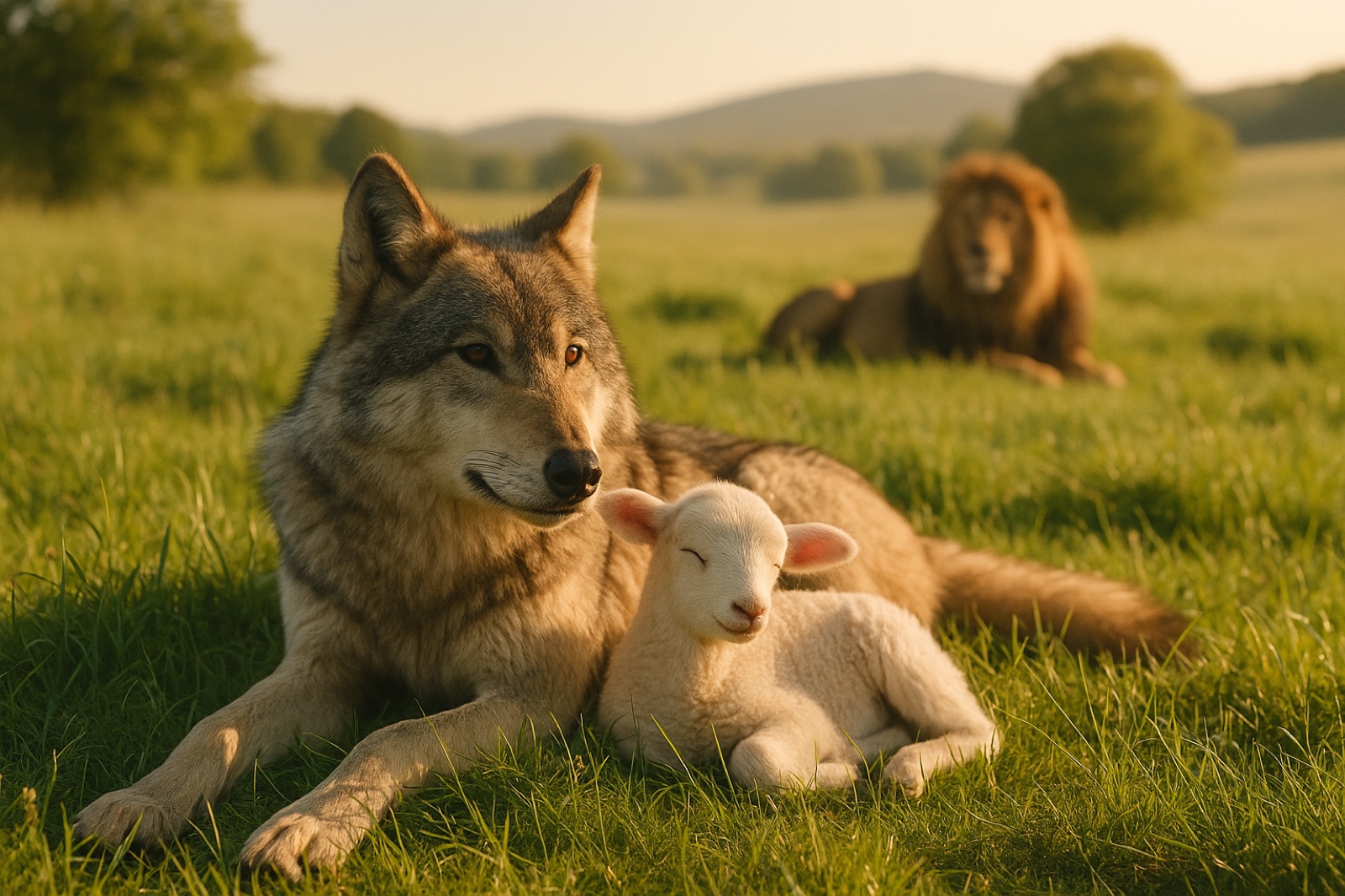
If you said “lamb,” you’re in very good company. A great many people do. The line shows up on paintings, greeting cards and church banners. There’s just one small problem. That line is not in the Bible, and it never was. It’s the best-known Mandela effect in the Bible. And once you see what the verse really says, it gets better, not worse.
What Is the Mandela Effect?
A Mandela effect is when a lot of people share the same wrong memory.
The name comes from Nelson Mandela. Around 2009 or 2010, a writer named Fiona Broome found that she clearly remembered Mandela dying in prison in the 1980s. So did many people she talked to. But he didn’t. He walked out of prison in 1990, became South Africa’s president in 1994, and died in 2013 at the age of 95.
Since then, people have collected more of these. Pikachu’s tail has no black tip. The Monopoly man doesn’t wear a monocle. C-3PO, the golden robot in Star Wars, has one silver leg.
In 2022, two psychologists at the University of Chicago, Deepasri Prasad and Wilma Bainbridge, tested this carefully. They gathered 40 well-known characters and logos. For a handful of them, people didn’t just get the picture wrong. They got it wrong in the same way. When people were asked to draw the pictures from memory, the same mistakes showed up again.
The researchers were honest about what they couldn’t explain. They ruled out a few simple reasons, and they said they have not yet found one single cause.
What we do know is this: memory isn’t a recording. It’s closer to retelling a story. Back in 1932, a British psychologist named Frederic Bartlett asked people to retell a folk tale they had never heard before. Over time their versions got shorter, and the odd details turned into familiar ones. The mind keeps the main idea, then rebuilds the rest with whatever feels like it should be there. It’s a close cousin of hindsight bias, another way the mind quietly edits the past.
The Mandela Effect in the Bible: What Isaiah Really Wrote
Here is the verse people are reaching for:
“The wolf also shall dwell with the lamb, and the leopard shall lie down with the kid; and the calf and the young lion and the fatling together; and a little child shall lead them.” (Isaiah 11:6, KJV)
Read it slowly. The wolf is with the lamb. The leopard lies down with the kid, which is a young goat. The young lion is beside the calf and the fatling, a well-fed farm animal.
So the lion is in the verse. The words “lie down” are in the verse. The lamb is in the verse. They’re just not together.
Isaiah comes back to this picture near the end of the book: “The wolf and the lamb shall feed together, and the lion shall eat straw like the bullock” (Isaiah 65:25, KJV). It’s the wolf and the lamb again. The lion is there again too, eating straw next to the cattle.
Did Someone Change the Bible?
Some corners of the internet say the verse used to read “lion” and was changed in secret. The evidence points the other way.
The Hebrew word in Isaiah 11:6 is ze’ev. It means wolf. The Great Isaiah Scroll, one of the Dead Sea Scrolls, was copied more than a hundred years before Jesus was born, and the wolf is there. The Geneva Bible of 1560 has the wolf dwelling with the lamb. So does the first King James Bible of 1611.
But here’s what I didn’t expect to find. The mix-up is nearly as old as the King James Bible itself.
In 1643, a Hebrew scholar named John Lightfoot preached to the House of Commons in London. His sermon was printed that same year. Describing the peace Isaiah promised, he wrote, “the Lambe and Lion couch together, and the Lion now as harmelesse as the Lambe.”
He wasn’t quoting the verse word for word. He was painting the picture from memory. And the picture already had the lion beside the lamb, just 32 years after 1611.
In 1660, a preacher named Gilbert Ironside wrote of “the wolfe to lye down with the Lamb.” He had the right animals. But “lie down” had slid over from the leopard.
That was more than 380 years ago, long before the internet. Nobody changed the Bible. We’ve been tidying this verse up in our heads for centuries.
Why the Lion Took the Wolf’s Place
Nobody can prove exactly why. But there are some good guesses.
- The lion is already close by. He’s in the same sentence, a few words away.
- “Lion and lamb” sounds right. The two words start with the same letter and roll off the tongue.
- The Bible pairs them somewhere else. In Revelation 5, Jesus is called “the Lion of the tribe of Juda,” and one verse later John sees “a Lamb as it had been slain” (Revelation 5:5-6, KJV).
- Artists helped. In the 1830s, an American Quaker painter named Edward Hicks began painting this scene over and over, with a lion among the animals. Pictures stick.
- Memory keeps the idea, not the words. The idea is “a fierce animal and a gentle animal, at peace.” When the mind rebuilds it, it reaches for the fiercest animal and the gentlest one.
Other Bible Lines We Remember Wrong
The lion and the lamb isn’t alone. Here are three more.
“Money is the root of all evil.” The verse says, “For the love of money is the root of all evil” (1 Timothy 6:10, KJV). Three small words went missing, and they change the meaning. We looked at that one in Is “Money Is the Root of All Evil” in the Bible?
The apple in the garden. Genesis never names the fruit. It says only that Eve “took of the fruit thereof, and did eat” (Genesis 3:6, KJV).
The three wise men. Matthew says “there came wise men from the east” (Matthew 2:1, KJV). He never says how many. He lists three gifts: “gold, and frankincense, and myrrh” (Matthew 2:11, KJV). Memory turned three gifts into three men.
The same thing happened with “pride comes before a fall,” which is a shortened version of a longer proverb. Each time, the pattern is the same. Memory makes the line shorter, smoother and easier to picture.
What the Real Verse Says That the Slogan Loses
This is where it stops being trivia for me.
The version we remember is one neat pair: a lion and a lamb. The real verse is a list. Wolf and lamb. Leopard and young goat. Lion and calf. The next verse adds the cow and the bear.
Look at how the list is built. Each hunter is placed beside the very animal it would eat. Isaiah isn’t painting one pretty picture. He’s going through, pair by pair, every place where one side has a reason to be afraid of the other.
Then comes the part the slogan drops completely: “and a little child shall lead them.” The smallest and weakest one in the scene is safe enough to be in charge.
The chapter begins with a promised king from the family of Jesse, King David’s father. Christians understand that king to be Jesus. This scene is what life under that king looks like. It’s a much bigger promise than “the strong one becomes nice.” It says fear itself comes to an end, everywhere it lives, all the way down to a child.
We nearly traded that for a slogan.
The Bible seems to know we do this. When Paul came to preach in a town called Berea, the people listened gladly. Then they went and checked.
“These were more noble than those in Thessalonica, in that they received the word with all readiness of mind, and searched the scriptures daily, whether those things were so.” (Acts 17:11, KJV)
They checked an apostle against the page, and the Bible calls them “more noble” for it. In the Bible, checking isn’t doubt. It’s honour.
That matters for more than animals. Many of us carry lines about God that we never checked. Something a grandparent said. A line from a song. A sentence on a poster. Some of us are living with a harsher God, or a smaller promise, than the page really holds.
The answer isn’t to feel foolish. It’s to go and look. Memory drifts. The words have stayed put.
A good place to start:
The Beginner’s Guide to Feeling God’s Presence Every Day
A simple daily rhythm to help you notice God with you in ordinary moments.
Get the free guide Free.
Actions to Take Today
- Look up Isaiah 11:6 for yourself. Don’t take my word for it. Open a Bible or a Bible app, read the verse out loud once, and count the animals. It takes two minutes.
- Test one line you “know.” Pick a saying you’ve always believed is in the Bible and go looking for it. You may find it. You may not. If you’d like a few to try, ask our free Bible Fun Facts assistant (it opens in ChatGPT).
- Check one thing you believe about God. Write down one sentence you carry about how God sees you. Maybe it’s “God is tired of me.” Then do what the people of Berea did, and look for where the Bible says it. If you can’t find it, you’re allowed to put it down.
A Prayer for Going Back to the Words
God, I’ve been carrying some lines I never checked. Some are small, like which animal lies beside the lamb. Some are bigger, like what I think you feel about me. Give me a ready mind like the people of Berea had, to listen gladly and then go and look. And thank you that your words have stayed put, even when my memory hasn’t.
Let’s Talk About It
Which one surprised you most: the wolf, the missing apple, or the wise men nobody counted? I’d love to hear. Leave a comment below.
Share This
- I would have bet money the Bible says “the lion shall lie down with the lamb.” It doesn’t. Isaiah 11:6 says the wolf. The lion is in the verse, just not next to the lamb.
- A preacher in 1643 was already putting the lion beside the lamb. The Mandela effect in the Bible isn’t new, and nobody changed the text. We’ve been tidying it up in our heads for centuries.
- The Bible calls the people who checked Paul’s preaching against the page “more noble” (Acts 17:11). Checking isn’t doubt.
Q&A: Mandela Effect in the Bible, Common Answers
What is the Mandela effect?
The Mandela effect is when many people share the same false memory. The name comes from Nelson Mandela: around 2009 or 2010, writer Fiona Broome found that she and many others remembered Mandela dying in prison in the 1980s, when he was actually released in 1990 and died in 2013. A 2022 University of Chicago study by Deepasri Prasad and Wilma Bainbridge found that people misremember certain well-known images in the same specific way, and the researchers said they have not yet found one single cause.
Does the Bible say the lion shall lie down with the lamb?
No. The Bible never says the lion shall lie down with the lamb. Isaiah 11:6 (KJV) says, “The wolf also shall dwell with the lamb, and the leopard shall lie down with the kid; and the calf and the young lion and the fatling together; and a little child shall lead them.” The lion is in the verse, but it is beside the calf, not the lamb. Isaiah 65:25 also pairs the wolf with the lamb.
Was Isaiah 11:6 changed from lion to wolf?
There is no evidence that Isaiah 11:6 was ever changed. The Hebrew word in the verse is ze’ev, which means wolf, and the wolf appears in the Geneva Bible of 1560 and the King James Bible of 1611. The mix-up itself is very old: a sermon by John Lightfoot printed in London in 1643 already describes “the Lambe and Lion” resting together, which shows people were blending the verse from memory centuries before the internet.
Why do so many people remember the lion and the lamb?
Nobody can prove exactly why people remember the lion and the lamb, but there are likely reasons. The lion appears in the same verse, Isaiah 11:6, only a few words from the lamb. “Lion and lamb” start with the same letter and are easy to say. Revelation 5 calls Jesus both a Lion and a Lamb. Paintings of the scene often feature a lion. And memory tends to keep the main idea, a fierce animal at peace with a gentle one, and rebuild the details.
What are other examples of the Mandela effect in the Bible?
Other commonly misremembered Bible lines include “money is the root of all evil,” when 1 Timothy 6:10 says “the love of money is the root of all evil”; the apple in the Garden of Eden, when Genesis 3:6 only says “the fruit”; and the three wise men, when Matthew 2 never gives a number and only lists three gifts. In each case the Bible text has stayed the same and popular memory has shortened or smoothed it.