 0
0
 0
0
You show up to pray and nothing happens. No warmth. No sense of being heard. Just you, in the quiet, saying words that feel like they’re bouncing off the ceiling. Maybe you’ve started wondering if something’s wrong with you — like real faith is supposed to feel like something, and yours has gone flat.
There’s a word for this season, and it’s older than you’d think: spiritual dryness. It’s one of the most searched phrases in Christian life today, and it was also exactly what David named — out loud, in writing — while he was hiding in an actual desert with people trying to kill him.
He didn’t wait for the feeling to come back before he prayed. He prayed the dryness itself. That’s Psalm 63, and it’s worth slowing down on.
The Prayer That Starts With “Thou Art My God” — Not “I Feel You”
Psalm 63 opens like this:
“O God, thou art my God; early will I seek thee: my soul thirsteth for thee, my flesh longeth for thee in a dry and thirsty land, where no water is.” (Psalm 63:1, KJV)
Read that again slowly. David doesn’t open with an explanation of what’s wrong. He doesn’t open with a request. He opens with a claim — thou art my God — and then immediately admits the truth underneath it: he is thirsty, and there is no water. Not “I used to feel close to you.” Not “remind me why I believe this.” Just: this land is dry, and I am seeking you anyway, early, before anything has changed.
That order matters. The seeking comes first. The relief doesn’t come until later in the psalm — verses 5 through 8 describe satisfaction “as with marrow and fatness,” a soul that “followeth hard after thee.” But that’s downstream. Verse 1 is written from inside the dryness, not after it lifted.
Where David Actually Was When He Wrote This
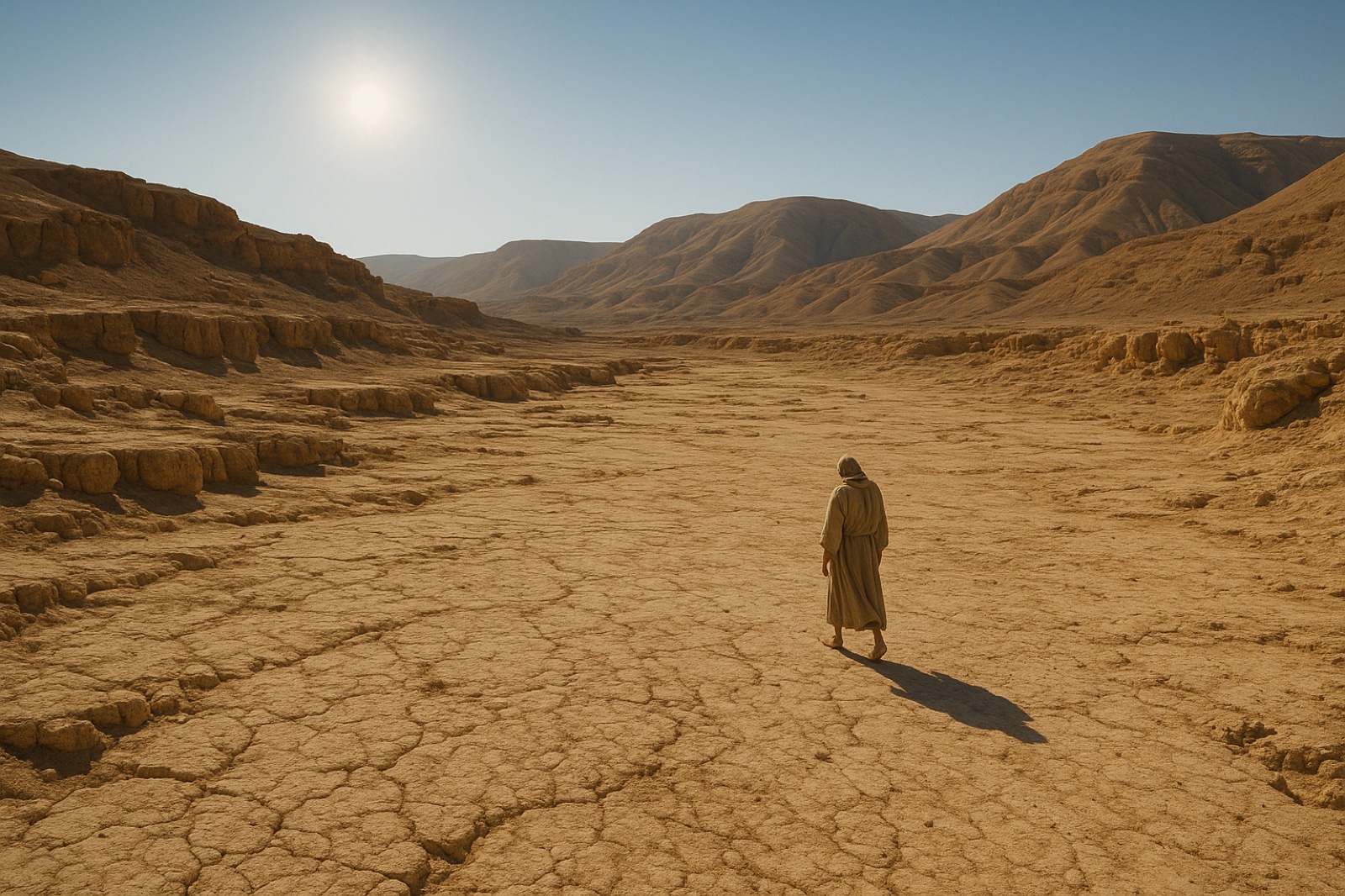
The psalm’s own heading tells you exactly where David was: “A Psalm of David, when he was in the wilderness of Judah.” This wasn’t a metaphorical desert. The wilderness of Judah is a real, harsh stretch of land east of Bethlehem toward the Dead Sea — rock, heat, almost no water sources, the kind of terrain where “dry and thirsty land, where no water is” is a literal description of the ground under his feet, not just a figure of speech for how he felt inside.
Tradition connects this psalm to two different seasons of David’s life spent in that wilderness — either fleeing King Saul years earlier, or fleeing his own son Absalom’s rebellion later, crossing out of Jerusalem into that same desert country. Scholars don’t fully agree on which one. But both readings point to the same thing: David wrote this while he was a king with no kingdom, a father possibly at war with his own child, hiding in a place that could kill him if he ran out of water.
That’s the man who wrote “thou art my God” in the present tense. Not once the danger passed. Not once he felt something. While he was still thirsty, in the dry land, with no water anywhere in sight.
The Turn: Dryness Isn’t Proof You’re Doing It Wrong
Here’s what most people assume about a dry season with God: it means something has broken. Sin got in the way. Faith got weak. You stopped doing something right, and now you’re paying for it with silence.
Psalm 63 doesn’t support that reading at all. David isn’t confessing a failure that caused the dryness. He’s naming the dryness as simply where he is — geographically, emotionally, spiritually — and then doing the one thing that actually matters: he seeks God from it, not after escaping it. The dry land isn’t the obstacle to the prayer. The dry land is where the prayer happens. That’s the piece a lot of us miss. We treat spiritual dryness like a problem to solve before we’re “allowed” to seek God with any confidence. David treats it like ordinary terrain — the actual ground he’s standing on today — and seeks anyway, early, before the feeling shows up. The seeking isn’t the reward for the dryness ending. The seeking is what he does in it.
Actions You Can Take Today
- Name your dry land in one honest sentence. Open your notes app right now and write exactly what’s dry — not “I feel distant from God” in general, but the specific thing. “I haven’t felt anything in prayer since [specific event].” Naming it precisely is what David did in verse 1 before anything changed.
- Set a 5-minute timer and pray Psalm 63:1 as your own words — out loud if you can. Not asking for the dryness to lift first. Just saying “you are my God” while it’s still dry, the same way David did.
- Tonight, before you fall asleep, do what verse 6 describes — “when I remember thee upon my bed, and meditate on thee in the night watches.” Pick one true thing about God you know, even if you don’t feel it, and hold that single thought as you fall asleep instead of scrolling.
Journal It Out
- What does your “dry land” actually look like right now — the specific circumstance, not just the general feeling of distance?
- Have you been waiting to feel something before you’re willing to pray with confidence? What would change if you prayed anyway, the way David did?
- What’s one true thing about God you still know, even in a season where you don’t feel it?
A prayer for the dry season, if you want to pray it as your own:
God, I don’t feel you right now, and I’m tired of pretending that I do. This land is dry and I don’t have anything to offer you except that I’m still here, still showing up, still saying you are my God even though it doesn’t feel like much right now. I’m not waiting for the feeling to come back before I mean it. Meet me in this dry place the way you met David in his. Amen.
Do you think a spiritual dry season serves a purpose of its own, or is it just something to get through as fast as possible? We’d love to hear how you’d answer that — tell us in the comments below.
If this stirred something, here are a few ways to say it in your own words:
- “David wrote ‘you are my God’ from an actual desert, before anything got better. Turns out you don’t need to feel close to God to mean it. #SpiritualDryness #Psalm63”
- “I used to think a dry season in prayer meant I was doing something wrong. Psalm 63 changed that — David prayed from the dry land, not after he escaped it.”
- “Spiritual dryness isn’t a sign your faith broke. It might just be the terrain you’re standing on right now — and it’s still a place you can pray from. — Psalm 63:1”
Common Questions About Spiritual Dryness
What does “spiritual dryness” mean in the Bible?
It describes a season where prayer, worship, and reading scripture stop producing any felt sense of God’s presence — even though nothing has necessarily gone wrong. Psalm 63 is one of the clearest biblical examples, written by David while he was literally in a desert wilderness.
Where was David when he wrote Psalm 63?
According to the psalm’s own heading, he was “in the wilderness of Judah” — a harsh, arid region between Bethlehem and the Dead Sea. Tradition links this to either his flight from King Saul or his flight from his son Absalom’s rebellion.
Is spiritual dryness a sign of weak or failing faith?
Not according to Psalm 63. David doesn’t treat the dryness as evidence of failure — he treats it as the honest condition he’s in, and seeks God from inside it rather than waiting for it to lift first.
How long do spiritual dry seasons usually last?
Scripture doesn’t give a timeline, and it varies person to person. Psalm 63 itself doesn’t resolve the wilderness circumstance — David’s satisfaction in verses 5-8 is about his relationship with God deepening, not about the desert disappearing.
What’s the difference between spiritual dryness and depression?
They can overlap, but they’re not the same thing. Spiritual dryness specifically describes an absence of felt connection to God in prayer and worship. If low mood, hopelessness, or loss of interest in daily life persist, that’s worth talking to a doctor or counselor about directly — Psalm 63 speaks to the former, not a substitute for the latter.
If you’ve ever wondered whether God feels distant for a reason, this look at Psalm 88 and why disconnection from God is common enough to fill an entire book of the Bible is a good next stop. There’s also a companion piece built around Psalm 42’s deer panting for water — Awakening the Thirst: Finding Renewal in Spiritual Dryness — that pairs well with David’s desert prayer here. And if the waiting itself is what’s wearing on you, the Hebrew word behind “wait on the Lord” in Isaiah 40:31 is worth a read — it isn’t the passive word most people assume.