 0
 0
If you came here looking for one sentence, here it is: every person who was on the American Heritage when the tanker struck it got off alive.
No one died. Not a passenger, not a crew member. The boat itself did not survive. Every person on it did.
That is the sentence a lot of people were hunting for on Friday afternoon, refreshing a news page with a sick feeling in the stomach, because a parent was on that river cruise, or a friend was, or there was a booking for next spring and suddenly it all felt very close.
So here is what happened in the New Orleans cruise ship crash. And here is the part of it almost nobody is talking about.
What happened in the New Orleans cruise ship crash
On Friday 13 November 2026, at about half past twelve in the afternoon, a tanker named the Atlantic Asphalt — a vessel around 160 metres long — struck the American Heritage, a paddlewheel river cruise boat tied up at the Port of New Orleans on the Mississippi.
The American Heritage had docked roughly two hours earlier, according to Port NOLA, and had started letting passengers off.
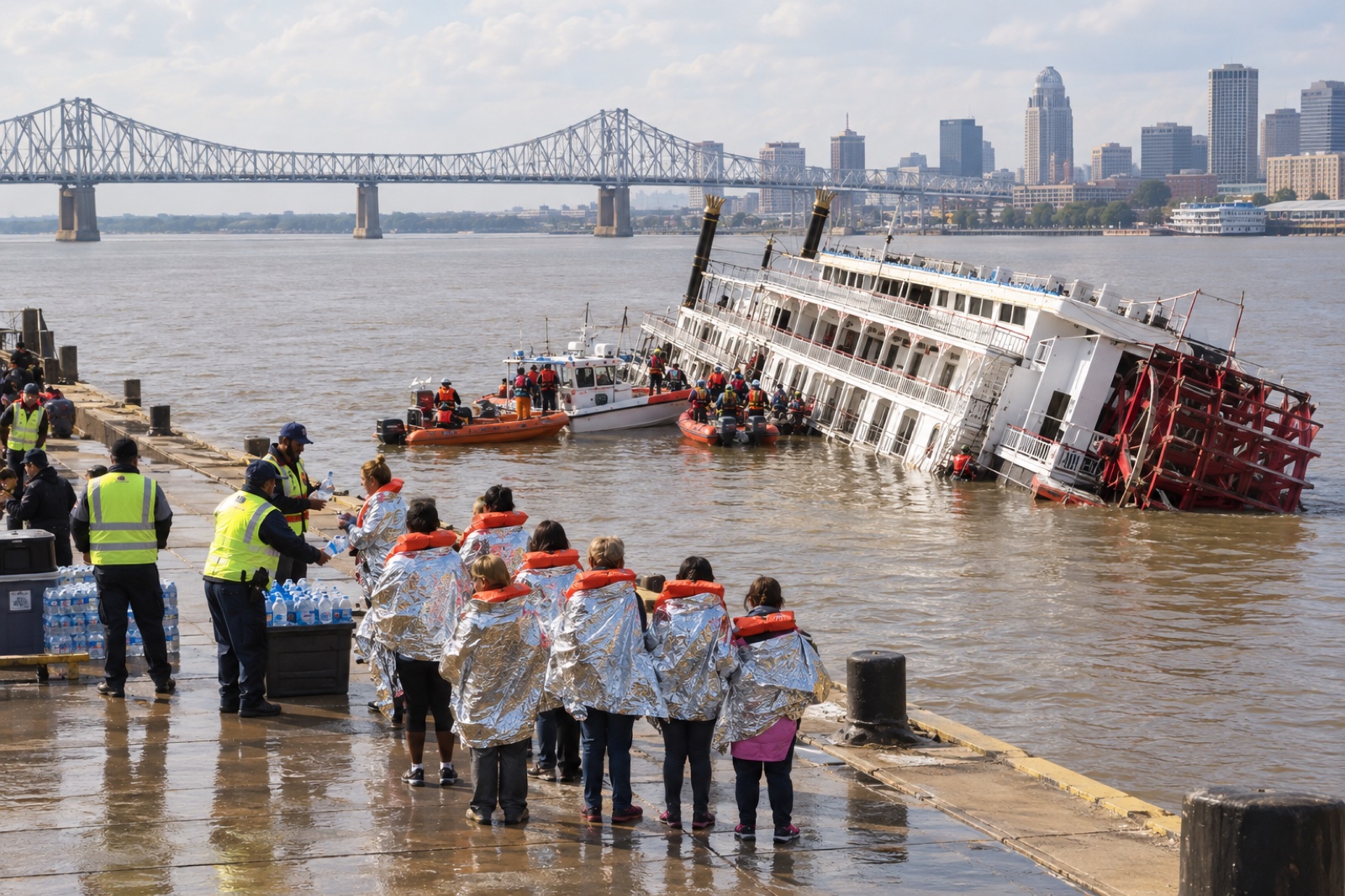
The riverboat began taking on water. Then it rolled onto its side and capsized against the dock.
New Orleans Mayor Helena Moreno said 191 passengers and crew were aboard. Earlier reports counted about 129 passengers, before crew were added in.
Thirty-two people were taken to hospital that day. By Saturday, officials said eight were still in hospital, two of them in serious condition and six stable. A later update put the number at six.
Officials said the tanker “lost control.” Investigators are examining a possible steering problem. That is as far as the known facts go. The cause has not been confirmed and no findings have been issued, so nothing here should be read as a claim about what went wrong or who is responsible.
The half hour nobody is talking about
Skim the headlines and you come away with an impression of a bang, then a rescue. That is not what happened, and the difference is the whole story.
Harbor Police Chief Melanie Montro said the American Heritage capsized somewhere between thirty and forty-five minutes after the collision. The exact timeline is part of the investigation.
Half an hour. Maybe a little more.
In that window, responders got more than 80 people off the boat before it went over. About 100 ended up in the river anyway, and were pulled out of the Mississippi by emergency crews and by other vessels that happened to be nearby and came.
Officials credited two completely unglamorous things with the fact that nobody died: life jackets, and how fast people moved.
And there is one more detail, stated once and then mostly dropped. The captain of the American Heritage was hurt. He refused treatment until he knew where everyone was, and he was the last person off the boat. “Every moment of the critical time, he did not want to leave his ship,” the mayor said.
So this is not a story about a ship being hit and everyone somehow living. It is a story about a gap — and a gap that got used.
What people mean when they call it a miracle
Officials and headlines reached for the word miracle, and you can see why. A loaded river cruise boat rolled over in one of the biggest rivers in the world, and the death toll was zero.
But notice what that word usually smuggles in with it. Miracle tends to be shorthand for nothing was lost. And that is not true here.
The American Heritage is lying in the river. Crews have to remove around 16,000 gallons of fuel — roughly 60,000 litres — before salvage can even begin, and Coast Guard Capt. Melanie Burnham said plainly that the job is “weeks, we’re not talking days.” Hundreds of people lost their luggage, their trip, and the easy assumption that a boat tied up at a dock is a safe place to be standing. Some are still in hospital beds. The Port of New Orleans has filed a federal lawsuit against the tanker’s owners, which is a claim being made, not a conclusion anyone has reached.
So something was genuinely lost. And something was genuinely kept.
Both halves are true at the same time, and we are strangely bad at holding them together.
The two things we say about disasters, and why both are wrong
When something like this happens, most people land on one of two sentences.
The first is “it’s a miracle, nothing was lost.” That one is kind, and it is false, and it quietly tells everyone still hurting that their loss does not count.
The second is “it was a disaster, everything is ruined.” That one sounds tough-minded, and it is also false, because 191 people went home.
Here is the odd thing. There is an account from the ancient world that deals with exactly this problem. It is one of the most detailed shipwreck narratives to survive from antiquity, written by a man who says he was on the boat — a grain ship, a prisoner aboard, a storm that ran so long that, as he tells it, every person on board finally gave up hope of being saved.
And in the middle of it, he says, God told him what the promise actually covered. Not the cargo. Not the ship. The people. Every life aboard, and the vessel lost.
That is a very strange thing to promise someone. It is not the comfort anybody would invent. It refuses both of our sentences at once: it will not say nothing was lost, and it will not say nothing was kept. It draws a line between the two and then tells you which side of the line you are standing on.
It gets stranger. The promise did not make anyone passive. By his own account they still had to stay with the ship instead of slipping away in the small boat, still had to eat after two weeks of eating nothing, still had to throw the cargo overboard to lighten her, and at the end still had to swim for it or ride in on broken pieces of the hull. The outcome was promised. The half hour still had to be used.
Which is more or less what happened on the Mississippi on Friday. Something held, and people worked inside it.
There is a related oddity in the archaeology of shipwrecks, by the way: the oldest wreck anyone has found has no ship left in it at all. The timber dissolved completely. What lasted was what it was carrying.
If you want something practical out of this
Most of us will never be on a boat that rolls over. The half hour is still worth copying.
- When you board anything — a ferry, a bus, a plane, a building you are sleeping in — find the exit and the life jackets before you sit down. It takes ten seconds and costs nothing.
- Do not wait for an announcement to start moving. The people who were off that boat before it rolled were off because the crew and responders did not wait.
- Help whoever is next to you. A hundred people came out of that river partly because vessels with no obligation to be there came over anyway.
- If you are the one still shaking a day later, that is not weakness. That is a body doing its job. You can get a quick, free read on where your own resilience actually sits in a couple of minutes.
Where it stands now
The lower Mississippi has reopened with a 500-foot safety zone around the wreck, and the tanker has been moved from the collision site. The National Transportation Safety Board recovered the tanker’s voyage data recorder, which captures speed, course and audio from the bridge, and had sixteen investigators on scene. Board member John DeLeeuw said the agency is in the early stages and has reached no conclusions. A preliminary report is expected in about thirty days. A final one, naming probable cause, is expected in eighteen to twenty-four months.
So the honest summary is short. We do not yet know why it happened. We do know what it cost, and we know what it did not cost.
A boat is lying in the river. Everybody who was standing on it is not.
And if you have ever reached the point in something where hope was the first thing to go over the side, there is an old phrase for exactly that, and it is older than most people think.
Keep an eye on who gets kept. That is usually the part of the story worth knowing.
A question worth arguing about
Officials called it a miracle. Other people will say it was training, life jackets and a thirty-minute window, and nothing more. Which word do you think fits what happened on the Mississippi — and does it have to be only one of them? Tell us how you would describe it in the comments.
Worth sharing
- A tanker hit a docked river cruise boat in New Orleans and it capsized. 191 people were aboard. Every single one of them lived. The reason is a 30-minute gap almost nobody is reporting. https://bgodinspired.com/index.php/bgodinspired-news/new-orleans-cruise-ship-crash-everyone-survived/
- “Miracle” usually means nothing was lost. In New Orleans the boat was lost and all 191 people were kept. Both are true, and we are terrible at holding them together. https://bgodinspired.com/index.php/bgodinspired-news/new-orleans-cruise-ship-crash-everyone-survived/
- The captain of the capsized New Orleans riverboat was injured, refused treatment until he knew where everyone was, and was the last person off. That detail got one line in most coverage. https://bgodinspired.com/index.php/bgodinspired-news/new-orleans-cruise-ship-crash-everyone-survived/
Q&A: the New Orleans cruise ship crash
Did anyone die in the New Orleans cruise ship crash?
No. Every passenger and crew member aboard the American Heritage survived the 13 November 2026 collision on the Mississippi River in New Orleans. New Orleans Mayor Helena Moreno said 191 passengers and crew were aboard, and all were accounted for. Thirty-two people were taken to hospital on the day of the crash, and a small number remained hospitalised over the following days, but no deaths were reported.
What happened to the American Heritage in New Orleans?
The American Heritage, a paddlewheel river cruise boat operated by American Cruise Lines, was docked at the Port of New Orleans when the tanker Atlantic Asphalt struck it at about 12:30 p.m. on 13 November 2026. The riverboat took on water and capsized against the dock roughly thirty to forty-five minutes after the collision. The vessel is still in the river, and officials say removing it will take weeks rather than days.
How did everyone get off the American Heritage alive?
There was a gap of roughly thirty to forty-five minutes between the collision and the moment the American Heritage capsized, according to New Orleans Harbor Police Chief Melanie Montro. Responders evacuated more than 80 people from the boat during that window. About 100 more ended up in the Mississippi River and were pulled out by emergency crews and by nearby vessels that came to help. Officials credited life jackets and the speed of the response with preventing deaths.
What caused the tanker to hit the New Orleans cruise ship?
The cause has not been confirmed. Officials said the tanker Atlantic Asphalt “lost control,” and investigators are examining a possible steering problem. The National Transportation Safety Board recovered the tanker’s voyage data recorder and had sixteen investigators on scene, and board member John DeLeeuw said the agency is in the early stages with no conclusions reached. A preliminary report is expected about thirty days after the crash, and a final report naming probable cause in eighteen to twenty-four months.
How long will the American Heritage stay in the Mississippi River?
Weeks, according to officials. Coast Guard Capt. Melanie Burnham said crews must remove around 16,000 gallons of fuel — roughly 60,000 litres — from the capsized American Heritage before salvage operations can begin, and that the work would take “weeks, we’re not talking days.” The lower Mississippi has reopened with a 500-foot safety zone enforced around the wreck.