 0
0
 0
0
Imagine your doctor could hand you a single piece of paper today that told you, with real accuracy, what your heart is going to do fifteen years from now. Not a guess. Not a pamphlet telling you to eat more vegetables. An actual forecast, built from your own blood.
That’s not science fiction anymore. Researchers at the University of Hong Kong just published a study showing that a new AI blood test can predict six major heart disease risks — heart attack, stroke, heart failure, irregular heartbeat, poor circulation, and dangerous blood clots — up to 15 years before a single symptom shows up. One blood draw. No genetic testing. No family tree required.
If that sounds like it should be a bigger headline than it is, you’re right to notice.
What This New AI Blood Test Actually Measures
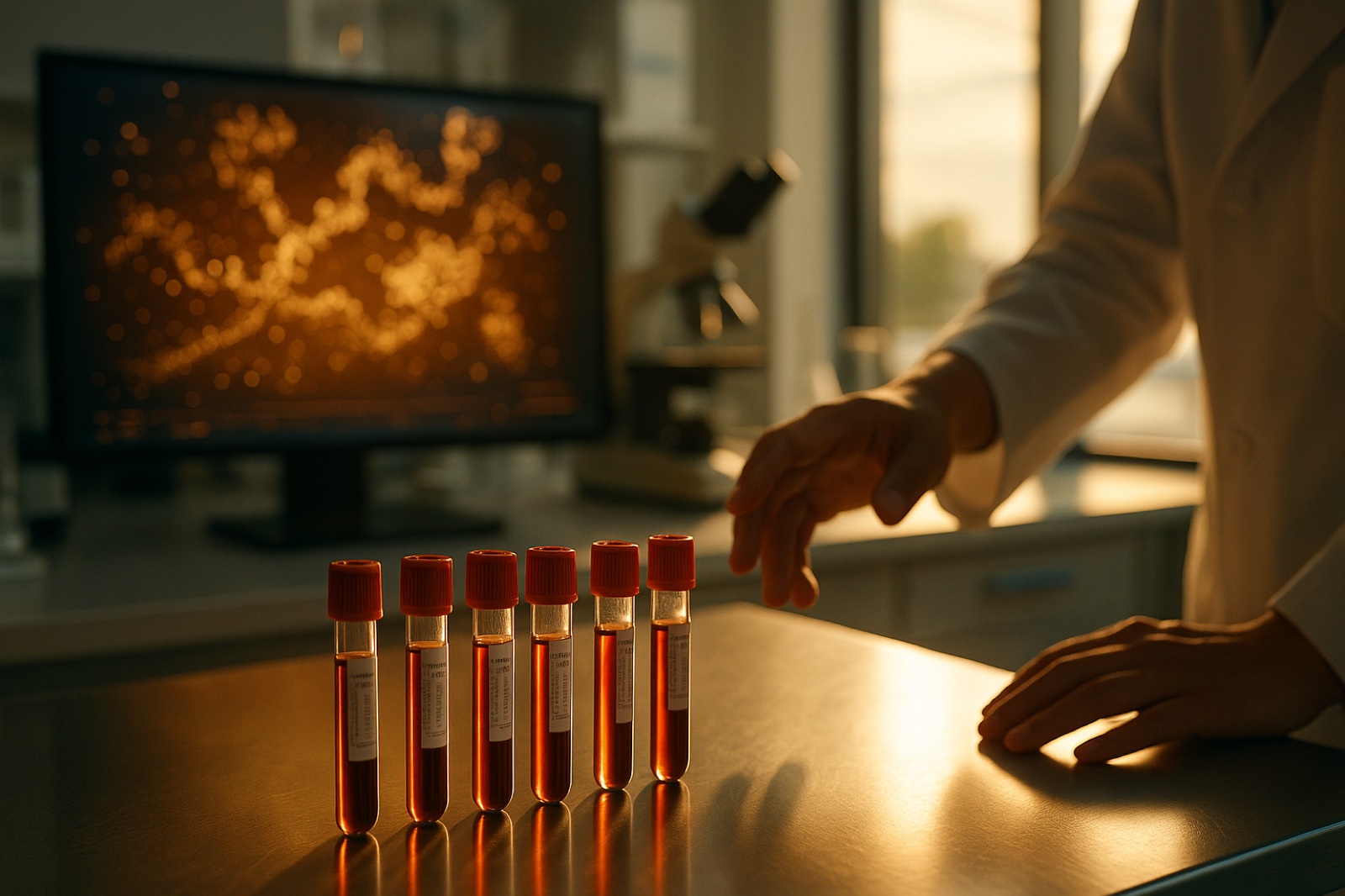
The test is called CardiOmicScore, and it comes out of HKUMed, the medical school at the University of Hong Kong, published this month in the journal Nature Communications. The research team pulled blood samples from the UK Biobank — one of the largest health databases in the world — and instead of scanning for the handful of risk markers a normal checkup looks for (cholesterol, blood pressure, blood sugar), the AI analyzed 2,920 circulating proteins and 168 metabolites at once.
That’s the real breakthrough. A human doctor, looking at a lab report, can track a few numbers. An AI system can find a pattern across thousands of molecules simultaneously — the kind of pattern that’s invisible to the naked eye but has apparently been sitting in your bloodstream the whole time, quietly telling on you.
Why This Is Different From a Genetic Test
Genetic risk scores have been around for a while, and they’re useful, but they measure something fixed — the risk you were born with, unchangeable, set the day you were conceived. CardiOmicScore measures something else entirely: your current biology. Proteins and metabolites shift with your diet, your stress levels, your sleep, your environment, your habits this year, not just your DNA from decades ago.
That distinction matters more than it sounds. A genetic test tells you what you can’t control. This test is closer to a live readout of what you still can.
Why 15 Years of Warning Actually Matters
Most heart disease doesn’t announce itself. It builds quietly for years — plaque narrowing an artery, a heart muscle slowly thickening, an electrical misfire becoming more frequent — until one day it isn’t quiet anymore. By the time symptoms show up, doctors are usually managing damage instead of preventing it.
A 15-year warning flips that. It means lifestyle changes, medication, and monitoring can start while the problem is still small and reversible, not after it’s already reshaped your life. We’ve written before about what a similar wave of health data did to an entire generation — a major 2026 study on middle-aged Americans declining faster than any previous generation found something almost identical: the earlier people could actually see what was happening to them, the more power they had to do something about it.
What Doctors Say This Could Change — and What It Won’t, Yet
To be clear, you can’t walk into a clinic and order this test next week. It’s still in the research stage, and it needs larger, more diverse trials before it becomes a standard part of a checkup. Researchers are cautious about that gap on purpose — a test this powerful, rolled out too fast, risks creating a new kind of anxiety: healthy people spending years bracing for something a probability score merely flagged as possible, not certain.
That tension is worth sitting with. Waiting on a number that might reshape your future — a scan, a test result, a diagnosis — is one of the more specific kinds of fear a person can carry, and it doesn’t always announce itself as fear. Sometimes it just shows up as a racing mind at 2 a.m. If that sounds familiar, this piece on what actually helps during a panic attack is worth a read regardless of what your bloodwork says.
The Kind of Warning No Blood Test Can Give You
Here’s the part that’s easy to miss in a headline about proteins and metabolites: even a test this sophisticated is only reading one kind of heart. The physical organ — the pump, the valves, the electrical wiring. Medicine has gotten remarkably good at forecasting what that heart will do.
But long before anyone had a microscope, let alone an AI model trained on 2,920 proteins, ancient wisdom was already drawing a line between two different hearts — the one you could examine, and the one you couldn’t. The visible organ was treated as the lesser concern. The invisible one — the part that decides what you actually love, what you actually fear, what you actually trust when nobody’s measuring — was treated as the real diagnosis. No panel of biomarkers, however advanced, has ever been able to print that one out. Some people have written about exactly that kind of look before — the harder, quieter kind of checkup nobody schedules for you.
It has always required something a blood draw can’t provide: the willingness to actually look, on purpose, instead of waiting for a number to do it for you.
Maybe the right response to a test like this isn’t just “put a reminder on the calendar for fifteen years from now.” Maybe it’s to take both kinds of inventory a little sooner than that — the one your doctor can eventually measure, and the one only you can actually see. Either way, the earlier you look, the more you still get to do about what you find.
Discussion Question
If you could know today, with real accuracy, something about your health fifteen years from now — would you want to? Would a test like this give you peace of mind, or would knowing become its own kind of stress? Tell us in the comments.
3 Things Worth Doing Today — Even Without a 15-Year Blood Test
- Know your family history. Until CardiOmicScore is widely available, your family’s heart history is still one of the best early-warning systems you actually have access to right now.
- Get the basic bloodwork you’re already entitled to. Cholesterol, blood pressure, and blood sugar screenings aren’t as sophisticated as an AI model, but most people put them off longer than they should.
- Take the other checkup too. Set aside a few honest minutes this week to ask what’s actually shaping your daily choices — what you’re loving, fearing, or trusting without quite noticing. It won’t show up on a lab report, but it’s just as real.
Share This
- Scientists can now predict your heart attack risk 15 years before it happens — from a single blood test. Wild. bgodinspired.com
- A new AI blood test can flag six major heart conditions up to 15 years early, using nearly 3,000 proteins from one blood draw. It’s not available yet, but it’s coming. Here’s how it works: bgodinspired.com
- Not just genetics — this new heart disease test reads your CURRENT biology, meaning the score can actually change as you do. That’s a big deal. bgodinspired.com
Frequently Asked Questions
What is the new AI blood test that predicts heart disease?
It’s called CardiOmicScore, developed by researchers at the University of Hong Kong (HKUMed) and published in Nature Communications in July 2026. It uses artificial intelligence to analyze 2,920 proteins and 168 metabolites from a single blood sample to estimate a person’s risk of six major cardiovascular diseases up to 15 years before symptoms appear.
How is this different from a genetic test for heart disease?
A genetic test measures fixed risk based on your DNA, which doesn’t change over your lifetime. CardiOmicScore measures your current biological state — proteins and metabolites that shift with your diet, stress, sleep, and lifestyle — so the score can change as your health changes.
Which heart conditions can this AI blood test predict?
The study found it can estimate risk for coronary artery disease, stroke, heart failure, atrial fibrillation, peripheral artery disease, and venous thromboembolism (dangerous blood clots).
Can I get this blood test at my doctor’s office right now?
Not yet. CardiOmicScore is still in the research and validation stage. It needs larger, more diverse clinical trials before it becomes available as a standard test, though researchers see it as a strong candidate for future preventive care.
What data was the study based on?
Researchers used large-scale population data from the UK Biobank, one of the world’s largest long-term health databases, analyzing thousands of participants’ blood samples alongside their actual health outcomes over time.