
 0
0
 0
0
There’s a season most people who have walked with God for any length of time know well.
It has a few names. The waiting season. The dry spell. The period between the prayer and the answer. You know what you need — or at least you know what you asked for — and the silence is stretching. Days. Months. Sometimes years. The thing you’re waiting for hasn’t come, and you’re not entirely sure what you’re supposed to do in the meantime except… wait.
Most of us picture waiting the way we picture a waiting room. You sit down. You check your phone. You look at the clock. You exist in a holding pattern until something outside of you moves. The waiting is something imposed on you from outside. The most active thing you can do is endure it without complaining.
That’s the English understanding of the word.
It’s not the Hebrew one.
And the gap between the two is the gap between exhaustion and strength — which is exactly what Isaiah was talking about when he wrote the verse.
Who Isaiah Was Writing To
Before we get to the word, it’s worth knowing who Isaiah was writing this for. Because the audience matters.
Isaiah 40 opens one of the most dramatic turning points in the entire book. The previous chapters have delivered hard messages of judgment. But here, the tone shifts completely. “Comfort, comfort my people,” God says at the start of the chapter. It’s tender, direct, and urgent.
The people receiving this passage were exiles — or were about to be. They were living through the slow collapse of everything they’d built. The temple. The city. The homeland. The life they’d expected to have. And they were being told to hold on. To believe in a deliverance they couldn’t see coming and couldn’t make happen on their own.
Isaiah 40:31 isn’t a promise given to people in a comfortable season. It’s a promise given to people in a devastating one. People who were genuinely exhausted. People for whom waiting wasn’t a spiritual discipline in the abstract — it was the actual condition of their daily lives.
The verse comes to that specific human situation. And when it does, it uses a specific word.
What Isaiah Actually Wrote
Isaiah 40:31 is one of the most quoted verses in the Bible. You’ve probably seen it on a plaque, heard it at a funeral, used it yourself when someone you cared about needed to hold on a little longer.
“But those who wait on the Lord will renew their strength; they will mount up with wings like eagles; they will run and not grow weary; they will walk and not faint.”
The promise is real. The verse is real. But there’s a detail in it that most English readers never see because it’s invisible in translation.
The word translated “wait” is the Hebrew word qavah (Strong’s H6960).
And qavah doesn’t mean to sit still.
What Qavah Actually Means
The root meaning of qavah is to twist together. To braid. To bind separate strands into something stronger than any single strand could be on its own.
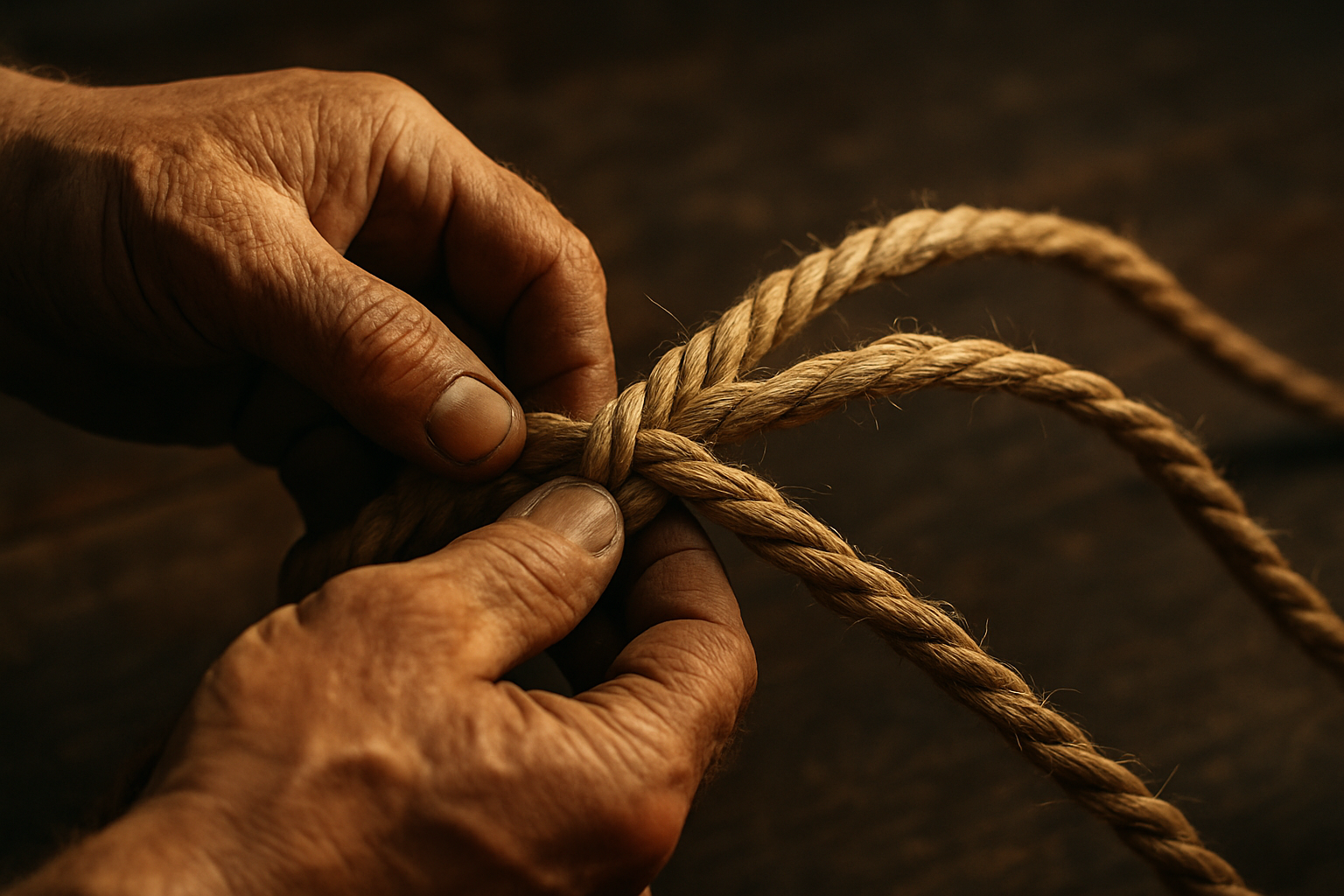
Think about how a rope is made. You start with individual fibers — flax, hemp, cotton, whatever the material is. A single fiber is fragile. You can break it between your fingers. But take dozens of those fibers, place them under tension, and twist them together — and you create something that can hold a ship to a dock, drag a vehicle out of a ditch, or lower a person safely down a cliff face.
The strength doesn’t come from resting. It doesn’t come from passively enduring the process. It comes from the tension itself. From the twisting. From the active work of braiding strands together under resistance. The more tension applied during the braiding, the stronger the finished rope.
That’s qavah.
When Isaiah writes that those who qavah the Lord will renew their strength, he’s not describing people who are sitting in a spiritual waiting room staring at the clock. He’s describing people who are actively twisting themselves into God — braiding their trust and their hope and their faith together under the weight of the delay. Letting the tension do its work.
This is not a small translation detail. It changes everything about what God is asking of you in a hard season.
The Same Word Translates Two Ways — And That’s the Clue
Here’s where it gets genuinely interesting.
Translators made a consistent choice with qavah: sometimes they rendered it as “wait,” and sometimes they translated the exact same Hebrew word as “hope.” Open different passages in the same English Bible and you’ll find both — with no footnote explaining that these are the same underlying word.
In Isaiah 40:31 — “those who wait on the Lord.”
In Lamentations 3:25 — “The Lord is good to those whose hope is in him.”
Same Hebrew word. Two English translations.
That isn’t a translation inconsistency. It’s a revelation. In Hebrew, waiting and hoping are not two different things that happen to use the same word. They are the same act, described from different angles. You can’t genuinely wait on God without actively hoping in him. And you can’t genuinely hope in God without the posture of waiting — turning toward him, twisting your expectation into his character, holding the tension between what is and what you believe is coming.
The two English words describe the same spiritual motion.
Which means that when you are waiting — really waiting, in the Hebrew sense — you are also, simultaneously, hoping. And when you are hoping — actively orienting yourself toward a God you trust — you are also waiting in the most engaged way possible. The two collapse into one thing.
The Psalmists Knew This
David used qavah in Psalm 27:14 — and he used it twice in the same verse, which in Hebrew is a form of emphasis:
“Wait for the Lord; be strong and take heart and wait for the Lord.”
The doubling isn’t repetition for the sake of rhythm. In Hebrew poetry, repeating a word like this carries emphasis: I mean this. This is the thing. Do this. The verse is framed on both ends by qavah — as if to say that everything in the middle (“be strong and take heart”) flows directly from the act of active waiting. The strength comes from the qavah-posture, not from managing your emotions into a better state on your own.
Then there’s Psalm 40:1, where David writes something even more striking:
“I waited patiently for the Lord.”
That phrase “waited patiently” is actually a single Hebrew construction: qavah qavah — the word used twice in immediate succession, what Hebrew scholars call the infinitive absolute. It’s the most emphatic grammatical form available in the language. It doesn’t mean “I waited a little while” or even “I waited a long time.” It means something closer to: I kept twisting myself into God. Over and over. Under the weight of the delay. I didn’t stop braiding.
And what happened? The next line:
“He turned to me and heard my cry.”
The response came after the qavah qavah. Not instead of it. The sustained, active waiting wasn’t the obstacle between David and the answer — it was part of the path to it. The braiding continued until something was completed.
One More Passage Worth Sitting With
Genesis 49:18 offers one of the oldest uses of the word. Jacob, at the very end of his life, pauses in the middle of blessing his sons to say:
“I wait for your salvation, O Lord.”
Same word: qavah. And the context is striking. Jacob is dying. He is at the very end of a long, complicated life that included deception, exile, loss, reconciliation, and grief. And in the final moments, the word he reaches for isn’t the word for passive resignation. It’s qavah. Active. Twisting toward God even at the last.
Whatever the delay looked like in your life — and whatever Jacob’s salvation looked like in that moment — the posture he describes isn’t someone who gave up and is just enduring. It’s someone who kept actively orienting toward God until the very end.
The Turn: What the Rope Teaches
Here’s what most teaching on waiting misses.
When a ropemaker twists fibers together, the tension isn’t a side effect of the process. The tension is the process. Remove the tension and you don’t have a rope — you just have a pile of loose fibers. The resistance is what creates the structure. The pressure is what makes the thing capable of holding weight. A rope made without adequate tension under the braiding will fail exactly when it’s needed most.
Isaiah 40:31 doesn’t promise that your strength will be renewed when the waiting is over. It promises that those who qavah — those who actively, persistently braid themselves into God while under the weight of the delay — will renew their strength. Present tense process, not future reward. The strength comes from the waiting itself. From the active engagement of bringing your hope and your trust and your belief into tension with the reality in front of you and choosing, over and over, to let God hold all of it together.
Mounting up with wings like eagles isn’t what happens when the waiting ends. It’s what happens in the person who has been actively braiding themselves into God through the silence. The wait isn’t the pause before the strengthening begins. The wait is the strengthening.
The rope gains its strength from the twisting. So does the soul.
What Qavah Looks Like in Practice
If you’re in a waiting season right now — the unanswered prayer, the unresolved situation, the long silence between what you asked for and what hasn’t arrived yet — the biblical invitation isn’t to do nothing and endure.
It’s to actively turn toward God in the middle of the delay. To bring the weight of what you’re carrying and braid it into what you know about who he is. To hold the tension rather than run from it or numb yourself to it. To let the resistance do what resistance does when it’s met with active engagement: make you stronger in the places where the waiting is pressing hardest.
Passive endurance says: I’ll just survive until this is over. That’s one way to get through a hard season.
Active qavah says something different: I will keep turning toward God even when nothing appears to be moving. I will bring what I’m carrying to him, again and again, and braid my trust into who I believe he is. I will let the delay press into my soul the way tension presses into a rope — and I will trust that the braiding is doing something I can’t yet see.
That posture isn’t resignation. It isn’t forced positivity. It isn’t pretending the delay doesn’t hurt. It’s the most engaged, most honest, most difficult thing a person in a hard season can do.
And it’s what Isaiah saw in the people who mounted up with wings like eagles — not people who were lucky enough that the waiting didn’t last long. People who had learned to braid.
If you want a daily practice for building exactly this kind of active, close engagement with God — especially through the hard seasons — 30 Days Walking with Jesus is built for that. Not a theology course. A daily walk. A way to build the habit of turning toward him in the middle of ordinary and difficult life, one day at a time.



2 thoughts on “The Hebrew Word for ‘Wait’ Isn’t Passive — And It Changes Everything About Isaiah 40:31”
Leave a Reply
You must be logged in to post a comment.
[…] is the same kind of discovery that happens with the Hebrew word qavah in Isaiah 40:31 — the word translated “wait” that actually means something far more […]
[…] can read about the Hebrew meaning of “wait on the Lord” — it carries an active, expectant quality that English loses. But what Lamentations captures is […]