 0
0
 0
0
You have probably seen it on a mug. Or a phone screen, or a wall in a hallway, printed over a photograph of still water at sunrise. Be still, and know that I am God.
And maybe you have read it on one of the worst days of your life and felt almost nothing.
If that has happened to you, the problem is probably not your faith. It may be that the verse was handed to you with everything around it removed. Because one line earlier, Psalm 46:9 is talking about burning chariots.
What Psalm 46:9 Actually Says
Here is the verse sitting immediately before the famous one, word for word:
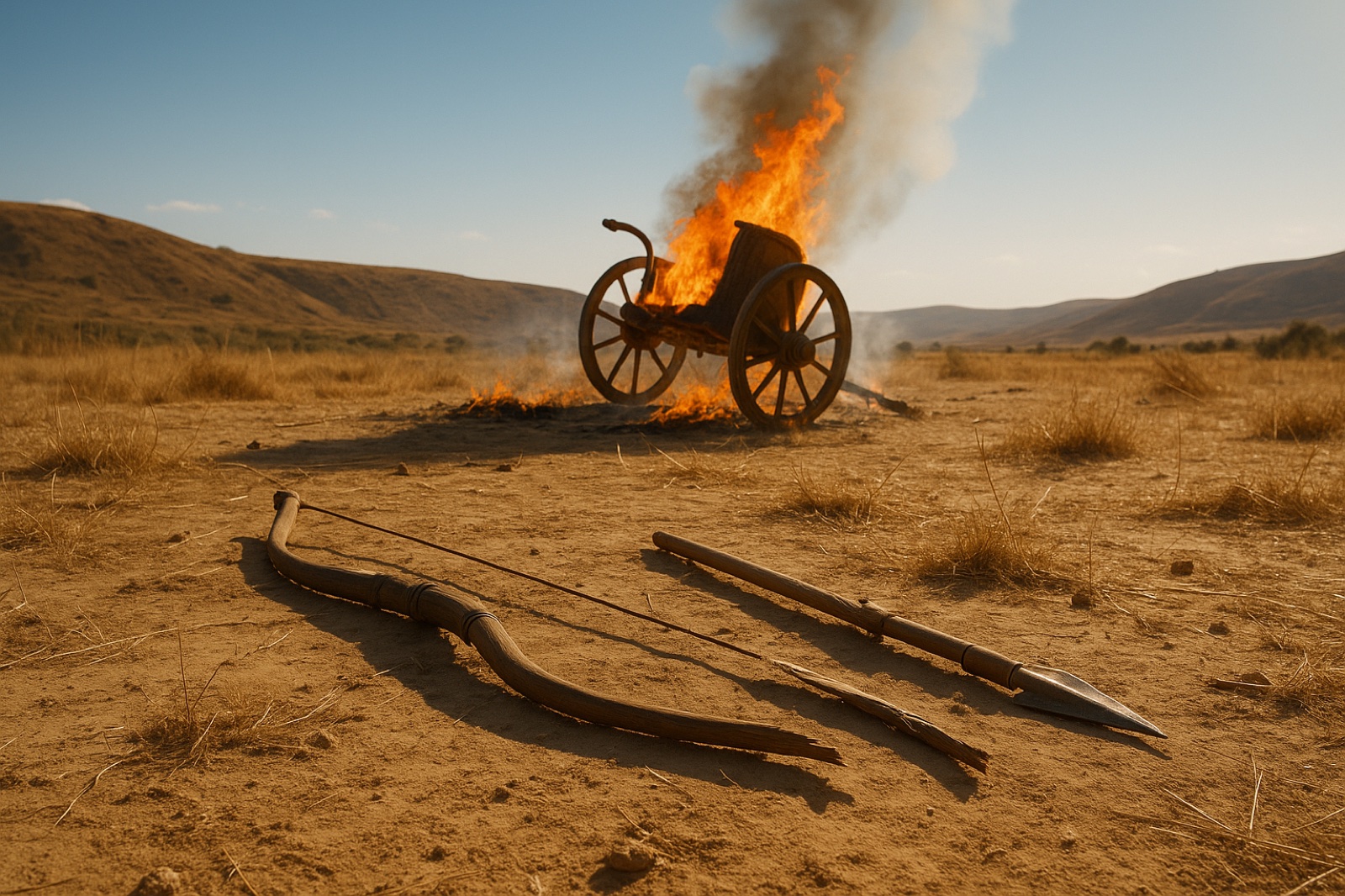
“He maketh wars to cease unto the end of the earth; he breaketh the bow, and cutteth the spear in sunder; he burneth the chariot in the fire.”
— Psalm 46:9, KJV
Read that list again slowly. A bow. A spear. A chariot.
That is not poetic decoration. That is an inventory of ancient military power, from the cheapest weapon to the most expensive. The chariot was the most advanced military technology of the ancient world — the thing a kingdom saved up for, trained for, and built its whole battle plan around.
And look at what God does with them. Not captures them. Not borrows them. Breaks the bow. Cuts the spear in two. Burns the chariot.
This is not a psalm about a quiet morning. It is a psalm about disarmament.
Then Comes the Verse Everyone Knows
“Be still, and know that I am God: I will be exalted among the heathen, I will be exalted in the earth.”
— Psalm 46:10, KJV
Almost every mug, card and lock screen stops at the word God. But the sentence keeps going, and the second half names an audience.
“The heathen,” in the King James wording, simply means the nations — the peoples outside Israel. Which means we have met this audience already, four verses earlier:
“The heathen raged, the kingdoms were moved: he uttered his voice, the earth melted.”
— Psalm 46:6, KJV
So follow the order of the psalm. The nations rage in verse 6. God disarms them in verse 9. And then, in verse 10, the command be still arrives — pointed outward, at the raging.
It reads less like a whisper to someone having a hard morning and more like a voice cutting across a battlefield.
The Detail Almost Nobody Reads
There is one more line in Psalm 46 that most of us skip, because it sits above verse 1 and looks like a filing label:
“To the chief Musician for the sons of Korah, A Song upon Alamoth.”
The sons of Korah. That name has a history.
Korah is the man in Numbers 16 who led a rebellion in the wilderness, and the ground itself opened underneath him. Numbers 26 records it plainly: “And the earth opened her mouth, and swallowed them up together with Korah, when that company died” (Numbers 26:10, KJV).
And then, one verse later, a sentence that is easy to read straight past:
“Notwithstanding the children of Korah died not.”
— Numbers 26:11, KJV
The children survived. The family line continued. And generations later, that same family name sits at the top of a psalm that opens like this:
“Therefore will not we fear, though the earth be removed, and though the mountains be carried into the midst of the sea.”
— Psalm 46:2, KJV
A song about not being afraid when the earth gives way, carrying the name of the one family in scripture who watched the earth give way and lived.
Be careful how hard you press that, and I want to be honest about the limits: the Hebrew heading can mean the psalm was written by the sons of Korah or assigned to them to perform, and scholars have argued both ways for a long time. Nobody can hand you a signature. But the connection is right there in the text, and once you have seen it, verse 2 stops sounding like a brave general statement and starts sounding like testimony.
God is not asking you to feel calm. God is asking you to stop fighting.
So Can You Still Pray It When You Are Anxious?
Yes. And you should be a little suspicious of anyone who uses the context to take the comfort away from you.
There is a whole style of teaching that says you have been reading this verse wrong your entire life, and it tends to leave people feeling foolish rather than helped. That is not what the context does here. Careful readers have applied this verse to personal fear for centuries, and they were not making a mistake.
It is also worth knowing that the Hebrew verb behind “be still” — raphah — is not really a word about silence. It carries the sense of letting go, going slack, dropping your hands, ceasing to strain. If you want to sit with that word specifically, we walked through it in detail in what the Hebrew word for “be still” actually means. Translators land on slightly different shades of it, and it is fair to hold that range loosely rather than claiming one definitive meaning.
The point of verse 9 is not that the comfort is wrong. It is that the comfort is bigger than we thought.
The Turn: Who Is Saying It Changes What It Means
Here is what shifts when you read verse 9 first.
“Be still” is not advice. Advice comes from someone standing beside you, equally powerless, hoping you feel better. This is not that.
This is the sentence of someone who has just been described breaking the bow, snapping the spear, and burning the chariot — and who then turns and says, stop. It is the difference between a stranger telling you to relax and the person who just put the fire out telling you that you can put down the bucket.
Most of us try to obey verse 10 by manufacturing a feeling. We try to be calm. We fail, because calm is not something you can decide to have while your life is on fire, and then we quietly conclude the verse does not work for people like us.
But the stillness in Psalm 46 does not rest on your emotional state. It rests on something God has already done. The command comes attached to evidence.
Which means you are not being asked to feel peaceful about the thing you are afraid of. You are being told to stop fighting a battle that God has already stepped into — and that is a very different instruction, because it is one you can actually follow while still shaking.
What This Looks Like on an Ordinary Day
You are almost certainly not facing an army. But you probably have something you are holding together by sheer grip — a family situation, money, someone’s health, a job that could go either way. And you have noticed that the gripping is not helping and you cannot make yourself stop.
Verse 9 gives you somewhere to put that grip down.
Not because the situation is resolved. Psalm 46 never says the trouble ends — it says God is “a very present help in trouble,” which means the trouble is still happening while the help is happening.
Actions to Take
- Read Psalm 46 all the way through, out loud, once — starting at verse 1, not verse 10. It takes about two minutes. Hearing the war before you hear the stillness is most of the work.
- Write down, in one line, the thing you are currently holding together by effort alone. Underneath it, write out verse 9. Put the two sentences next to each other and just look at them for a minute.
- Swap the verse you keep in front of you for one week. Wherever verse 10 lives for you — lock screen, mirror, the inside of a notebook — put verse 9 there instead. When verse 10 comes back at the end of the week, it will not sound the same.
Questions to Sit With
- When someone tells you to be still, what do you assume they are asking you to feel? Where did you first learn that stillness meant a feeling?
- What are you gripping so tightly right now that letting go of it would feel like losing rather than resting?
- If you genuinely believed God had already moved against the thing you are bracing for, what is one thing you would stop doing tomorrow?
A Prayer for Right Now
God, I am tired of holding this. I have been told to be still so many times that the words have almost stopped meaning anything, and I do not know how to feel calm about something that has not changed yet. But if verse 9 is true — if You have already moved against things far bigger than this — then I do not have to fight this alone tonight. Help me loosen my grip a little, even before I feel any different.
If it helps to keep praying past that, there is a longer prayer for peace here that goes at the same thing from another direction. And if you came looking for this verse because a feeling sent you searching, our free Bible Verse for How I Feel finder will point you toward scripture matched to where you actually are today.
One Question Worth Talking About
Do you think knowing a verse’s original context makes it more powerful, or does it get in the way of the comfort people need from it? Leave a comment — genuinely, I would like to know where you land on this one.
Share This
- “Be still and know that I am God” comes one verse after God breaks the bow and burns the chariot. It was never a whisper. It was said over a battlefield.
- I always read Psalm 46:10 as a command to calm down. Turns out it comes attached to evidence — verse 9 is God destroying the weapons first. The stillness rests on what God already did, not on how I manage to feel about it.
- The psalm that says “we will not fear, though the earth be removed” carries the name of the one family in the Bible who watched the earth open up and survived it.
Common Questions About Psalm 46:9
What does Psalm 46:9 mean?
Psalm 46:9 says, “He maketh wars to cease unto the end of the earth; he breaketh the bow, and cutteth the spear in sunder; he burneth the chariot in the fire.” It describes God ending war by destroying the weapons themselves — a bow, a spear and a chariot, which together represented the full range of ancient military power. It presents God not as a stronger participant in the fighting but as the one who removes the ability to fight at all.
Why does the context of Psalm 46:9 matter for “be still, and know that I am God”?
“Be still, and know that I am God” is Psalm 46:10, the verse immediately after the description of God breaking weapons. Reading them in order shows that the command to be still is spoken by someone who has just been described disarming an enemy. The stillness is grounded in an action God has already taken, rather than in the listener’s ability to produce a calm feeling.
Who is “be still, and know that I am God” addressed to?
The full verse reads, “Be still, and know that I am God: I will be exalted among the heathen, I will be exalted in the earth.” The second half names the nations, and Psalm 46:6 has already described those same nations raging. So the command is directed outward at raging peoples, not only inward at an individual. Many careful readers still apply it personally, and the wider context does not rule that out — it enlarges what the command is resting on.
What does the Hebrew word for “be still” in Psalm 46:10 mean?
The Hebrew verb is raphah, which carries the sense of letting go, going slack, dropping the hands, or ceasing to strain, rather than simply being quiet. Translators render it in slightly different ways, and the range of meaning is genuinely broad, so it is more accurate to hold several shades of it together than to claim one definitive translation.
Who wrote Psalm 46?
Psalm 46 carries the heading “To the chief Musician for the sons of Korah, A Song upon Alamoth.” The sons of Korah were descendants of the Korah of Numbers 16, whose rebellion ended with the ground opening beneath him, though Numbers 26:11 notes that “the children of Korah died not.” The Hebrew heading can mean the psalm was written by them or assigned to them for performance, and scholars have long disagreed about which, so the authorship cannot be stated with certainty.