 0
0
 0
0
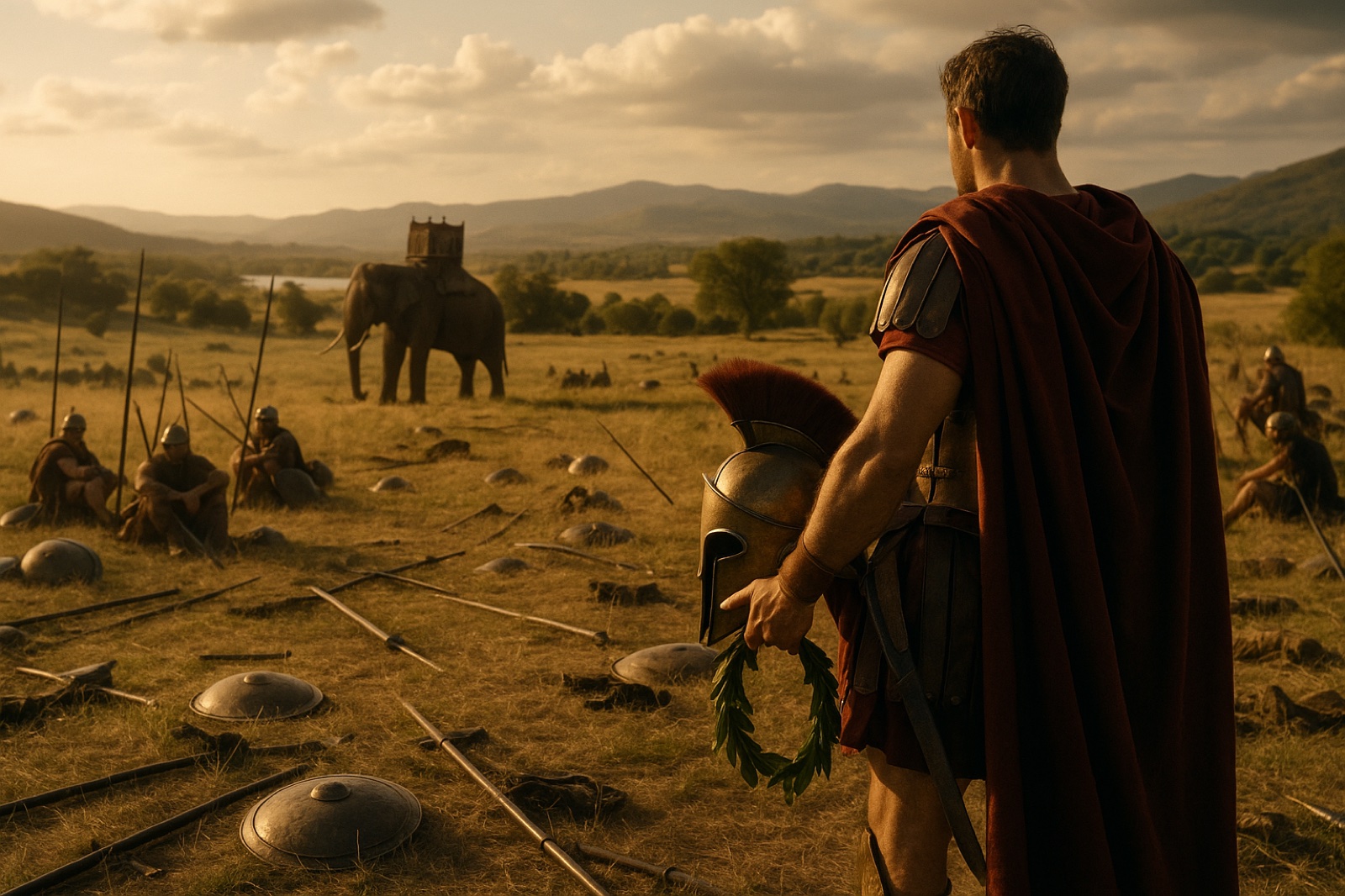
The battle was over, and the king had won.
His name was Pyrrhus. He had crossed the sea with an army and twenty war elephants to fight the Romans. Now he had beaten them a second time. The field was his.
Someone walked up to say well done.
Pyrrhus did not smile. “If we are victorious in one more battle with the Romans,” he said, “we shall be utterly ruined.”
That line, said in Italy in 279 BC, gave us the phrase Pyrrhic victory. The Pyrrhic victory meaning is simple, and most of us have lived it at least once. But the old story holds two things almost nobody repeats. By one early count, Pyrrhus lost fewer men than the army he beat. And before the war even began, a friend asked him a question he could not answer.
What Does Pyrrhic Victory Mean?
A Pyrrhic victory is a win that costs so much it is almost the same as losing. You get the thing you were fighting for, but you pay so much for it that you end up worse off than before. The phrase comes from King Pyrrhus of Epirus, who beat the Romans in battle and lost so many of his best men doing it that he could not afford to win again.
You say it PIRR-ik. It rhymes with “lyric.”
People use it for wars, court cases, business fights, elections and family arguments. “She won the case, but the lawyers took everything. It was a Pyrrhic victory.”
The story is very old. The phrase is much younger. The Online Etymology Dictionary dates “Pyrrhic victory” in English to 1885. People were telling the story long before English had this name for it.
The Real Pyrrhus Quote and Where It Comes From
The line comes from the Greek writer Plutarch, in his Life of Pyrrhus. The wording above is from Bernadotte Perrin’s English translation, printed in 1920.
You will see shorter versions everywhere. “Another such victory and we are undone.” “One more such victory and we are lost.” These are loose retellings. They keep the idea and change the words.
Two honest notes about the quote.
Plutarch was not there. He wrote close to four hundred years after the battle. He even opens the line with “we are told.” So this is a saying that was handed down. It is not a recording.
The old writers did not agree about the battle. Plutarch names two earlier historians. One, Hieronymus, says the Romans were beaten on the second day and lost six thousand men. The other, Dionysius, says the two armies fought until sunset and then just pulled apart, with more than fifteen thousand dead between them. In that telling there is no clear winner at all.
So the most famous “victory” in the phrase book may not have been a clean victory. That fits the point rather well.
Why the Win Ruined Him: He Lost Fewer Men
Here is the part that surprised me.
Go back to the first count, the one from Hieronymus. He says the Romans lost six thousand men. He says Pyrrhus lost 3,505, a number taken from the king’s own notes.
By that count, Pyrrhus lost far fewer men than Rome did. On paper, he was well ahead.
So why did he say one more win would ruin him? Plutarch gives the reasons right after the quote.
- He lost the wrong people. Plutarch says he had lost a great part of the army he came with, and “all his friends and generals except a few.” These were the men he trusted and could not train again.
- He could not refill. He was far from home. There was nobody left to send for. His local allies were losing interest.
- The other side could. Plutarch says the Roman army filled up again quickly, “as if from a fountain gushing forth indoors.” And losing did not break them. It made them more set on the fight.
That is the real lesson inside the phrase. A Pyrrhic victory is not about the score. Pyrrhus was ahead on the score. It is about paying with things you cannot get back, against something that can keep going longer than you can.
What Cineas Asked Pyrrhus Before the War
This is the part of the story that should be famous and is not.
Pyrrhus had an adviser named Cineas. He was such a good speaker that Pyrrhus used to say Cineas had won him more cities with words than he had won with weapons.
Before the army sailed for Italy, Cineas found the king in a quiet moment. Plutarch writes down the talk, and it goes roughly like this.
The Romans are great fighters, Cineas said. If we beat them, what will we do with the win?
Easy, said Pyrrhus. All of Italy will be ours.
And after Italy?
Sicily is right next door. Rich, and easy to take.
And will we stop there?
No, said Pyrrhus. After that, who could keep his hands off Carthage and North Africa?
Cineas agreed. With that much power, he said, they could take back Macedonia and rule Greece as well. Then he asked one more time. “But when we have got everything subject to us, what are we going to do?”
Pyrrhus smiled. “We shall be much at ease,” he said. They would drink together every day, and gladden each other’s hearts with good talk.
Then Cineas said the thing he had been walking toward the whole time. “Then what stands in our way now if we want to drink bumpers and while away the time with one another?” We can do that today, he said. We have it already, without the blood and the danger, and without hurting other people or being hurt ourselves.
A “bumper” is an old word for a cup filled to the top.
Pyrrhus had no answer. Plutarch writes that he “was more troubled than he was converted.” He saw clearly the happiness he was leaving behind. He just could not let go of what he wanted.
Then he sailed.
What Happened to King Pyrrhus After the Victory
You might think the famous line was a turning point. A man who can say out loud that one more win will finish him has seen the truth.
He saw it. He did not stop.
He left Italy to fight in Sicily. Then he came back to Italy and lost to the Romans. Plutarch says he spent six years on those wars. He had sailed out with more than twenty thousand foot soldiers. He came home with eight thousand, and no money.
So he looked for another war to pay his army.
A rival king, Antigonus, said Pyrrhus was like a man playing dice who makes many fine throws and does not know what to do with them. Plutarch’s own verdict is the line I keep thinking about. Through “passionate desire for what he had not,” Pyrrhus always failed to make safe what he had.
The end came in 272 BC, in a street fight in the Greek city of Argos. An old woman was watching from a rooftop. She saw her son fighting the king, picked up a roof tile with both hands, and threw it. It hit Pyrrhus below the helmet. He fell from his horse, and an enemy soldier killed him moments later.
He was one of the best generals of his age. He never got to the quiet evening he told Cineas he was fighting for.
Pyrrhic Victory Meaning in Everyday Life: 5 Examples
Most of us will never lead an army. We still win this way all the time.
- The argument you win. You prove you were right. You have the last word. And the friend, the brother, the wife or husband goes quiet and stays quiet.
- The job you finally get. The bigger title comes. So do the hours. A few years on, the children are grown and the marriage is two tired people passing in a doorway.
- The fight over what a parent left behind. Somebody gets the house or the land. Nobody gets the family back.
- The price war. One shop cuts prices until the shop across the road closes. Then it finds it has no money left to stay open either.
- The body. You hit every deadline for years, and your health sends the bill later.
Notice what these share. In every one, the scoreboard says you won. That is what makes a Pyrrhic victory so hard to see while you are in it. It feels like winning. It is the same trap we wrote about in what hustle culture really costs, and in the story of the sword of Damocles, where a man has the whole feast in front of him and cannot enjoy a bite.
How to Spot a Pyrrhic Victory Before You Win It
The old story hands you three checks. They cost nothing, and you can run them tonight.
- Count what cannot be replaced. Pyrrhus did not lose the most men. He lost the ones he could not get back. Money can often be earned again. Time with a child, trust, health and an old friend mostly cannot. Before the next fight, ask what you are really paying with.
- Ask who can keep going longer. Rome could refill. Pyrrhus could not. Work will always have one more task. A grudge will always have one more round. You are the side with the small army.
- Ask the Cineas question. When you have won all of it, what will you do? Say the answer out loud. Rest. Eat with people you love. Laugh. Then ask what stands in your way now.
If you are not sure what you would refuse to trade, our free What Are My Core Values? quiz takes about two minutes and shows what is really driving your choices.
The Same Question, Three Hundred Years Later
About three hundred years after Pyrrhus, in a small corner of the empire that outlasted him, a teacher put the whole matter into one question. What good is it to win the whole world, if it costs you your own soul?
It is the Cineas question taken as far as it can go. Cineas asked what the winning was for. This one asks what is left of the winner.
And the old wisdom behind it carries a quiet claim about you. You are worth more than anything you could win. You are not a supply to be spent. And the ease Pyrrhus kept marching toward was never a prize waiting at the far end of the last war. It was a gift, already set on the table. God had put it there before the first ship sailed.
A good place to start: if you would like to notice what is already on your table, we made a short free guide called The Beginner’s Guide to Feeling God’s Presence Every Day. It is a simple video and companion PDF for noticing God in ordinary moments, even when life feels like one long fight. Get the free guide. Free.
The Cups Were Already on the Table
Pyrrhus is remembered for one honest sentence after a battle. I think the more useful sentence is the one he could not answer before it.
He wanted to sit with his friends, eat, drink and talk. He said so himself. He had the friends. He had the table. He had the evening. Then he spent the friends trying to earn the evening.
You do not have to give up every fight. Some things are worth what they cost. But it helps to know the price before you pay it, and to know what you are hoping to do when the fighting is over.
Whatever that is, some small piece of it is likely within reach today. A meal. A phone call. An hour with nothing to win.
Take it tonight. It is yours already.
Discussion Question
Is a win still a win if it costs you a friendship? Or are some things worth winning at almost any price? Tell us what you think in the comments.
Share This
I never knew this: by one old count, King Pyrrhus lost fewer men than the Romans in his “Pyrrhic victory.” It ruined him because he lost the ones he could not replace. https://bgodinspired.com/?p=117957
Before his war, a friend asked King Pyrrhus what he would do once he had won everything. He said he would take it easy and drink with his friends. The friend asked what was stopping him from doing that now. He had no answer. https://bgodinspired.com/?p=117957
“He spent the friends trying to earn the evening.” A good read if you are winning something right now and it is wearing you out. https://bgodinspired.com/?p=117957
Pyrrhic Victory: Common Questions Answered
What does Pyrrhic victory mean?
A Pyrrhic victory is a win that costs the winner so much that it is almost as bad as losing. The winner gets what they were fighting for, but the price in people, money, time or relationships leaves them worse off than before. The phrase comes from King Pyrrhus of Epirus, who beat the Romans at the battle of Asculum in 279 BC and lost so many of his best soldiers and officers that he could not afford another win like it.
What did King Pyrrhus actually say after the battle?
According to the Greek writer Plutarch, King Pyrrhus said to a person who congratulated him after the battle of Asculum: “If we are victorious in one more battle with the Romans, we shall be utterly ruined.” That wording is from Bernadotte Perrin’s 1920 English translation of Plutarch’s Life of Pyrrhus. Shorter versions such as “Another such victory and we are undone” are loose retellings. Plutarch wrote close to four hundred years after the battle and introduces the line with “we are told,” so the quote is a handed-down saying and not a record made at the time.
How do you pronounce Pyrrhic?
Pyrrhic is pronounced PIRR-ik, with the stress on the first part of the word. It rhymes with “lyric.” The “rrh” in the middle sounds like a plain “r.” The word comes from the name Pyrrhus, the king of Epirus in ancient Greece whose costly wins against Rome gave the phrase “Pyrrhic victory” its meaning.
What is an example of a Pyrrhic victory in everyday life?
An everyday example of a Pyrrhic victory is winning an argument with a close friend and losing the friendship. Other common examples are a court case where the legal costs are greater than the amount won, a promotion that costs a person their health or their marriage, and a family fight over an inheritance where one person gets the property and the family stops speaking. In each case the person wins on paper and ends up worse off.
Who was Pyrrhus and how did he die?
Pyrrhus was the king of Epirus, a region in the north-west of ancient Greece, and one of the most admired generals of his time. He fought the Romans in Italy from 280 BC, won costly battles at Heraclea and Asculum, fought in Sicily, and returned home after about six years with a much smaller army. According to Plutarch, Pyrrhus died in 272 BC during street fighting in the Greek city of Argos, after an old woman watching from a rooftop threw a roof tile that struck him below the helmet.