 0
0
 0
0
Read your last three contracts. Not the boring parts — the exit. Your phone plan has one (“cancel anytime”). Your apartment lease has one (a notice period, a penalty, but a way out). Even a lot of marriages now start with one, on paper, before the wedding even happens. We have gotten very good at building an escape hatch into every promise we make.
So here’s a strange question: when was the last time you heard someone actually use the word covenant? Not “agreement.” Not “deal.” Not “contract.” Covenant. It shows up in wedding vows sometimes, and in old hymns, and that’s about it. The word has almost disappeared from ordinary conversation — and that’s not an accident of language drifting. It’s because we don’t really make those anymore. We don’t have a modern equivalent for a promise with no exit built in for either side.
That gap in our vocabulary is worth stopping on, because the Bible uses this word constantly, and it does not mean what “agreement” means. Once you see what it actually meant to the people who first heard it, one of God’s most repeated promises to you stops sounding like religious language and starts sounding like something much stranger and much sturdier.
What Does “Covenant” Actually Mean in the Bible?
The Hebrew word behind covenant is berith, and the verb that goes with it is not “make” — it’s “cut.” In Hebrew, you don’t make a covenant. You cut one. That’s not a poetic flourish. It’s describing an actual physical ceremony that ancient people used to seal their most serious promises, and it’s more intense than almost anything we do today to close a deal.
Here’s how it worked. Two parties who wanted to bind themselves to a promise — a king and a vassal, two tribal leaders, two families — would take animals, cut them in half, and lay the halves opposite each other, forming a path of blood and flesh down the middle. Then both parties would walk together, side by side, straight through the middle of the pieces.
It wasn’t a photo opportunity. It was a self-curse, spoken out loud as they walked: may what happened to these animals happen to me if I break this word. Both people took on that risk. Both had skin in the game, literally, walking the same blood path together. That is what “cutting a covenant” meant, and it’s the picture sitting behind the word every time you read it in Scripture.
The Night Abram Didn’t Get to Walk
Which makes what happens in Genesis 15 one of the strangest scenes in the entire Old Testament, if you actually slow down and picture it.
God tells Abram to bring a heifer, a goat, a ram, a dove, and a young pigeon. Abram cuts the animals in half and lays them opposite each other — exactly like the covenant ceremony everyone in that culture would have recognized on sight. He’s set the stage for the walk. He’s ready to do his part.
He’d just had a strange encounter one chapter earlier with a priest-king named Melchizedek who appears out of nowhere with no recorded family line — so Abram is already primed for something outside the ordinary rules. Then this happens:
“And when the fowls came down upon the carcases, Abram drove them away… And when the sun was going down, a deep sleep fell upon Abram; and, lo, an horror of great darkness fell upon him.” — Genesis 15:11-12 (KJV)
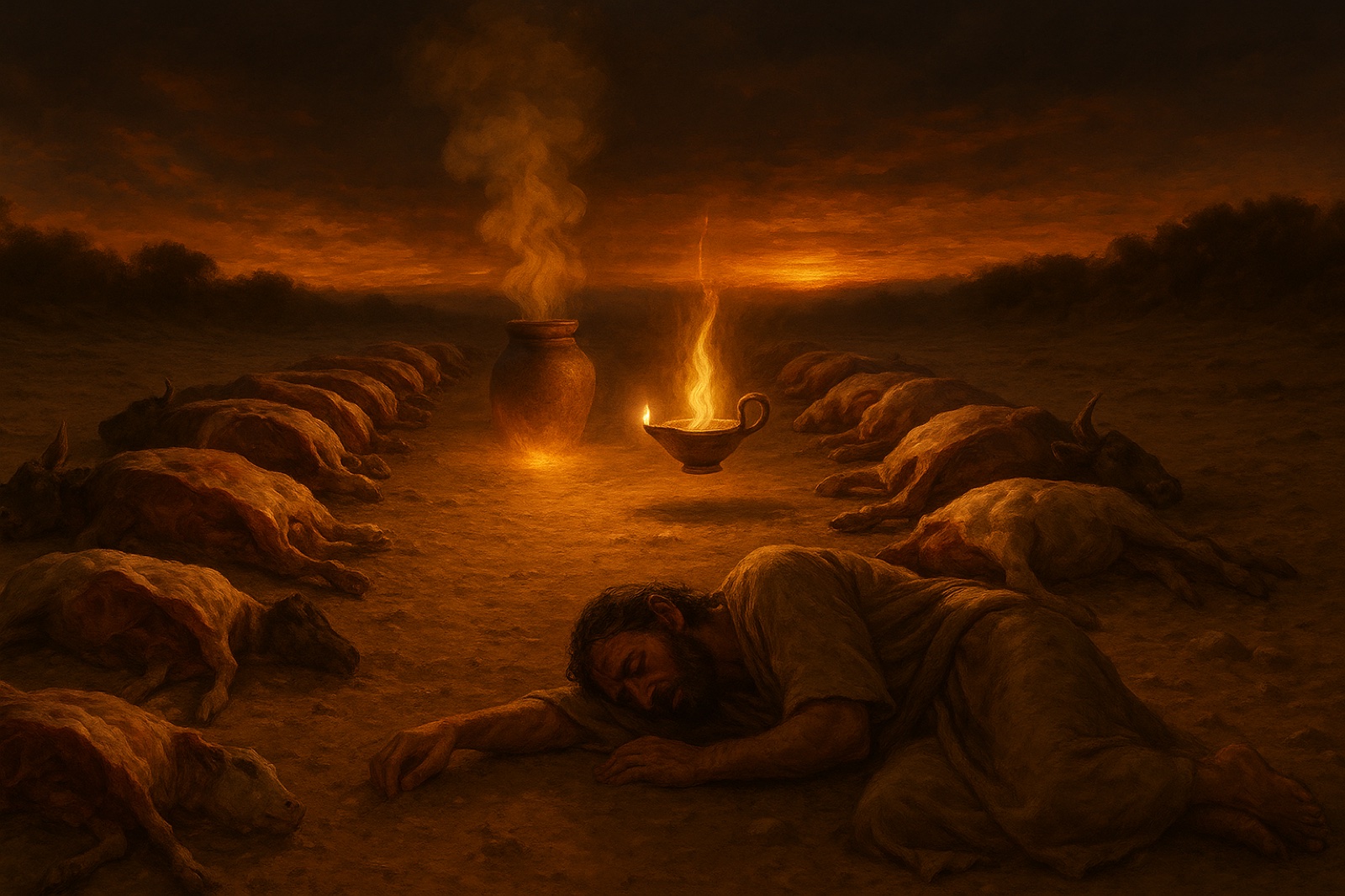
Abram doesn’t walk anywhere. He’s unconscious. Something the text calls “an horror of great darkness” comes over him, and he goes down before the ceremony even starts. He is, by every physical measure, completely out of the picture for what happens next.
“And it came to pass, that, when the sun went down, and it was dark, behold a smoking furnace, and a burning lamp that passed between those pieces.” — Genesis 15:17 (KJV)
A smoking furnace and a burning lamp — the visible sign of God’s own presence — pass between the pieces alone. Not Abram and God together. Just God. The one person required for a covenant who never showed up to do his half of the walking was the human being. God walked it by Himself, while the man He was making the promise to was face-down and unconscious on the ground.
The Turn: A Promise With Only One Name on the Contract
If you know anything about how these ceremonies were supposed to work, that detail should stop you cold. Every covenant in the ancient world required both parties to walk, because the whole point was mutual risk — both sides accepting the same curse if they broke faith. God rewrote the ceremony in front of Abram’s unconscious body. He kept the form everyone would recognize, and then quietly removed the other half of it. He alone accepted the curse. He alone carried the weight of what would happen if the covenant were ever broken.
This is the piece our modern, exit-clause world has no real category for. Every contract you sign assumes two parties, two sets of obligations, and a way out if one side doesn’t hold up their end. God’s covenant with Abram wasn’t structured that way at all. It wasn’t a fifty-fifty deal where the promise holds only as long as Abram performs his part. Abram wasn’t even conscious for his part. The entire weight of keeping it landed on God, and only God, from the very first night it was cut.
The writer of Hebrews picks up this exact idea centuries later, explaining why that matters for you specifically:
“For men verily swear by the greater: and an oath for confirmation is to them an end of all strife. Wherein God, willing more abundantly to shew unto the heirs of promise the immutability of his counsel, confirmed it by an oath: That by two immutable things, in which it was impossible for God to lie, we might have a strong consolation.” — Hebrews 6:16-18 (KJV)
God had no one greater to swear by, so He swore by Himself — the same move as Genesis 15, just spelled out in plain language. Two things “impossible for God to lie” about, the writer says: the promise, and the oath backing it. That’s not a legal technicality. It’s the reason a promise made 4,000 years ago to one exhausted, frightened man is something you can actually stand on today, whether or not you’ve had a great week of faith.
What This Actually Means for You on a Monday
Here’s where this stops being ancient history. If you’ve ever quietly believed that God’s commitment to you rises and falls with how well you’ve been doing lately — how consistent your prayer life is, how long since your last real mess-up, how “worthy” you feel walking into church on a given Sunday — Genesis 15 is a direct answer to that fear. It’s worth remembering, too, that Scripture never once actually uses the word “disappointed” to describe God’s posture toward you — a covenant God carries alone isn’t the kind of promise He was ever going to walk away from over your bad week. The covenant was never fifty-fifty. You weren’t even required to be conscious for the part that mattered most. God cut it, God walked it, and God is the one holding it together, then and now.
That doesn’t erase your part entirely — Scripture never stops calling you to faithfulness. But it does mean the foundation under your standing with God was never your performance in the first place. It was His word, sworn on Himself, with nothing left for you to add to make it more binding than it already is. The “horror of great darkness” that fell on Abram that night is its own kind of clue here — the reverent awe Scripture calls “the fear of the Lord” isn’t about being afraid God will hurt you, it’s the appropriate response to standing next to a promise this weighty and this one-sided.
Actions to Take Today
- Find one exit clause, tonight. Pull up an actual contract you’ve signed — a lease, a phone plan, a streaming subscription — and find the exact sentence that lets either side walk away. Takes two minutes. You’re looking at the modern default so the next step actually lands.
- Read Genesis 15:9-18 out loud before you go to sleep tonight. Picture yourself as Abram — not performing, not participating, just asleep — while God does the part that mattered most on your behalf.
- Name the one thing you’ve been treating like your job to hold together. Write one sentence: “I’ve been acting like my standing with God depends on ___.” Then look at it next to Genesis 15 and ask if that was ever actually true.
Questions Worth Sitting With
- Where in your life have you been waiting to feel “secure enough” before you actually trust that God is keeping His word?
- If your standing with God has never depended on your consistency, what’s one area you’ve been white-knuckling like it does?
A Prayer for the Nights You Feel Unsteady
God, I think I’ve been trying to hold up my end of something You already carried by Yourself. That’s probably why I feel so unsteady half the time — like the whole thing falls apart if I don’t show up right. Thank You for Genesis 15, for walking through the fire alone so I wouldn’t have to earn what You already gave. Help me actually rest in that today instead of running scared that You’ll walk away the moment I fall short. I believe You keep what is Yours. Amen.
A Question for You
If you had to explain the difference between a contract and a covenant to someone who’d never heard either word, what would you say actually separates them? Tell us in the comments below.
Share This
- I just learned that ancient covenants required both people to walk through cut animal halves as a mutual promise — and in Genesis 15, only God did. Abram was asleep for it. That changes how I read every promise God’s ever made me.
- Turns out every contract I’ve ever signed has an exit clause built in for both sides. God’s covenant with Abraham didn’t have one for Him at all. He put Himself on the hook, alone. #Genesis15
- The word “covenant” basically means “cut.” God cut a promise with Abraham and only He walked through the pieces. Wild.
Questions People Are Asking
Q: What does the word “covenant” actually mean in the Bible?
A: The Hebrew word is berith, and the verb used with it literally means “cut” — because ancient covenants were sealed through a real ceremony where animals were cut in half and both parties walked between the pieces as a mutual self-curse. A covenant is a far more binding, sealed-in-blood kind of promise than a modern contract or agreement.
Q: What is the actual difference between a covenant and a contract?
A: A contract assumes two parties, two obligations, and usually an exit if one side fails to perform. A biblical covenant was sealed through mutual, irrevocable self-curse and, in God’s covenants with people like Abram, was often carried entirely by God’s own oath rather than depending on the human party’s performance to hold it together.
Q: What actually happened in Genesis 15 between God and Abram?
A: God told Abram to cut several animals in half and lay the halves opposite each other, which was the standard setup for a covenant ceremony. But instead of both parties walking through the pieces together, Abram fell into a deep, terrifying sleep, and only a smoking furnace and a burning lamp — representing God’s own presence — passed between them.
Q: Why did only God pass between the pieces in Genesis 15, instead of both God and Abram?
A: In the standard ancient ceremony, both parties walked to signal shared risk under the same curse. By walking alone while Abram was unconscious, God signaled that He alone was taking on the full weight and risk of the covenant — it did not depend on Abram’s participation or performance to be binding.
Q: Does God’s covenant with me depend on how faithful or consistent I am?
A: According to Genesis 15 and Hebrews 6:13-18, no — the covenant’s strength rests on God’s own unchangeable character and oath, not on the human party’s track record. Scripture still calls believers to faithfulness, but the foundation of the promise itself was never the person’s performance to begin with.