 0
0
 0
0
You know that feeling when everyone else seems to have started ten steps ahead of you? They grew up knowing all the Bible stories by heart. Their parents prayed with them at the table. Their grandparents’ names show up in the family Bible, going back generations. And you’re just… catching up. Maybe you didn’t grow up in church at all. Maybe your family tree doesn’t have a single “person of faith” anywhere on it. So some part of you wonders if that means you’re starting from behind — like everyone else got a head start you’ll never make up.
There’s a man in the Bible who never had a family story at all. Not because it was hidden. Not because it was lost. Because Scripture simply never gives him one. And it turns out that missing genealogy isn’t a gap in the story — according to the book of Hebrews, it’s the entire point.
The Three Verses Where He Appears
His name was Melchizedek, and his entire scene in Genesis lasts three verses. Genesis 14 tells the story: Abram (before God renamed him Abraham) had just won a battle, rescuing his nephew Lot and a small army’s worth of captives from four invading kings. On his way home, exhausted and still covered in the dust of battle, two kings came out to meet him.
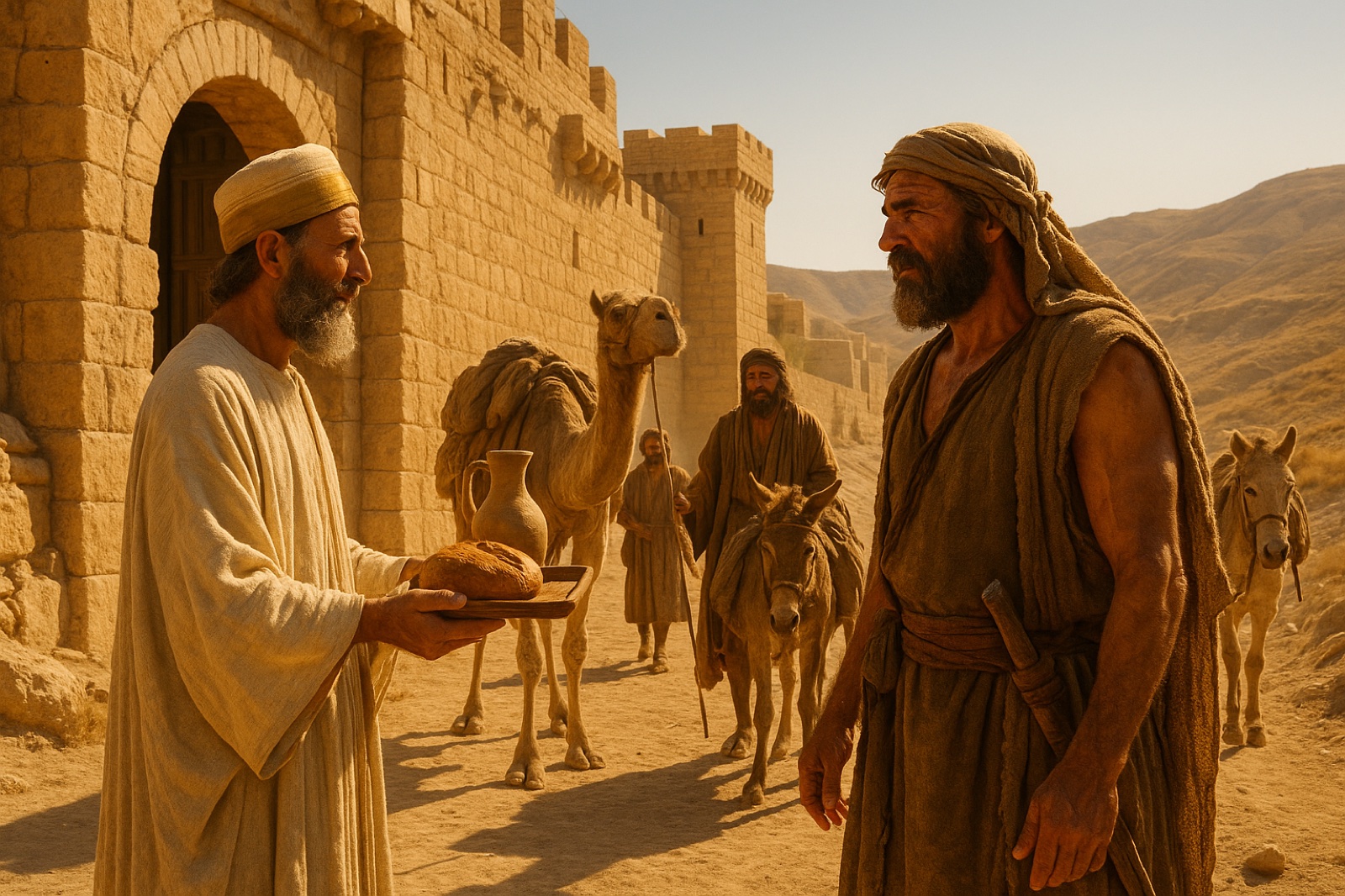
One was the king of Sodom — the city that would later become a byword for judgment. The other was a man nobody had mentioned before and nobody would fully explain: “And Melchizedek king of Salem brought forth bread and wine: and he was the priest of the most high God” (Genesis 14:18, KJV).
Salem is the ancient name for what would become Jerusalem. Melchizedek blessed Abram, gave credit to God for the victory, and Abram — in response — gave him a tenth of everything he’d recovered (Genesis 14:19-20). Then Melchizedek walks out of the story completely. He’s never mentioned again for the rest of Genesis. No introduction. No exit. Just… there, and then gone.
He’s not the only figure in Scripture whose whole story fits into a handful of verses. Lydia in Acts 16 gets exactly one scene, too — and it carries just as much weight.
Why the Silence Was Actually Strange
Here’s what makes this stranger than it sounds today: in the ancient world, genealogy wasn’t a nice-to-have. It was everything. Your family line was your resume, your legal standing, your entire claim to legitimacy. This mattered so much to Israel specifically that centuries later, when the exiles returned from Babylon, a group of priests couldn’t prove their family line and were disqualified from serving at the altar until the records could be verified (Nehemiah 7:63-64). Your genealogy wasn’t just interesting family history — it was your credential.
Which makes Melchizedek’s total absence of one deliberate-sounding, not accidental. No father listed. No mother listed. No birth. No death. In a culture obsessed with lineage, here’s a priest — the very first person in the entire Bible called a “priest” — who has none at all.
It’s worth noting Jesus’s own genealogy runs through people you’d never expect, for the opposite reason. Rahab, a woman from a city God destroyed, is listed directly in His family line in Matthew 1. Melchizedek has no genealogy at all; Rahab’s genealogy is the one nobody expected. Both point the same direction: God was never limited by the family tree.
The Prophecy Nobody Expected
Melchizedek disappears from the story for almost a thousand years. Then King David, writing under the Spirit’s inspiration, says something strange in Psalm 110 — a psalm about the coming Messiah: “The LORD hath sworn, and will not repent, Thou art a priest for ever after the order of Melchizedek” (Psalm 110:4, KJV).
Not “after the order of Aaron.” Not the priesthood every Israelite would have expected — the one built entirely on proving you descended from the tribe of Levi. David points a thousand years backward to a priest with no bloodline at all, and says the coming King would be a priest exactly like him.
What Hebrews 7 Does With the Silence
Centuries after that, the writer of Hebrews picks this thread back up and does something remarkable with it. Hebrews 7 spends an entire chapter unpacking why a priest who appears for three verses in Genesis matters this much. Here’s the key verse: “Without father, without mother, without descent, having neither beginning of days, nor end of life; but made like unto the Son of God; abideth a priest continually” (Hebrews 7:3, KJV).
The author isn’t claiming Melchizedek was literally eternal or superhuman. He’s making a careful argument from silence: because Scripture records no genealogy for Melchizedek, he becomes a living illustration — a preview — of a completely different kind of priesthood. One that isn’t inherited. One that isn’t earned by the right birth. One that’s established directly, by God’s own appointment.
Then Hebrews makes the case even bolder: since Abraham (who would become the ancestor of Levi, and therefore of every Levitical priest after him) paid tithes to Melchizedek, in a sense “Levi also, who receiveth tithes, payed tithes in Abraham” (Hebrews 7:9, KJV). The entire priesthood system Israel depended on — the one you had to prove your bloodline to enter — bows, in this story, to a priest who had no bloodline to prove.
The Turn: What This Actually Proves About Jesus — and About You
Here’s where it lands. Hebrews 7:16 says Jesus became a priest “not after the law of a carnal commandment, but after the power of an endless life.” Jesus’s authority to stand before God on your behalf was never something He inherited through a system that could exclude the wrong family, the wrong tribe, the wrong background. It was established directly, by God’s own oath — the same way Melchizedek’s was.
And if that’s true for Jesus’s priesthood, it’s true for your access to God, too. Whatever you think disqualifies you — no church background, no “spiritual” family, no head start the way you imagine everyone else got one — was never actually the qualification. It never was. Melchizedek’s missing family tree isn’t a loose end in the story. It’s proof, written centuries before your specific doubt ever existed, that God’s invitation was never gated behind pedigree. Not His Son’s. Not yours.
It’s the same pattern behind Hagar’s story — a runaway nobody was looking for, who became the first person in the entire Bible to give God a name. Access to God has never run through the channels we assume it does.
That’s worth sitting with for a second, because most of us are quietly running on the opposite assumption — that somewhere behind the scenes there’s a qualifying round we didn’t make it into. There isn’t. There never was.
What To Do With This Today
Three things you can actually do with this, starting right now:
- Name the “credential” you’ve been assuming you need. Take 60 seconds and finish this sentence honestly: “I’d feel more legitimate in my faith if I had ______.” Write it down. Then write Hebrews 7:3 right next to it.
- Read the actual scene for yourself. Open Genesis 14:18-20 in your own Bible — it’s four sentences. Underline “priest of the most high God.” That’s the first time the word “priest” shows up anywhere in the Bible, and it happens outside of Israel entirely, before the Law, before the tribe of Levi even exists.
- Pray without the “right” words. Skip whatever formal opening you think a prayer is supposed to have. Say one honest sentence to God right now, in whatever words you actually have. Access was never about proper form. Melchizedek’s whole story proves that.
A few questions worth sitting with, if you want to go deeper:
- What “credential” have you quietly believed you needed before you could feel qualified to come to God?
- Where else in your life have you assumed you needed the right background just to belong?
- If God’s access was never based on the family you were born into, what does that change about how you see your own story?
Here’s a prayer, if you want to pray it exactly as it is:
God, I think I’ve been carrying around a scorecard You never actually gave me. I’ve believed that my family, my past, my lack of a “head start” made me less qualified to come to You. Melchizedek had no family line at all, and You still called him Yours. So I’m asking You to help me actually believe there’s no line I failed to qualify for. I’m not coming to You because of my resume. I’m coming because You already said I could. Thank You for that. Amen.
Here’s a question worth genuinely wrestling with: if a priesthood with zero genealogical credentials could be declared greater than one with a flawless family record, what does that say about the “credentials” so many of us think we still need today? Drop your honest answer in the comments — we’d love to hear it.
Share This
- “There’s a guy in Genesis with no parents, no birth, no death on record — and Hebrews says that’s exactly why he points straight to Jesus. Wild.”
- “I used to think I needed the ‘right’ spiritual background to really belong to God. Then I read about a priest in Genesis 14 with no genealogy at all — who somehow outranked the entire priesthood system. Access was never about pedigree.”
- “Melchizedek shows up for three verses in the whole Bible. Three. Hebrews 7 uses his missing family tree to explain why Jesus’s authority never came from bloodline either. This rewired how I think about being ‘qualified.'”
Common Questions About Melchizedek
Who was Melchizedek in the Bible?
Melchizedek was the king of Salem (the ancient name for Jerusalem) and “priest of the most high God,” described in Genesis 14:18-20. He met Abram after Abram’s victory over four invading kings, brought out bread and wine, blessed him, and received a tenth of everything Abram had recovered. He’s mentioned only twice more in all of Scripture — Psalm 110:4 and throughout Hebrews 7 — and never appears again in Genesis after this single scene.
Why does Melchizedek have no genealogy in the Bible?
Scripture simply never records one — no father, no mother, no birth, no death. In the ancient world, genealogy was the primary way people proved their legitimacy, so this silence stood out enough that Hebrews 7:3 highlights it directly: Melchizedek was “without father, without mother, without descent, having neither beginning of days, nor end of life.” The author of Hebrews is making an argument from that silence, not claiming Melchizedek was literally eternal.
What does Hebrews 7 say about Melchizedek and Jesus?
Hebrews 7 argues that Jesus’s priesthood follows “the order of Melchizedek,” quoting Psalm 110:4, rather than the order of Levi and Aaron. Because Melchizedek’s authority wasn’t based on inherited bloodline, he becomes a picture of a priesthood based on God’s direct appointment and “the power of an endless life” (Hebrews 7:16) — exactly the kind of priesthood Jesus holds.
Why did Abraham give Melchizedek a tenth of everything?
Genesis 14:20 says Abram “gave him tithes of all” after Melchizedek blessed him. Hebrews 7:9 treats this as significant: since Levi (Abraham’s future descendant) was, in a sense, present in Abraham’s body when this tithe was paid, the author argues that Levi’s own priesthood implicitly acknowledges Melchizedek’s greater one.
What’s the main lesson from the story of Melchizedek?
That standing with God was never based on pedigree, credentials, or the right family line — it’s based on God’s own appointment and invitation. Melchizedek’s missing genealogy became the very proof that access to God never required the “right” background, which is exactly what Jesus’s priesthood later confirmed for everyone who comes to Him.