 0
 0
Most people who go looking for Bible verses about faith are not feeling very full of it. You search for them on the night the test result is late, or the week the prayer you have prayed for two years still has not moved. You want a verse that will hold. And the verses that come up first are beautiful, and they can also feel like a bar you are supposed to clear and cannot.
So before the list, here is something worth knowing. One of the Bible’s most-quoted verses about faith was spoken to a man in the middle of an argument with God. And the Hebrew word behind it, the first time it appears in Scripture, is not about believing anything. It describes a tired man’s hands.
The Bible Verses About Faith Everyone Quotes First
If you have searched this before, you have met this verse:
Now faith is the substance of things hoped for, the evidence of things not seen.
Hebrews 11:1, KJV
It is the opening line of the Bible’s great faith chapter. Abel, Enoch, Noah, Abraham, Sarah, Moses. One after another, “by faith” they did something hard. Read on its own, the chapter can sound like a hall of fame you will never be inducted into.
Then, halfway through, the writer stops and says something that almost nobody puts on a card:
These all died in faith, not having received the promises, but having seen them afar off, and were persuaded of them, and embraced them, and confessed that they were strangers and pilgrims on the earth.
Hebrews 11:13, KJV
They died without getting it. The chapter says it twice. Near the end: “And these all, having obtained a good report through faith, received not the promise” (Hebrews 11:39). The heroes of the faith chapter are not people who believed hard enough to make the answer arrive. They are people who kept going when it did not.
That changes what the chapter is for. It is not a scoreboard. It is a list of people who stayed.
A Faith Verse Three New Testament Books Quote Was Said to a Man Arguing With God
Three different New Testament books reach back for the same Old Testament line about faith. Paul uses it in Romans 1:17 and again in Galatians 3:11. Hebrews 10:38 uses it too. In the King James, it reads:
Behold, his soul which is lifted up is not upright in him: but the just shall live by his faith.
Habakkuk 2:4, KJV
Now look at where it comes from. Habakkuk is a short book, and it does not open with a vision or a song. It opens with a complaint. “O LORD, how long shall I cry, and thou wilt not hear! even cry out unto thee of violence, and thou wilt not save!” (Habakkuk 1:2). That is the second verse of the book. The prophet is watching his own nation fall apart and he wants to know why God is doing nothing.
God answers, and the answer is not what Habakkuk wanted. So he complains again. Then he climbs a watchtower and waits. If that long silence is where you are living right now, what Habakkuk did when God stayed silent for years is worth reading on its own.
The answer that finally comes includes this, one verse before the famous one:
For the vision is yet for an appointed time, but at the end it shall speak, and not lie: though it tarry, wait for it; because it will surely come, it will not tarry.
Habakkuk 2:3, KJV
Then: the just shall live by his faith.
So a faith verse the New Testament reaches for three separate times was not handed to someone who felt sure. It was handed to a man who had just been told to keep waiting, with no date attached. “Faith” in that sentence is what you do between the promise and the arrival. It is how you live while it tarries.
The Word Behind “Faith” Once Meant Steady Hands
Here is the detail that reorganised this whole topic for me.
The Hebrew word Habakkuk uses is emunah. English Bibles usually render it “faith” or “faithfulness,” and the dictionaries gloss it as firmness, steadiness, reliability. It is a word about holding a position.
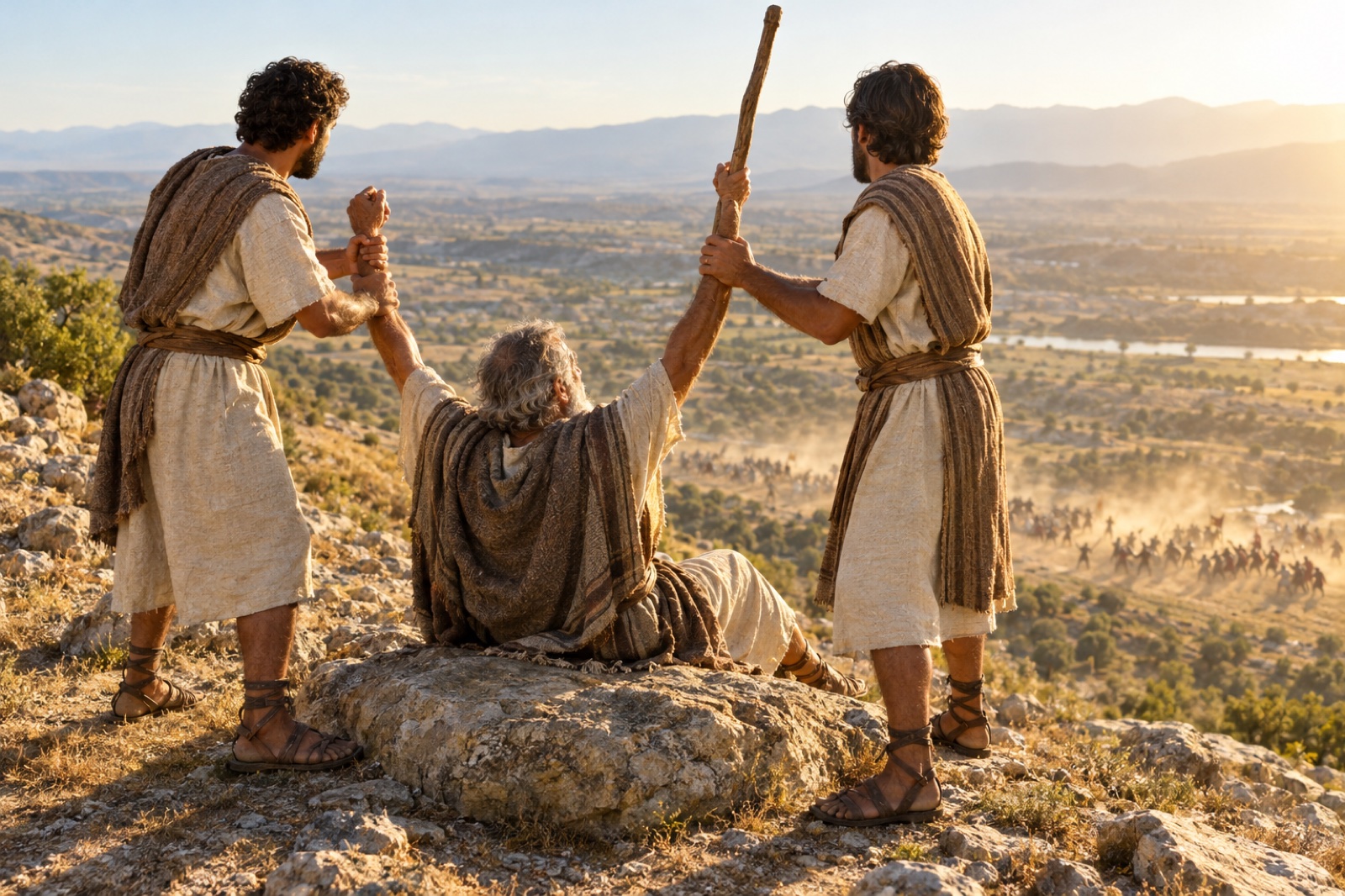
Now go to the first place that word appears in the Bible, reading from Genesis forward. It is not in a verse about believing. It is Exodus 17, where Israel is fighting Amalek in a valley and Moses is on a hill above them with his hands raised. When his hands are up, Israel wins. When they drop, Israel loses. And his hands drop, because he is a man.
But Moses’ hands were heavy; and they took a stone, and put it under him, and he sat thereon; and Aaron and Hur stayed up his hands, the one on the one side, and the other on the other side; and his hands were steady until the going down of the sun.
Exodus 17:12, KJV
“Steady.” That is emunah. The same noun Habakkuk uses for the faith the just live by is the word Exodus uses for a tired man’s arms that stayed up because two friends held them.
Read it again with that in mind. The arms were not steady because Moses found more strength. The verse says the opposite: his hands were heavy. They were steady because someone found him a stone to sit on and two people got close enough to carry the weight. We wrote about Aaron and Hur before, and what it costs to let people hold you up. What I had not seen until now is that the Bible’s own word for faith was first used to describe exactly that.
And it is not only used of people. In Deuteronomy 32:4 Moses sings that the LORD is “a God of truth,” and the word under “truth” is emunah again. Before faith is ever something we are asked to have, it is something God is. Steady. The one who does not drop the arms.
The Faith Verse That Admits It Is Only Half There
If faith means steadiness rather than certainty, then one more verse belongs on any honest list of Bible verses about faith, and it is a strange one. A father brings his son to Jesus. The boy has been sick since childhood. Jesus tells him that all things are possible to the one who believes, and the father answers:
And straightway the father of the child cried out, and said with tears, Lord, I believe; help thou mine unbelief.
Mark 9:24, KJV
He says both things in one breath. I believe. I do not. And Jesus heals the boy anyway. The man did not get his faith to full strength first. He brought what he had, said out loud what was missing, and stayed standing in front of Jesus. That was enough. If you have ever prayed for your own child from that exact place, this prayer for a son was written from the same verse.
What Changes When Faith Means Steady
Put the three together.
Hebrews 11 says the heroes of faith died before the promise came, and counts them faithful anyway. Habakkuk 2:4 was given to a man told to keep waiting with no date. Exodus 17:12 uses the word for faith to describe arms that were held up by other people. And Mark 9:24 records a man who confessed his unbelief in the same sentence as his belief, and was answered.
None of that describes a feeling you have to manufacture. It describes a posture you can hold, and that other people can help you hold. The question stops being “do I believe enough?” and becomes “am I still here, still facing the right way, and have I let anyone hold my arm?”
That is a question you can answer tonight, even if your faith feels thin. Thin faith that stays is what the Bible calls faith. And faith that is being held up by two friends is not a lesser version. In Exodus, it is the only version that lasted until sundown.
Habakkuk ends his book with the fig tree not blossoming, the vines empty, the fields bare, “Yet I will rejoice in the LORD” (Habakkuk 3:18). Nothing had been fixed. He had simply become steady.
Actions to Take
- Read Habakkuk 1:2 out loud, then say your own version. One sentence, the real complaint, in your own words. A faith verse the New Testament quotes three times was given to a man who started there. You are allowed to start there too.
- Pray Mark 9:24 exactly as written, both halves. “Lord, I believe; help thou mine unbelief.” Do not edit out the second half. Say it once before you put your phone down tonight.
- Ask one person to hold one arm. Message someone with the specific thing you are waiting on and the words “would you pray this with me this week?” Not “I’m struggling.” Name the arm. Aaron and Hur knew exactly which one to take.
Journaling Prompts
- When you say your faith feels weak, what are you actually measuring? A feeling, a certainty, or whether you are still standing where you were?
- Whose hands have gone heavy near you lately, and what has kept you from being the person on one side of them?
A Prayer for When Your Faith Feels Thin
God, I came looking for verses because mine feels like it is running out. I did not know the word for faith first meant hands that stayed up because someone else held them. So I am asking plainly: hold mine. Send me the people who will stand on either side, and give me the nerve to let them. I believe, and I do not, and I am saying both to you tonight because Jesus answered a man who did the same. Keep me steady until the sun goes down on this.
Discussion Question
Do you think faith is mostly something you feel, or mostly something you do? Tell us how you see it in the comments. Someone reading today has heavy arms and needs to hear how you have kept yours up.
Share This
- The Hebrew word for faith in Habakkuk 2:4 is the same word Exodus 17:12 uses for Moses’ hands being “steady.” They were steady because two friends held them up. That is what faith meant first.
- Hebrews 11 says its heroes “died in faith, not having received the promises.” The faith chapter is not a list of people who got the answer. It is a list of people who stayed.
- “Lord, I believe; help thou mine unbelief.” A man said both halves in one breath and Jesus healed his son anyway. You do not have to get to full strength first.
Q&A About Bible Verses on Faith
What is the most famous Bible verse about faith?
Hebrews 11:1 is the most quoted: “Now faith is the substance of things hoped for, the evidence of things not seen” (KJV). It opens a chapter that lists Abel, Noah, Abraham, Sarah and Moses acting “by faith.” The same chapter also says, in Hebrews 11:13, that “these all died in faith, not having received the promises,” so the chapter describes people who kept going before the answer came, not people whose belief made the answer arrive.
Which Old Testament verse about faith is quoted three times in the New Testament?
Habakkuk 2:4, “the just shall live by his faith” (KJV), is quoted in Romans 1:17, Galatians 3:11 and Hebrews 10:38. In its original setting it is part of God’s answer to the prophet Habakkuk, who had opened his book by complaining that God was not listening (Habakkuk 1:2). The verse just before it, Habakkuk 2:3, tells him the answer will come at “an appointed time” and “though it tarry, wait for it.”
What does the Hebrew word for faith actually mean?
The Hebrew noun in Habakkuk 2:4 is emunah (Strong’s H530). Dictionaries define it as firmness, steadiness, faithfulness or reliability. Its first appearance in the Bible is Exodus 17:12, where it is translated “steady” and describes Moses’ raised hands, which Aaron and Hur held up until sunset. In Deuteronomy 32:4 the same word is used of God, translated “truth” in the King James Version. So the biblical word for faith is closer to “steadiness” than to “certainty.”
Is it a sin to have doubts and still have faith?
Mark 9:24 records a father saying to Jesus, “Lord, I believe; help thou mine unbelief,” and Jesus healed his son without first requiring the doubt to be gone. Hebrews 11 counts as faithful people who “received not the promise” (Hebrews 11:39). Scripture treats faith as staying in position before God while being honest about what is missing, rather than as the absence of doubt.
What Bible verse about faith helps when you are waiting on God?
Habakkuk 2:3-4 (KJV) was given to a man who had been waiting for God to act: “though it tarry, wait for it; because it will surely come, it will not tarry… the just shall live by his faith.” Habakkuk ends his book still waiting, with the fig tree not blossoming and the fields bare, and writes “Yet I will rejoice in the LORD” (Habakkuk 3:18). The verse defines faith as how a person lives between a promise and its arrival.