 0
 0
The parable of the rich man and Lazarus in Luke 16 is usually read as a story about money. Read it slowly and something harder surfaces: the rich man knew the beggar’s name. He says it from torment — send Lazarus — and asks for him again a few verses later, and he never once speaks to the man himself. Lazarus, the only person Jesus ever named in any parable, is given no line to say anywhere in the story. This page carries the full script of the video, both passages in the King James text, the chapter list, the sources, and five questions people actually ask about it. The question it ends on is not about a bank balance.
Chapters
- 0:00 — The detail most retellings walk past
- 0:35 — What Jesus actually said happened
- 1:39 — What the rich man asked for
- 2:12 — Who do you already know by name?
- 3:12 — Why a resurrection would not have fixed it
- 4:03 — A prayer for one name
The detail most retellings of the rich man and Lazarus walk past
There is a gate. On one side of it stands a man in purple; on the other, lying right there in the entryway, a man named Lazarus, covered in sores. You have heard this one. But here is the part that is easy to walk straight past: the rich man knew his name.
He knew it, which means that gate was never a wall of ignorance. He knew exactly who was lying at his own front door, and he still thought of him as somebody who could fetch water.
What Jesus actually said happened
Jesus tells it plainly. The rich man is dressed in purple and fine linen and eats well every single day of his life, while Lazarus is laid at his gate — not down the road, but at the rich man’s own gate — hoping for the crumbs that fell off the table, while the dogs came and licked his sores.
Then both men die, which is the hinge of the whole thing. Death does not change who either of them is, it just stops the pretending, because Lazarus is carried away by angels while the rich man is simply buried.
In torment the rich man lifts up his eyes and sees them both a long way off. What he says next is the line the whole parable turns on:
Father Abraham, have mercy on me, and send Lazarus, that he may dip the tip of his finger in water, and cool my tongue.
Luke 16:24, KJV
Send Lazarus. Not send somebody, but send Lazarus — the name itself, said out loud in torment. Abraham tells him no, because there is a great gulf fixed now and nobody crosses it.
What the rich man asked for
Look at what he actually asked for. He does not ask for forgiveness, and he does not ask for another chance. He asks for an errand. When that gets refused he tries again, because he has five brothers back home and he wants Lazarus sent to warn them. Even from there, he is still giving Lazarus jobs.
And Lazarus never says a word. Not one line in the whole story. Jesus gives him a name and gives him nothing to say, although he does not need to say anything, because the gate already said it for him.
Who do you already know by name?
That is the part that should sit heavy, because when we hear this story we go looking for the rich man somewhere else — somebody with more money, or somebody worse. But the test here was never a bank balance. It was a name.
So here is the question the gate asks. Who do you already know by name?
Not the stranger on the news, but the person whose name you could say out loud right now. The cousin who called twice and you meant to call back. The neighbour whose porch light has been off for three weeks. The man at work who went quiet in April and nobody asked why. The parent you keep meaning to visit on a weekend that keeps filling up.
You are not a cruel person, and the rich man probably did not feel cruel either, which is the horror of it. There is no moment in this story where he decides to ignore Lazarus. He just had a day to get on with, and the gate was on the way, and tomorrow would do.
Why a resurrection would not have fixed it
His last idea is actually a decent one. Send somebody back from the dead, he says, and that would wake my brothers up. Abraham tells him no again:
If they hear not Moses and the prophets, neither will they be persuaded, though one rose from the dead.
Luke 16:31, KJV
Which is the hardest line in the story, because a man named Lazarus did walk out of a tomb. John writes it down in his own Gospel, and some of the people who stood there and watched it happen went off and made plans to kill him.
So we can stop waiting for the thing that would finally move us, because it already came and it did not work. What is left is a name, and an ordinary Tuesday, and a phone that still works. Say the name out loud, right now, because that is how a gate gets opened.
A prayer for one name
Father, we are not asking to feel more, because we have felt plenty and done nothing with it. Give us one name. Bring it up now, while we are still sitting here, and keep bringing it up until we actually move. Make us people who notice a gate before it becomes a gulf. And where we are the one lying at it, unseen and too tired to ask, be the God who helps. Amen.
Sources
- Luke 16:19–31, King James Version — the parable in full, including verse 24 (“send Lazarus”), verse 26 (the great gulf fixed) and verse 31. Checked against bible-api.com.
- John 12:10, King James Version — “the chief priests consulted that they might put Lazarus also to death,” after the raising recorded in John 11. Checked against bible-api.com.
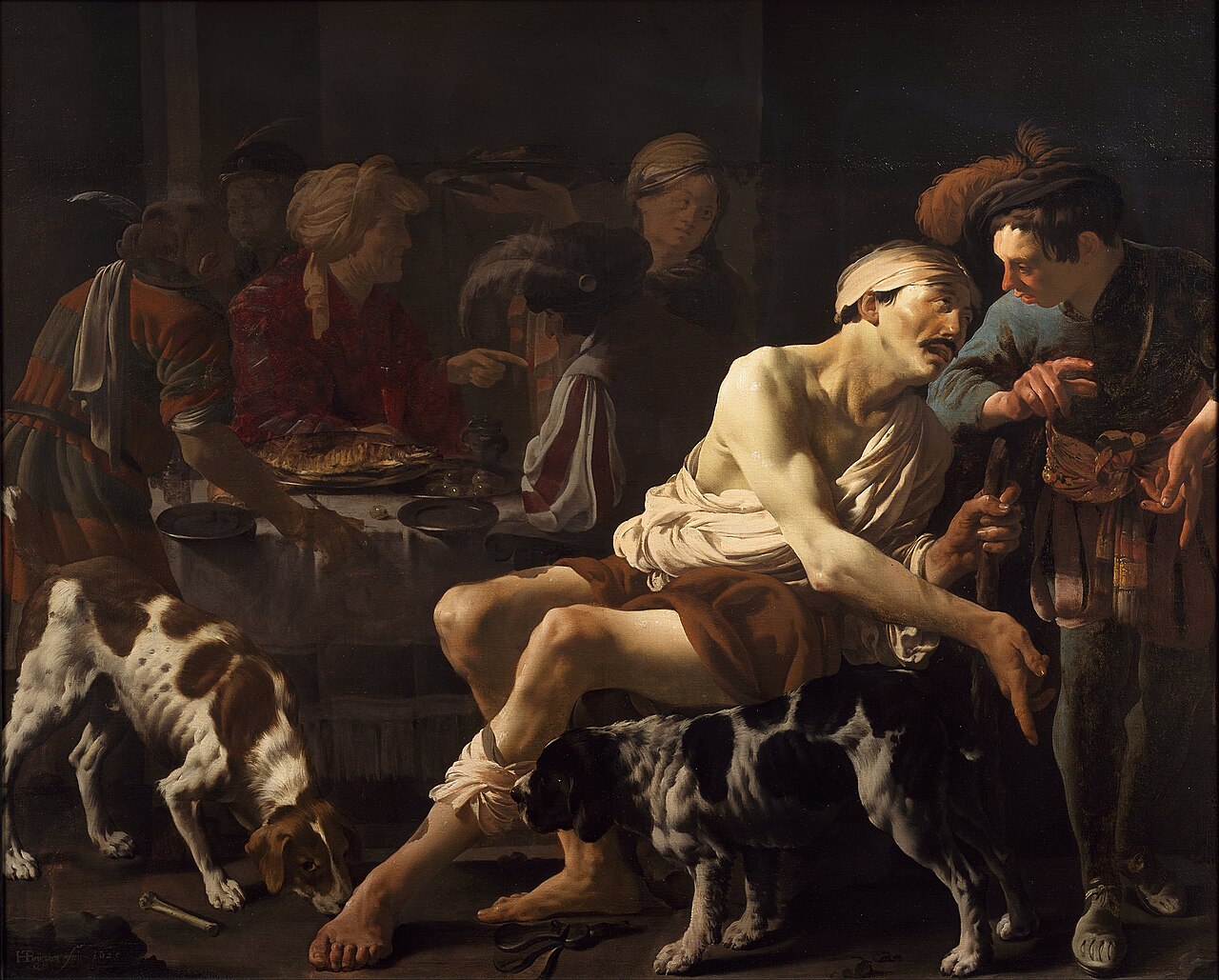
- Artwork, all public domain: “The Rich Man and the Poor Lazarus” by Hendrick ter Brugghen; “The Rich Man and Lazarus” by Girolamo da Ponte; “Il ricco Epulone” by Bonifacio de’ Pitati; “Lazarus and the Rich Man” by Gustave Doré.
The whole of Matthew, free, as a PDF and a 28-chapter audiobook — if a parable Jesus told is the kind of thing you want more of:
Questions people ask about the rich man and Lazarus
Who was Lazarus in the parable of the rich man and Lazarus?
Lazarus in Luke 16 is a beggar who lay at a rich man’s gate, covered in sores and hoping for the crumbs that fell from the man’s table. He is a different person from Lazarus of Bethany, the friend Jesus raised from the dead in John 11. The beggar is the only character Jesus ever gave a name to in any of his parables, and he is given no line of dialogue anywhere in the story.
Did the rich man know Lazarus by name?
Yes. In Luke 16:24 the rich man calls out from torment, “send Lazarus, that he may dip the tip of his finger in water.” He uses the name, and in verse 27 he asks for Lazarus to be sent to his five brothers. He never once speaks to Lazarus directly. The parable’s indictment is not that he failed to notice a stranger, but that he knew the man at his own gate and still only pictured him running errands.
What does the great gulf fixed in Luke 16:26 mean?
Abraham tells the rich man that “between us and you there is a great gulf fixed,” so that nobody can cross from either side. In the parable it marks the point at which the distance the rich man kept during his life becomes permanent. The gate he stepped around every day and the gulf he cannot cross are the same distance, measured at two different times.
What is the main lesson of the rich man and Lazarus?
The parable is usually read as a warning about wealth, but the detail it turns on is a name. The rich man is never named; the beggar is. The man knew who was at his door and kept him at the distance of an errand. The lesson lands closest to home with the person you can already name and have quietly stopped seeing: the cousin, the neighbour, the parent, the colleague who went quiet.
Why did Abraham say a resurrection would not persuade the five brothers?
Abraham answers that “if they hear not Moses and the prophets, neither will they be persuaded, though one rose from the dead” (Luke 16:31). The Gospel of John reports exactly that test: after Jesus raised a man named Lazarus, some who saw it plotted to kill him instead (John 12:10). The problem was never a shortage of evidence, so waiting for better proof is not the thing standing in the way.
Related on BGodInspired
- Awakened: a devotional on the other Lazarus — the friend Jesus raised in John 11.
- Who was Delilah?
- Who was Bathsheba?
Watch Lazarus and the Rich Man: He Knew His Name the Whole Time on YouTube.