 0
 0
This Sunday, 1 November, tens of thousands of people will line up in New York and run 42.195 kilometres through five boroughs. Over the next few weeks, hundreds of thousands more will do the same thing in cities all over the world — on closed roads, past strangers holding out paper cups.
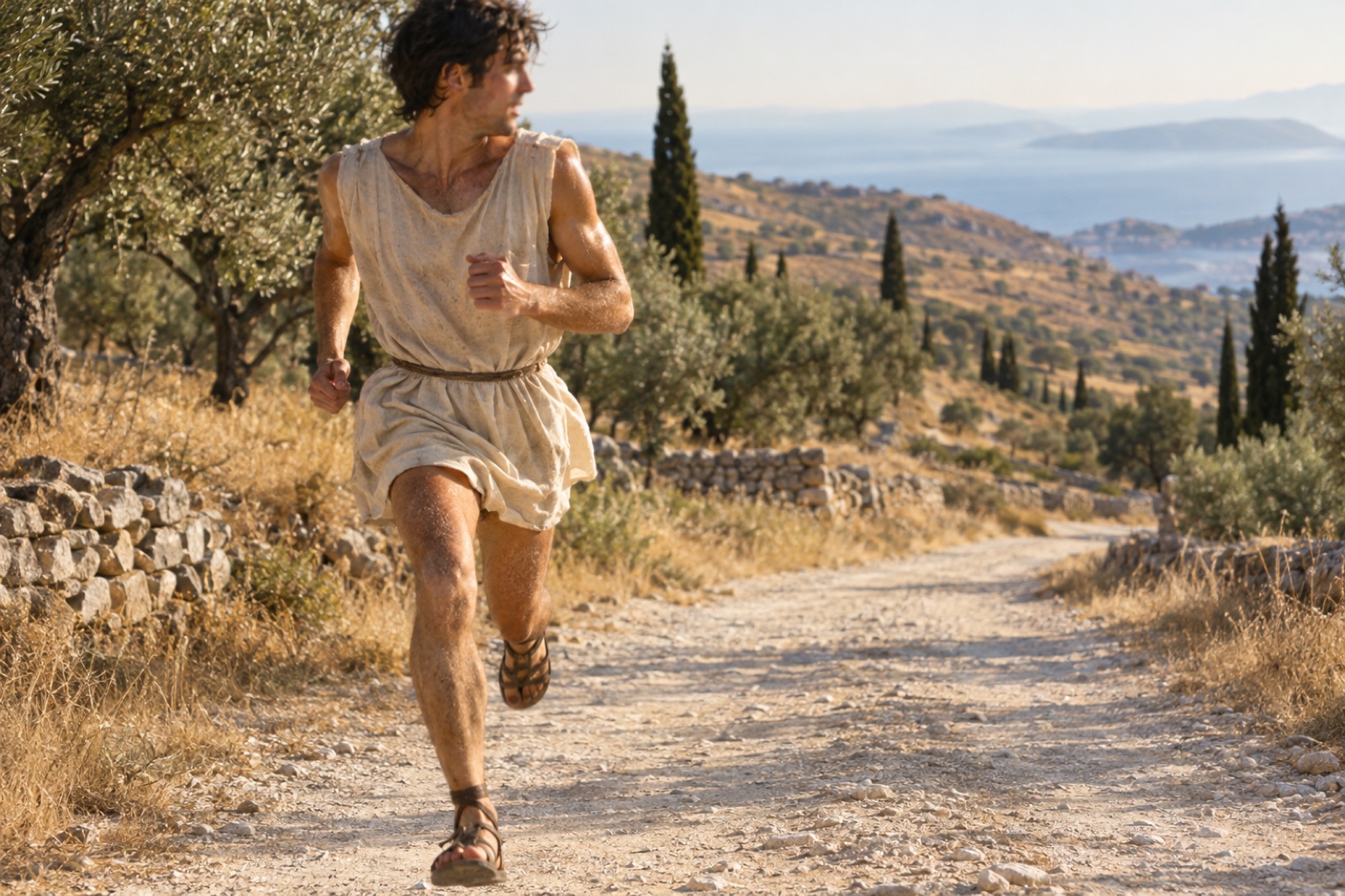
Almost every one of them could tell you why it is called a marathon. A Greek runner carried news of a battle back to Athens, gasped out that his side had won, and dropped dead at the finish line.
It is a perfect story. It is also missing from the one place you would most expect to find it.
What the oldest surviving account of the marathon origin story actually says
The battle was real. In 490 BC a Greek force beat a Persian army on the plain of Marathon. The first surviving account of it was written by Herodotus a few decades later — close enough to the event to talk to people who were alive when it happened.
Herodotus does write about a runner. Just not that run.
In his telling, the Athenian generals send a herald named Pheidippides — one manuscript spells it Philippides — to Sparta to beg for help. And they send him before the battle, not after it. He was a professional. Herodotus describes him as a long-distance runner who made that his calling. The distance was roughly 225 kilometres. Herodotus says he reached Sparta the day after he left Athens.
Then comes the gap. Herodotus has nothing at all about a runner going from Marathon to Athens afterwards. No announcement. No collapse. No death. In his account of what happened after the battle, there is no messenger at all.
And Pheidippides himself? He lived. He delivered his message perfectly. And it did not work. The Spartans said they wanted to help but could not break their own law — they could not march out before the moon was full. So they waited, and Athens fought without them.
The most famous run in history, in its oldest surviving version, is a man who ran further than a marathon, arrived ahead of time, said exactly the right thing, and was told to come back later.
Where the dying runner came from
The collapse at the finish does exist in ancient writing. It just turns up late, and the sources cannot agree on who the man was.
Plutarch, writing more than five hundred years after the battle, reports a messenger who ran in with the news and died on the spot. But he does not call him Pheidippides. He names Thersippus, and credits an earlier writer, Heracleides Ponticus, for the story. Other ancient reports give the runner’s name as Eucles instead.
The version everybody actually knows — the famous name, the route from Marathon to Athens, the last words, the death — appears in Lucian, a satirist writing in the second century AD. That is roughly six centuries after the event. Lucian’s runner is Philippides, and what he says before he dies is something close to “Joy to you, we have won.”
So the story we repeat looks like two separate things fused together: Herodotus’s real, documented run to Sparta, and a vaguer tradition about a battlefield messenger — welded into one man, given one name, and handed a death scene, half a millennium after the fact.
Even the distance is modern. The first modern Olympic marathon, in 1896, was about 40 kilometres. The odd number we run now — 42.195 km, or 26 miles and 385 yards — comes from the course used at the 1908 London Olympics and was adopted as the standard in the early 1920s. Why that exact figure was chosen is not clearly recorded; the governing body’s own minutes are reported to be silent on the reasoning.
Which is a strange thing to carry to a start line. The distance has no documented reason. The founding story has no early source. People run it anyway, and it still does something to them.
An older footrace that was written down in full
Here is the part that surprised me most.
There is an older account of a news-carrying footrace that is reported in almost obsessive detail: the argument before the start, the route each runner chose, who overtook whom, what the lookout on the wall said, and exactly what the winner managed to say when he arrived.
It sits in the Hebrew records of King David’s reign, in the second book of Samuel, and it is roughly four centuries older than the battle of Marathon.
David’s army has just put down a rebellion led by his own son, Absalom. Absalom is dead. Somebody has to carry that back to the king.
A young man named Ahimaaz volunteers. The commander, Joab, refuses him, because the news is not good news whatever the battle result says. Ahimaaz asks again. Joab sends a different man instead — an unnamed Cushite — with a flat instruction: go and tell the king what you have seen.
Ahimaaz will not let it go. He asks a third time. And Joab gives him the warning the whole story turns on:
Wherefore wilt thou run, my son, seeing that thou hast no tidings ready?
Why do you want to run, when you have nothing to deliver?
He runs anyway. Joab gives him a single word of permission — “Run” — and Ahimaaz takes the smarter line, “by the way of the plain,” and overtakes the man who was actually sent.
The detail that makes this read as reporting rather than legend: up on the wall, the lookout recognises him long before he can see a face, by the way he moves. The running of the first man, he says, is like the running of Ahimaaz. The king hears the name and decides the news must therefore be good.
Ahimaaz arrives first. He is fast, he is right about the route, he wins. He bows to the ground and says that all is well, and blesses God for handing over the men who rose up against the king.
Then the king asks the only question he actually cares about. Is the young man safe? Is my son alive?
And the winner of the race says:
I saw a great tumult, but I knew not what it was.
He is told to step aside and stand there. A moment later the unnamed runner — the one who never asked for it, who was simply sent, who lost the race — walks in and tells the king his son is dead.
It is worth knowing that the word these records use for the news a runner carries is besorah, and that word had a long life ahead of it. It is the word that eventually became the English word “gospel”. It started out as something a sweating man brought in from a battlefield.
Winning the race and arriving empty
Two runners. One wanted the run; one was handed it. The one who wanted it got there first with nothing to give. The one who was sent got there second carrying the whole weight of it.
Anyone who has trained for months for a finish line knows the feeling that story is pointing at. You cross. The clock stops. And instead of the thing you were expecting, there is a flat, quiet gap where the meaning was supposed to be. Not sadness exactly. Just nothing, yet.
That gap is not evidence you did it wrong. It is evidence that a finish line was never built to hold that much on its own.
And it is interesting that the oldest version of the marathon story seems to have known this already. Herodotus’s runner came home with something stranger than a result. He reported that out on the road, in the hills above Tegea, a god had called him by name and asked why the Athenians kept neglecting him. Athens believed him. They built a shrine and ran a torch-race in that god’s honour every year afterwards. The thing that survived best from the first telling was not the time, the distance or the win. It was that something met him on the road.
Both of these old accounts, written centuries and continents apart, keep circling the same quiet idea: the running is not the point, and what you are carrying is. In neither story does the runner get to choose what he carries. It is given to him, or it is not. That is a very old thought, older than either story, and it tends to outlast a finish line — that purpose is something handed to you rather than something seized, and that the fastest person on the road can still arrive with empty hands. Different centuries have given that source different names. A great many people have called it God.
What that changes on a start line
None of this should make anyone’s race smaller. A marathon is still one of the few things left that an ordinary person can do slowly, badly and completely, and come out the other side changed by it.
But it does change the question you carry round the course. Not “what was my time” — that will sit in your watch for the rest of your life, and it will not answer anything. The older question is the one Joab asked before anyone had run a single step: what have you got ready?
It is a question that applies well beyond running, and well beyond people who are fast. Some finish lines have no crowd at all. A rover on Mars quietly covered a marathon’s worth of ground over five years with nobody clapping at the end of it, and the distance counted exactly the same.
If you are not sure what you would be carrying across your own finish line, that is normal, and it is worth more thought than most of us ever give it. Our free What Is My Purpose? assessment is a quiet place to start.
And on Sunday, when the pack goes past, it is worth remembering that the man the race is named for may never have run it, probably did not die, and almost certainly was not called what we call him. What he did do was carry something true, a very long way, for people who needed it. That part has lasted two and a half thousand years. It is the part worth copying.
Questions People Ask
Did Pheidippides really run from Marathon to Athens and die?
There is no early evidence that he did. Herodotus, who wrote the oldest surviving account of the battle of Marathon a few decades after 490 BC, describes Pheidippides running from Athens to Sparta before the battle to ask for help, a distance of roughly 225 kilometres. Herodotus never mentions a run from Marathon to Athens and never mentions the runner dying. The death scene appears centuries later, in Plutarch and then in Lucian, who wrote in the second century AD.
Who was the runner who died after the battle of Marathon?
Ancient sources disagree. Plutarch, writing more than five hundred years after the battle, names Thersippus and credits the earlier writer Heracleides Ponticus; other ancient reports name Eucles. The familiar name Philippides, together with the Marathon-to-Athens route and the famous dying announcement, comes from Lucian in the second century AD. Because the earliest surviving account has no messenger at all, historians generally treat the death scene as a later tradition rather than a recorded event.
Why is a marathon 42.195 kilometres?
The distance is modern, not ancient. The first modern Olympic marathon in 1896 was about 40 kilometres, and early races varied. The figure 42.195 km, which is the metric equivalent of 26 miles and 385 yards, comes from the course used at the 1908 London Olympics and was adopted as the standard distance in the early 1920s. The reasoning behind choosing that exact number is not clearly documented.
Is there a footrace in the Bible?
Yes, and it is reported in unusual detail. The second book of Samuel, chapter 18, describes two runners carrying news of a battle to King David. A young man called Ahimaaz begs for the job and is refused, since the news includes the death of the king’s son. He begs again, is warned that he has no message ready, runs anyway, chooses a faster route across the plain and overtakes the man who was actually sent. He arrives first and then cannot answer the king’s only question. The second, unnamed runner arrives later and delivers the news.
What does the name Ahimaaz mean in the story of the two runners?
Ahimaaz was the son of Zadok the priest and acted as a messenger for King David during Absalom’s rebellion. In the account in 2 Samuel 18 he is identified by a lookout purely from the way he runs, before his face is visible. He is the faster of the two runners and arrives first, but when King David asks whether Absalom is safe, Ahimaaz answers that he saw a great commotion and did not know what it was. The unnamed Cushite runner, who was the one formally sent, arrives afterwards and gives the king the real news.
A Question Worth Sitting With
If the founding story of the world’s most famous race turns out to be late, uncertain and probably stitched together from two different events — does that make the race mean less, or does it not matter at all what actually happened? Tell us what you think in the comments.
Share This
- The marathon is named after a runner who, in the oldest surviving account, ran in the opposite direction, lived, and was told the Spartans couldn’t come until the full moon. https://bgodinspired.com/index.php/bible-resources/bible-history/marathon-origin-story/
- Three ancient sources, three different names for the runner who died at Marathon. The earliest one doesn’t mention him at all. The legend took about 600 years to finish assembling. https://bgodinspired.com/index.php/bible-resources/bible-history/marathon-origin-story/
- There’s a footrace written down 400 years before Marathon with the route, the argument before the start, and the dialogue at the finish. The man who won it arrived with nothing to say. https://bgodinspired.com/index.php/bible-resources/bible-history/marathon-origin-story/