 0
0
 0
0
Some days you feel like you don’t quite belong where you are. Maybe it’s a new church where everyone already knows each other. Maybe it’s a family you married into, or a faith you came to late, and part of you is still waiting for someone to notice you’re not really from here.
If that’s you, the Bible’s olive branches have something to say to you. And it isn’t what most people expect.
Ask what the olive branch means in the Bible and nearly everyone answers “peace,” because of Noah’s dove. But look closely and the dove never carried a branch at all. Genesis 8:11 says “an olive leaf pluckt off,” one fresh leaf (we unpacked that story and the peace idiom in Olive Branch Meaning: Noah’s Dove Brought Back a Leaf). The places where Scripture really does talk about olive branches are somewhere else. And in every one of them, the branch matters because of what it’s connected to.
What Does the Olive Branch Mean in the Bible?
In the King James Version, olive branches show up in a handful of places, and three stand out:
- Nehemiah 8:15, where the people cut olive branches to build shelters for a festival.
- Zechariah 4:12, where a prophet sees “two olive branches” pouring out golden oil.
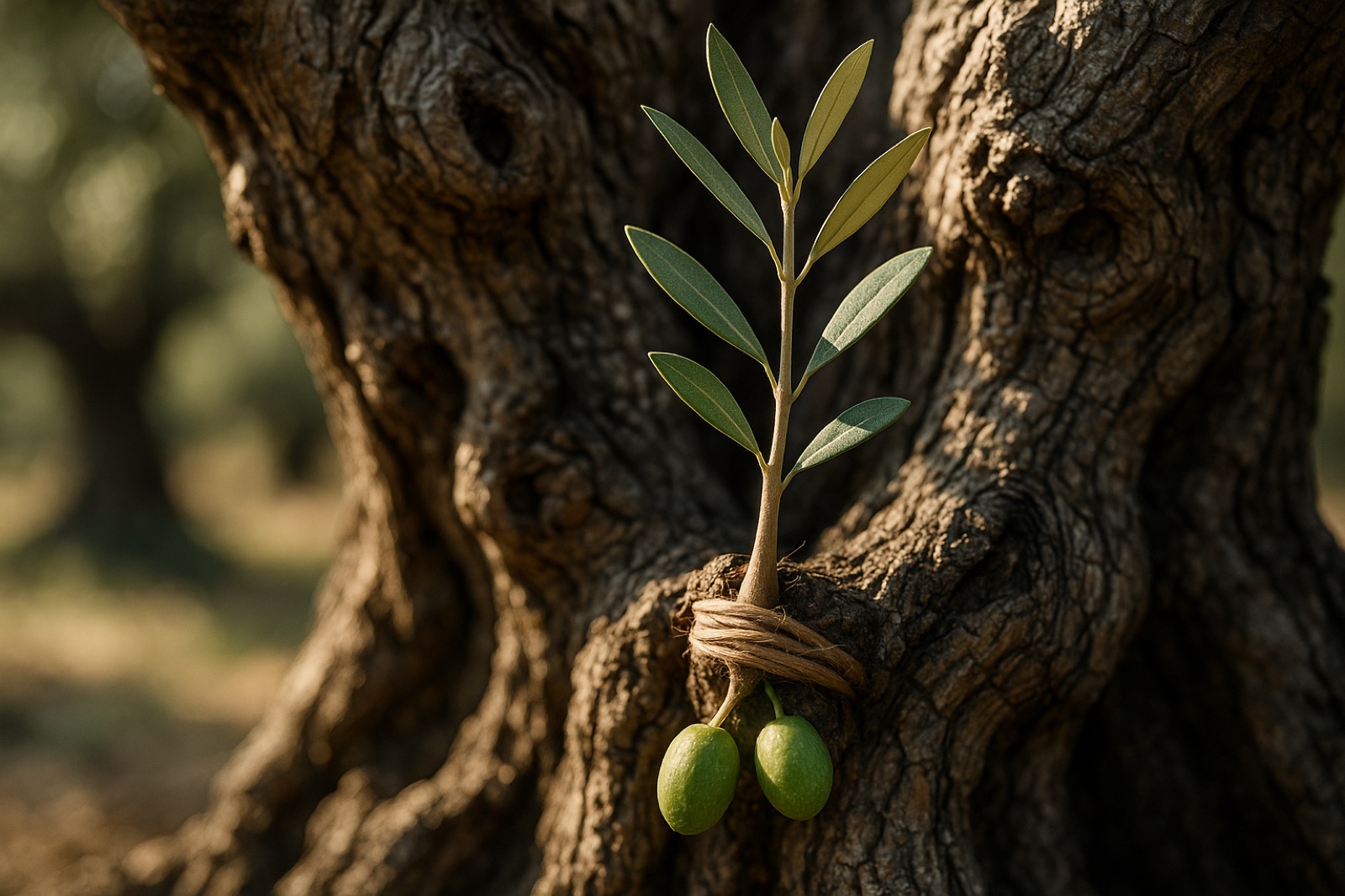
- Romans 11:17-24, where Paul compares God’s people to the branches of one olive tree, some broken off and some grafted in.
Put together, they point to a meaning deeper than “peace.” In the Bible, an olive branch is about belonging and supply: being joined to a root you didn’t grow, and being fed by something bigger than you.
Olive Branches for a Week of Living in Tents
After the exiles came back to Jerusalem, Ezra read the law out loud to the whole crowd. They found a command they had forgotten, so the word went out:
“Go forth unto the mount, and fetch olive branches, and pine branches, and myrtle branches, and palm branches, and branches of thick trees, to make booths, as it is written.” (Nehemiah 8:15, KJV)
This was the Feast of Tabernacles. For seven days, families lived in rough shelters made of branches. Leviticus gives the reason: “That your generations may know that I made the children of Israel to dwell in booths, when I brought them out of the land of Egypt” (Leviticus 23:43, KJV).
So the first olive branches in this story were roofing. People who finally had houses again went outside and slept under leaves on purpose, so they would remember they had once been homeless wanderers, and that God had carried them anyway. The branch was a reminder of where they came from and who had kept them alive.
Two Olive Branches Pouring Out Oil
The prophet Zechariah had a strange vision. He saw a golden lampstand with an olive tree standing on each side, and he couldn’t work out what it meant:
“What be these two olive branches which through the two golden pipes empty the golden oil out of themselves?” (Zechariah 4:12, KJV)
The angel’s answer was: “These are the two anointed ones, that stand by the LORD of the whole earth” (Zechariah 4:14, KJV). Many readers take these as the two leaders of that day, Zerubbabel the governor and Joshua the high priest, though the text itself doesn’t name them.
Here’s the picture to notice. In the tabernacle, the lamp was kept burning with “pure oil olive beaten for the light” (Exodus 27:20, KJV), and somebody had to bring that oil. In Zechariah’s vision, nobody is carrying jars. The branches pour the oil straight into the lamp. The light never runs dry, because the supply comes from the living trees. That is why, just a few verses earlier, the same chapter says, “Not by might, nor by power, but by my spirit, saith the LORD of hosts” (Zechariah 4:6, KJV).
The olive branch here isn’t a white flag. It’s a pipeline.
The Branches That Were Grafted In
The fullest olive-branch passage in the Bible is in Paul’s letter to the Romans. He’s writing to non-Jewish believers who had joined a faith with deep Jewish roots, and some of them were starting to feel a little superior. So Paul gives them a gardening picture:
“And if some of the branches be broken off, and thou, being a wild olive tree, wert graffed in among them, and with them partakest of the root and fatness of the olive tree; Boast not against the branches. But if thou boast, thou bearest not the root, but the root thee.” (Romans 11:17-18, KJV)
Read that last line slowly: thou bearest not the root, but the root thee. A branch never holds up a tree. The tree holds up the branch. Every bit of sap and every olive that grows comes up through a root the branch didn’t plant.
The detail most people read past
A few verses later, Paul says the wild branch was “graffed contrary to nature into a good olive tree” (Romans 11:24, KJV).
That phrase “contrary to nature” is Paul admitting his picture is backwards from what you’d expect. Grafting usually works the other way round: a grower takes a branch from a good tree and joins it onto hardy rootstock, because a good branch is the prize. Nobody goes looking for a wild, bitter branch to fix onto a healthy tree. Paul says that is exactly what God did. The outsider wasn’t added because the branch was valuable. The branch was added because the gardener wanted it there.
And the grafting isn’t only one way. Paul ends the passage with hope for the branches that were broken off: “God is able to graff them in again” (Romans 11:23, KJV). In this tree, nobody is too far gone to be joined back on.
What This Means When You Feel Like an Outsider
Here is where the olive branch meets your Monday.
If you’ve ever felt like the “wild branch,” the late arrival, the one who doesn’t know the songs or the history or the right words, Romans 11 doesn’t tell you to work harder until you earn your place. It tells you that your place was never about you earning it. You were grafted in. You are being held up. The root bears you.
That takes the pressure off in two directions at once:
- You don’t have to prove you belong. A grafted branch doesn’t produce its own sap. It receives. Your job is to stay connected, not to impress the tree.
- You don’t get to look down on anyone else. Paul’s whole point was “boast not.” If you were joined in by grace, so was everyone else, and the person who still feels like an outsider next to you is someone the gardener also wants there.
This is also the quiet link between all three passages. The booths reminded people they had been carried. The branches in Zechariah poured out oil they didn’t make. The grafted branch lives on a root it didn’t grow. The Bible’s olive branch isn’t a symbol of someone being strong enough. It’s a symbol of someone being supplied.
If the feeling of not belonging runs deep for you, we wrote more about it in Why Do I Feel Like I Don’t Belong Anywhere? What Hebrews 11 Says. And if you like the way old symbols open up when you read the verse slowly, try What Does the Rainbow Mean in the Bible?, the other great sign from the end of the Flood.
A good place to start:
The Beginner’s Guide to Feeling God’s Presence Every Day
A simple way to notice that you’re connected to God in the ordinary moments of your day, not just on the good Sundays.
Get the free guide
Free.
Actions to Take
- Read Romans 11:17-24 out loud once. It takes about two minutes. Each time you hear the word “root,” notice that it’s never the branch doing the holding.
- Name one place you feel like the wild branch. A group, a family, a church, a job. Write it down in one line, then write under it: “The root bears me.”
- Be the root’s welcome for someone else. Think of one person who seems to be on the edge of a group you’re part of. Send them one message this week, or sit next to them, or ask them one real question.
Journaling Prompts
- Where have you been trying to make your own sap, earning your place instead of receiving it?
- When you picture yourself as a branch “graffed contrary to nature,” what feeling comes up first: relief, doubt, or something else?
- Who in your life might feel like the outsider right now, and what keeps you from reaching toward them?
A Prayer
God, some days I still feel like I’m not really supposed to be here. Thank you that I didn’t get grafted in because I was good enough, but because you wanted me on the tree. Help me stop trying to hold myself up, and let me rest on a root I didn’t plant. And show me who else is standing at the edge, so I can help them feel at home too. Amen.
Discussion Question
Paul warned the grafted branches not to look down on anyone. Why do you think people who were once outsiders sometimes become the hardest on the next newcomers? Share your thoughts in the comments below.
Share This
- “‘Thou bearest not the root, but the root thee.’ (Romans 11:18) I don’t have to hold myself up today.”
- “I always thought the olive branch in the Bible meant peace. In Romans 11 it means belonging: a wild branch grafted in on purpose.”
- “Zechariah saw olive branches pouring oil straight into the lamp. The light never ran dry because the supply never came from the lamp.”
What Does the Olive Branch Mean in the Bible: Questions and Answers
What does the olive branch mean in the Bible?
In the Bible, olive branches stand for belonging and God’s supply more than for peace. Nehemiah 8:15 uses olive branches to build booths that remind Israel they were carried through the wilderness. Zechariah 4:12 describes two olive branches pouring oil into a lamp. Romans 11:17-24 pictures believers as olive branches grafted into one tree and held up by its root.
Did Noah’s dove carry an olive branch?
No. Genesis 8:11 in the King James Version says the dove returned with “an olive leaf pluckt off,” a single fresh leaf rather than a branch. The leaf showed Noah that the floodwaters had gone down and that trees were growing again. The idea of the dove with an olive branch as a peace symbol grew later through art and through Greek and Roman customs.
What are the two olive branches in Zechariah 4?
Zechariah 4:12 describes two olive branches that pour golden oil through two golden pipes into a lampstand. In Zechariah 4:14, an angel calls them “the two anointed ones, that stand by the LORD of the whole earth.” Many interpreters identify them with Zerubbabel the governor and Joshua the high priest, although the passage does not name them.
What does grafted in mean in Romans 11?
In Romans 11:17-24, Paul compares God’s people to an olive tree. Some natural branches were broken off, and non-Jewish believers, pictured as a wild olive branch, were grafted in to share the tree’s root. Paul says this grafting was “contrary to nature” and warns the grafted branches not to boast, because “thou bearest not the root, but the root thee.”
Why did the Israelites use olive branches to make booths?
Nehemiah 8:15 tells the people to gather olive, pine, myrtle, and palm branches to build booths for the Feast of Tabernacles. Leviticus 23:42-43 explains that Israel lived in booths for seven days so later generations would remember that God made them dwell in booths after bringing them out of Egypt.